
Is the restitution policy of colonial looted art a neo-colonial repeat of past actions?
How are Belgium and the Netherlands dealing with the sensitive issue of returning looted art and researching its colonial origins? An exploration of some treacherous areas in the quagmire of new Dutch and Belgian restitution policies.
“Beware of a neo-colonial repeat of the past, in which our own opinions, feelings, norms and values are the main guiding principles for action.” This was the warning issued to the Dutch cabinet by the Council for Culture in its 2020 advisory report Colonial Collection and Recognition of Injustice. The report served as the basis for the new policy on the restitution of looted art from the colonial era, which put the Netherlands in the forefront in Europe. Meanwhile, more than 900 items, many of them from the Rijksmuseum and Wereldmuseum in the Netherlands, have now been returned to Indonesia, Sri Lanka and Nigeria, including the famous Lombok treasure and a number of ‘Benin Bronzes’.
An initial inventory by the Council for Culture showed that some 300,000 items from the collection of the Dutch Wereldmuseum might be classified as looted art. But even if all these items were to be returned, we need not fear an empty museum. At the current rate of restitution –an average of around 300 objects per year– it would take 1,000 years to return everything, if indeed that is the intention.
While the Netherlands and neighbouring countries such as Great Britain, France and Germany have recently started returning looted art, Belgium is lagging behind, with no restitutions to date
Meanwhile, in Belgium, the art collection of the AfricaMuseum in Tervuren has 130,000 objects whose provenance is in question. By 2021, it had already been established that just under 900 pieces had been wrongfully acquired. The museum itself has now started researching the provenance of the rest. Nonetheless, while the Netherlands and neighbouring countries such as Great Britain, France and Germany have recently started returning looted art, Belgium is lagging behind, with no restitutions to date, apparently because more time is needed for careful formulation of the policy.
The Dutch government exercised this care by commissioning the report mentioned above from the Council for Culture, which advised that, to prevent the practical implementation of the new restitution policy from becoming another example of the lopsided relationships of the colonial era, it should be developed in consultation with the countries of origin. Due to the coronavirus crisis, however, the Council’s planned visits to countries of origin to hear the views of people living there did not take place. Instead, “exploratory talks” were held via the internet, which “gave the impression that the countries of origin were keen to reach agreements with the Netherlands”.
Blind spot
In Belgium, the drafting of a new restitution law went wrong early on, according to political scientist Nadia Nsayi. Since her appointment in 2021 as public relations officer at the AfricaMuseum in Tervuren and columnist for De Morgen, she has emerged as an important critical voice in the debate on the restitution of colonial looted art.
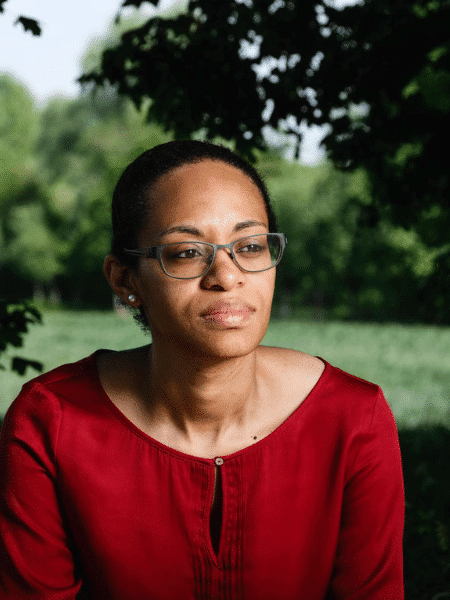 Nadia Nsayi
 © Bart Dewaele
Despite criticism of the Belgian bill by Congolese experts and the Congolese government’s request to allow room for political negotiations on the matter, the Belgian parliament unilaterally proceeded to a vote in 2022. “Just like looting in colonial times, restitution is about power relationships”, says Nsayi, “Belgium is in a very comfortable position because, due to weak political leadership that does not give political priority to restitution policy, Congo’s cultural policy is very weak at the moment. As they did in the past, the Belgians can easily say, ‘Ah yes, the Congolese, they are still not ready’. The response of many people of Congolese origin is, ‘You did not need a law to steal it in those days! And now you are going to create a law to give it back? Imagine, you come to my house in complete anarchy and steal something from me. And then, to give it back afterwards, you also impose certain conditions. That is the incongruity we still face today.”
Nadia Nsayi: Just like looting in colonial times, restitution is about power relationships
So, what is the alternative? Nsayi replies pragmatically, “The law, with all its flaws, is now in place. Congo should now request that objects are returned. And it is up to Belgium to cooperate constructively. Not just to declare its openness to restitution on paper, but to put it into practice too, without delaying the restitution process by imposing conditions such as preservation in Congolese museums, an official request from Congo, and so on. Looted art – the pieces that the museum considers in any case to be stolen – should be returned to Congo immediately and unconditionally.”
Here, Nsayi touches on the paradoxical, fundamental point that is easily overlooked in both countries: the former colonial powers are basing their new restitution policy on the premise that they are the owners, while it is precisely the theft of these objects that is the reason for the restitution policy.
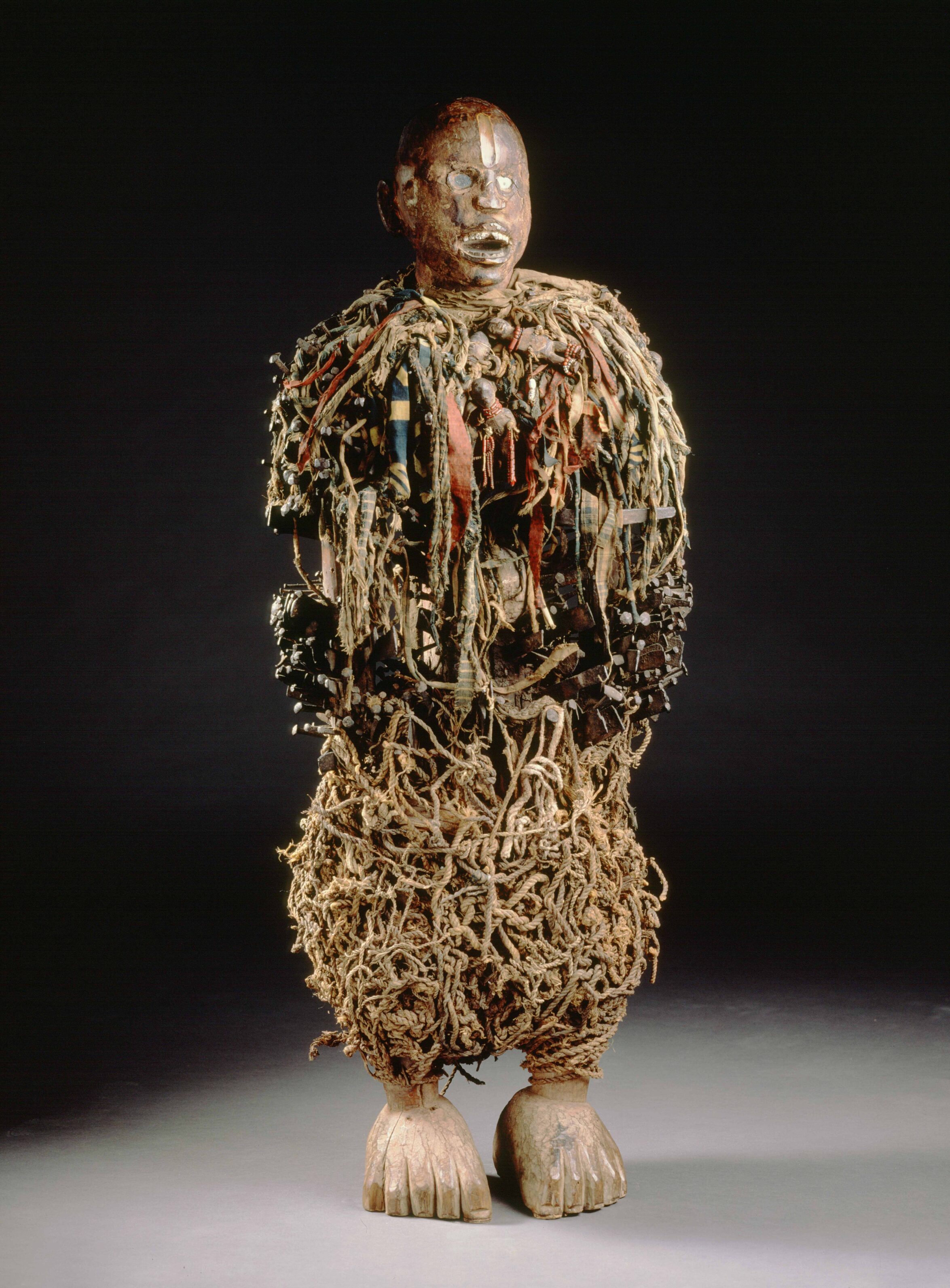 The Nkisi Nkonde power statue, stolen in the Boma region at the end of the nineteenth century by Belgian trader Alexander Delcommune, had a living significance in Congo. “It stands among the rest here as if there is no problem”, says Nadia Nsayi
 © AfricaMuseum, Tervuren / Photo Frederik Beyens
Pan-African political resistance fighter Mwazulu Diyabanza sharply criticised this selective neo-colonial blindness. In 2020, he entered the Africa Museum in Berg en Dal to “take back what belongs to us”, took a looted statue from a display case and walked out with it. There he was handcuffed by the Dutch police. He also carried out similar protest actions in other European museums to stimulate discussion about the return of looted art. In the Dutch documentary The Story of Ne Kuko (2023) about the looted Nkisi Nkonde power statue in Tervuren, Diyabanza says about his action and the current attitude of Western countries, “It is not up to them how and when they return it. That is up to us.”
The former colonial powers are basing their restitution policy on the premise that they are the owners, while it is precisely the theft of these objects that is the reason for the restitution policy
How does Prof. Dr. Wayne Modest view such actions? Since 2021, he has been director of content at the Dutch Wereldmuseum, which has branches in Amsterdam (the former Tropenmuseum), Leiden (the former Museum Volkenkunde) and Rotterdam (the former Museum voor Volkenkunde). Modest says, “We appreciate pointed statements like that from activists who give impetus to the discussion. But we also find ourselves in the practical, legal situation that the state owns the collection and has a say in when objects are returned. As a museum, we are part of the ongoing discussion on the subject, with the aim of achieving a more just and equal world. To achieve this, legal frameworks need to be changed. That is what is happening now in the Netherlands and throughout Europe.”
Paternalism
In the Netherlands, following the advice of the Council for Culture, an independent Colonial Collections Committee was established in the autumn of 2022 by the then State Secretary for Education, Culture and Science, Gunay Uslu. This committee advises the government on foreign requests for the return of “cultural objects”. The commission consists of Western experts: Dutch-Surinamese lawyer Lilian Gonçalves–Ho Kang You; Dutch-educated Fleming Laura Van Broekhoven, who is director of a British natural history museum and professor of museum studies, ethics and material culture; Dutch professor of (post)colonial cultural history Remco Raben; and Dutch university lecturer in colonial and world history Alicia Schrikker.
The rationale behind the Council for Culture’s advice, on which the policy is based, also referred mainly to Western experts and Western museum practices.
Speaking of the composition of the committee Modest said, “The frameworks are Western. But then we are in the West here. And we are engaged in criticising Western frameworks. I am more concerned with what we can do in practical terms to contribute to change than with criticising the composition of the committee. As a museum, we are here to work with our partners in the countries of origin to make the best possible requests for restitution. I would never have imagined that, in such a short time since the establishment of the committee, nearly 1,000 objects would be returned. So even with the restrictions of the legal infrastructure, we can find methods for change.”
 Wayne Modest: "As a museum, we are here to work with our partners in the countries of origin to make the best possible requests for restitution"
© Research Center for Material Culture
The aim of the restitution policy is – as the mantra in all the publications on the subject states – to redress injustice. The restitution should therefore be “generous and unconditional”. Nevertheless, Dutch Minister Ingrid van Engelshoven said in her policy vision that she still “wants to hold discussions” with the recipients about how the objects in question would be preserved and made accessible by their original owner.
Nsayi warns against this “paternalistic argument”, which also plays a role in Belgium. “The risk is that the Belgians will say, the Congolese will not be able to preserve it themselves. Conditions have been imposed since the 1970s. Belgium will return the objects, but Congo must first build a museum. That is how the museum in Kinshasa came into being. Now Belgium is doing the same thing again with this law, which distinguishes between physical and legal restitution. Provided the legal ownership of an object is returned, the law makes it possible for it to remain in Tervuren as a form of loan.”
The Netherlands also makes a distinction when it comes to restitution. If it cannot be proven that an object was looted – which, according to the minister, will often be the case “given the nature and complexity of our colonial history” because “sources and archives are often incomplete and difficult to trace” – the Netherlands will weigh up the interests involved. That is, on the one hand, the “special significance” of the item for its country of origin and, on the other hand, Dutch interests, such as the special cultural-historical or scientific significance of cultural objects for the Dutch collection, or their special significance for Dutch people with roots in the countries of origin.
In this way, the Netherlands presents itself as the protector par excellence of these cultural assets and makes it possible to place its own immigrant communities above the people of the countries of origin. Preservation options and accessibility in a country of origin may then play a role in the decision whether to proceed with restitution or not. Since, in cases of uncertain origin, redressing injustice is no longer the goal, the Netherlands can impose stricter conditions, or it may even decide to proceed only with an exchange or loan.
With regard to this weighing up of interests, Modest says, “I respect the policy that has been deployed. That does not necessarily mean that the way in which interests are currently being weighed is perfect. As a museum, we take a stand on this and are part of the ongoing debate. It is obvious that – because of our Western perspective – our interests are given greater weight than those of others. Further consideration is needed to balance this. We need to rethink matters so that we do not continue to dominate via a Western view of justice. For example, two PhD students at the Vrije Universiteit Amsterdam are currently working on this issue as part of a research programme on colonial heritage, funded by the National Research Agenda (NWA), to better understand and map out this sort of question.
Marking our own homework
Because proof of the looting of the items in question plays a decisive role in the extent to which conditions can be imposed on restitution, museums’ provenance research is becoming very important in the assessment of restitution requests. This is remarkable, to say the least, given that in the past museums themselves were often involved as clients in controversial acquisitions of cultural objects in colonial areas. Now, as custodians of these objects, they are once again an interested party in the decision as to whether they are returned or not.
To guarantee the thoroughness of provenance research – including in consultation with countries of origin – the Council for Culture advocated the establishment of an independent centre of expertise. However, this recommendation was put on hold, first by the Dutch minister responsible at the time, Ingrid van Engelshoven, and then by the now outgoing minister Eppo Bruins, both of whom want to wait and see first how many restitution requests there are going to be.
It is once again the Western, former colonial power that is in charge, determining the procedure and making the final decisions on its application. Like students marking their own homework
Although Dutch policy documents are full of references to consultation and cooperation with the countries where the looted art originates, it is once again the Western, former colonial power – as always with good intentions – that is in charge, that leads and manages the research, deciding, as their owner, on items’ disposal, determining the procedure and making the final decisions on its application. Like students marking their own homework. Or rather, the homework they stole from someone else without permission and are now returning as if it were a generous gift. Is this not the neo-colonial repeat of past actions that the Council for Culture warned against?
Delaying tactics
The AfricaMuseum started researching the provenance of looted art in July 2021. At the time, it had already been established that a little over one per cent (just under 900 pieces) of the nearly 130,000 objects in the AfricaMuseum’s art collection had been unlawfully acquired.
An initial inventory, made by the AfricaMuseum, of looted art that might be eligible for restitution resulted in a list of available data on 83,234 items and the archived circumstances under which they were acquired. In early 2022, these were handed over to the then Congolese Prime Minister Sama Lukonde. After all, sharing information and knowledge about the provenance of the collection with countries of origin is crucial for those countries to be able to submit restitution requests. It says nothing definitive about their legal status.
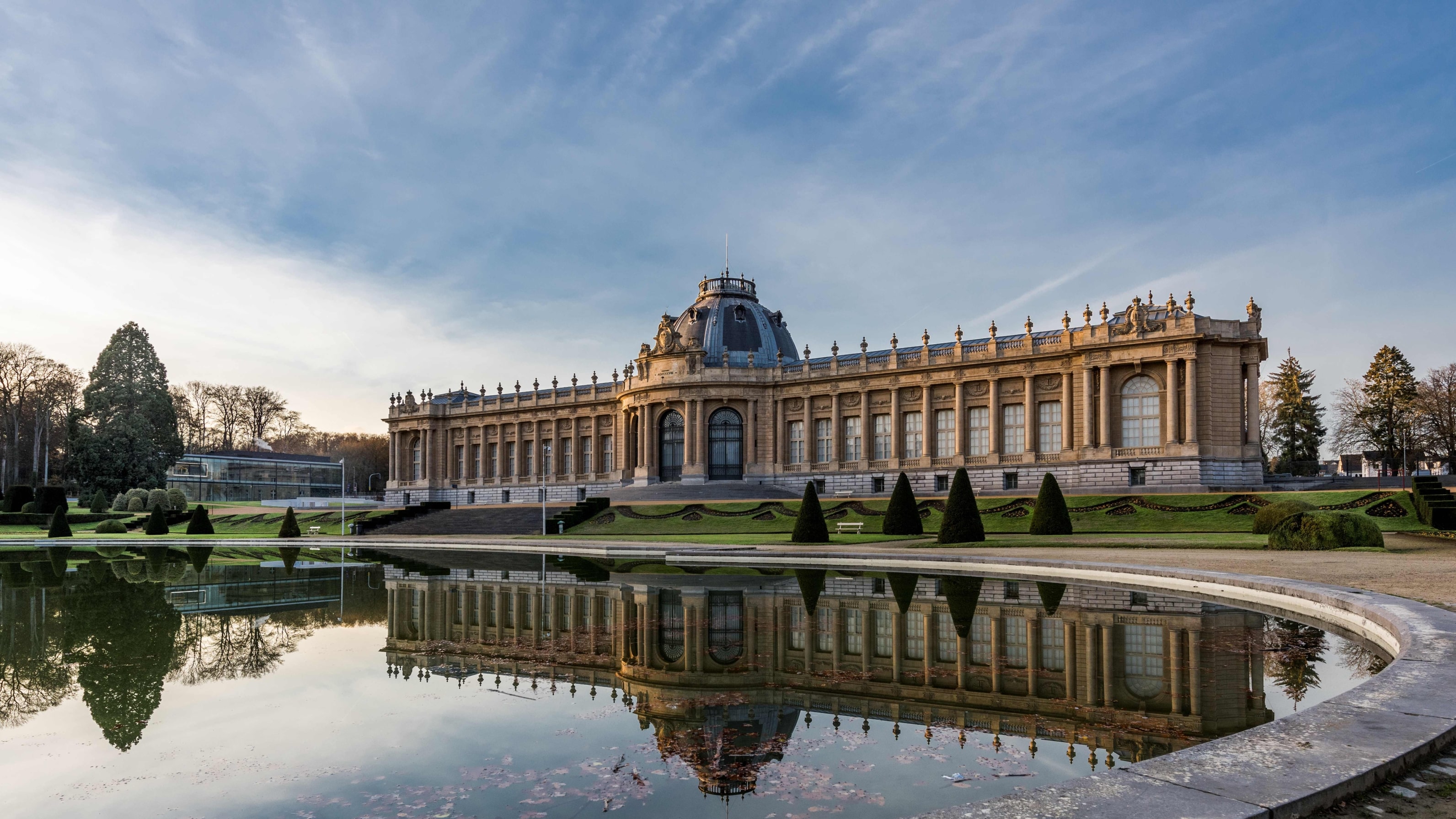 The AfricaMuseum
 © AfricaMuseum, Tervuren / photo J. Van de Vyver
Thanks to a government grant, researchers affiliated with the AfricaMuseum are currently working with Congolese colleagues to further investigate the provenance of these more than 80,000 objects. The provenance of 35 to 40 per cent of the entire collection is currently still unclear. The museum claims that it acquired the other nearly 60 per cent legitimately and that they will therefore remain the property of the Belgian state. As yet there is no commission to decide on restitution requests, a political treaty must first be drawn up for that.
The conditions for restitution, concerning the way in which the returned items are to be preserved, are based on a Western view of the objects in question
Nsayi fears that the provenance research is a delaying tactic and emphasises the importance of the independence of the researchers and future decision-makers. After all, they will also decide in Belgium what was acquired lawfully and what was not, and whether it is eligible for return. Nsayi questions the involvement of scientific researchers employed by the AfricaMuseum as interested parties in this process.
Furthermore, the conditions for restitution, concerning the way in which the returned items are to be preserved, are also based on a Western view of the objects in question.
Inspired
French filmmaker Mati Diop showed why this Western view of looted art is problematic in her Golden Bear-winning film Dahomey (2024), about the return of 26 looted artworks by France to Benin in 2021. In it, she points to the clinical way in which looted art is presented in display cases in the West, how it tears the objects from their context, strips them of their living history and their often-ceremonial significance. In African and Eastern cultures, a soul and a voice are attributed to masks and power figures. They are regarded not as objects but as persons or higher powers and are part of the daily life of a village or of living rituals in the open air. In the Dutch documentary The Story of Ne Kuko (2023), the difference between how living images and their history are treated in Congo and the Low Countries is described as follows, “When people die, they become history. When images die, they become art.”
The materialistic view of the (market) value of artworks is a Western approach, whereas in former colonial areas their spiritual significance often takes precedence. Exhibiting these images in museums in their countries of origin is therefore a neo-colonial practice that has been adopted from the colonial powers. By promoting the establishment of Western-style museums and making this a condition for restitution, Western countries continue to impose their worldview on the countries of origin.
Nsayi also finds it objectionable that in Belgium (as in the Netherlands), restitution can only be made to countries and not to local communities or individuals. “Non-Western people are still not taken as seriously, as individuals with equal rights, as members of Western societies are”, says Nsayi. In the context of Nazi-looted art, we now consider it perfectly normal for the objects to be returned to the Jewish community or the families who lost them during the Second World War. They are returned to the people from whom they were stolen. Not to Israel or anywhere else, but to the families. But when it comes to the restitution of colonial looted art from Belgium to Congo, suddenly the Congolese government is the rightful owner. Then I think, why shouldn’t a local chief of a region where something was stolen be able to submit a request? Currently, that chief must go through the Congolese government and the president. Often, small communities are not even aware that something of theirs has been returned.”
Swamp
The reason given by the Dutch government for only returning items to states is that it does not want to interfere in domestic affairs. This is particularly problematic when it comes to unjust internal relations in which the Netherlands itself has played an active role. Such as in the oppression of the Papuans by Indonesia. The Dutch documentary The Promise, about the painful “forgotten” history of Dutch New Guinea, which is now part of Indonesia as (West) Papua, has been showing in Dutch cinemas since 22 May 2025. Its motto is the aphorism attributed to Jean-Jacques Rousseau, “There are always four sides to a story: your side, their side, the truth, and what really happened.”
The film is about the infamous role played by the Netherlands and the UN in the transfer of the colonial territory – including the largest gold mine in the world – to Indonesia, over the heads and against the will of the inhabitants, and contrary to the Netherlands’ promise of independence. Since the transfer of West Papua to Indonesia in 1962, some 500,000 Papuans have been murdered by the Indonesian army, a “genocide in slow motion” that is still ongoing.
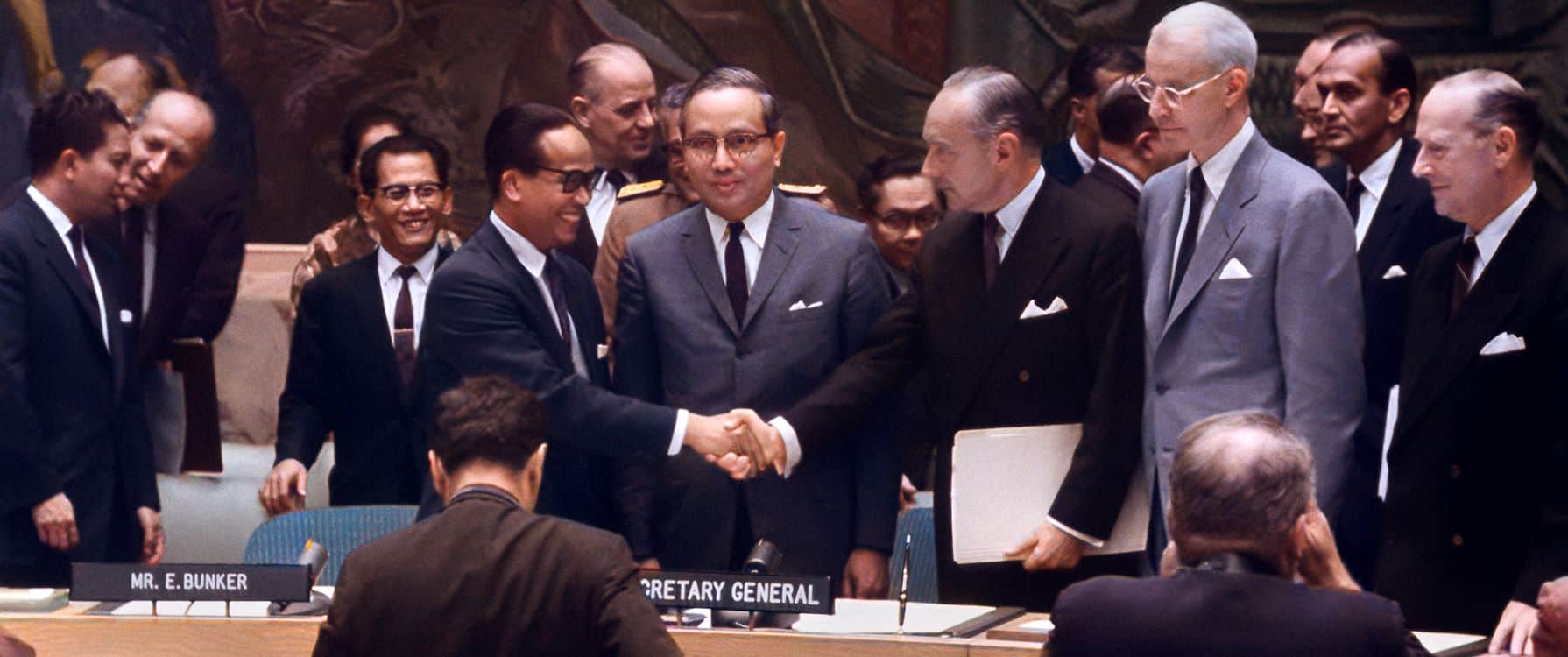 The signing of the New York Agreement on the transfer of New Guinea to Indonesia in 1962. Indonesian Foreign Minister Soebandrio and Dutch representative to the United Nations Herman van Roijen shake hands under the watchful eye of Secretary-General U Thant
© Image from The Promise
Under the current policy, for example, the six Bisj poles from Papua in the central hall (lichthal) of the Amsterdam World Museum (see part 1 of this two-part series) cannot be reclaimed by the Asmat people – the ethnic group from the Indonesian province of Papua to whom they belong. Bisj poles are metres-high poles of human figures that are used in ceremonies to commemorate the deceased. Afterwards, they are thrown into the swamp to rot away as part of the natural cycle of life and to nourish new plants.
It is unlikely that a government that persecutes a minority will ever reclaim its Bisj poles. And even if Indonesia did, do the poles not belong in West Papua rather than in the National Museum in Jakarta?
 Demonstration at the Binnenhof in The Hague for the independence of West Papua, on 8 June 1982, twenty years after its transfer to Indonesia
 © Anefo Collection
Modest, once again diplomatic, says, “The state-to-state approach to policy needs to be further developed too. We consider it valuable criticism that there are communities who say that this approach prevents them from getting their objects back as they would like, but we must also respect the sovereignty of independent states. We appreciate the criticism we receive, both as a museum and concerning the colonial nature of the policy and the process. That said – as a museum, but also as a society – we must recognise the complexity of the situation if we want to find anti-colonial solutions. We are committed to this process.”
One could say that restitution and respect for other people’s property and identity means that the community to which the pieces belong can dispose of them freely. And, therefore, that this also applies if they decide to restore the broken life cycle and return their Bisj poles to the swamp.
This is the second part of a two-part series on looted art and restitution policy. You can read part one HERE.
You might also like




Leave a Reply
You must be logged in to post a comment.