

In the nineteenth century, nationalism was on the rise in the Netherlands, too. The country fell back heavily on its Golden Age, a time when the Republic was a naval superpower and marine painting was a blossoming art. This was the origin of the image of the Netherlands as a seafaring nation. Today, the glorification of this past collides with a growing consciousness of the history of slavery and the Netherlands’ maritime role in it.
The Kingdom of the Netherlands wrestled with economic hardship for much of the nineteenth century. It needed some good PR, in other words. Historians and intellectuals found this in the shipping industry of the sixteenth and seventeenth centuries, when the Dutch were lord and master of the world’s seas.
The wealth of the so-called Golden Age at the time of the successful Republic of the Seven United Netherlands (Dutch Republic) became a model to emulate for the young nation. In this process, marine painting, paintings of ships and seascapes played a small but very important role.
Heroics at sea
Between 1750 and 1850, the cultural movement of Romanticism spread throughout the whole of Europe. Themes central to Romanticism’s aesthetics of feeling were nature and history. The romantic yearning for the past led in the Netherlands to an enthusiastic interest in the highlights from the nation’s history. Intellectuals and historians dove into the archives. Historical sources were discovered, sometimes exaggerated to mythical proportions, and published.
This search lasted throughout the nineteenth century, and in this rich substrate of growing historical awareness, a new nationalism began to blossom. And so the history, literature and visual art of the seventeenth-century Republic gained a new, highly interested audience.
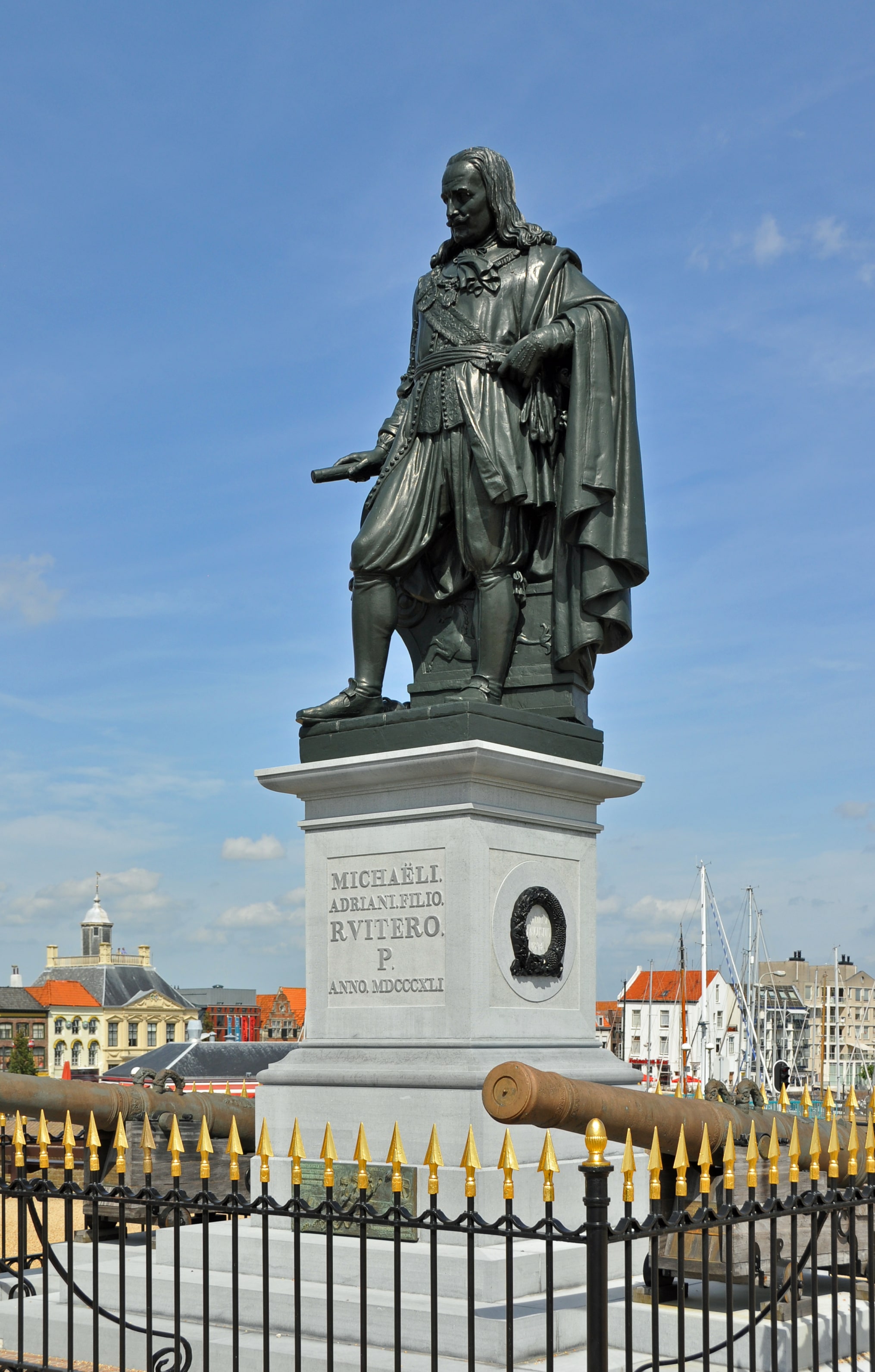 Louis Royer, statue of Michiel de Ruijter in Vlissingen, 1841
© Marc Ryckaert / Creative Commons
In particular, there was a special interest in maritime history. Poet Hendrik Tollens wrote in 1807 the prizewinning Tafareel van den Vierdaagschen Zeeslag (Scene of the Four-Day Sea Battle), a historical poem about an episode from the second Anglo-Dutch war (1666), in which Lieutenant Admiral Michiel de Ruijter shone as the leading man and commander of the Dutch fleet. Novels, biographies, theatre works and children’s books celebrated the chilling adventures of fearless seafarers. One of the first historical picture books of the nineteenth century is Heldendaden der Nederlanders ter zee van de vroegste tijden tot op heden (Heroic deeds of Dutchmen at sea from the earliest times until today), from 1849-55, by the marine painter Petrus Schotel. Facts about naval weaponry were remembered and enthusiastically celebrated, often combined with the unveiling of a new statue of a seafaring hero of the motherland.
Familiar image
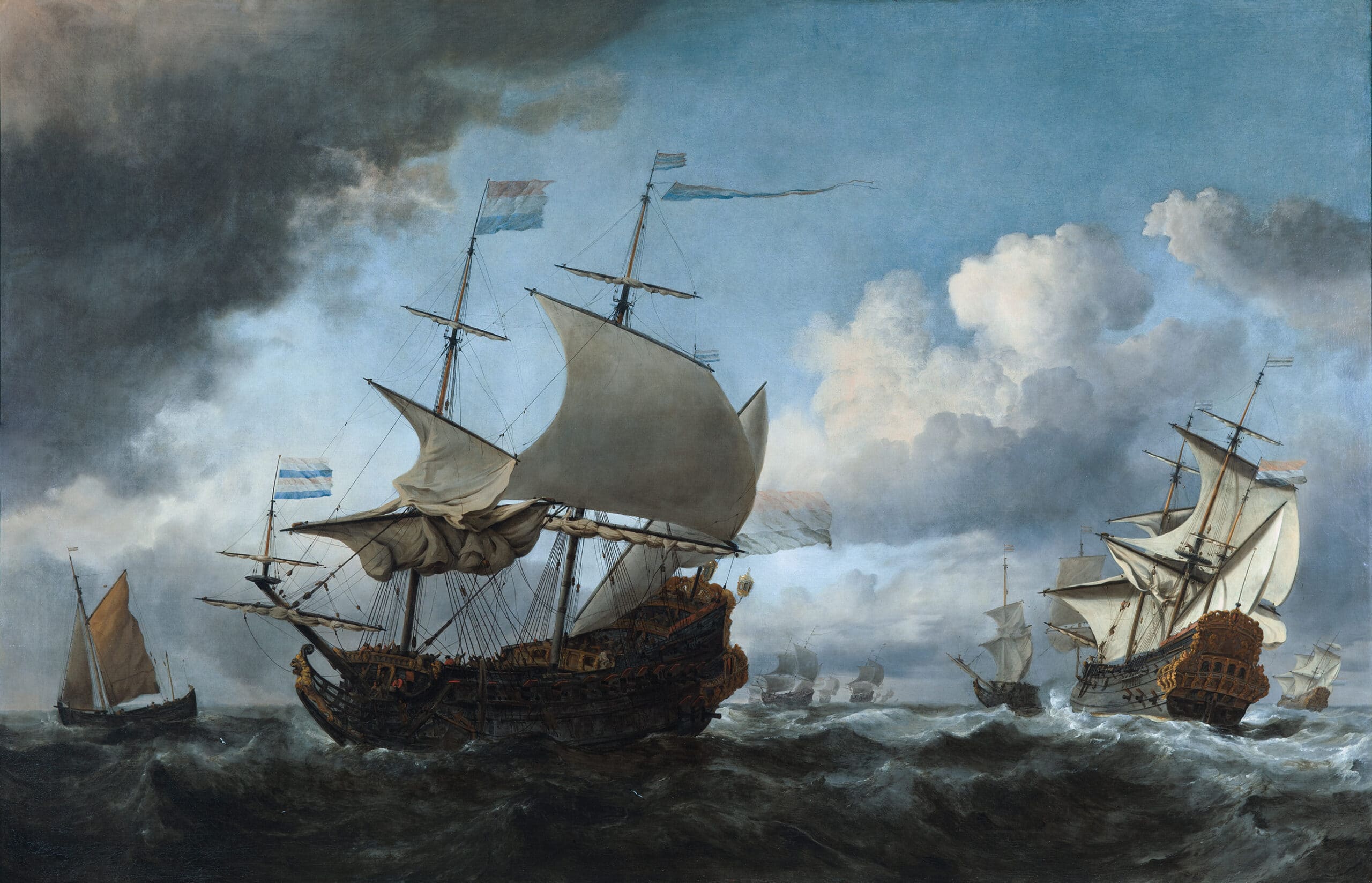 Willem van de Velde the Younger (1633-1707), The Dutch Fleet Assembling Before the Four Days’ Battle of 11-14 June 1666, 1670
 © Moveo Art Collection
Paintings of ships and the sea were seen as bearers of a national pride and therefore enjoyed considerable status. This characteristic genre of painting of the seventeenth-century Dutch school stood as a symbol of the historical connection between the land and the water for the Netherlands as a seafaring nation.
In 1791, the poet Rhijnvis Feith described this deep bond. In his view, the inhabitants of the Netherlands had created their land, and they had learned how to subject the sea to their own needs, transforming it into a source of prosperity. Every view of the sea reminded them of the greatness and success of the Republic. Accordingly, the Dutch were eager to view “een zeetje van Van de Velde” (“a little sea painting by Van de Velde”), and so Feith believed that the painted sea battle should be resurrected.
The marine paintings of the Dutch school stood as a symbol of the historical connection between the land and the water
Feith’s ideas were gladly adopted. In art-historical lectures and publications, the wonders of Willem van de Velde (I), his son Willem van de Velde (II), and Ludolf Bakhuizen were extolled, the undisputed painting greats of the time. To the nineteenth-century marine painter, their work stood as benchmarks for quality and comprised the most important examples of the style.
Marine painting underwent spectacular development in the seventeenth century. Painting the sea and ships on it became a flourishing specialism on the international art market, in part thanks to the naval superpower the Republic had become; hence the nineteenth century’s inclination to view marine painting as an appropriate stimulant for notions of the nation’s collective identity. For this purpose, the ‘general’ sea view, executed in the style of the Dutch school, was already sufficient.
An example of this is Ships on calm water, from roughly 1860 by George Opdenhoff (1807-1873), a scene of contemporary ships with, at the heart of the painting, the Dutch flag. Such compositions, which can be traced back to the work of Willem van de Velde (II), addressed Dutch patriotism pleasantly and modestly. By reproducing the familiar image of the everyday maritime industry, this type of painting drove the growth of Dutch patriotism in a simpler and more accessible manner than historical paintings.
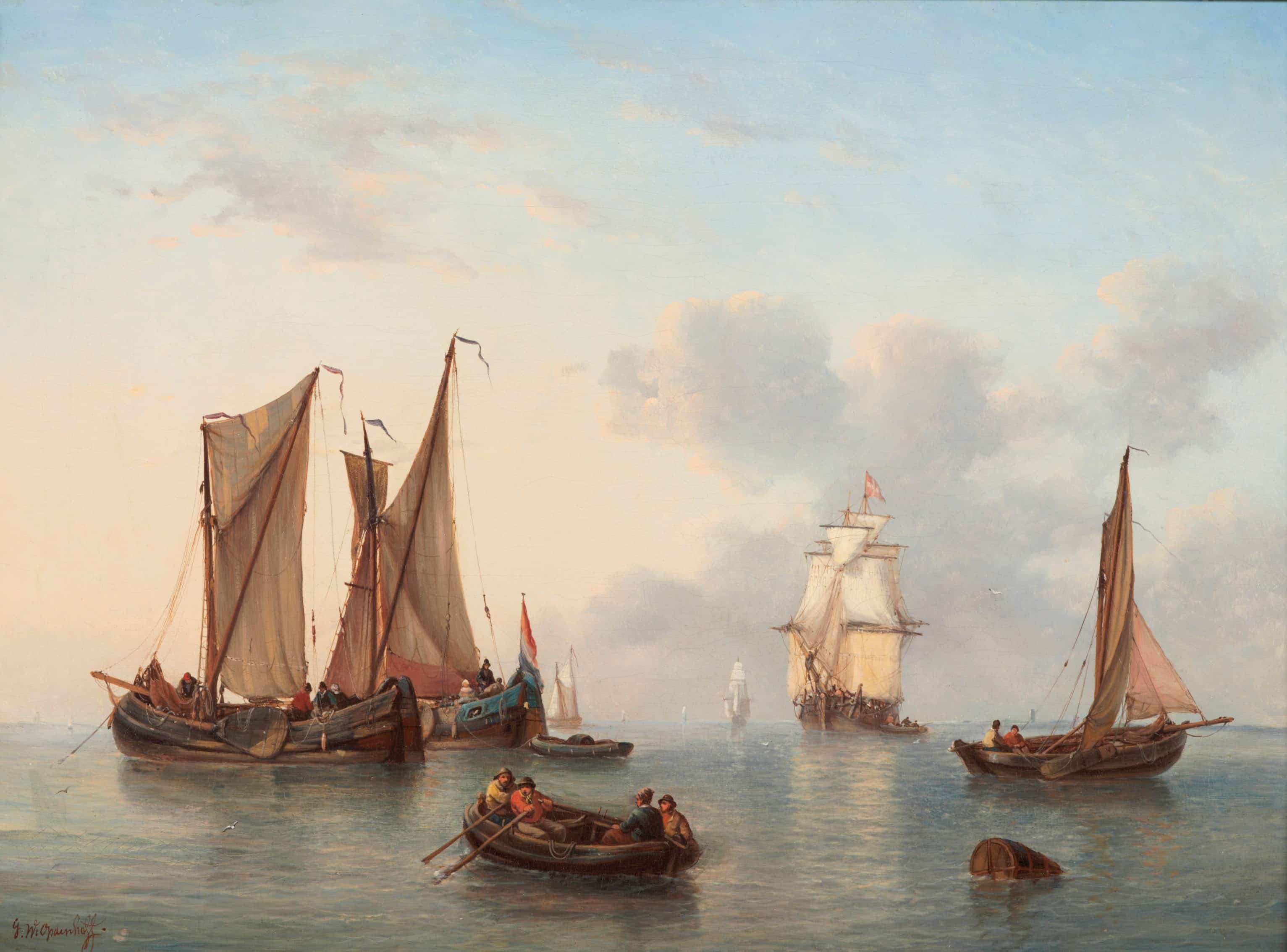 George Willem Opdenhoff, Ships on calm water, circa 1860
© Maritime Museum, Amsterdam
Landscape painting played a more-or-less similar role to marine painting in the formation of a national consciousness. Effortlessly recognisable to viewers as their immediate surroundings, this genre evoked an instant familiarity. Furthermore, it was the most common subject of Dutch painters. In art criticism, both genres were repeatedly related to the original Dutch school of painting. Contemporary imitations of both seventeenth-century schools were held in the same high regard.
A remarkable and essential difference between these genres, though, can be found in their respective stimulation of feelings of patriotism. Upon viewing marine pieces, art critics often reported experiences of historical sensations. Sea scenes with ships directly brought to mind the glorious Dutch maritime history. Because the sea, and not the Dutch landscape, had been the theatre of the nation’s important wars, voyages of discovery and trade routes, discussions of contemporary landscape paintings never feature such historical sensations.
Patriotism
By now, it is clear that marine painting and nationalistic interest in maritime cultural heritage were very closely related. The specialised painters of Dutch seafaring must have realised this for themselves, simply because this interpretation was ubiquitous at the time. The conservative and historicising style of painting of such sea scenes, the trademark of a fully-fledged Dutch genre, and above all, the portrayal of seas with ships supported national thinking. In the context of nineteenth-century European nationalism, the meaning of marine painting was exceptional, as it was historical painting that predominated as the art of choice in driving patriotism and nationalistic thinking in other countries.
European countries used historical painting to instil patriotism, but the Netherlands made the unusual choice of marine painting.
The close connection of marine painting with Dutch culture was also acknowledged internationally. Evidence of this echoes in the question of a Belgian reporter to Johannes Schotel, after the latter had received the golden medal of honour from the committee of the Salon d’Exposition in Brussels in 1936. The journalist asked Schotel if he minded that he had received the distinction from Belgium. The artist replied diplomatically: “The arts no know motherland: they blossom wherever good taste reigns”.
These were the years following the Belgian Revolution of 1830-1831, and political relations between the two countries were difficult. With his careful questioning, the reporter hinted at his realisation that a typically Dutch artistic specialism was being singled out for an award by a Belgian jury. Johannes Schotel, a veteran of international exhibitions for commercial reasons, responded in a smartly neutral way. In doing so, and at no risk to his future income, he fulfilled the traditional image of the artist who lives for his art, and does not concern himself with vulgarities of public or political life.
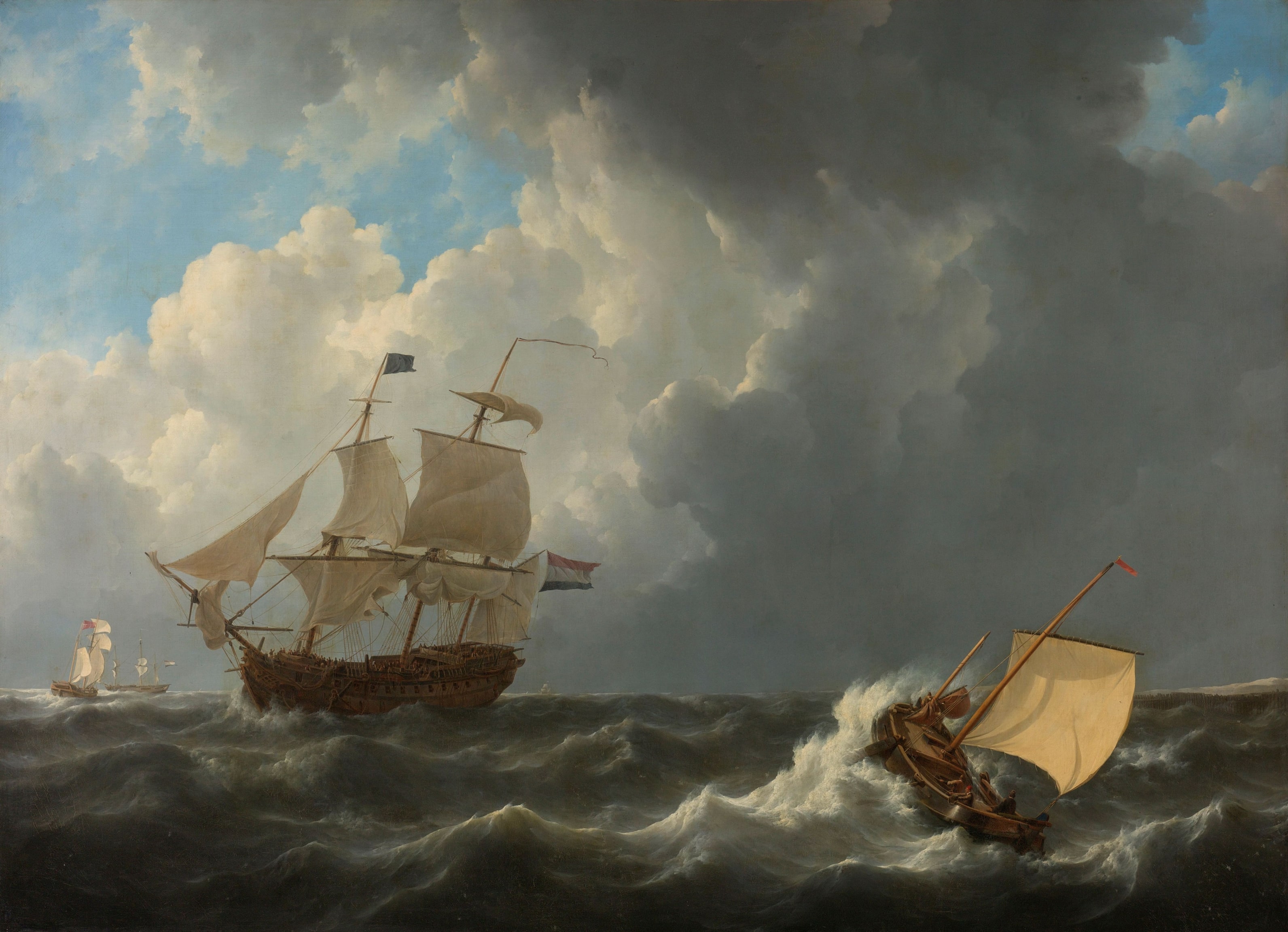 Johannes Christiaan Schotel, Ships on a rough sea, 1826
© Rijksmuseum, Amsterdam
In loyal imitation of the master marine painter Johannes Schotel, the majority of later painters at work in the genre kept alive the conventions of the seventeenth-century Dutch school. Art reviews, too, defended the style’s traditional stylistic traditions as criteria by which to judge quality, and eschewed new developments in paintings of maritime scenes. And, although the main interest of art critics lay in painters’ style and not in nautical details, the correct depiction of ships in sufficient number also remained important. Reviews spoke of a sense of close connection to ships and the sea, and the genre was understood as “the nation’s own”. Indicative of the conservative nature of art critics is their long and stubborn refusal to pay attention to depictions of modern maritime vessels in the form of steamships.
Old-fashioned
In the final decade of the nineteenth century, as the Barbizon school of French painters became increasingly influential in the Dutch art world, the broad appreciation of marine art began to decline. These landscape painters worked in a new, realistic style en plein air in coastal areas, something that attracted many Dutch and foreign painters. From 1880, all along the North Sea coast of the Netherlands, there was a blossoming of international artist colonies in which painters were very much occupied with the natural surroundings.
The fishermen and women and their daily toils among the ships, fishing nets and catches of the day became subjects for inclusion in painters’ compositions, too. The local residents, involved in the everyday rhythm of the natural elements, were portrayed as a harmonious part of Nature.
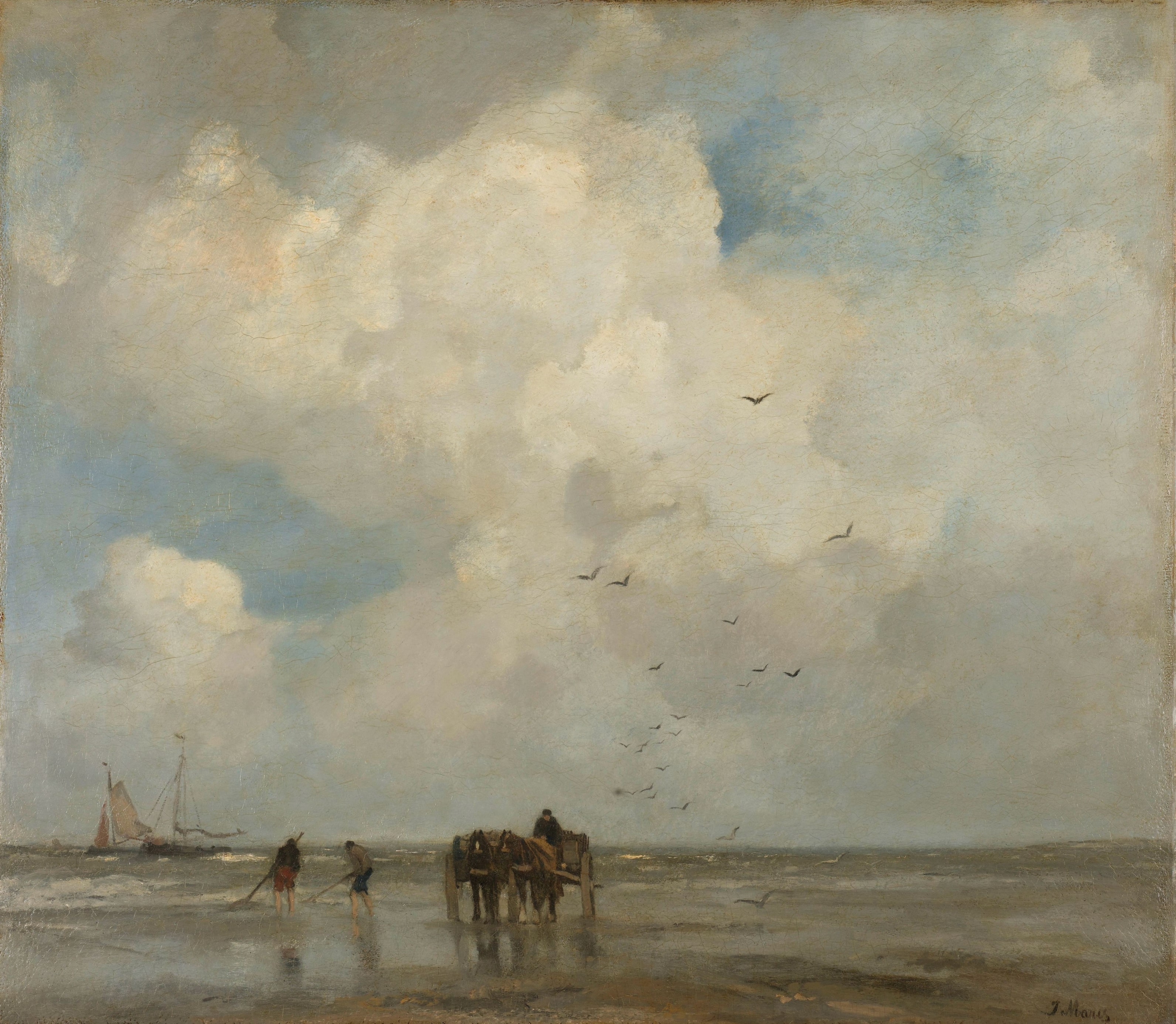 Jacob Maris, Shell gatherers, 1885
© Rijksmuseum, Amsterdam
Now the focus was on painting the dune landscape, the sea and the beach, with here and there a ship and the coastal population engaged in their quotidian work. The emphasis now was on a quick and assured painting style, the translation of a particular mood, and the rendering of the artist’s own feelings. These artists were not interested in the nautical per se. While, as for the marine painters, the seventeenth-century Dutch school was to a certain extent a source of inspiration, this movement represented a totally different kind of sea painting, one that answered to the demands of the art-buying public.
For a long time, art critics refused to pay attention to depictions of modern maritime vessels in the form steamships
In the meantime, a new generation of art critics had arrived, too, who judged the quality of modern painting with unflinching sharpness. At a rapid tempo, the cohort of the traditional seventeenth-century Dutch school imitators was dismantled. Though marine painters like Louis Meijer, Willem Schütz and Willem Mesdag worked hard to modernise their style, they were no longer discussed in art criticism.
Such painters’ passion for and expertise in depicting the nautical had long been a unique capacity, but proved eventually also to be their downfall. Detailed renderings of ships in smooth, colourful paintings were by now old-fashioned. And though a small market of conservative art buyers persisted for such paintings, this once-revered genre no longer held any artistic value in modern artistic circles, and disappeared from the canon of Dutch visual art.
The flipside of the Golden Age
Although the seventeenth century has all but disappeared from marine painting, many Netherlanders still appear eager to be reminded of the phenomenon of the Golden Age. For example, in 2015, SAIL Amsterdam–the largest festival of maritime culture in the Netherlands–adopted the quite uninhibited slogan “Golden past and golden future’, a direct reference to the success of Dutch worldwide seafaring and the Republic’s colonies.
Yet, when understood in the context of today’s public debates about the impact of colonialism, such triumphant positions prove painfully one-dimensional. In all manner of layers of society, these discussions are leading towards a realisation that this maritime history was not equally fortuitous for all involved. Today, there is much greater attention paid to this history’s violence, its oppression, and its subjugation of people to slavery on the Republic’s colonial plantations.
In all manner of layers of society, there are discussions leading towards a realisation that this maritime history was not equally fortuitous for all involved
Better late than never: in December 2022, the then Prime Minister Mark Rutte apologised on behalf of the Dutch state for its history of slavery. A fund of two hundred million euros was established for projects that develop public consciousness of the Netherlands’ participation in the history of slavery. The government made funds of twenty-seven million euros available for the construction of a museum. These funds and the museum are intended to expose and provide insight into this loaded history. This task is especially difficult, as it clashes so painfully with the deep-rooted glorification of the Netherlands as a seafaring nation, an image that collides with a recognition of the pain and sorrow of colonialism.
During Keti Koti (Emancipation Day in Suriname), on 1 July 2023, King Willem-Alexander also offered an apology for the role his forefathers played in the history of slavery. This was a remarkable moment on a national day of remembrance of the abolition of slavery in the Netherlands, exactly one hundred and fifty years prior. The king made a sincerely felt gesture that was warmly received by activist groups and descendants of enslaved people alike. People were carefully optimistic, but what will follow next is still unclear.
An open view
Unfortunately, a sack of money alone is not enough, and apologies are little more than empty phrases if complacency and smugness are not replaced by a more realistic view of Dutch maritime history. According to a 2019 public poll conducted by British pollsters Yougov, half of all Dutch respondents look back on the nation’s colonial past with more pride than shame. This puts the Netherlands in a comfortable first place in a poll that includes England (32 per cent), France (26 per cent) and Belgium (23 per cent). A mere 6 per cent of Dutch respondents answered that they are ashamed of the colonisation of Indonesia, South Africa and Suriname, among others.
How can you reshape two hundred years of nationalistic maritime indoctrination into an open view of the history of Dutch slavery?
Why do so many in the Netherlands continue stubbornly to believe in this seafarers’ myth? It almost seems as if they don’t know any better. To a certain extent, this is true: since the beginning of the nineteenth century, history teachers have been spoon-feeding positive stories about historical seafaring to generation after generation of Dutch youngsters. The legendary seafaring past is nothing less than a core part of the national identity, so it’s a sensitive issue. After all, how can you reshape two hundred years of nationalistic maritime indoctrination into an open view of the history of Dutch slavery?
The good news is that today colonialism is more often rigorously and exhaustively researched, for example has been the case with the Indonesian War of Independence. In addition, in 2020, the Surinamese anti-colonialist Anton de Kom was added to the recommended curriculum for history teaching in Dutch schools. These are necessary steps towards a dialogue through which the one-sided vision of the coloniser is completed by the other side of the national story.
This article is largely based on the book Dutch Sea Painting in the Nineteenth Century, Amsterdam University Press, 2024, by Cécile Bosman.





Leave a Reply
You must be logged in to post a comment.