
In the twentieth-century interrogation room, cigarettes were a tool of power
For most of history, criminal interrogations were smoke-free. That changed at the beginning of the twentieth century. Cigarettes in interrogation rooms indicate significant historical shifts, writes historian Elwin Hofman.
The twentieth century is the century of modernity. For a while now, I’ve been researching the history of criminal interrogations and often wonder what modernity truly meant. There were no major changes in interrogation laws and regulations. But if we zoom in on the daily practice of interrogation, indeed a lot seems to have changed. During my research, I’ve discovered that seemingly trivial matters sometimes offer key insights into understanding this. Like the cigarette, for example.
For most of history, criminal interrogations were smoke-free, and not because people didn’t smoke. In the seventeenth century, the pipe was popular, and by the late nineteenth century, a big cigar was the hallmark of a gentleman (certainly not for a woman, regardless of her social standing). At the time, however, tobacco was primarily associated with the culture of relaxation, not with the hurried and tense atmosphere of an interrogation.
That changed when cigarettes became popular at the beginning of the twentieth century. The First World War, when a soldier’s daily ration included five cigarettes, led to a breakthrough in Belgium. The Netherlands didn’t lag behind. After the Second World War, cigarettes became even more popular, also among women. In the 1960s, about half of the adult population in the Netherlands and Belgium smoked.
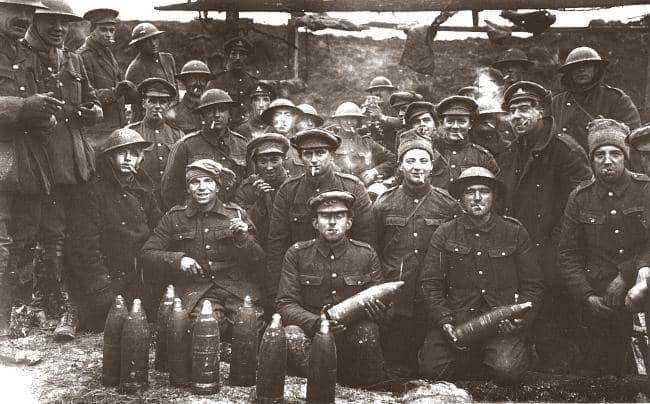 Cigarettes became popular at the beginning of the twentieth century. The First World War, when a soldier’s daily ration included five cigarettes, led to a breakthrough in Belgium.
© Albums Valois, BDIC - Public Domain
Unlike the pipe or the cigar, the cigarette was less associated with relaxation. Cigarettes belonged to modern, urban and hurried life. As such, they also became part of the arsenal of modern police interrogators. After all, at the beginning of the twentieth century, they were searching for new ways to encourage suspects to confess. Physically mistreating suspects was not only forbidden but also viewed within the police force as a sign of powerlessness. A skilled interrogator succeeded in obtaining confessions by employing psychological methods.
Early twentieth-century police manuals emphasised that the best strategy for interrogators was, as J.H. Smith and F.H. Poser put it in 1930, to adopt a “sympathetic and cooperative” attitude. “They convince them (the suspects) that by honestly confessing the truth, they can relieve their conscience and thus regain inner peace. This leads them to a relaxed mood, which easily results in a confession.”
In his 1938 manual for detectives, S.W. Moolenaar, for instance, recommended offering a cigarette to a “smoking addict” during interrogation, particularly if the suspect had not been allowed to smoke in their cell
Cigarettes could also be useful in creating this relaxed mood. In his 1938 manual for detectives, S.W. Moolenaar, for instance, recommended offering a cigarette to a “smoking addict” during interrogation, particularly if the suspect had not been allowed to smoke in their cell. After all, this would place the individual in a “somewhat friendly, grateful mood.” However, this tactic should not go too far: if the suspect ended up sending the interrogator himself to fetch a packet of cigarettes, it clearly indicated that the inspector lacked sufficient authority.
There was another reason why cigarettes became prevalent in interrogation rooms precisely in the early twentieth century. At that time, the aversion to bodily odours, such as sweat and bad breath intensified significantly due to an increased emphasis on personal hygiene. Overcrowded and poorly ventilated interrogation rooms frequently drew complaints from interrogators. The smell of tobacco could mask these unwanted odours. Allowing cigarettes in the interrogation room was not only a blessing for the smoke-addicted suspect, but also for the interrogators themselves.
After the Second World War, cigarettes became increasingly dominant in the interrogation room. “Given the highly nervous and tense state” of suspects, as one police interrogator wrote in 1958, offering them a cigarette was a sensible move. It could create the “right atmosphere of trust.” A 1978 film produced by the Dutch Ministry of the Interior illustrates this practice clearly. Surrounded by a haze of smoke, a suspect is grilled. He takes a final drag on his cigarette before confessing, “I did it.”
In the second half of the twentieth century, the cigarette had become a fixed element in techniques used by police interrogators to try to build a relationship of trust with suspects. But it was more than that. Blowing cigarette smoke into the face of the suspect or interrogator could serve as a power tactic. Likewise, refusing an offered cigarette could also function similarly.
The Belgian Minister of the Interior, Patrick Dewael, indicated that smoking in interview rooms was still permitted if it was deemed to aid the “search for the truth”
The era of the cigarette did not last. Medical studies already demonstrated the harmful effects of smoking tobacco during the interbellum. The first anti-smoking campaigns were immediately launched in Germany. From the 1970s onwards, the fight against tobacco intensified in the Low Countries as well. Warnings and bans were introduced. In 2004 and 2005, smoking in the workplace was banned in the Netherlands and Belgium – including in police stations. However, an exception did remain in place for a while: in a circular letter, the Belgian Minister of the Interior, Patrick Dewael, indicated that smoking in interview rooms was still permitted if it was deemed to aid the “search for the truth”.
That exception did not last long. The advancing fight against smoking ensured that smokers were banished to outdoor areas. But police interviewers were not keen on losing their strategic advantage. They still occasionally offer cigarettes to suspects who smoke. Now, however, they have to step outside with the suspect to light up. That also creates a bond. Nonetheless, smoking has now been pushed to the margins of the interrogation process. The smoke has long since vanished from interview rooms, and the smell of sweat has returned. Mechanical ventilation must now provide relief.
The cigarette seems like a footnote in the history of interrogation. Yet this brief history highlights significant changes: the growing importance of a bond of trust between interviewer and suspect, the subtle mechanisms of power during an interrogation and the aversion to bodily odours. The sensory and emotional experience of an interrogation underwent a complete transformation during the twentieth century – and the cigarette offers us a way to understand that shift.

You might also like



It’s all double Dutch to ChatGPT




Leave a Reply
You must be logged in to post a comment.