
Liberated by Books: Escape Prison life with Literature
Is there space for books when your life plays out between four walls? Of course there is: even in prison there are libraries, book clubs and writing groups. People can still lose themselves in a book.
At the start of the twentieth century a prison teacher in Rotterdam had a progressive idea: reading could be fun, even for those serving a sentence. In the eyes of Jan Jacob Janssen Schollmann books weren’t just for ‘moral edification’; they could also be allowed to offer comfort, relaxation and distraction. He wanted to be able to hand out ‘boys’ books’ that didn’t make it onto the officially recommended lists. Once gripped by such books, the prisoner would naturally become ‘an impassioned reader’, he believed.
For decades now, a weekly library visit has belonged to the rights of prisoners in Belgium and the Netherlands – but what is the role of the book in prison in 2025? To what extent is reading encouraged at all, and are there differences between the Dutch and Flemish approaches?
Before I delve deeper into these questions, let’s begin with some facts and figures. According to Eurostat, the statistical office of the European Union, in 2023 there were 102 people in prison for every 100,000 Belgian residents, compared with 66 in the Netherlands. In both countries the vast majority (95 percent) of prisoners are men, more than half of them holding Belgian or Dutch nationality, and the majority between 25 and 45 years of age. There is a distinction between those charged, awaiting potential conviction, and those convicted, who are serving their sentences. Where I talk about detainees in this article, I’m talking about men serving a long(er) sentence.
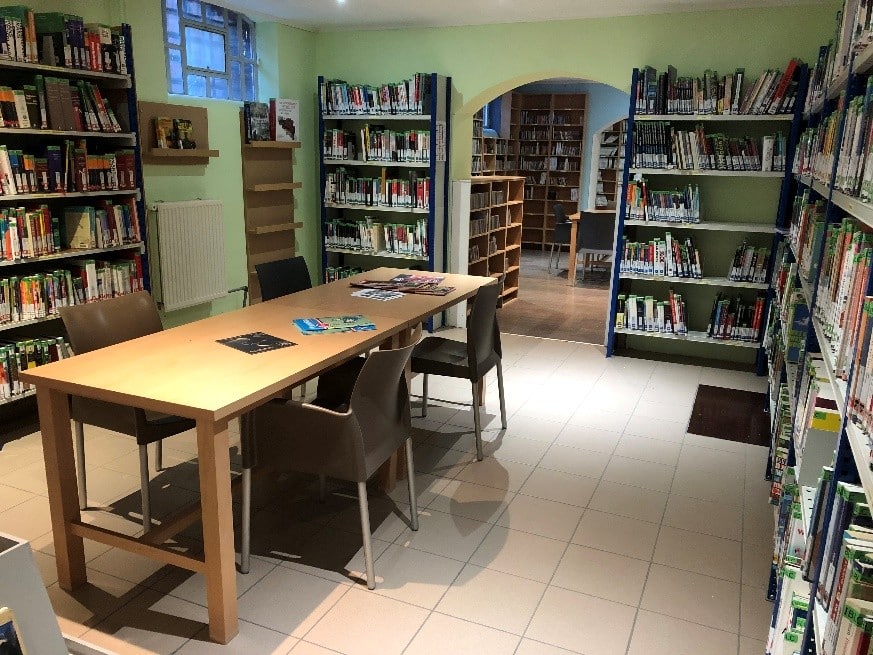 The library in Leuven prison. Sabrina Bruyneel is a volunteer here: ‘Stories can enrich you as a person, that’s why I’m so keen to get those men reading. It helps you mentally’ © Stad Leuven
 Thinking about good and evil
‘The big difference is that the prison library falls under justice in the Netherlands and under culture in Belgium. Belgium has that odd state structure, whereby justice is primarily a matter of federal authority, whereas wellbeing and culture are for community authorities, either Flemish or French,’ Bart Dils, an employee of Leuven’s prison libraries, explains.
This leads to another important difference: in Flanders the prison library is linked to the public library. Since 2009 the Flemish Community has provided subsidies for this collaboration. The lion’s share of this money is invested in staff, either by directly appointing a prison librarian, or by allocating supporting duties to an employee of the public library.
In Flanders the prison library is linked to the public library. Since 2009 the Flemish Community has provided subsidies for this collaboration
The latter is the case in Leuven’s central prison. There the librarian, himself a prisoner, is supported by Dils. ‘In general men who end up in prison tend to have a lower level of education and a culture of reading wasn’t instilled in them growing up. So my most important task is promoting reading.’
Dils no longer has Janssen Schollmann’s problem. His detainees are allowed to borrow everything the libraries of Leuven have to offer, but the Rotterdam librarian never had to worry about audiovisual competition. These days series and films are the most borrowed items in all prison libraries, says Dils.
Is that a problem? Does Dils believe that reading makes us better people? ‘We don’t start out from the idea that we need to combat reoffending, but we know that meaningful pastimes are vital for getting through detention. Developing new skills such as reading can help with that. Young adult books are often a first step. And alongside them, crime novels are popular, just as they are in the outside world.’
In order to increase access to reading, Dils works with the librarian to come up with campaigns, such as the Prison Book Jury and the Blind Date with a Book. Committed volunteers bring great added value to these kinds of initiative.
One of them is Sabrina Bruyneel. Three years ago she entered the prison, heart pounding, but she’s now completely at ease. ‘That abstract image of a dangerous prisoner you have to be afraid of disappears when you get to know someone. Of course there’s a reason people are here, but I also see the struggle.’
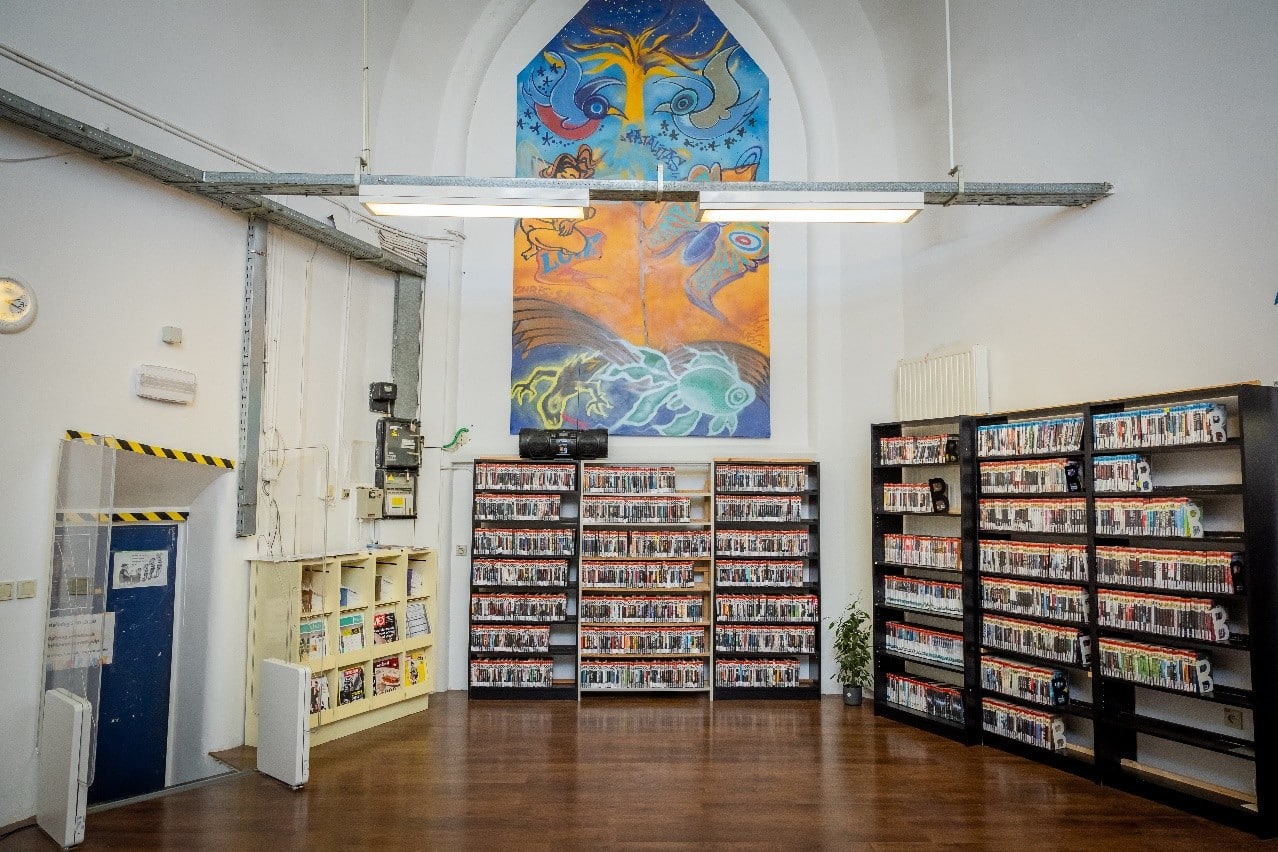 The library in Leuven prison. Sabrina Bruyneel is a volunteer here: ‘Stories can enrich you as a person, that’s why I’m so keen to get those men reading. It helps you mentally’ © Stad Leuven
 Bruyneel, psychologist and passionate reader, is convinced that reading can help detainees. ‘Believe it or not, Dostoyevsky’s Crime and Punishment brought nuance to my thinking on good and evil when I was a teenager. Stories can enrich you as a person, that’s why I’m so keen to get those men reading. It helps you mentally.’
Paper island
I find her enthusiasm infectious, but how do people in detention feel about it? That question formed the starting point for Martine Van Gorp’s master’s thesis: Gedetineerden over hun gevangenisbibliotheek en over de betekenis van lezen tijdens de detentieperiode (‘Detainees on their prison library and on the meaning of reading during the detention period’, Open Universiteit Antwerpen, 2017). Van Gorp recorded surveys and interviews among library visitors in three Flemish prisons and concluded that the 160 respondents were extraordinarily positive about the library and its employees and that a little less than half of them read non-fiction on a daily basis.
Reading, they say, is a way to relax, to kill time, but also to acquire insight and expand their language skills. The library forms a ‘little paper island’ within the strict prison regime and the people who work there have nothing to do with punishment or crime.
Van Gorp equally observes that detainees must overcome the necessary obstacles in order to reach that island. Some battle with personal problems or addiction, others simply aren’t able to read well. For them Het Lezerscollectief (The Readers’ Collective) could be a solution, an organisation of reading companions who want to make literature accessible to all sorts of different groups, including prisoners.
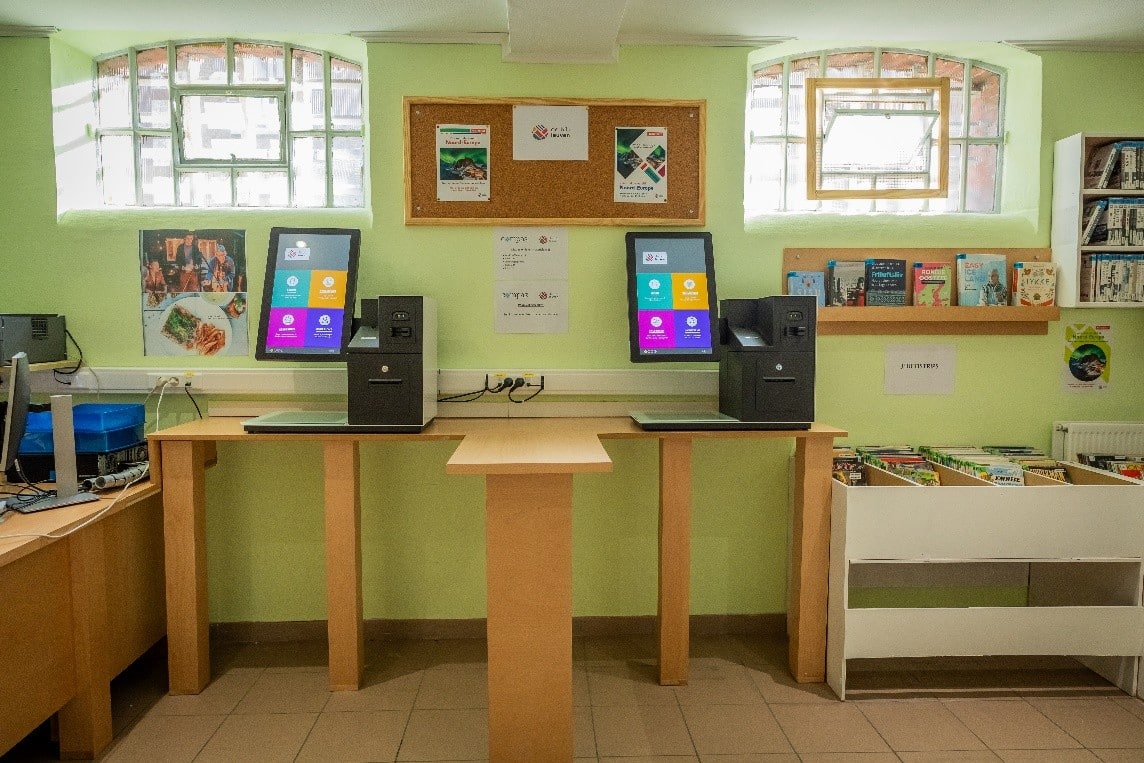 Ellen Frissaer supervises a reading group in Hasselt prison: ‘the first meeting it’s a case of feeling your way, but that tension soon disappears through the reading’
For the last eight years Ellen Frissaer has been supervising a Samen Lezen (reading together) group of his kind in the prison in Hasselt. ‘It’s a special setting and the first meeting it’s a case of feeling your way, but that tension soon disappears through the reading. We start with a short story or excerpt from a book and finish with a poem. We always read literature and everyone is given the text, but I read it aloud and then pose open questions: ‘What does that story do to you? Do you recognise yourself in this?’ We talk about characters and that creates a safe distance to talk about ourselves too; the participants can lose themselves in the story.’
Human approach
In the Netherlands budget cuts shook the foundations of prison libraries more than a decade ago. Tablets were the future, according to the State Secretary for Justice at the time, and they would save money, for instance on the physical library and its staff. There was persistent criticism and the plans never made it beyond a pilot project.
The Custodial Institutions Act therefore still obliges prisons to offer library facilities, but they are free to shape such facilities as they choose. In practice it helps when the management is in favour of the library, and that is the case in the penitentiary institution in Heerhugowaard, where I was welcomed for an interview with librarian Vera, along with a few detainees who are members of a writing group (to preserve their privacy and safety I do not use the full names of employees of the Custodial Institutions Agency or detainees).
After the metal detector and a labyrinth of corridors and doors, we come into a space of light green walls, cabinets with plastic-covered books and games, a reading table, a magazine rack, a counter with a computer, a tall box of comics; in short, a mini-version of a regular library. ‘That’s precisely what we’re aiming for,’ Vera confirms.
In Heerhugowaard, as elsewhere, the ‘crime shelf’ is popular. ‘Beyond that there is mainly a demand for books about sport, nutrition and life skills such as mindfulness. The library offers information, but also a sense of purpose. The department is often busy, but you can find peace here, browse a newspaper and decompress.’
Those are all functions a tablet can’t fulfil. ‘And sometimes someone really falls in love with books, even if he didn’t read before his sentence,’ Vera tells me, beaming.
Does a prison librarian require special skills? ‘You can’t come here wanting to wield power. The men here are simply visitors to my library.’
That human approach is also central to the charity Stichting Blocknotes, founded by writer Christine Otten, which has writing groups active in four penitentiary institutions. Otten supervises the meetings in Heerhugowaard. She wasn’t present during my visit but explains over the phone what it’s about: ‘The writing group is a kind of safe space in prison. People in detention are constantly dealing with all that stigma, but art doesn’t judge, literature is a sanctuary.’
The writing group is a kind of safe space in prison. People in detention are constantly dealing with all that stigma, but art doesn’t judge, literature is a sanctuary.
Furthermore, Otten emphasised, the writing produced in those groups is surprisingly good. She always picks a theme and takes texts with her. ‘We talk about it, then we write for ourselves and read out our work. In this environment you see the empowering effect of literature, reading can open doors and writing humanises difficult issues.’
No novels
Meanwhile F. has taken a seat in the prison library. He has a special role within the writing group, as although he does write, he doesn’t participate in the fortnightly sessions, instead acting as editor-in-chief of the publications they produce. ‘There have been four books so far,’ he tells me. ‘I’ve always loved language, language is a puzzle. But I’ve been inside for a long time and most of what I write I throw away. I don’t read much either, I no longer have space for longer texts.’
 Author Christine Otten supervises a writing group in the penitentiary institution in Heerhugowaard: ‘It’s a kind of safe space where you can be yourself once every couple of weeks’
 © Keke Keukelaar
Anyone who stays for a long time in an environment with little stimulation tends to battle with concentration problems. F. too struggles with this damage caused by detention. He and Vera explain that in any case not everyone is suited to the writing group, as you have to have the courage to take a critical look at yourself and be open to the stories of others.
Does the writing automatically lead to more reading? ‘I’ve certainly seen boys in here starting to find books fun. They didn’t come into contact with them on the outside due to their upbringing or environment,’ says F.
In Otten’s absence Vera participates in the writing group. We move from the library to another room – suspended ceiling, tables set up in blocks, thermos flasks of coffee and tea – and the writers from the inside, despite the sensitive nature of the meeting, have nothing against an author from the outside joining them. There are six of us and we’re set to talk and write about the theme of the telephone. W. came up with the idea and for inspiration he plays the song ‘Bless the Telephone’ by Labi Siffre.
I’ve certainly seen boys in here starting to find books fun. They didn’t come into contact with them on the outside due to their upbringing or environment
At an impressive pace the men then commit their thoughts to paper. One writes a poem, another describes how it feels to call home from prison for the first time. A third has jotted down a spirited account of the telephone as a medium for incriminating evidence.
The writing group, the men say, breaks through the grind and stimulates their creativity. No, they didn’t write before they were inside, nor did they read, but they do now, almost daily. Currently: the Bible, Nelson Mandela’s autobiography and a book by Stijn Franken, a famous criminal defence lawyer. There’s not much demand for novels. (‘Sorry.’)
Liberating force
Before I know it time’s up, and back outside I feel strangely cheerful. Can it be ‘fun’ in prison? Apparently it can. ‘There’s an addictive quality to the writing group, because you see so clearly what literature is capable of,’ Christine Otten notes.
There’s an addictive quality to the writing group, because you see so clearly what literature is capable of
Perhaps that’s what keeps everyone involved going. Literature, in the broadest sense of the word, can provide nuance, reflection, distance from your own circumstances; words can (fleetingly) emanate a liberating force. Please note, life in prison is no thriller, detainees aren’t characters, you don’t just end up behind bars for nothing and the time you spend there is no story-time, it’s real time, lifetime – and that’s the punishment.
Both in Belgium and in the Netherlands there is a regular call for more severe sentences, but anyone who immerses themselves in the role of the book in prison runs into people who have not lost sight of what should be an obvious fact: the deprivation of liberty is the punishment. On the paper island people are trying to avoid losing all contact with the outside world.
Most men in detention, after all, eventually return to society. They probably won’t do so as impassioned readers; it’s not easy – any more than it is outside – to win people over to the book, but sometimes they do succeed, in whatever form, and the impact is as powerful as it is elusive. Or, to put it in F.’s words, ‘The positive effects… lie between the lines, as does the entire story.’
For the sake of privacy and security, I have not used the full names of Custodial Institutions Agency employees or detainees.

You might also like

It’s all double Dutch to ChatGPT




Leave a Reply
You must be logged in to post a comment.