
The light show that gave us Hollywood
Long before audiences ever set foot in a movie theatre, they were no strangers to the thrill of projected images. The invention of film in the late nineteenth century was not the sudden leap into the unknown it is often made out to be: moving images had been captivating crowds for centuries. Chief among the forerunners was the magic lantern, a device that, well into the early twentieth century, drew audiences ranging from curious scientists to credulous believers across Belgium and the Netherlands.
It was dark that January evening in 1896 at the Parisian Grand Café located at 14 Boulevard Les Capucines. Nevertheless, the room was packed. The buzz of conversation died down as soon as the sound from the projector became audible. All eyes turned to the screen, where a train appeared. The crowd watched in suspense as the colossus sped forward, seemingly straight at them. The train did not slow down but seemed to plunge into the darkness where the audience was seated! Some people jumped straight out of their seats in panic, others screamed or covered their eyes and softly muttered a quick prayer.
Accounts like these of what is said to have unfolded during screenings of L’arrivée d’un train en gare de La Ciotat, the fifty-second silent film produced by Auguste and Louis Lumière, are a dime a dozen. In popular accounts and historical works alike, you come across claims that screenings of this footage, one of the first commercial films ever made, sent audiences into a panic, or left them paralysed with fear. However, that myth has been successfully debunked. Not only are there no contemporary sources that provide evidence for this anecdote, it is also very unlikely that the public at the time would have mistaken the projected images for reality.
In the nineteenth century, optical illusions were very much in vogue. The “objectivity” and detailed accuracy of photography, the three-dimensional effects of stereo pictures, the lifelike wax figures at Madame Tussauds in London, the moving dioramas depicting historical battles, landscapes or cityscapes, the huge, circular paintings known as panoramas that use perspective and lighting to create three-dimensional vistas, and the moving images and other special effects of the magic lantern: all of them were already captivating large audiences. The people who showed up for the first film screenings therefore took their seats expecting the promised experiences of tension, sensation and illusion.
The very first moving images were in keeping with common practices, not the sudden leap into the unknown they are often made out to be
The very first moving photographic images did not, then, constitute an abrupt break with the existing visual culture, but were in keeping with common practices and popular forms of entertainment. Of course, film differed in many ways from, for example, lantern projection. Film images were projected “in a loop” and often had to speak for themselves, whereas the individual images of a slide show performance needed an accompanying commentary to string them together into a coherent story.
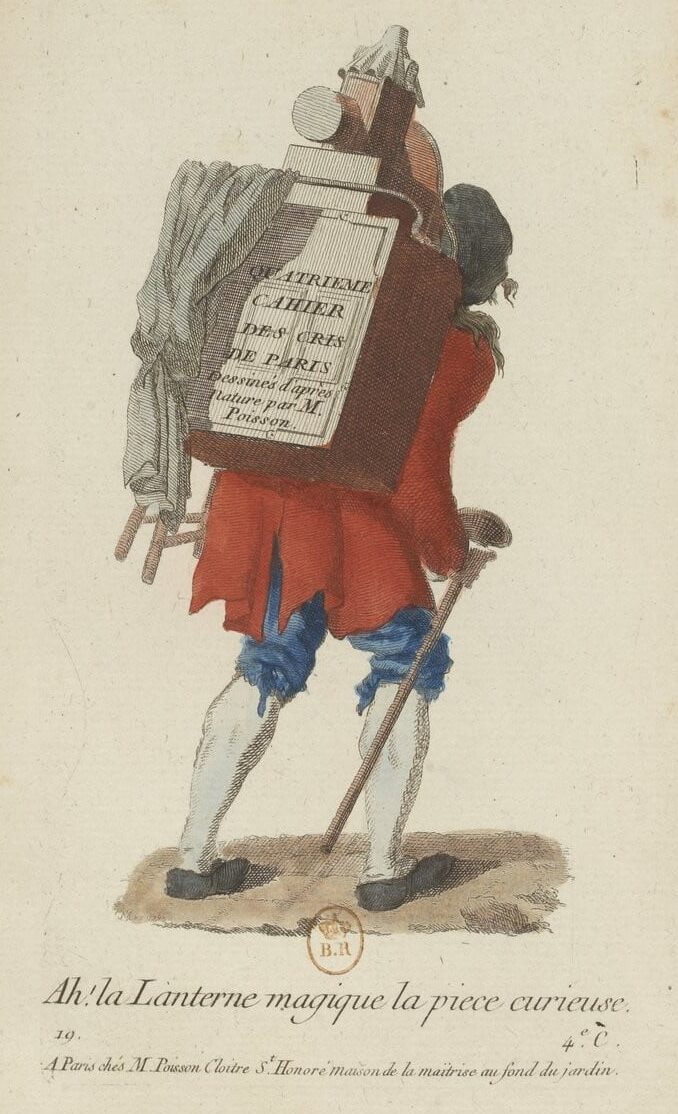 Itinerant lantern operators toured fairs, markets and taverns.
© Public domain, Bibliothèque nationale de France
For centuries itinerant entertainers had managed to amaze and entertain audiences with colourful moving images using mechanical slides. The photographic slides that had come onto the market in the course of the nineteenth century had further enhanced the illusion. The strong appeal of both cinema and the magic lantern was not only due to the sensation and spectacle value of the moving images on the screen, but also in the awareness that individual, still images were being transformed to provide (the illusion of) movement.
Between science and magic
The magic lantern was invented around 1660. There is still some debate about who the inventor was, though most researchers believe it was the Dutch mathematician and scientist Christiaan Huygens. The instrument originally consisted of a box of modest dimensions in which a candle or oil lamp was placed. A small chimney on top let the smoke escape. A mirror was placed in the back of the box to reflect the light. Translucent images painted on glass slides could be placed in front of the light source and were then projected, substantially enlarged, through a lens in the front of the device.
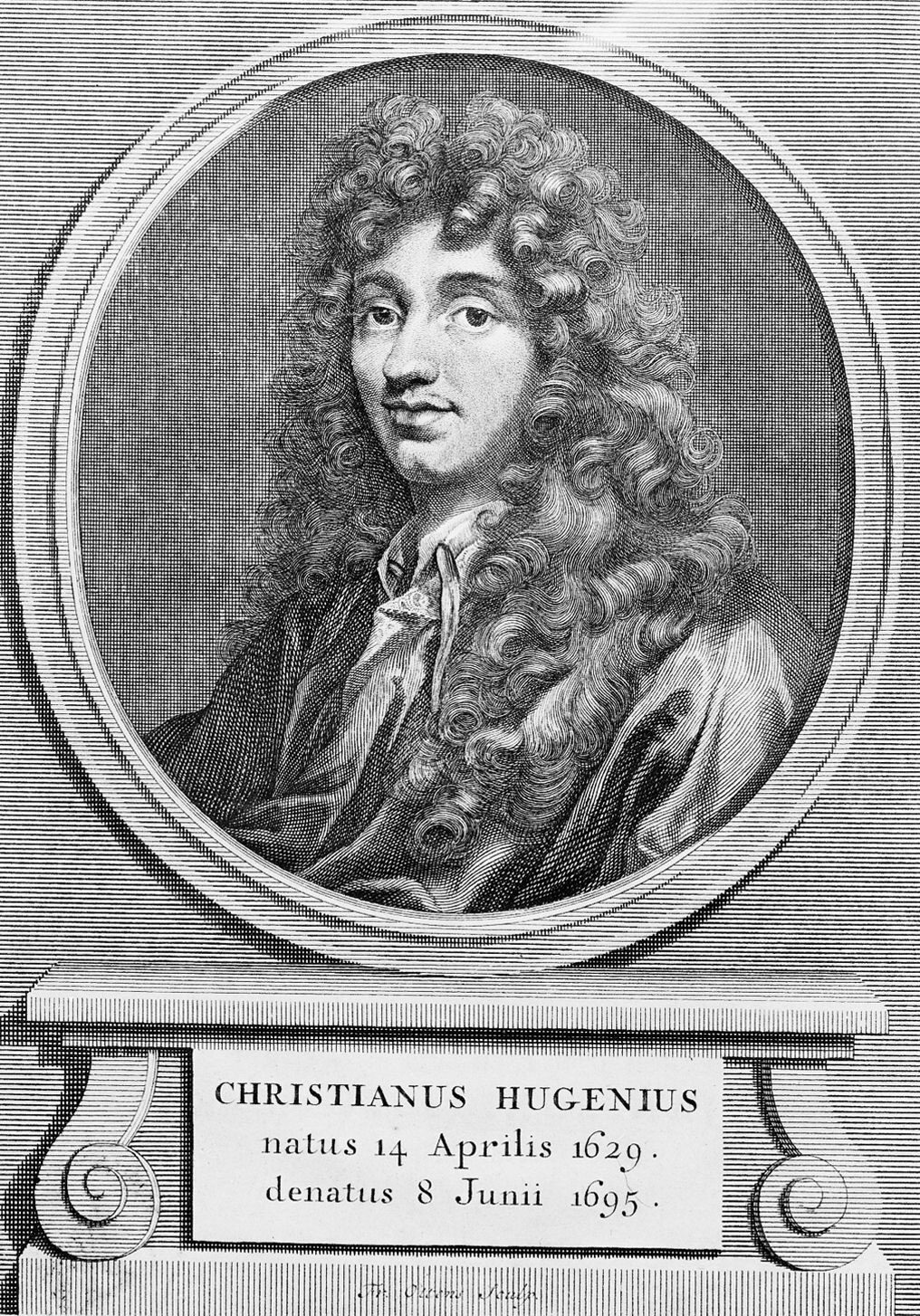 The invention of the magic lantern is generally attributed to the Dutchman Christiaan Huygens.
© National Portrait Gallery, London
Initially, the lantern was used primarily as a visual aid by the scientific community. Prominent scientists such as Gottfried Wilhelm Leibniz (1646-1716) enthusiastically promoted the use of projection to communicate the latest scientific discoveries and inventions to colleagues in a comprehensible way. By 1720, the leading European manufacturers of scientific instruments were also producing magic lanterns. When the first Italian physics lab was opened, in 1755, the projection lantern was part of the set of instruments on offer.
When the lantern appeared on the scene, the projected image was still new to most onlookers. The images projected on the wall – often flickering because of the candle or lamplight – were associated with dreams, visions and apparitions. Hence, the magic lantern was a tool not only of scientists but also of those trading in superstition. During this time of social, political and religious instability in Western Europe, the lantern could both facilitate scientific proof and stimulate belief in the supernatural.
The magic of nature
As the technology improved, more powerful light sources were introduced: the Argand lamp, an improved version of the traditional oil lamp with brighter light, a more stable flame and hardly any soot or smoke came on the scene in 1783. It was followed less than a century later by the limelight (circa 1860), an extremely bright gas lamp providing intense white light. Both inventions changed the settings and increased the audiences for lantern performances.
Near the end of the eighteenth century, the lantern found a use in the theatre. The interest in the bizarre, terrifying and supernatural that characterised the Romantic Period led to the widespread success of phantasmagoria, a form of horror theatre in which, amongst others, the Dutch-Belgian Paul Philidor (1785-1828) would gain fame by using magic lanterns to summon skeletons, demons and ghosts. Terrifying images were projected onto walls, billows of smoke and transparent screens to maximise the illusion. For the same reason, the operator and his instrument were kept out of sight as much as possible. Mobile, portable projectors, sometimes in combination with other types of projectors, were used to suggest movement. Sound and light effects enhanced the macabre atmosphere.
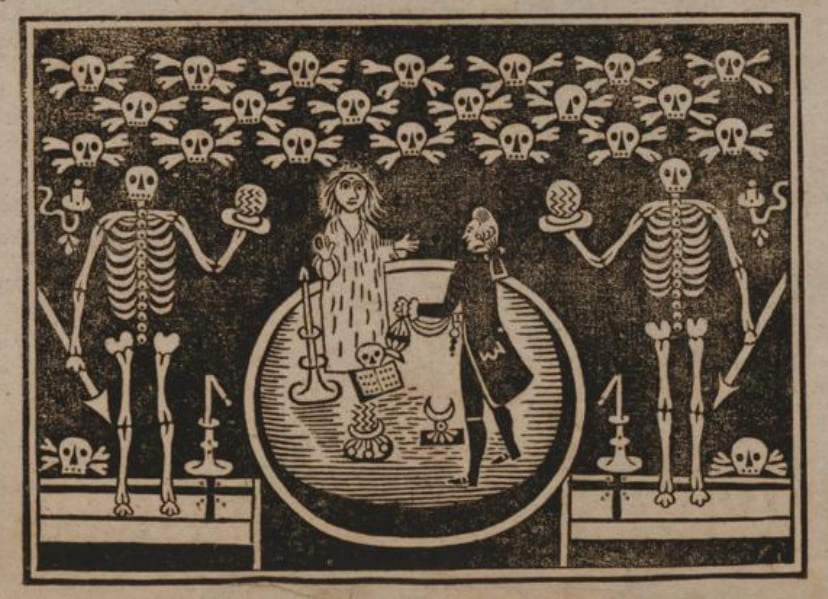 Illustration of a performance of Paul Phylidor, a magician and a pioneer of phantasmagoria shows, 1791
© Wikimedia Commons
The lantern’s ability to create these diabolical illusions led the general public to identify the device with black magic. At the same time, it was also an engineering marvel, a fantastic optical and scientific instrument, valued by the highly educated. In the course of the nineteenth century, these two applications would be successfully combined in the so-called physiques amusantes. These Paris shows put on by the Belgian physicist Étienne-Gaspart Robert (1763-1837), better known by his stage name Robertson, were the most successful examples of this new use. Using a magic lantern, Robert brought together the physical and the supernatural. Before the public got to see the phantasmagoria, he presented a number of physics experiments, ranging from hydraulics to galvanism. By his own account, his goal was to teach viewers how others could misuse scientific knowledge and physical phenomena to trick them.
The magic lantern was a tool not only of scientists but also of those trading in superstition
In the early nineteenth century, optics were also increasingly used at carnivals and fairs to amaze and amuse audiences. The shows, sometimes presented by magicians, sometimes by scientists themselves, blurred the lines between spectacle and education, between “magic” and science. Touted as wondrous chemistry, amusing physics, or entertaining mathematics, lantern shows employed scientific principles, mechanical structures and optical instruments to achieve effects that seemed to defy the laws of nature. Their popularity peaked during the first half of the nineteenth century, but would last until the turn of the century, when film came on the scene.
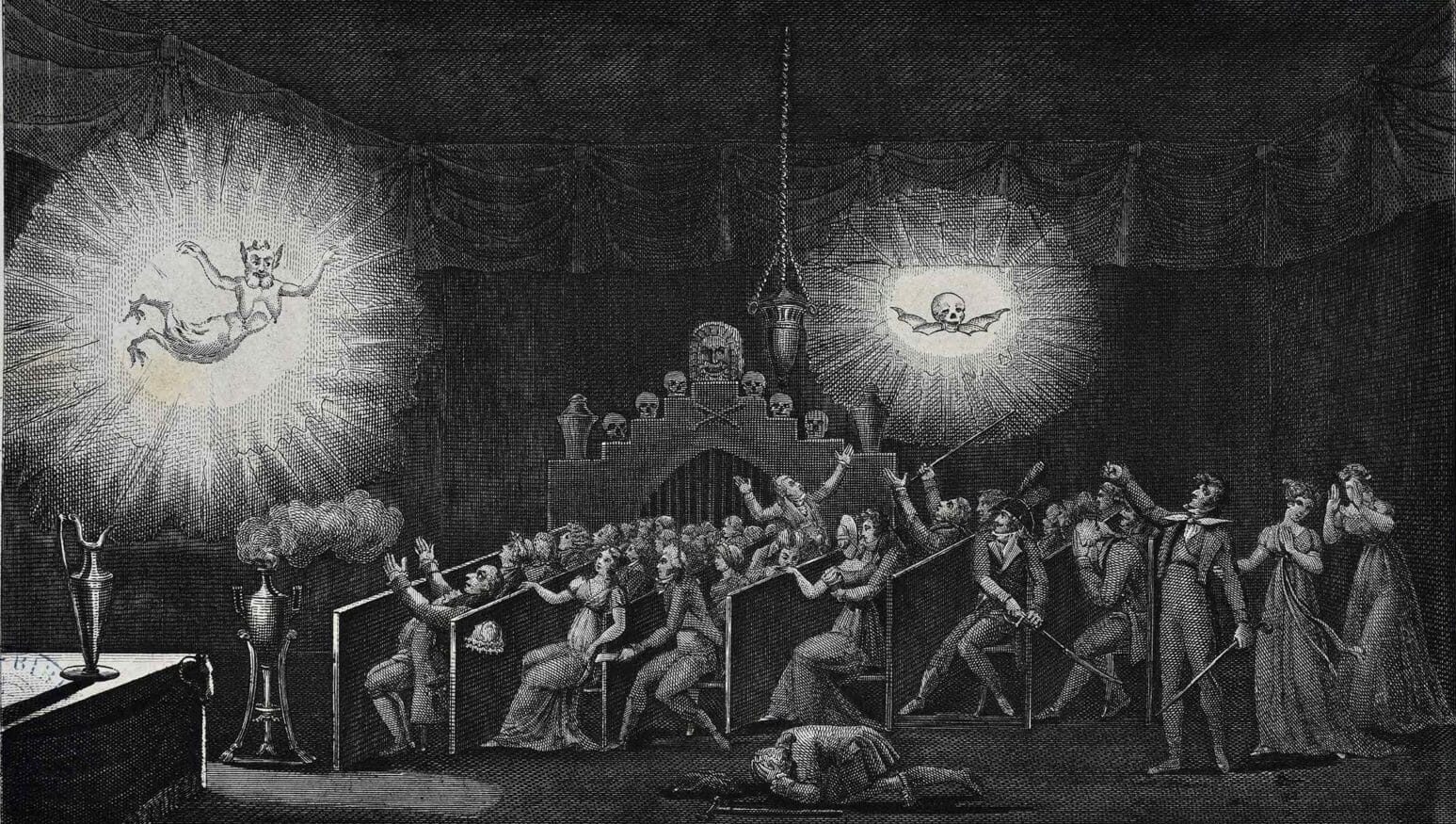 Engraving from the Memoirs of E.G. Robertson, physicist and aeronaut, known for his phantasmagoria experiments.
© Public Domain
Projection and didactics
The fact that the magic lantern could be so successfully exploited for the popularisation of science did not escape the attention of teachers. When it became possible in the second half of the nineteenth century to make photographic lantern slides, some enthusiastic teachers in Belgium decided to promote their use in the classroom. After all, the projection of photographic images made it possible to show both the infinitely large, such as the Milky Way, as well as the unimaginably small that only became visible under the microscope, to large groups at the same time. Moreover, the advent of photography had led to a new concept of scientific objectivity that encouraged scientists to “let nature speak for itself”. Mechanically produced images that “reproduced reality” were a good way to achieve that.
Projection technology also suited the new theories replacing traditional education in Belgium, the Netherlands and elsewhere in the West. All over Europe, on the advice of educators, governments began to demand that education be enlivened with pictures, objects and outings. Indeed, by the last decades of the nineteenth century, educators had agreed that the memorisation of dry lists of facts would never be as effective as education that actually showed students what the course material was really about. But, despite the popularity of this new pedagogical methodology, the use of the projection lantern in Belgian and Dutch education remained rare for a long time.
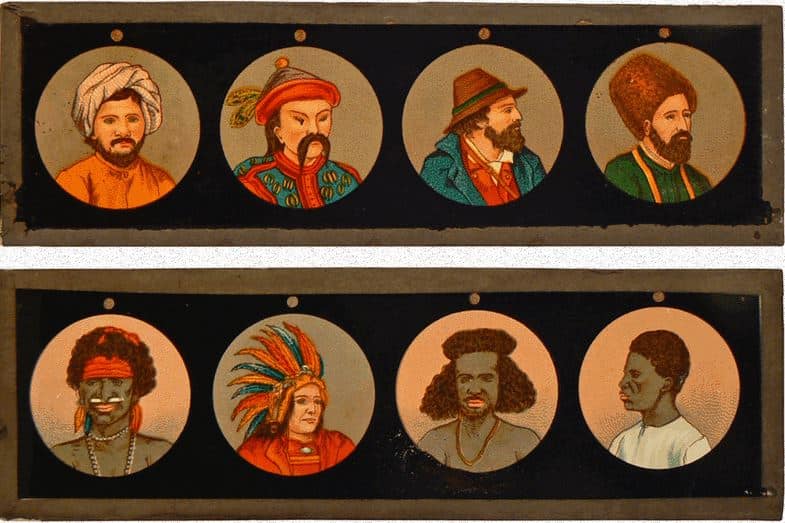 If the use of the magic lantern in class was encouraged, the premises were often ill-suited for it.
© Le compendium
Using the projection lantern in the classroom not only required teachers to change their teaching practice, but also required adaptations to the classrooms. The few schools with the budget to buy a lantern and a few sets of projection plates were confronted with the problem that the classroom could not be darkened enough for students to see the light images sharply. The most modern, user-friendly models worked with electric light, but many schools were not connected to the electricity grid before the First World War.
The rise of the cinema: a new beginning?
The invention of film in the late nineteenth century was not actually the starting point for a revolutionary new visual culture but, rather, the result of a centuries-long, broad preoccupation with the illusion and spectacle value of moving images and the fascination with science. In addition, there was a mutual influence between the story lines and imagery of lantern shows and early cinema, not least because many lantern operators found work in the film industry.
Like the magic lantern, movie projectors in the early days were operated by hand, which made the technical knowledge of lantern operators very marketable. Several manufacturers made film projection systems that worked in concert with magic lanterns; sometimes, film and lantern slides were literally projected side by side in lectures. In addition, lantern and film showings in the first two decades of film also required accompanying commentary from a lecturer.
In the first two decades of the twentieth century, Belgian and Dutch journals for and by teachers complained about “the cinema plague”
Surprisingly, the boom in commercial film also led to the definitive breakthrough of lantern projection in education. In the first two decades of the twentieth century, Belgian and Dutch journals for and by teachers complained about “the cinema plague”. While film was inherently a fine medium, they argued, it was bad for children’s eyes and nerves. Moreover, the often “unchristian” themes of the movies were deemed to have a negative impact on their moral development. If films were to be used for educational purposes, their content would have to be better guarded. Moreover, film was seen as a very passive medium, requiring little intellectual effort from young people. For the time being, it was therefore better to focus on lantern projection, since the teacher could maintain more control over the images shown and the accompanying narrative.
The age of slides
Technological advancements in lantern projectors and investments in school infrastructure after the First World War I accelerated the diffusion of projection technology for educational purposes. By the mid-1920s, lantern projection was well established in primary and secondary schools and educational organisations.
At the same time, new projection media were making an appearance. Episcopes (early overhead slide projectors) made it possible to project opaque images that the teacher or lecturer often already had available, such as postcards, images in textbooks, self-drawn illustrations or newspaper clippings. This solution was also cheaper and less fragile than lantern slides. Filmstrips offered similar benefits. These consisted of a roll of positive film (or slide film) about one meter long and 30 or 35 mm wide on which twenty to fifty still images were reproduced. Using a filmstrip projector, which was considerably less expensive to purchase than a lantern projector, the images could be projected one at a time. At the end of the decade, the filmstrips were cut frame by frame and the individual 35mm images were placed in metal frames or between glass. Thus, the era of the slide projector and slides was ushered in.
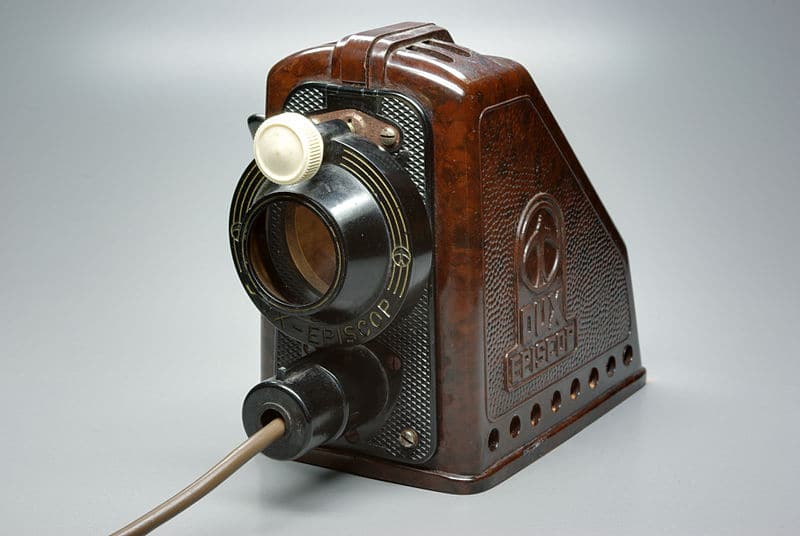 Epicsope
© Wikimedia Commons
Continuing practices
By the 1930s, both educational films and still image projection were widely used in Belgian and Dutch schools and educational organisations. But the projection of still images proved to be no match for the entertainment value evoked by moving images at the beginning of the twentieth century. While the magic lantern may have proved less magical to new generations of spectators than film, television, and, later still, social media videos, the use of still light images in teaching remains a common didactic practice to this day.

You might also like



It’s all double Dutch to ChatGPT





Leave a Reply
You must be logged in to post a comment.