
Hannah Cycles Over the River IJ: Amsterdam in 2075

In 2075, Amsterdam will celebrate its eight-hundredth anniversary. What will the city look like in half a century? Has it been able to cope with the challenges it now faces? Journalist and social geographer Floor Milikowski paints a future picture of the city on the river IJ, where parcels are delivered by boat, public transport is free, and young people are once again choosing the traditional, non-electric bicycle.
As soon as she reaches the top of the bridge, Hannah lifts her feet off the pedals. She sits upright and takes a moment to look around, just as she always does. Although it’s now hard to imagine the bridge not being there, it still feels special to be above the river IJ and admire the city from above. On her left, she can see Central Station, and across the water, through the buildings, she catches a glimpse of her old secondary school. On her right, in the distance, she can see the kilometres-long, sleek white bridge to Almere. That, too, remains a remarkable sight. After years of debate, it was finally constructed to mark the Olympic Games of 2048.
It was one hundred and twenty years after the previous Olympic Games in Amsterdam, exactly one hundred years after Fanny Blankers-Koen’s three gold medals in London and eighty years after the southern part of the Flevopolder was drained. Officially, Amsterdam was the host city, but a lot also happened in Almere, on the other side of the water. That’s where the Olympic Village was located, where the ten thousand participating athletes slept, ate and relaxed. Amsterdam had promised to organise the greenest games ever, which provided the perfect excuse to finally build the metro line that had long been talked about. A wide, attractive cycle path was constructed alongside the bridge, so now you can get from IJburg to Almere Duin by electric bike in under fifteen minutes.
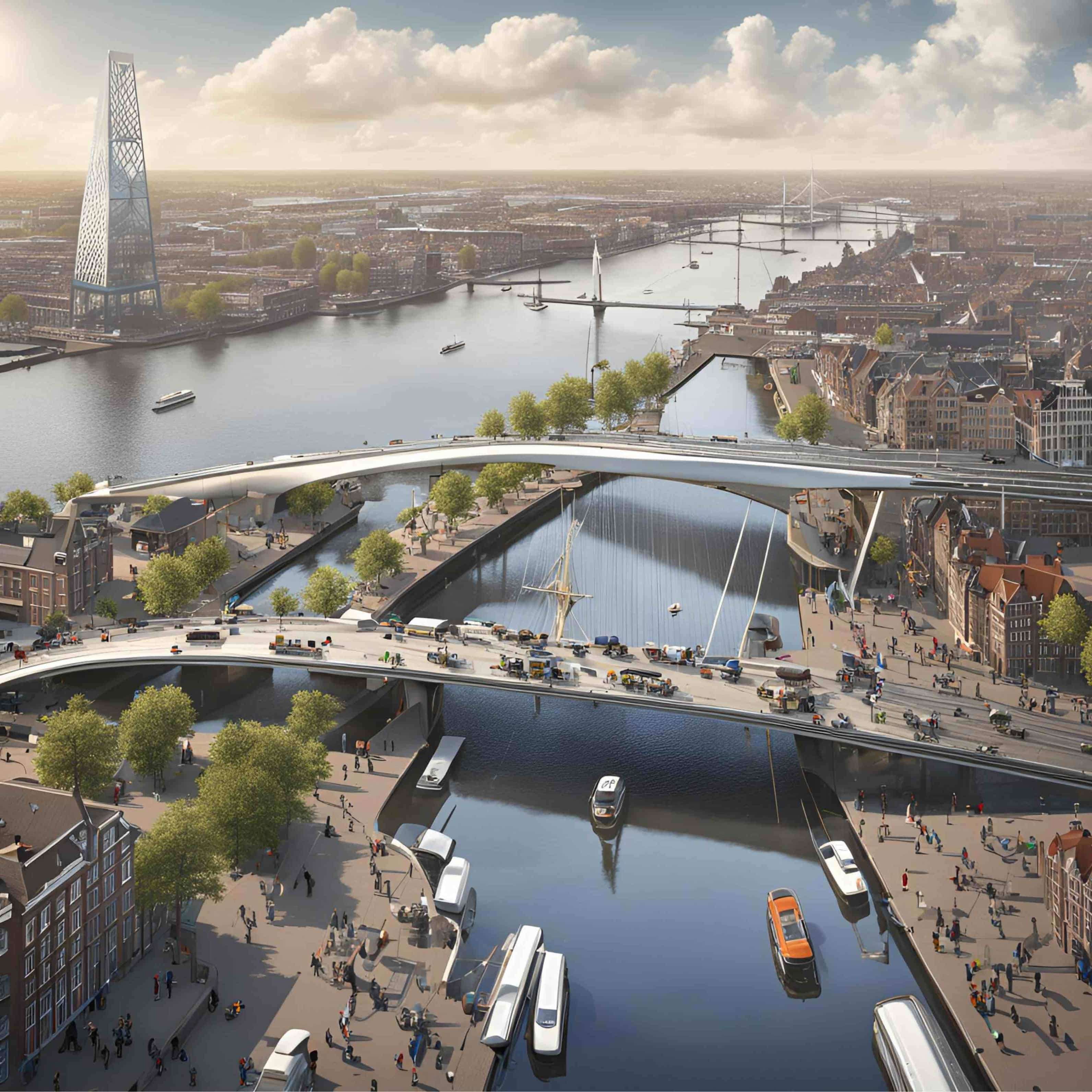 Futuristic view of Amsterdam
© AI for Canva
If she looks closely, she can just see a metro train leaving IJburg as it crosses the bridge. “Maybe we can do that later,” she thinks as she passes the top of the bridge on her bike and slowly starts to pick up speed. On Wednesday mornings, she looks after her grandchildren, and when the weather is nice, they sometimes go to the beach in Almere. Especially since nature has been given free rein along the dike, it’s become a beautiful area. It’s a kind of reed and marshland, with waterbirds that she never saw near Amsterdam before. Once, when they went on a trip in a whisper boat, they saw two otters playing between the tree roots along the bank. They had sat there and watched them quietly for a while. Hannah had asked the guide whether these otters also slept floating on their backs, as she had often seen in videos, but it turned out those were sea otters. These were river otters, and they sleep in burrows.
Maybe later they could have some hot chocolate and look for sticks on the beach. Especially her granddaughter loves scavenging and can spend hours searching for special little things. Hannah often tells her about the shells she used to find on the beach at Sanibel Island in Florida. The island is now mostly underwater, but when she visited once as a child, the most beautiful treasures could be found there every day. Some of those shells are still displayed on the windowsill of her childhood home, where she’s been living again for the past fifteen years. Or maybe later they could visit one of the city farms or orchards in Waterland. That’s always fun too, and closer by. Plus, the apple pie and plum tart at De Appelboer are absolutely delicious. Maybe they could take a minibus. The children could enter the address and press the start button. It’s still such a joy to be able to travel so easily, for free and without any hassle using public transport.
It’s still not cheap to live in Amsterdam, but it’s certainly nowhere near as extreme as it used to be
When she was a child, the tram and the bus got more expensive every year. The train too, for that matter. In hindsight, it was quite a strange time. Everyone was constantly trying to make as much money as possible from everything. Until people realised that having a lot of money in the bank doesn’t mean you’re doing well. Or that a well-filled state treasury doesn’t mean that society is doing well. That awareness came gradually, but it did lead to major change. For her generation, finding an affordable house was no longer such a big issue. It’s still not cheap to live in Amsterdam, but it’s certainly nowhere near as extreme as it used to be.
Snail’s pace
On the slender cycle bridge over the river IJ, her bike finally starts to pick up speed. She places her feet back on the pedals and gently squeezes the handbrake, just enough to slow down slightly, but not so much that she loses the sensation of almost flying. Going uphill, she’s always overtaken by electric bikes, scooters and unicycles, but on the way down, gravity lets her keep pace with the rest. Hannah still rides the same bike she used to ride onto the ferry every day. A stylish Batavus with seven gears. She got it when she started secondary school and has maintained it ever since. Over the years, all the parts have been replaced multiple times, but the frame is still the same one she took on the ferry every day. Lately, she’s been seeing more and more school pupils and students riding around on old-fashioned bikes. They’re not black like hers, but brightly coloured with all sorts of prints and paintings on them. Teenagers and twenty-somethings cruise peacefully through the city on them. Hannah can well imagine how lovely it must feel to ride at a snail’s pace when you’re used to the speed of an electric bike. She finds it heartening to see how younger generations always do something different from what the older generations expect of them – accelerating when people think they’ll slow down and slowing down when everyone assumes they want to go faster.
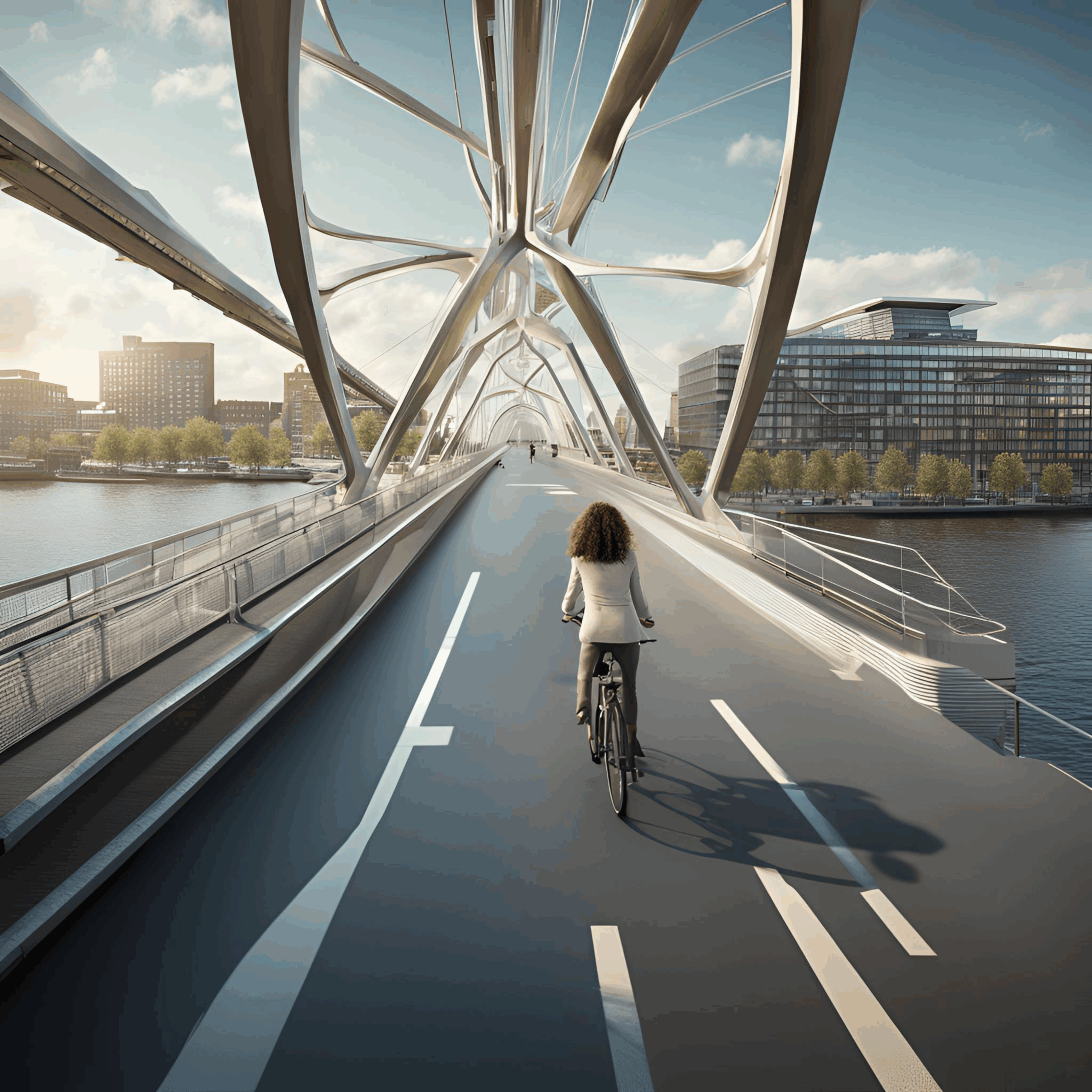 Futuristic cycle bridge in Amsterdam, circa 2075
© AI for Canva
The bridge over the river IJ hadn’t been built yet when she was at school. It sounds a bit roundabout now, but it was always a lovely little journey across the calm waters of the busy city. Especially in those days, it was nice to be forced to stop for a while. Things were so hectic; people were restless and constantly glued to their mobile phones. It was a collective obsession. Parents and children went to bed with them and woke up with them. Even in cafés or on terraces, you’d see people endlessly staring at their screens. Looking back, it’s bizarre really. Hannah loves telling her grandchildren about that time. About having a phone in the classroom and secretly gaming during lessons. She still remembers how she once spent an entire day watching Marvel films with two classmates. When she showed her grandchildren a clip of Wolverine, they laughed. They thought it looked so old-fashioned they couldn’t even take it seriously. “Grandma, were you alive in the Middle Ages?” her grandson asked later that day. It was exactly the same question Hannah had asked her own mother more than fifty years earlier. And even then, her mother had said, “One day, when you have children, they’ll think your youth was old-fashioned too.”
Robot with an Amsterdam accent
As Hannah approaches the densely wooded green banks of Amsterdam-Noord, a small train of boats from the municipal postal service sails beneath her. Through the boat’s glass canopy, she can see stacks of parcels. It still reminds her of Sinterklaas’s steamboat. When Hannah lived on Prinsengracht for a while after her studies, parcels were still delivered along the canals in vans. She sometimes laughs when she remembers how the delivery drivers would have to stop their vans right in the middle of the road because there was nowhere else to park. Cars behind them would be honking, and annoyed cyclists weaved their way through the hustle and bustle. And then there were the tourists with their suitcases and selfie sticks, wandering about a bit lost in the chaos. From her third-floor window, Hannah could watch it all for hours.
Amsterdam was the first city to start delivering parcels by water. These days, no one bats an eye at the electric, self-driving boats
In hindsight, it was only a relatively short period in the city’s history. Once Amsterdam truly shifted to a sustainable economy, the flood of visitors quickly came to an end. The same thing happened all over the world. Airports shrank, people stayed closer to home more often and both cities and nature had a chance to recover. Hannah found it a relief. The people who did come were more aware of their surroundings – just as she tried to be when she travelled.
She had just moved to Noord when the postal boat was introduced. It made headlines around the world. Amsterdam was the first city to start delivering parcels by water. These days, no one bats an eye at the electric, self-driving boats and the robots that deliver the parcels. But back then, locals and tourists alike would stand on the sidelines taking photos and videos. Now and then, things went wrong, and a robot would tip over. That also happened a few times when people tried to take a selfie and pushed the robot with packages over. It also resulted in endearing clips of passersby setting the robot upright again and placing the parcels back in its basket.
To curb the TikTok hype surrounding the robots, the postal service stopped dressing them in hoodies after just a few months. At first, the robots had worn red and black hoodies with three white crosses on the front, and they spoke in a thick, old-fashioned Amsterdam accent. The voices had been created from old recordings of Tante Leen and Johnny Jordaan. Now, they were more standard robots that just did their job and spoke in a neutral voice. It was far more practical, but the time when they wandered around as old-school Amsterdammers had become the stuff of legends. You still see those images everywhere, and when you’re abroad, people often bring them up.
Circular manufacturing industry
It feels like a long time ago that the canals in summer were filled with pleasure boats, lots of booze and loud music. These days, they’re used in a far more practical way: for delivering post and parcels and collecting waste. There’s an ingenious system of underground waste storage along the quays. Rubbish is collected by refuse boats and gathered , processed and recycled about ten kilometres away along the North Sea Canal.
On the former grounds of Koninklijke Hoogovens and Tata Steel, lies the campus for sustainable energy and mobility
Around the canal, where Hannah herself also worked for a long time, a thriving circular manufacturing industry has emerged. After finishing secondary school, she studied industrial design in Delft. After a few years of travelling, she returned to Amsterdam and took a job at one of the many small, new bicycle manufacturers in the city. Unlike a few decades ago, the bikes are now built on the very same site where they’re designed. Not far from there, on the former grounds of Koninklijke Hoogovens and Tata Steel, lies the campus for sustainable energy and mobility. TU Delft, the RWTH Aachen University of Technology and the University of Groningen collaborate here with businesses, municipalities and the province to develop practical solutions for a sustainable economy. On campus there are wind tunnels and laboratories, which Hannah visited regularly for testing. She also enjoyed going to the secured site of the regional waste processing centre, where on an immense terrain, discarded and returned products are dismantled into separate, reusable parts. Some of the most remarkable new ideas and inventions still come from there.
No more language barriers
Since switching from designing to writing, Hannah still visits the campus and the recycling centre regularly to keep up with the latest developments. For her, it always feels a bit like stepping into Gyro Gearloose’s shack, except that no one has managed to invent a time machine just yet. She loves writing about it for newspapers and magazines. And because everything can be read online in all languages instantly, her work is also widely read abroad, and she gives lectures and guest talks around the world. Even then, language is no longer a barrier. Hannah speaks in Dutch, and the audience can instantly listen in any possible language. She usually gives her lecture from her office in Amsterdam, but now and then she accepts an invitation to attend in person.
Hannah rides off the bridge and cycles into Amsterdam-Noord, on her way to see her grandchildren. Will it be Almere or Waterland today? Or perhaps just the playground in the courtyard where they live, where plenty of neighbourhood kids gather every Wednesday morning? Either way, she’ll need to make sure she’s home on time to pack. Tomorrow morning, she’s taking the train to Stockholm, where her best friend lives. She’ll arrive by late afternoon, and then they’ll take a small boat to a cottage on one of the islands off the coast. If all goes well, the groceries will already have been delivered before they arrive. They use the same little boats and robots there as in the canals of Amsterdam. When placing an order and selecting a language, you can even choose the voice of Tante Leen or Johnny Jordaan.

You might also like




Leave a Reply
You must be logged in to post a comment.