

What do the words brug, bridge, and brêge have in common? Their origins lie in Ingvaeonic, the coastal language that helped mould English, Frisian, and Dutch centuries ago. Traces of it can still be heard today in our vocabulary, in dialect sounds, and in the names of places ending in ‘muiden’.
They are referred to as North Sea Germans or Ingaevones: the Germanic tribes that lived along the North Sea coast in the first millennium AD. The term “Ingaevones” first appeared in the book Germania by the Roman historian Tacitus, who divided the West Germanic tribes into three groups: Ingaevones, Irminones, and Istvaeones. In his book, Tacitus described the Germanic tribes that lived outside the Roman Empire. The proximi Oceano Ingaevones lived, as described in Latin, “close to the ocean”. Historical linguists have adopted Tacitus’ term Ingvaeonic to denote the coastal phenomena in language.
Cor van Bree, an emeritus professor of historical linguistics and language variation, has devoted much of his academic career to studying Ingvaeonic. In his farewell lecture delivered in 1997 at Leiden University, this topic was central. He also dedicated a chapter to it in the revised 2016 edition of his textbook Historical Grammar of Dutch. In his home in Oestgeest, not far from the Dutch coast, we talk about Ingvaeonic.
Air of mystery
The air of mystery around Ingvaeonic is not without reason: we know very little about the people who once spoke this language. The dating is so early that we do not have texts at our disposal ; unlike Latin, Greek, and Sanskrit, we have no ancient documents of the earliest Germanic. This means that we can only arrive at Ingvaeonic through the reconstruction of existing languages.
Through this reconstruction process, Ingvaeonic is usually dated to around 500 AD, explains Van Bree. That is a few centuries later than the mention of the coastal inhabitants by Tacitus in the first century. “In the first century, Germanic was probably still fairly homogeneous. At that time, Gothic also had yet to emerge, a language that belongs to the East Germanic branch. We do have a text from that time: the Codex Argenteus of Wulfila, who lived in the fourth century. It is not likely that there was a split within West Germanic before that time.”
Ingvaeonic is not comparable to a language like modern Dutch. It was a vernacular, with a lot of variation and without a standard language
It’s also difficult to speak of a language in a strict sense of the word. “Ingvaeonic is not comparable to a language like modern Dutch. It was a vernacular, with a lot of variation and without a standard language. Those people probably didn’t even feel like they were speaking the same language.” Linguist Klaas Heeroma preferred to call it a “language without a name” for that reason, Ingvaeonic is a name later given to it by linguists.
The oldest Ingvaeonic
“It is likely that the Ingaevones, similar to other Germanic people, originated from the southern area around the Baltic Sea,” says Van Bree. The Ingaevones included the Angles, the Saxons, the Jutes, and the Frisians. They migrated to lower coastal areas and eventually inhabited the coastal area from Germany to the French Boulogne-sur-Mer. This allowed the earliest Ingvaeonic to spread over a large area. Linguistic features from that period can still be found in Germany today.. An example is the form distinction between accusative and dative. “That difference, for example, in mich versus mir, exists in High German.. But Low German, spoken in the northern part of Germany, lacks that distinction, due to the influence of Ingaevonic. Later on, the northern part of Germany became strongly Frankish-influenced by the south.”
In the sixth century, some of the Angles, Saxons, Jutes, and Frisians migrated to England. Celtic was originally spoken there, but the Angles rulers imposed their own language on them. English was later influenced by Danish and Norwegian, due to the invading Norsemen in the eighth century, and even later, in the eleventh century, by the French of the Normans. Accordingly, Ingvaeonic plays an important role in shaping modern English.
English retains ancient Ingvaeonic features, such as the form me for both dative and accusative (He gave me the book. He loves me). However, it also has young Ingvaeonic features, which arose after English colonisation. “This shows that contact between England and the continent persisted. The sea has been a connecting force in this context. Especially in West Flanders and Calais, where you can already see Dover. Even in later times, there are typical similarities between England and West Flanders: The English word order ‘when he came home, he went to bed’ is also found in the West Flemish dialect.” In Standard Dutch, the word order differs; translated to English it would be: ‘when he came home, went he to bed’.
Traces in names of places
In the eighth century, Ingvaeonic on the European mainland had to yield to the language of the Franks. Despite this, traces of Ingvaeonic or Ingvaeonic features remained preserved, as Van Bree clarifies based on the language contact theory: “There was likely an intensive language contact situation, in which the Franks formed the upper layer and the Ingaevones the lower layer. The Ingaevones adopted the language of their rulers but unconsciously continued to use certain characteristics from Ingvaeonic.”
Furthermore, there were words that the Franks, in turn, would have adopted, such as words from a particular context of use. Typical coastal words trace back to Ingvaeonic, such as eiland (island), nes (peninsula), zwin (tideway) and schaar (deep channel).
Ingvaeonic is also well-preserved in the names of places. Van Bree elaborates: “A famous example is the place names that end in –muiden. The form mui developed from the old form of mond (mouth), where the n disappeared and the preceding vowel changed into a diphthong or digraph, as in the English mouth. Along our coast, in addition to the word mui, you also find place names such as Muiden, Arnemuiden, and Leimuiden.
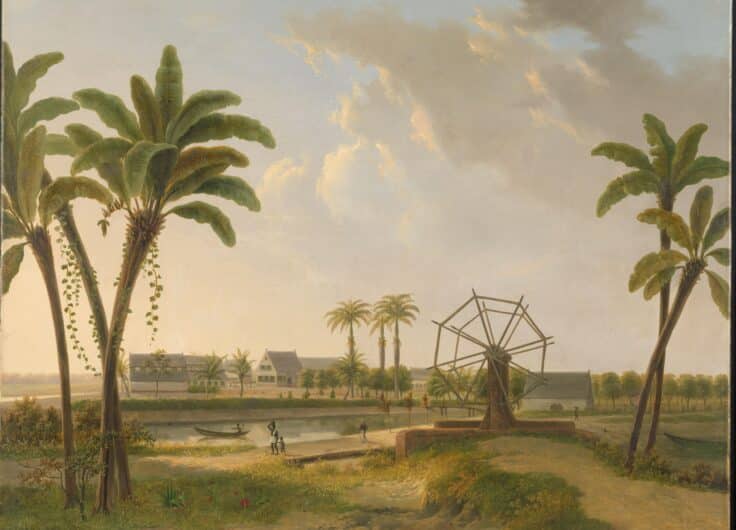
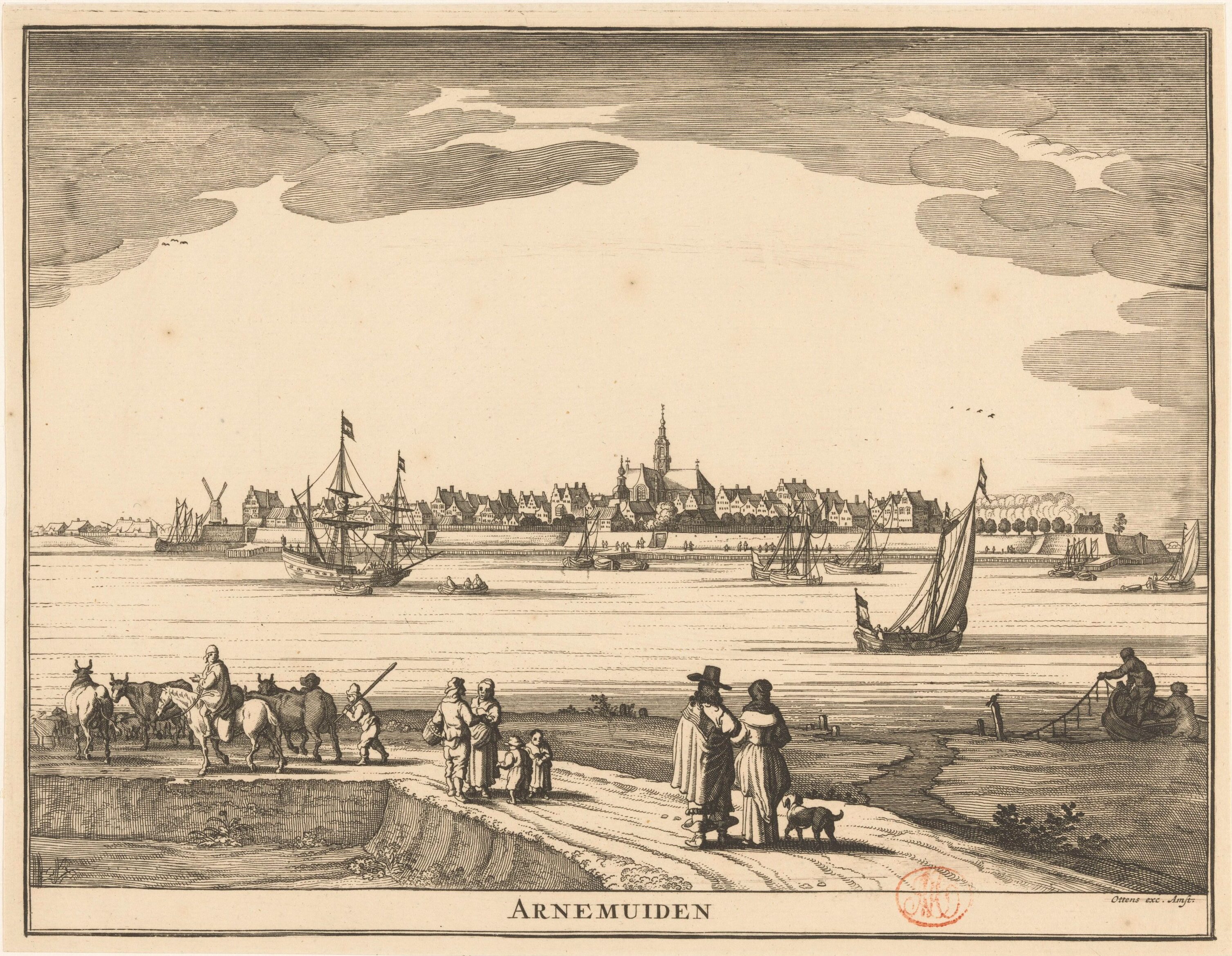 Pieter Hendrickszoon Schut, View of Arnemuiden, 1719–1725, Rijksmuseum, Amsterdam Place names ending in “muiden” have an Ingvaeonic origin.
© Rijksmuseum
Easy pronunciation
Especially in sounds, many examples of Invaeonisms can be found. Unrounding is a typical Ingvaeonic phenomenon: the u-sound, where the lips are rounded, changes to an i or an e. The Dutch word brug has been unrounded to bridge in English, and along the Dutch and Flemish coasts, you can find forms with an i and e as well: such as brigge in Zeelandic, bregge in Katwijk dialect, bregh in North Hollandic, and brêge in Frisian. The Dutch word dun is thin in English, din in West Flemish, dinne in Zeelandic, and tin in Frisian.
Unrounding is a typical Ingvaeonic phenomenon: the u-sound, where the lips are rounded, changes to an i or an e
According to Van Bree, many of these examples point to an easier way to pronounce words. This could explain the emergence of Ingvaeonic. Van Bree explains, “The pronunciation of brug requires rounding the lips, which is an effort you do not need to make when using an i or e. Furthermore, languages with rounded vowels are relatively rare compared to those without. The Dutch language actually has three of these vowels: the uu, the eu, and the u. They also occur in nearby languages such as German and French, and in the Scandinavian languages. However, English has unrounded these sounds. As a result, languages featuring these vowels are quite rare, especially from a global perspective.
From Ingvaeonic to Frisian
From the eighth century until the end of the Middle Ages, Ingvaeonic was still in use, but by that time it could also be referred to as Frisian. In old sources, Frisian also appears as a geographical term for the Dutch and Flemish coastal areas. For example, Mare Frisicum was used to denote the North Sea in the eighth century, and around 1018, Flanders was also referred to as regio frisionum. But these geographical references do not necessarily mean that an early form of Frisian was spoken during that period, stresses Van Bree. It’s also very likely that the southern coastal region was under Frisian rule during that time, with Frisian law prevailing.
Remnants of Ingvaeonic can still be found primarily in North Holland, Zeeland, and West Flanders
Nevertheless, Frisian develops into a distinct linguistic variety in the northern coastal region during this period. As a result of the growing Frankish influence, this Frisian influence from the south is increasingly pushed back. West Friesland remains Frisian for a longer period, but is also conquered by the Franks in 1285. Since the end of the Middle Ages, Groningen has not been Frisian-speaking. From then on, Frisian is confined to the province of Friesland. However, West Frisian and Gronings still retain many Frisian characteristics.
Remnants of Ingvaeonic can still be found primarily in North Holland, Zeeland, and West Flanders. In South Holland, they are relatively scarce due to the significant influence of the large cities. Also, as noted earlier, Ingvaeonic is the root of modern Frisian and English. “Many people struggle with the current anglicisation of Dutch,” concludes van Bree, “but as a joke, I also refer to it as the heringweonisering (re-ingvaeonization) of Dutch.”

You might also like

The Struggle to Establish Dutch as the Language of Business in Flanders




Leave a Reply
You must be logged in to post a comment.