
Our Culture Deserves a Megaphone: Let Us Speak
The future of Ons Erfdeel, the Flemish-Dutch cultural organisation behind, among others, the magazine de lage landen and the website the low countries, is under severe threat. In an open letter, more than a hundred leading figures from the cultural and media sectors, academia, and the business community call on the Flemish and Dutch governments to urgently provide the organisation with the resources necessary to safeguard its vital work.
Dear politicians,
We are deeply concerned about the future of Ons Erfdeel vzw and its publications. The Flemish government plans to halve its support for this cultural organization due to budget cuts, while the Dutch government is taking it a step further by scrapping its funding entirely. As a result, not only does a unique and internationally respected institution risk disappearing, but both Flanders and the Netherlands stand to damage their reputation and cultural standing.
There is much at stake.
Cultural compass
For nearly seventy years, Ons Erfdeel has provided a clear and high-quality perspective on the arts, literature, language, history, and social developments in the Low Countries. The organization places our culture within a broader context and is the only one to systematically achieve this across the full spectrum, bringing Flanders and the Netherlands closer together. Without Ons Erfdeel, we lose an indispensable cultural compass in a world that seems adrift.
Critical forum
In times of polarization, fake news, and superficial reporting, Ons Erfdeel offers what is essential in a democracy: nuance, plurality, depth, and reliable analysis from independent voices on topics that matter today, free from the fleeting news cycle. Severely cutting its resources means impoverishing public debate and shrinking the space for critical reflection on art and culture.
Window to the world
Ons Erfdeel is much more than a Dutch-language magazine with a website. It publishes books and organizes events both at home and abroad. Through multilingual publications and its websites les plats pays and the low countries it gives Flemish and Dutch culture an international voice, reaching over half a million readers worldwide every year. This global mission is a form of cultural diplomacy that profiles the Low Countries as open, creative, and culturally rich. Abandoning that role will make Flanders and the Netherlands less attractive internationally.
Investment in the future
Ons Erfdeel builds on the legacy of founder Jozef Deleu, but it also invests in the future. Teachers, students, journalists, and readers draw inspiration and information from its publications. Scholars, artists, and writers find a stage at de lage landen to present themselves to a wide audience, while talent development projects foster young editorial talent. By cutting back here, we lose knowledge, education, cultural vitality, and even economic impact.
Shaping our cultural memory
Ons Erfdeel helps shape our cultural memory. The organization teaches us who we are as a Dutch-speaking cultural community, where we come from, and what future we might have. Cutting its funding strikes at the heart of its mission and means losing a part of ourselves and our history.
Dear politicians, it is high time to act. Take responsibility. Do not let Ons Erfdeel bleed dry. Provide this indispensable cultural organization with the resources to continue its unique work with vigor, because a society that neglects its cultural voices deprives itself of its soul.
With cultural regards,
Ludo Abicht (author) – Kim Andringa (lecturer, Sorbonne Université) – Gerbrand Bakker (author) – Herman Balthazar (former governor of East Flanders) – Abdelkader Benali (author) – Mohammed Benzakour (author) – Willem Bongers-Dek (director, deBuren) – Johan Braeckman (philosopher) – Geert Buelens (professor, Utrecht University) – Axel Buyse (former diplomatic representative of Flanders) – Mark Coenen (columnist, De Morgen) – Daniel Cunin (translator) – Kurt De Boodt (poet) – Stefaan De Clerck (chair, Proximus) – Els De Geest (director, Willemsfonds) – Bert De Graeve (board member) – Carl De Keyzer (photographer) – Rik De Nolf (chair, Roularta Media Group) – Sophie De Schaepdrijver (professor, Penn State) – Peter Debrabandere (editor-in-chief, Neerlandia) – Ellen Deckwitz (poet) – Paul Demets (poet) – Wouter Deprez (comedian) – Kris Deschouwer (emeritus professor, VUB) – Luc Devoldere (chair, Literatuur Vlaanderen) – Franky Devos (coordinator, VIERNULVIER) – Fikry El Azzouzi (author) – Myriem El-Kaddouri (poet) – Elsbeth Etty (author) – Kees ’t Hart (author) – Thomas Heerma van Voss (author) – Armand Héroguel (chair, Maison du néerlandais) – Anne-Lot Hoek (historian) – Elwin Hofman (assistant professor, Utrecht University) – Lotte Jensen (professor, Radboud University) – Emy Koopman (author) – Anton Korteweg (poet) – Hilde Laga (chair, ING) – Tom Lanoye (author) – Tessa Leuwsha (author and documentary maker) – Thomas Leysen (chair, Mediahuis) – Henriette Louwerse (senior lecturer, University of Sheffield) – Marita Mathijsen (emeritus professor, University of Amsterdam) – Gert Meesters (professor, Université de Lille) – Lut Missinne (emerita professor, University of Münster) – Charlotte Mutsaers (author) – Philippe Noble (translator) – Cyrille Offermans (author) – Jeroen Olyslaegers (author) – Connie Palmen (author) – Koen Peeters (author) – Jan Peumans (honorary president, Flemish Parliament) – Ilja Leonard Pfeijffer (author) – Leo Pleysier (author) – Henk Pröpper (former director, Institut néerlandais) – Jonathan Reeder (translator) – Marc Reugebrink (author) – Magaly Rodriguez Garcia (lecturer, KU Leuven) – Vibeke Roeper (director, Onze Taal) – Christine Sas (chair, International Association for Dutch Studies and senior lecturer, University College London) – Paul Schnabel (former director, Netherlands Institute for Social Research) – Annick Schramme (professor, University of Antwerp) – Herr Seele (artist) – Manfred Sellink (former director, Museum of Fine Arts Ghent) – Anne Sluijs (director, International Association for Dutch Studies) – Els Snick (chair, Joseph Roth Society) – Lize Spit (author) – Peter Terrin (author) – Hendrik Tratsaert (director, PassaPorta) – Aleid Truijens (author and journalist, De Volkskrant) – Steven Van Ammel (bookseller) – Anne-Laure Van Bruaene (professor, Ghent University) – Rik Van Cauwelaert (journalist) – Jan Van Daele (president, Orde van den Prince) – Emmanuel Van de Putte (director, Native) – Freek Van de Velde (professor, KU Leuven) – Karl Van den Broeck (editor-in-chief, Apache) – Nicoline van der Sijs (emerita professor, Radboud University) – Leen van Dijck (chair, KANTL) – Adriaan van Dis (author) – Judith Van Doorselaer (director, KANTL) – Kurt Van Eeghem (author) – Katrijn Van Hauwermeiren (acquiring editor, De Bezige Bij) – Geert van Istendael (author) – Joke van Leeuwen (author, illustrator, performer) – Bart Van Loo (author) – Marc van Oostendorp (professor, Radboud University) – Frits van Oostrom (emeritus professor, Utrecht University) – Rik Van Puymbroeck (author and journalist, De Tijd) – David Van Reybrouck (author) – Dave Van Robays (director, Poëziecentrum) – René van Stipriaan (cultural historian) – Wim Vandenbussche (professor, VUB) – Wim Vanseveren (cultural consultant) – Henk te Velde (professor, Leiden University) – Annelies Verbeke (author) – Pascal Verbeken (author and journalist) – Eva Vereecke (director, de Brakke Grond) – Paul Verhaeghe (emeritus professor, Ghent University) – Gerdien Verschoor (author) – Ivo Victoria (author) – Philippe Vlerick (CEO, Vlerick Group) – Hendrik Vos (professor, Ghent University) – Vivien Waszink (researcher, Dutch Language Institute) – Tommy Wieringa (author)
You might also like
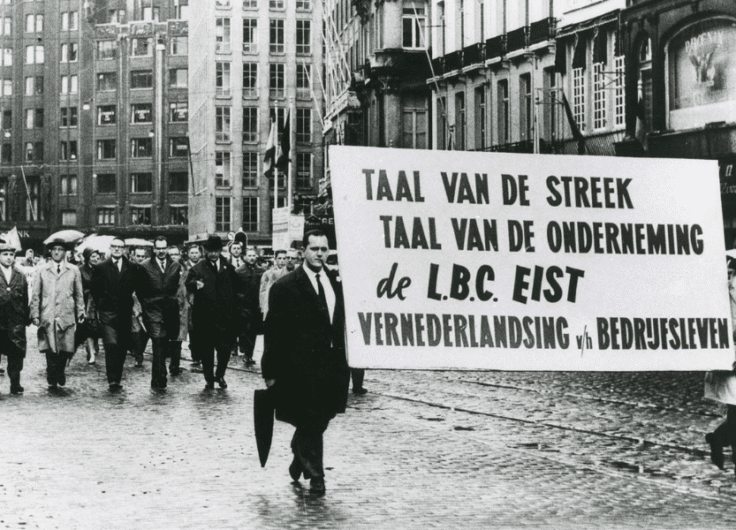
The Struggle to Establish Dutch as the Language of Business in Flanders


Leave a Reply
You must be logged in to post a comment.