
The Struggle to Establish Dutch as the Language of Business in Flanders
Dutch had been the official language in Flemish education and local government for years, but it was not until 1973 that companies completely dropped French as their working language. This was largely due to the lobbying efforts of two very determined figures.
In September 1973, a decree was passed that, though it was full of jargon, was particularly important for Flanders. The so-called September Decree marked the end of the last French-speaking bastion, the business community.
By then, the official and administrative use of Dutch in Flemish society had been underway for a decade. With the establishment of the language border, in 1962, the last remnants of French-language education had disappeared from Flanders and local authorities officially communicated in one fixed language, Dutch in Flanders and French in Wallonia. However, for internal company communications French frequently remained the working language.
 Hein Beniest with his wife Hélène Overlaet
© Marleen Beniest
Yet for years there had been efforts to establish Dutch as the language of business. The driving force for this, in the 1920s and 1930s, was entrepreneur Lieven Gevaert. In the 1950s and early 1960s, filmmaker Hein Beniest, with the support of companies like Gevaert, made an important contribution too. With their years of lobbying and investment, Gevaert and Beniest each succeeded in their own way in accelerating the use of Dutch in the Flemish economy.
Inferior ‘patois’
Let us start at the beginning. When Belgium became independent, in 1831, French became the language of government, secondary and higher education, the judiciary and industry all over the country. According to the brand-new constitution, Dutch had equal standing. However, the French-speaking elite regarded it as an inferior ‘patois’ spoken by the Flemish plebs, and therefore unsuitable as a language of government. Dutch-speaking intellectuals and citizens resisted this idea and united in what would later become the Flemish Movement.
Initially the movement strove mainly for cultural prestige, with newspapers, literature and theatre in Dutch, but it soon took on a political dimension as well. This led in 1873 to the first language law, the Coremans Act, which made Dutch the primary language in criminal cases in the Flemish provinces. Although in practice, Dutch was still rarely used. For example, if their clients agreed, lawyers could plead in French. The impact of the Coremans Act may have been limited, but it was the first in a whole series of language laws.
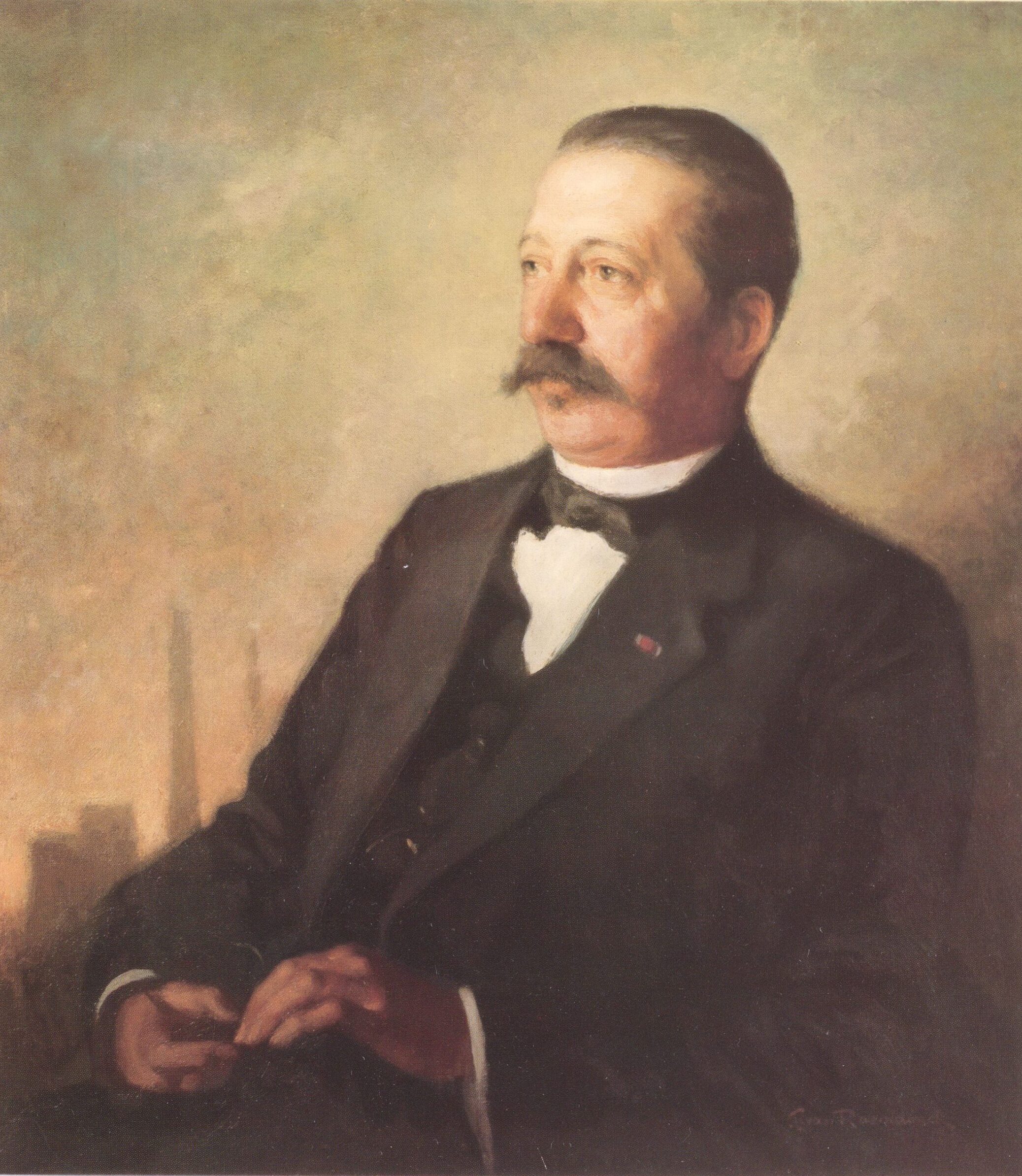 Lieven Gevaert, the self-made man who founded the first completely Dutch-speaking Catholic secondary schools, in 1932
© George Van Raemdonck / Felixarchief / Wikimedia Commons
For a long time little changed in the business community, for the simple reason that the industrial centre of gravity lay in Wallonia. Flanders was predominantly agricultural at the time and the (mostly French-speaking) large land owners called the shots. The few industrialists in Flemish cities were also often Francophone and had ties with Walloon industry.
The situation changed at the end of the nineteenth century. Industry was rapidly developing in Flanders, with factories in the Kempen region processing raw materials from the colonies, the textile industry in Ghent, Aalst and Ronse, the mines in Limburg and the growing port of Antwerp. Traditionally French-speaking industrialists suddenly had to tolerate Flemish colleagues in their midst who actively strove for a strong Flemish economy with Dutch as the working language.
Gradually the Flemish Movement realised that, as a region, you only have a say if you are economically strong. The economy therefore had to be able to function independently of Wallonia and Brussels. To achieve this you need, among other things, well-educated workers who speak and write in their own language, so the Flemish Movement also championed the establishment of Dutch as the official language of instruction at Ghent University and, by extension, in the entire education system.
Language gardens and competitions
More and more business leaders involved in the Flemish movement realised that, if they wanted to establish Dutch as the language of business in Flanders, they would have to unite in an interest group that could carry some weight. The Flemish trade association Vlaamsch Handelsverbond was founded for this purpose, early in the twentieth century. However, the organisation was disbanded shortly after the First World War. In 1926, it was succeeded by the Vlaams Economisch Verbond (VEV), known in English both as the Flemish Economic Association and the Flemish Economic Union. Its first chairman was Lieven Gevaert, the founder of the present multinational Agfa-Gevaert which, among other things, develops analogue and digital imaging systems.
By that time, Gevaert was already a well-known name in activist Flemish business circles. A self-made man, he taught himself French, German and English, using them to read about and specialise in photographic processes. First he set up a photo studio and later he began to produce his own photographic paper. He was so successful that, in 1920, after a series of relocations and expansions, he founded the Mortsel-based public limited company Gevaert Photo-Producten.
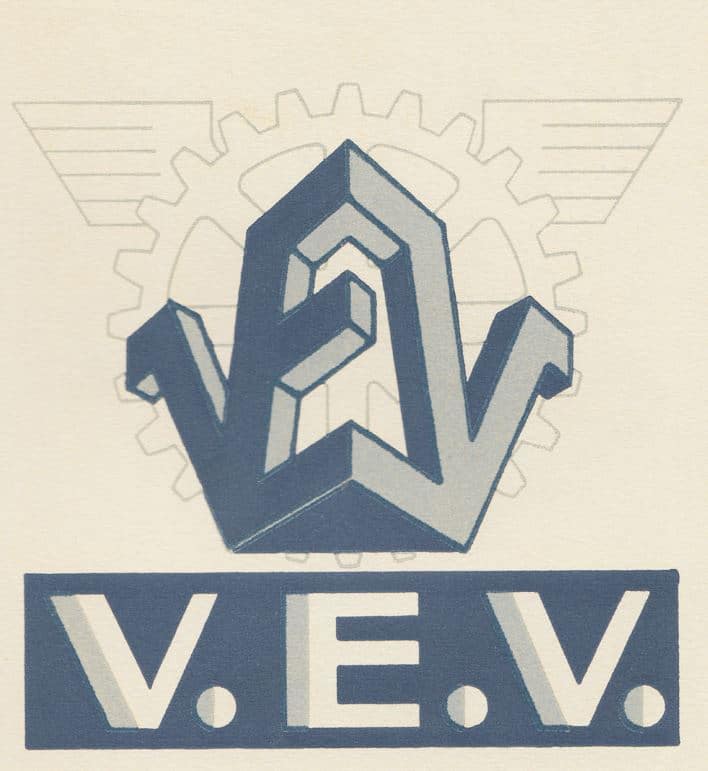 Logo of the Flemish economic association VEV. The organisation was founded in 1926, with Lieven Gevaert as its first chairman
 © ADVN Antwerpen / Encyclopedie van de Vlaamse Beweging (Encyclopedia of the Flemish Movement)
Lieven Gevaert came from a staunchly Flemish family and became involved at a very young age in organisations that defended Flemish demands. Later, he helped bring about the establishment of Dutch as the official language of instruction at Ghent University and, as an entrepreneur, supported other pro-Flemish initiatives. In 1932 he founded the first completely Dutch-speaking Catholic secondary schools, the Sint-Lievenscollege for boys and the Sint-Lutgardiscollege for girls, both in Antwerp. After Gevaert’s death, in 1935, the two schools and the VEV would play an important role in the struggle for the official recognition of the Dutch language. In schools, the first ABN core groups were formed, in which pupils encouraged each other to speak ABN (Algemeen Beschaafd Nederlands, i.e. standard correct Dutch rather than dialect). The VEV also lobbied successfully for years for the use of Dutch in business life in Flanders.
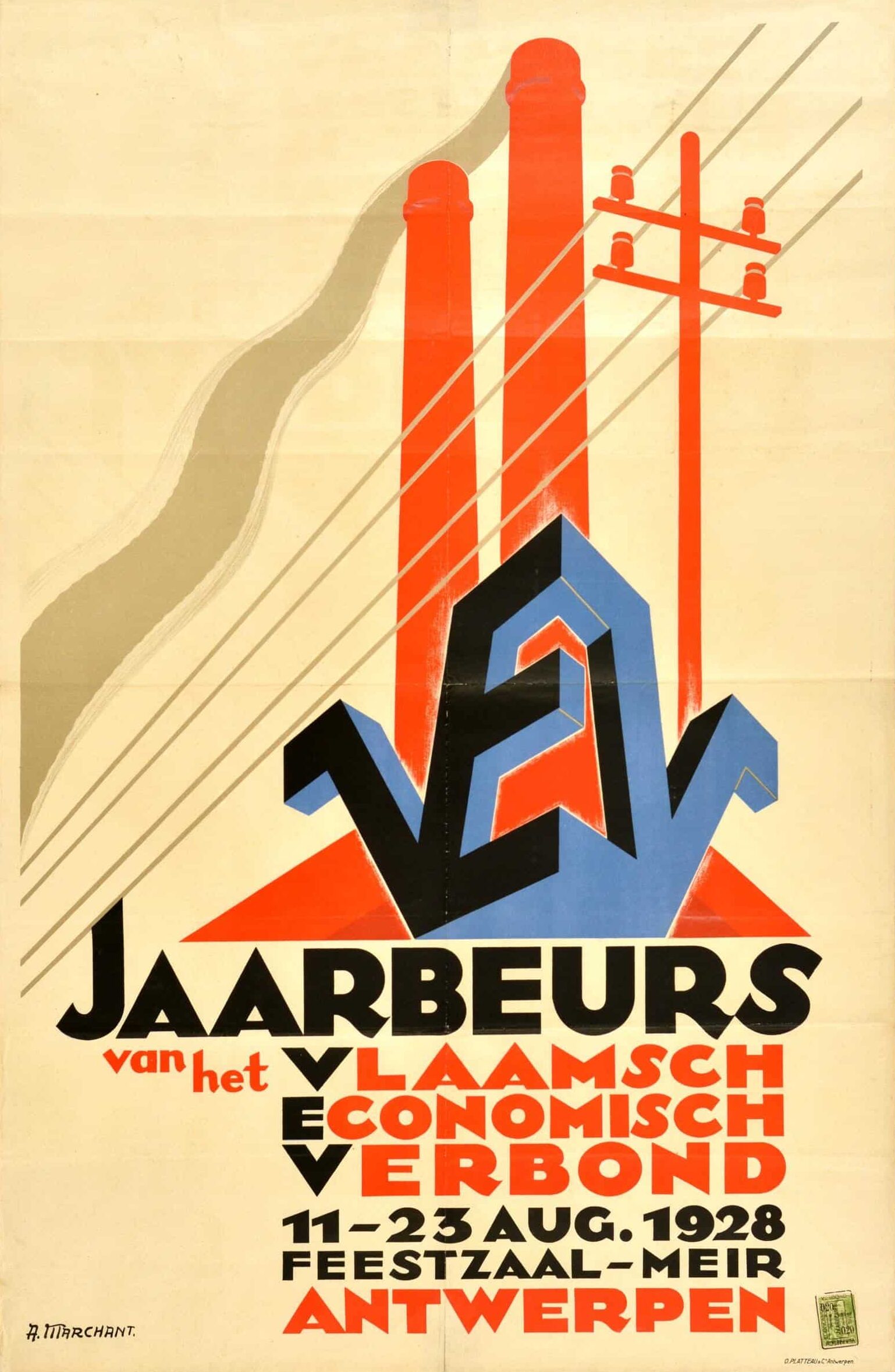 Poster of the Flemish economic association VEV
© ADVN Antwerpen / Encyclopedie van de Vlaamse Beweging (Encyclopedia of the Flemish Movement)
After the Second World War, the economic centre of gravity shifted from Wallonia to Flanders, boosting Flemish cultural emancipation too. For the first time, the business community was confronted with a generation of Flemish intellectuals who had been educated entirely in Dutch, Flemings who wanted to work and be addressed in their own language. The VEV’s lobbying for the recognition of Dutch as a fully-fledged business language gained momentum.
The VEV was not alone in this, campaigns promoting ABN sprang up everywhere. In education, the so-called ABN core groups and the Vereniging voor Beschaafde Omgangstaal (VBO), an association for the everyday use of correct language, were active. Newspapers and magazines published ‘language gardens’ (short pieces about what was good and what was bad Dutch), and the public broadcaster launched the TV programme Hier spreekt men Nederlands – We speak Dutch here. No one could escape ABN.
So, what did companies do? They sponsored campaigns. Thanks to advertisements placed by sympathetic companies, ABN core groups were able to publish their magazine Bouw. Prizes for tournaments and competitions organised by ABN core groups and the VBO were donated by bookshops and companies that supported the ABN campaigns, such as the publishing house Dupuis. But that was not all. Entrepreneurs such as Gevaert and his successors also organised courses, lectures and competitions for their staff.
Feature films about ABN
Then there was Hein Beniest’s ABN-Centrale. Like Lieven Gevaert, Beniest was a true autodidact. After finishing secondary school, he threw himself into filmography, among other things. In the early 1950s he opened his public relations agency, something that was still relatively unknown in Flanders at the time, and created advertising campaigns and promotional films. A little later, in 1954, he began making documentaries and reports under the name the ‘ABN-Centrale’. He even made six feature films with ABN as the common theme.
Making feature films was an expensive business, especially at that time. So, how did Beniest finance these productions? Certainly not with subsidies. One source of income was the admission fees collected at screenings. The ABN films did not end up in the regular cinema circuit, but were shown on demand in schools, socio-cultural associations like the Flemish Catholic Davidsfonds and the Boerinnenbond, a Flemish Catholic women’s organisation, and in companies. These screenings were organised via the five provincial branches of the ABN-Centrale. Staffed by volunteers, they took their reels, projectors and screens to schools, parish halls and company canteens, where they set up temporary cinemas.
 Hein Beniest with script supervisor Lieve Redant and cameraman Jef Van Nooten during the filming of Brigands voor outer en heerd (1961)
© Marleen Beniest
However, that was not enough to purchase the expensive equipment and support the Beniest family, so Beniest made agreements with some companies whose managements were actively sympathetic towards the Flemish Movement, like Gevaert. He would make promotional films to be shown before the start of every main film, advertising directly to the target audiences in return for sponsorship – as is still done in cinemas today.
Beniest went even further, going personally to schools and associations to speak about the importance of ABN and ‘speaking correctly’. He also organised competitions with the ABN-Centrale. Again, companies such as Flandria (steamboats), Dupuis (publishing), Mercator (insurance) and Kredietbank provided sponsorship. This enabled Beniest to offer very attractive prizes, from piles of Spirou comics for schools to vouchers and even trips to the Tyrol for the staff of participating companies. More than once, this got the ABN-Centrale into the newspapers, which pleased the sponsors of course.
In the second half of the 1960s, it became increasingly difficult for Beniest to sell his film screenings. People would stay at home, settled in front of their brand-new television sets to watch the latest episode of Hier spreekt men Nederlands. No screenings meant no audience for the publicity films – and no sponsors. ABN-Centrale’s last film, Zomercapriolen, was released in 1962. After Beniest had screened his final reportage, in 1965, the ABN-Centrale folded, and its founder turned his attention to other activities.
Marches on Brussels
So, did all those years of lobbying and investment pay off? Definitely. To begin with there is the language border. It did not come without a struggle. In 1961 and 1962 the Flemish Movement, partly under the influence of the VEV, organised two ‘Marches on Brussels’. The aim was to put pressure on the government, to permanently establish the language border, despite resistance from French-speakers, and to amend the language legislation for business and education. Hein Beniest reported on both marches.
The language border was established two weeks after the second march; the legislation followed in 1963. According to this law, companies were henceforth required to draw up all documents for their staff and those intended for the authorities or addressed to the public, in the language ‘of the region’, i.e. in Dutch in Flanders.
 14 October 1962. Demonstrators carrying banners during the second ‘March on Brussels’
 © Eric Koch / Anefo / Wikimedia / Commons
It was an important step, but it was not enough to make Dutch the working language in every company in Flanders. Communication both at the highest level and with employees fell outside the new law and often continued to be conducted in French, because many companies were run by Walloons, Brussels residents or French-speaking Flemish entrepreneurs. Flemings who wanted to make it to the top of the business world still encountered the barrier of French. Obviously this did not align with the ultimate goal of the VEV, a fully-fledged Flemish and therefore Dutch-speaking business community.
September Decree
After intensive lobbying by the VEV and others, the Vlaamse Cultuurraad, or Flemish Cultural Council, which had been set up meanwhile and, as the forerunner of the current Flemish Parliament, was responsible for culture and language use, approved a decree in 1973 that was intended to settle the matter once and for all. The September Decree, officially the decree on the use of languages in social relations between employers and employees, as well as in written documents and records required of companies by the law and statutes, stipulates that every company with a branch in Flanders is obliged to conduct all communication with its staff in Dutch. If there are enough employees who speak other languages, translations must be provided, due to a special procedure, but these do not replace the Dutch-language documents. Wallonia and Brussels have their own language legislation.
Initially, the September Decree presented many companies with a sizeable translation challenge. French-language documents and terminology, such as invoice components, instructions from employers to their employees, pay slips and messages to staff, suddenly had to be translated into Dutch. In the mines, German terminology (such as schacht and schachtbok), which was commonly used in the Dutch mines, was initially adopted, but very quickly there was a switch back to the more familiar Dutchified French terms (beur, bellefleur).
 Demonstration by Flemish Catholic labour movement Rerum Novarum in Antwerp (1962). The trade union organisation Landelijke Bediendencentrale (LBC) also supported the call for Dutch to be made the official language of the business community in Flanders
© Kadoc, Leuven / Encyclopedie van de Vlaamse Beweging (Encyclopedia of the Flemish Movement)
The September Decree still regulates the use of language in every company with a branch in Flanders. All their invoices must still be drawn up in Dutch, at the very least, and all communication with employees, from emails to the language of software, must be in Dutch. The procedure that provides for translations for foreign-language employees also still applies. And invoices may be drawn up in another European language in addition to Dutch.
Today, French has given way to Dutch as the natural working language in Flemish companies. In multinationals particularly, English is also used, but it cannot completely replace Dutch. At least for as long as the September Decree is in force.

You might also like

Belgium and its Language Border





Leave a Reply
You must be logged in to post a comment.