
Who’s Afraid of Angry Women?
In many areas of the arts, women are shown venting their anger. At the same time, the reputations of hysterical women and witches from the past are being restored. Why is it vital that women’s unheard anger be given a platform? “The wild women are being obscured.”
“No, I cannot say that I was really driven by anger when creating this performance,” says theatre-maker Julika Marijn. With her show, In de schaduw van Rembrandt (In the Shadow of Rembrandt), she restores the reputation of Rembrandt’s relatively unknown mistress, Geertje Dircx, who was cast aside after a seven-year relationship and demanded compensation in a lawsuit. At Rembrandt’s instigation, Geertje was declared insane and imprisoned in a house of correction for years.
About her motives, Marijn says: “I thought the way Dircx was treated was fundamentally unfair. I was also stunned.” Then she suddenly falls silent. “Well, wait a minute! Maybe I was indeed angry about it. I realised that this had actually happened! And that no biographer dares to go there. Even to this day. Absurd!”
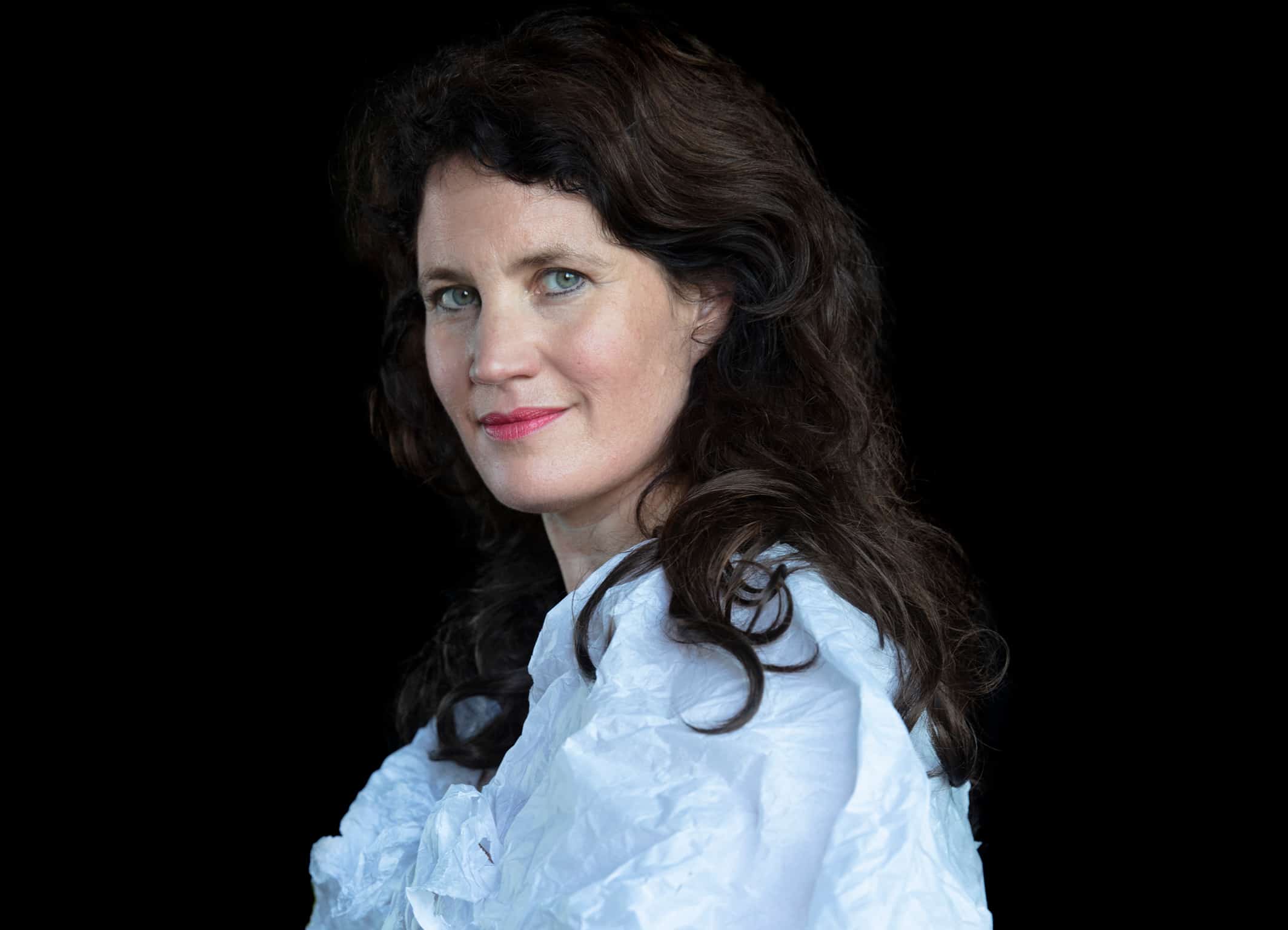 Julika Marijn: "I never learned anything about women’s history at school. I’m only just gradually discovering what exactly our foreland is. Women who are angry are still being invalidated.”
© Carla van de Puttelaar
According to American writer and activist Soraya Chemaly, it’s a well-known phenomenon. Women learn to hold back their true emotions because they can expect to be mocked or ridiculed if they allow their hearts to speak. She explained how that works in an interview with Dutch newspaper NRC at the publication of the Dutch translation of her book, Rage Becomes Her: The Power of Women’s Anger (Fonkelend van woede: De kracht van boosheid van vrouwen, De Geus, 2019). Women who express their anger are seen as a threat, as troublesome or unpleasant. They are quickly denounced as “drama queens” or “demanding bitches”. Meanwhile, men are allowed to show anger; more often, this is considered to be strong or a virtue, especially if they use anger to put someone in their place or to stand up for someone else.
On average, women worldwide felt more anger than in previous years
Recently, a study on emotions in 150 countries, conducted by the American research centre Gallup, showed that something is changing. On average, women worldwide felt more anger than in previous years. The difference with men has grown notably over the past five years. Explanations referred, among other things, to the burden of the Covid measures, which were disproportionately placed onto the shoulders of women: they stayed home more often to care for children and more often lost their jobs. But the #MeToo-fueled outrage about the sexist treatment of women in the workplace also played a role.
On the barricade of the heart
In the meantime, a platform has also been created in the arts of the Low Countries for women’s anger. For example, Fixdit, a collective of eleven female writers, published its manifesto Optimistische woede (Optimistic Anger) – an ardent plea for equal treatment of female authors in literature – at the end of 2022, because it “mirrors and shapes the relationships in society”. Although roughly half of writers are women, women’s books are still read less, receive fewer literary prizes and are less frequently included in school reading lists.
In 2023, the Nationale Toneel (National Theatre) staged Shakespeare’s classic tragedy, Coriolanus, with a woman (actress Yela de Koning) in the title role of the raging general. Director Nina Spijkers commented on this choice: “What happens if this enraged general is not a man, but a woman? While anger in men is often seen as a strength, angry women are usually dismissed as weak or hysterical. Even though they have so many reasons to be angry.
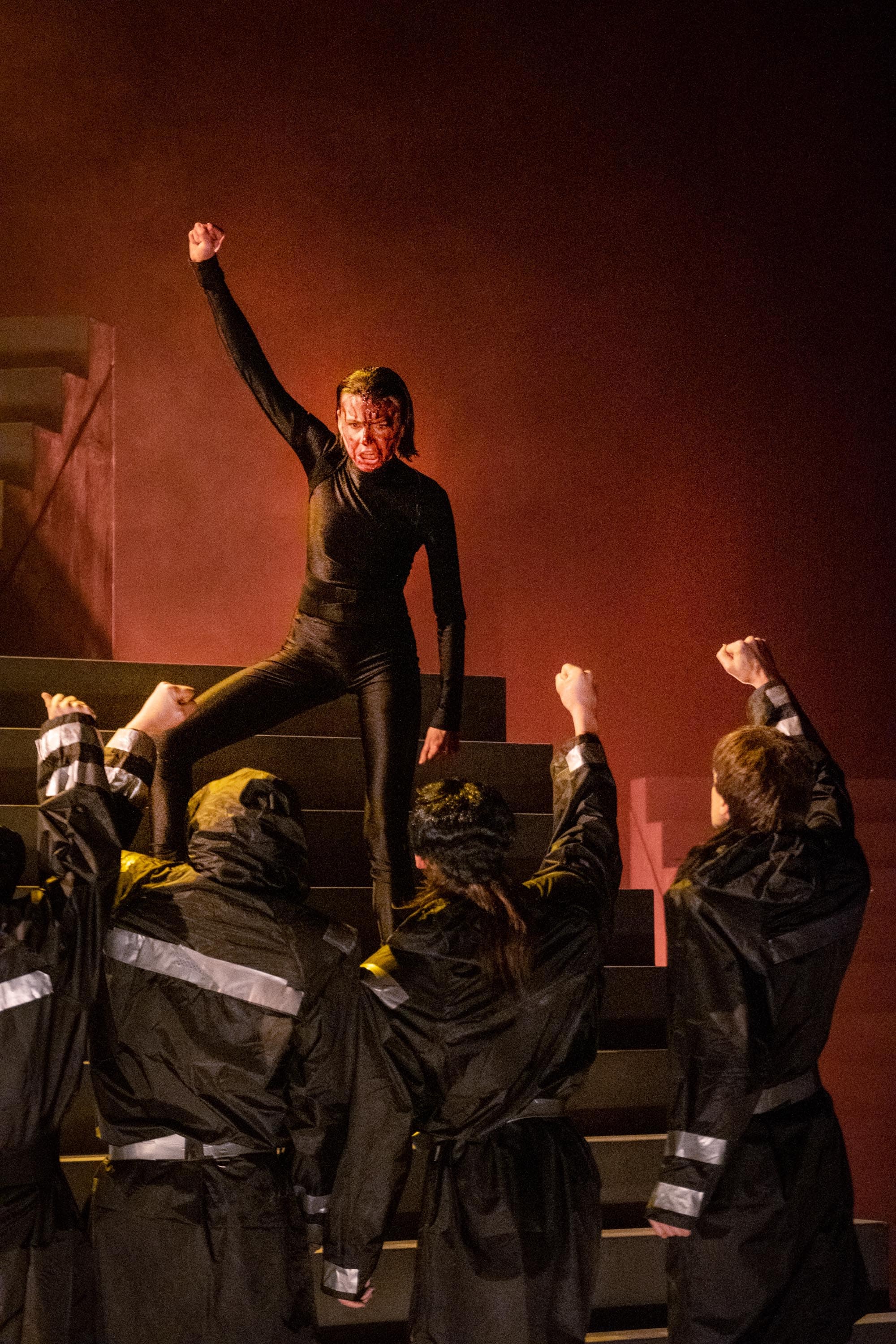 In 2023, the Nationale Toneel (National Theatre) staged Shakespeare’s classic tragedy, Coriolanus, with a woman in the title role of the raging general
© Kurt Van der Elst
As Rotterdam city poet and theatre-maker, Elfie Tromp had been venting her anger in her theatre performance, Op de barricade van het hart (On the Barricade of the Heart). She was upset about female stereotypes, underpayment in healthcare, the taboo on female anger, sexism, assault, capitalism and skewed power structures.
At the same time, work was being done on several fronts to restore the honour of women from the past who were branded as shrews and furies. Heks! Heks! Heks! (Witch! Witch! Witch!) by writer Jente Posthuma was released on 8 March, International Women’s Day. In it, she expresses her anger towards the clichés surrounding the maladjusted women who were labelled witches in the past and had to fear for their lives. After a bookseller from Twente asked Posthuma to do a modern translation of three witch sagas recorded in 1914, she decided to completely rewrite those stories: she refused to continue passing on the platitudes about graceful young virgins and mean old women to future generations.
And theatre-maker Julika Marijn made amends for Rembrandt’s “hysterical” mistress, Geertje Dircx.
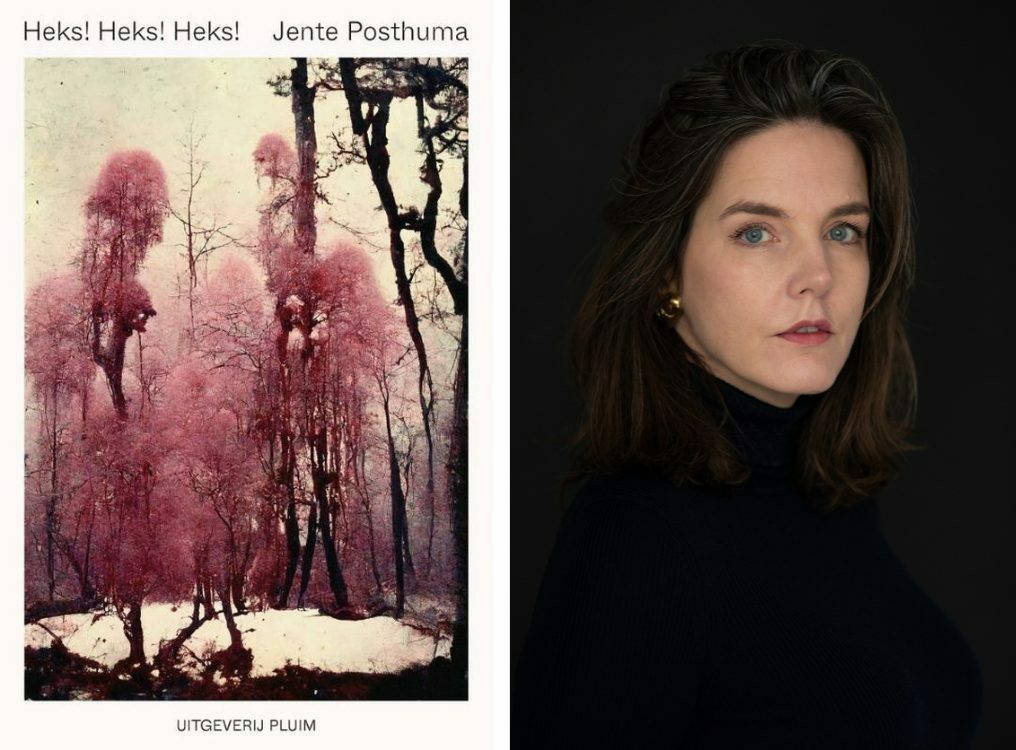 In Heks! Heks! Heks!, Jente Posthum expresses her anger towards the clichés surrounding the maladjusted women who were labelled witches in the past and had to fear for their lives
© Bas Uterwijk
Silent and demure beings
The taboo on female anger runs deep and is culturally and historically anchored, it turns out. In her performance, Marijn points to the legacy of Father Cats, the celebrated moral preacher and much-cited poet from the Golden Age, who praised woman as a “silent and demure being”. His wishlist of female virtues: submission, fidelity, kindness, shame, occupation and modesty. Marijn: “When you consider that, in times of crisis, our cabinet still meets at the Catshuis, you understand where we’re coming from.”
According to Gaea Schoeters of Fixdit, the great reluctance among women to speak out about their disadvantaged position is partly to blame for the fact that things are changing so slowly. “They’d rather keep the peace, as they have been taught over the past two thousand years: never enter into a confrontation head-on; being compliant is the norm.”
Jente Posthuma calls the cultural-historical learned inhibition to speak out “stake fear”: from an early age, girls are taught to hide behind a “smile mask”
Posthuma calls this cultural-historical learned, social norm-induced inhibition to speak out “stake fear”: from an early age, girls are taught to hide behind a “smile mask”. She writes how that paralysed her as a young woman and what she put up with in order not to fall from grace – this even included a forced blowjob: “How to lose yourself for fear of not being liked anymore.”
In her performance, Tromp also lashes out against that socially determined “muzzle of laughter”. Accompanied by hard punk rock, she mocks what she hears from men when she gets excited about something: “‘You are so fierce. Laugh a little, girl!’ Because giggling girls are harmless. Everything quiet, harmonious, peaceful and tranquil. YUCK!!!”
Historical anger
In her performance about Geertje Dircx, Marijn sketches how the age-old legacy of pent-up anger regarding injustice has become entrenched in what she calls “the pain body”, which stems from the time when capitalism arose. She explains on the phone: “It’s a kind of female primal pain about living in a man’s world, being pushed aside, having no place, not knowing you’re safe. It’s buried deep in an undercurrent. I never learned anything about women’s history at school. I’m only just gradually discovering what exactly our foreland is. Women who are angry are still being invalidated.”
In her performance, Tromp demonstrates how anger is her first memory. An inherited anger, “from all the women before me who weren’t allowed to feel that anger”. She learned to be angry from her mother, who said: “Life is worth fighting for.”
In her own words, Tromp rages across the stage for an hour and a half “like a punk-Oompa Loompa” (seven months pregnant, in a burst open, virginal white corset and deliciously angry). Among other things, about the submissive kindness that is still expected of women.
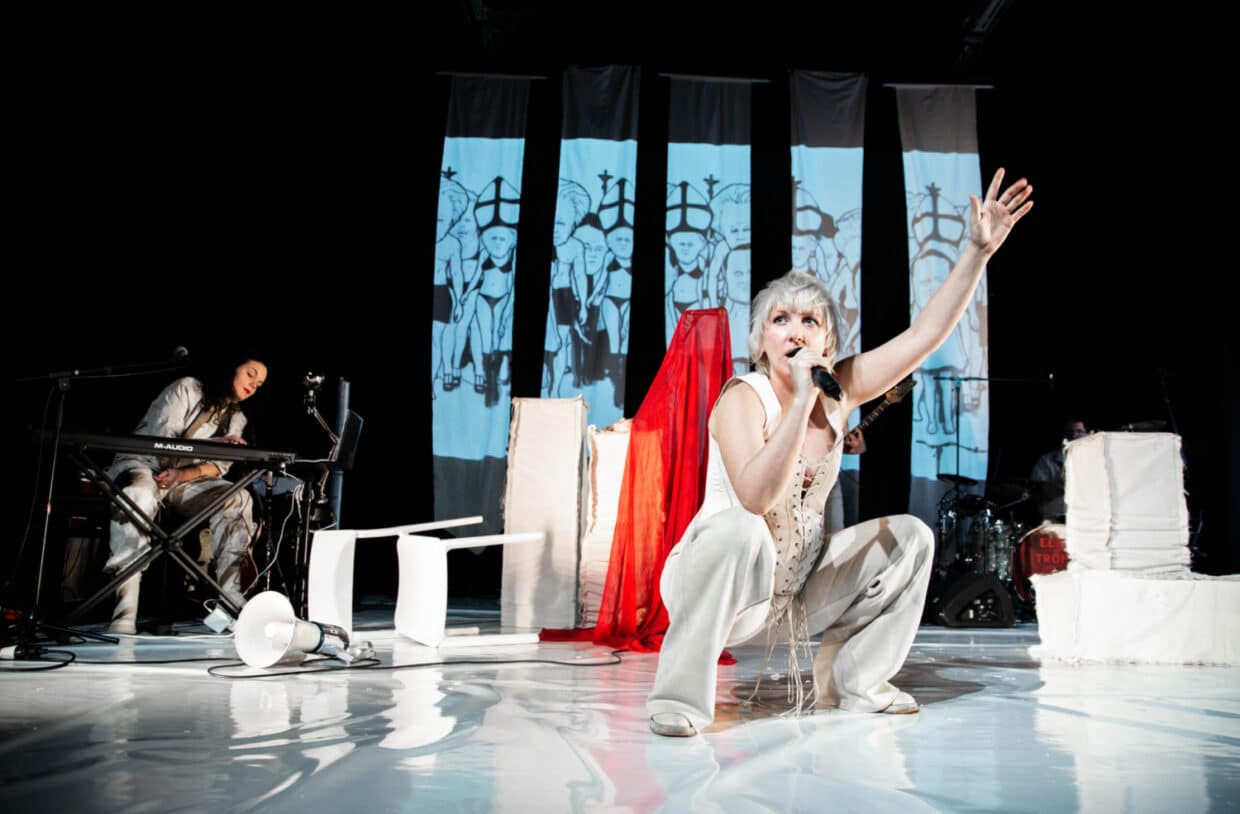 In her performance, Tromp rages across the stage for an hour and a half “like a punk-Oompa Loompa” (seven months pregnant, in a burst open, virginal white corset and deliciously angry)
© Isabelle van Putten
On the phone, Tromp says: “The wild women are being obscured. Unconventional mothers like feminist icon Cobi Schreijer, a forgotten heroine from the 1970s, of whom I sing a protest song in my performance. In her biography, you read that she was often called a difficult woman. She did not fit the stereotypical image of woman, because she ran a café and a stage while being a single mother. While I think: how wonderful that you can do that as a mother! How cool that Simon & Garfunkel slept on her couch!”
Radical tenderness
Tromp continues: “I have been furious for a long time without really knowing why. Compared to the women before me, I had it relatively easy. But I have now learned to use that anger functionally, also against the system: against capitalism, against patriarchy. There is oppression in the bloodline and history of all women. You can deal with this in multiple ways. Anger is a very important emotion when it comes to detecting where your boundaries are and defending them.”
Does she want to pass that anger on to her daughter? Tromp: “I would like to give her a manual for dealing with anger. That she learns to recognise and trust her anger instead of suppressing it by displaying socially desirable behaviour. In my performance, I work with what I call ‘radical tenderness’. You can be radically hard if you’re also radically tender. I don’t spare myself. Then people can’t help but open themselves up and look inwards. I see that happening with my audience. In Amsterdam after a performance, a woman came to me and immediately started crying inconsolably. She said: “I’ve been at home with a burnout for over a year, and I just can’t get angry.” The guilt you’re made to feel, that a burnout is your fault, is of course bullshit. We are in a system that asks too much of us.”
As curator of the Dead Ladies Show, which spotlights the lives of deceased female artists, Schoeters also sees the detrimental consequences of unaddressed anger. “Many of these women turned to alcohol or drugs, ended up in a psychiatric institution or committed suicide. All largely due to artistic frustration, depression, burnout and that constant confrontation with not being able to fully experience their artistry. This is precisely why I find it imperative to keep fighting for that cause.
Marijn on the cathartic power of expressed anger: “If you can make contact with your anger, you get to your core, of what you think and feel. That physical pain represents collective traumas which all of us must transform by looking at them attentively, by acknowledging that things have gone horribly wrong and by rectifying those wrongs.”
Yoga mat potential
At the point in her performance where Tromp starts to demolish the set to hardcore punk rock, she slams the yoga classes where many women loosen their stress-cramped muscles. “Fuck that! What kind of protest potential is being wasted here? If only I could get those women to demonstrate … ”
She offers encouraging words to women who find themselves in the endless queue at the Dutch government’s Communal Health Services: “We are not crazy! We are canaries in the coal mine! Hear us sing!” To offer an alternative, she opens the microphone to the public for five minutes during her performance. This gives women the chance to stand next to her on stage. To speak out publicly about what enrages them.
Elfie Tromp: “We are not crazy! We are canaries in the coal mine! Hear us sing!”
Liesbeth Coltof, who started out as a theatre director in the Netherlands in the 1980s (when female directors were still few and far between) and who currently took over directing Coriolanus due to Spijkers’ maternity leave, knows how catching such an example can be: “After the first try-out, for, among others, a secondary school class, eight girls aged about seventeen approached Yela (who played Coriolanus, KW) to say how fantastic it was to see a woman being angry on stage. The girls found that very liberating.”
Coltof sees that women have become much more empowered since #MeToo: “In business, at the dentist and also in the theatre world. Where it used to be a public secret among women which boss couldn’t keep his hands to himself and that you shouldn’t go to his office alone, attention is now being given to a safe working environment. Abuse is no longer tolerated. A movement has started to address the over-representation of major male roles and the fact that men still get more text. Female directors are making themselves heard. In the past, I was often the only female director at a table full of men, but now there are more of us. Things are headed in the right direction, but it is far from equal.”
Varnish emancipation
Schoeters, who in the past was dismissed as a “frustrated woman” because of her fervent, emancipatory writings, which negatively affected her career, is no longer alone. “Because Fixdit brings together a lot of expertise from the field, from literary scholars and historians, the dissatisfaction can be placed in a larger, rational framework and substantiated, thereby gaining leverage. Additionally, it is important to join forces with different art disciplines, so that it is removed from the exceptional, the support increases, and you get a network of women who say: we, as female creators, demand a part of the artistic field. There is still a glass ceiling at the mid-career level for translations, for internationalisation, for nomination for prizes on shortlists. Attention is paid to the influx and talent development of women, also from Flanders Literature, for example. But in order for them to progress to the top, support and a change of mentality in the field are needed.”
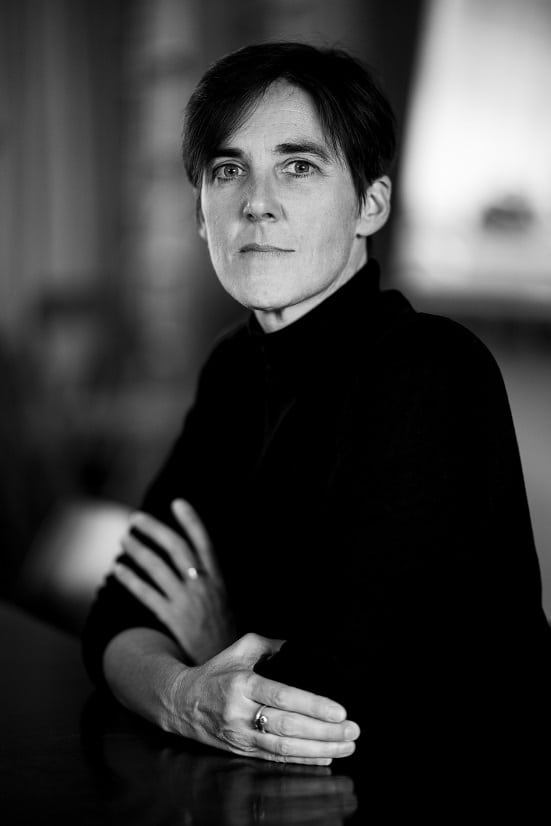 Gaea Schoeters warns against what she calls “varnish emancipation”. “I see that things are shifting on the surface in the performing arts: for example, that performances are being made about women, with female performers. But behind the scenes, the same men often continue calling the shots, as general director or maker”
© Sébastian Van Malleghem
At the same time, Schoeters, who also writes librettos and plays, warns against what she calls “varnish emancipation”. “I see that things are shifting on the surface in the performing arts: for example, that performances are being made about women, with female performers. But behind the scenes, the same men often continue calling the shots, as general director or maker.”
Overreacting men
What Schoeters also notices is that the inequality that women bring to the forefront often does not really interest men. At the Dead Ladies Show, she tallies the men in the room: an average of two to four per cent. Schoeters: “But when you talk to men, they are very surprised: they have never seen or understood things that way. Most are more than willing to see it from another angle. But as soon as you take your place as a female maker, there is still a very strong reaction. In the Fixdit manifesto Optimistische woede (Optimistic Anger), Rwanda-born Flemish-Dutch writer Munganyende Hélène Christelle, describes that mechanism as follows: “As soon as you expose a problem, you yourself are seen as the problem.”
Coltof notices something similar in the reactions to Coriolanus. “You may ask yourself if an angry woman is really so earth-shattering. I don’t think so. There were men afterwards who said: ‘I really like the performance, but why does she have to scream all the time?’ Then I replied: ‘Well, I directed this piece of over an hour and a half, so I know how often she screams: three times, really loud. But those three times apparently make such an impression on you that you think she’s screaming all the time.’
Schoeters also recognises this from the world of literature: “If, for example, twenty per cent of the literary prizes go to women, men quickly exclaim: isn’t this too much? Aren’t the scales tipping in the other direction? But before you reach a fifty-fifty distribution, there is no such thing as tipping scales. Yes, as far as the reactions of those men are concerned, perhaps.”






Leave a Reply
You must be logged in to post a comment.