
Waves of Wellness: How the North Sea Shapes Our Health

The sea is calming, and bathing in salt water is good for your health – or so they say. But is there also an element of truth in these clichés? Could the North Sea really be a vast medicine cabinet with a cure for every ailment?
It’s a place where romantic stories both begin and end, where the weather forecast is never quite what we expect, where we travel time and again, despite hours of traffic and packed trains. The coast, the sea! A place we long for and where we find peace. Stress and restlessness give way to happiness, connection, awe for nature, and a mellow nostalgia. It’s a place of nothingness, and yet promises so much. There, time seems to tick by not in seconds but in waves, tides, and lunar cycles. Simply put, the sea does something to us and our (mental) health. But what exactly is this sea-effect, and what are the mechanisms behind it?
Healing baths
First, let us look back at our relationship with the sea and the coast throughout history. About 200,000 years ago, humans evolved from our ape-like ancestors somewhere in Africa. Under the scientific name Homo sapiens, we left the African jungle behind us, setting off to master the savanna and other new environments. Some tens of thousands of years later, we had already conquered the entire African continent along with large parts of Europe and Asia. That’s quick, in evolutionary terms.
But we were not the first to do so. Our evolutionary relatives Homo erectus, Homo habilis and the Neanderthals had come before. Yet only “ we” remained. This is because Homo sapiens foraged along coastlines, developing a more efficient brain thanks to the eating of molluscs and crustaceans along the shores of Africa and Europe. This food, rich in fatty acids, was power food for our brains. We became superior to those kindred species and evolved into the humans we are today. At least, that is one of the current hypotheses.
 Those who live by the coast report better health.
© Atlantic Ambiance / Pexels
When people talk about the health benefits of the sea, they often talk about the healing effects of ocean water and air. People then refer back to the bathing culture of the Greeks and Romans, who went to large bathhouses to seek social connection and revive the body. To them, water was central, coming either from mountain springs or straight from the sea. Bathing culture, however, went into decline in Europe during the late Middle Ages (fourteenth century) with the advent of epidemics (such as syphilis) and a widespread fear of infection.
Interest in the beneficial properties of water gradually returned during the Renaissance. Spas and thermal baths sprung up all around Central Europe, where you could bathe in sea or spring water, heated or otherwise. The British really latched onto this idea, coupling it with tourism. Thalassotherapy – the use of seawater to treat ailments – was popularised at newly developed sanatoriums along the shores of the North Sea and the English Channel. Places like Bremerhaven (Germany), Scheveningen (Netherlands), Ostend, Knokke (Belgium), Zuydcoote and Wimereux (France) became established centres for bathing.
At the end of the eighteenth century, the wealthy and powerful were the first to flock to the sea for relaxation, spending their free time in and around the water. From then on, coastal tourism developed as we know it today. After the rich, over the course of the nineteenth century, the working middle classes made their first forays to the sea. Lower classes and mass tourism followed, thanks to the expansion of socioeconomic rights, like paid leave in 1936.
Thalassotherapy – the use of seawater to treat ailments – was popularised at newly developed sanatoriums along the shores of the North Sea and the English Channel
So the focus of tourism shifted away from coastal bathhouses to a desire to visit the sea itself. At first, coastal holidays were popular purely because of the benefits of seawater. But the bath towns kept on growing to meet the needs of eager visitors – now featuring hotels, restaurants, and all kinds of entertainment (like casinos). In seaside towns today, you can still see how the coastline perfectly intersects with an approach road to the nearby train station.
The magic of the coast?
But did this popularity stem only from a widespread belief in the benefits of seawater? Or were there real health benefits that could be scientifically substantiated? In Ostend, doctors such as Louis Verhaeghe, Henri Noppe, and François Jacques Janssens were researching seawater treatments as early as the first half of the nineteenth century. They recorded their findings in Les bains de mer d’Ostende, leurs effets physiologiques et thérapeutiques, and in a handbook of seawater cures entitled Le médecin de soimême aux bains de mer ou manuel complet d’hygiène et de thérapeutique indispensable aux baigneurs.
According to them, bathing in hot or cold seawater could cure virtually any ailment, including skin conditions, nervous system disorders, depression, urinary tract infections, and even malformations of the female sex organs. The findings of these “water doctors” were based on individual observations – there was no peer review, and no indication that they compared their findings against a control group of patients who were not undertaking seawater treatments.

Meanwhile, modern scientific research on health and the ocean has primarily focused on the risks associated with bathing in seawater. Studies have investigated the impact of toxic algal blooms, the presence of anthropogenic pollutants, and potentially dangerous microbes. But in the last decade, the positive effects of the sea have become a renewed topic of interest – perhaps thanks to an abundance of literature on the health benefits of green inland nature.
Today, people take to the coast for reasons only indirectly related to their health –bathing in seawater is no longer the focus. It’s more about the pursuit of that “vacation feeling” or “a bit of R&R.” Consequently, contemporary scientific research concentrates more on the benefits of visiting the seaside rather than the benefits of seawater itself.
We know from current scientific research that the outdoors directly lowers stress levels and restores cognitive capacity by encouraging physical and social activity, and by providing a healthy, unpolluted environment. If this also holds true for the coast, then residents who regularly spend their time along the shore should exhibit better overall health because they experience less stress, have more social contact, engage in more physical activities, and experience less air pollution.
One theory is that Homo sapiens developed a more efficient brain thanks to the consumption of shellfish and crustaceans
One of the first studies on this topic reported that English people tend to be healthier the closer they live to the sea. Moreover, this finding was not found to be correlated with a pattern of healthier people moving to the coast – the sea itself brought the benefit. In the first Belgian study, it was also found that those who live along the coast (0 to 5 kilometres from the waterline) reported living healthier lives.
Research in eighteen countries worldwide (fourteen in Europe, along with the USA, China, Australia, and Canada) reports analogous findings: coastal residents feel healthier. This consistently seems to be associated with less stress, more physical activity and social contact, and better air quality. These benefits do not stem from some magical, unexplained coastal effect or the sea air. The underlying reason, simply, seems to be that coastal residents are more likely to actively visit the coast in their day-to-day lives.
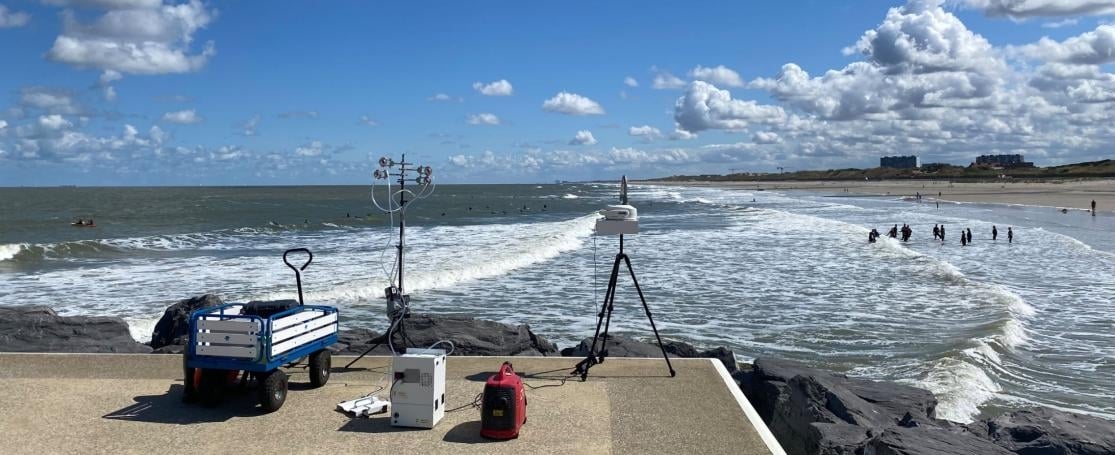 The researchers collected aerosol samples in Ostend.
© VLIZ / Decombel
And recent research by Ghent University, the University of Antwerp, and the Flanders Marine Institute (VLIZ) was able to demonstrate for the first time that sea air strengthens immunity and resistance to disease. Aerosols from splashing seawater contain bacteria that interact with specific receptors in the body. The scientists observed this after analysing human cell lines.
Virtual beach
The finding that people tend to be physically and socially active along the coast, thereby directly reducing their stress levels, has perhaps the most far-reaching impact on our health. In Western lifestyles, mental ill health and loneliness are not at all uncommon phenomena. Many of us spend the day largely sedentary, while immersion in high-quality natural spaces is increasingly rare. Meanwhile, today’s healthcare systems are struggling to meet the rising demand for psychological care. And current therapies (talk therapy, cognitive behavioural therapy, and psychotropic medications) often result in relapse.
One recent study has even shown that visiting a (Belgian) beach in virtual reality can have a positive impact on health. Not only does it lower psychological stress levels, but it also slows down breathing and deactivates the sympathetic nervous system, which is responsible for our fight-or-flight response. But the question remains whether this restorative power specifically applies to those who spend their time along the coastline of the North Sea. Much research is still needed to better understand the responses of the human body and the brain to seaside living. Everyone has a unique relationship to the sea. Future research might reveal the varied profiles of seaside revellers and how their different uses of the sea and coastlines lead to varying effects on health and wellness.
Perhaps the sea will become the medicine of the future, with general practitioners, someday, recommending a coastal visit or prescribing a medicinal course of “seawater bathing” to cure all manner of ailments.
You might also like



The Struggle to Establish Dutch as the Language of Business in Flanders








Leave a Reply
You must be logged in to post a comment.