
In Jozef Deleu’s Poetry, Nothing Was Lost
Even considering all that Jozef Deleu (1937-2026) meant to cultural life in the Low Countries, it was his poetry that formed the core. From the very beginning, his own verses were imbued with a sense of transience.
The first poem in Jozef Deleu’s first collection is titled ‘De Uitvreter’ (‘The Parasite’), a title that evokes the image of someone who loves nothing more than dozing off in a forest on a summer day, even if this sleep is a harbinger of the sleep of death:
De stilte groeit tot boom
tot langzaam bos.
De schaduw maakt mij loom.
Van donkerte groot
is de schaduw
van de dood.
The silence grows from a tree
into a slow forest.
The shadow makes me languid.
Great of darkness
is the shadow
of death.
It is a sonorous and skillful poem, beginning with silence and ending with death, and, in fewer than 25 words, completing a full life cycle. Because human life lies embedded in the much slower cycle of the forest, and because the narrator feels at ease there, the shadow of death has a comforting quality. Moreover, the poem itself begins with the breaking of a silence and fades away at the end onto the white of the page. Its advantage is that it can be reread time and time again, like a sonorous mantra. The languid wanderer sleeps in the security of his own language.
Poems that open a collection, indeed even an oeuvre, call for a programmatic interpretation. In that context, it is remarkable that Deleu, who never idle in his life, calls the protagonist of this poem a freeloader, a parasite. But perhaps that is precisely the strength of this striking figure: he manages to flourish in the vita activa because he can always retreat into the inner world of the vita contemplativa, where the complexity of existence is condensed into its essence through the use of extremely controlled language.
It is impossible to give a brief overview of everything Deleu has meant to the cultural life of the Netherlands, but it seems evident that poetry formed its core, like the inner core of a tree that, while expanding into ever-new rings, nevertheless remains itself.
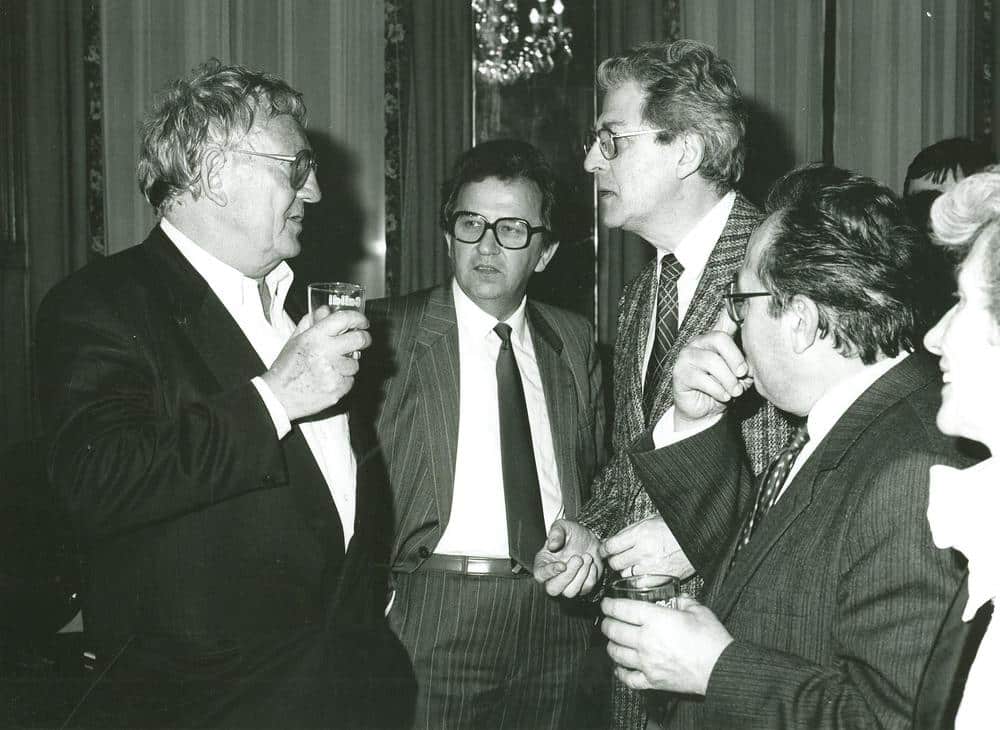 Informal gathering at the Poésie en Flandre event, Belgian Consulate-General in Lille (1988). From left to right: Hugo Claus, Jozef Deleu, Jean Callens (Director of Furet du Nord), and André Fontaine (Consul-General of Belgium in Lille)
© Ons Erfdeel / de lage landen
Deleu must have been an insatiable reader. As editor-in-chief of Ons Erfdeel, he followed literature closely and personally approached poets who caught his eye, asking them to perform at events he organized. From 1976 onwards, his extensive anthology Groot Verzenboek (The Great Book of Verse), arranged by existential themes, regularly appeared in new editions (with a 19th printing in 2021). Deleu started with Gezelle and Gorter, the poetry relevant to contemporary readers, but added new work by young poets to every subsequent edition, reflecting the continuously changing societal developments occurring over the past half century.
Risky Venture
Once retired, Deleu founded the magazine Het Liegend Konijn (The Lying Rabbit), with the first issue appearing in April 2003. It was 90 pages long and contained poetry by ten established names, in alphabetical order, from Anna Enquist to Menno Wigman. Within that group of ten, David Van Reybrouck was a debutant in the sense that he had not previously published any poetry. In the preface, Deleu describes the project as reckless, for who in the 21st century starts a magazine dedicated to poetry containing exclusively poems, without any reflective context? Moreover, he immediately states unequivocally that he is the sole editor, whereas the zeitgeist demands collectives and diversity.
 ‘Het Liegend Konijn’ was the quintessential journal you had to be published in at least once to make a name for yourself in Dutch-language poetry. Photo: with David Van Reybrouck at the launch of issue 1, volume 7, 2009
© deBuren
When the magazine appeared for the last time at the end of 2025, it became clear once again that the venture had become an institution. The tastefully laid-out issues grew thicker; in 2014, an edition dedicated to war appeared weighed in at 436 pages. Because Deleu apparently kept a close eye on everything relating to poetry that was appearing in the Low Countries’ magazines and at festivals, he succeeded time and again in recruiting new talent. He also ensured that established poets remained happy to contribute. Het Liegend Konijn became pre-eminently the magazine one had to appear in at least once to make a name for oneself in Dutch-language poetry. Editors of other magazines, event organizers and other publishers followed the publication closely to discover which new poets were on the verge of a breakthrough. Only Deleu, with his charisma and diplomatic skills, could have launched this magazine.
Who would even start a poetry magazine in the 21st century that’s nothing but poems, with no critical context whatsoever?
As a poet, Deleu did not make a huge name for himself, yet since 1963 he has steadily built up an oeuvre that can be called impressive. The vast majority of the poems are modest in size; two or three stanzas, lines of verse sometimes consisting of only a handful of words. The tone is always subdued. A fine example is ‘The Vine’ from Overboord (Overboard, 2012). The collection bears a motto by Seneca: ‘Let fate find us prepared, ready to go.’ The allegorically-tinged epigram, which could easily have been included in a book of seventeenth-century emblems, reads as follows:
de wijnstok kreeg
te lange armen
werd in volle zomer
gesnoeid
alsof hij erom vroeg
the vine grew
arms too long
was pruned
in the height of summer
as if he asked for it
The setting is rural, as in much of his work. The imagery is clear as the personified vine takes on a moral significance, but in such a way that the speaker hedges his bets by using the words ‘as if.’ The most interesting device here, however, is the past tense, which ensures that readers visualize the little tree simultaneously in a pruned and an unpruned state, and take comfort in the knowledge that those arms can always grow back.
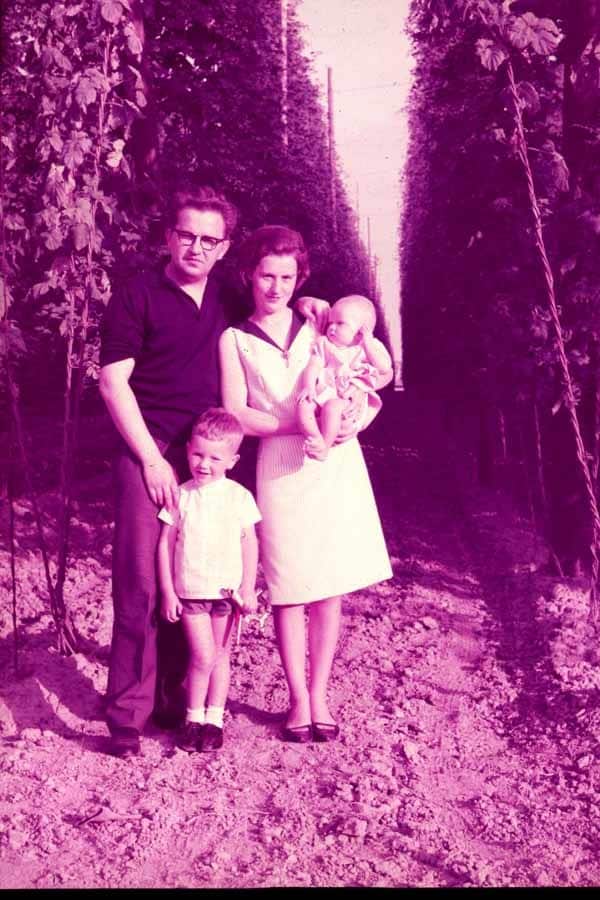 The farmer’s son always remained deeply attached to the countryside. Photo: with his wife Annemarie Deblaere and his children Lodewijk and Marjolein among the hops in Poperinge, 1965
© Archief Deleu
Considering that Jozef Deleu always radiated so much vitality, it is striking that his poetry was permeated with an awareness of transience. The debut collection, from which I quoted the first poem above, is titled Schaduwlopen (Shadow Walking), with an epigraph from ‘Het uur U’ (‘The Hour of Reckoning’) by Martinus Nijhoff). In it, we read lines like this: ‘Playing with death / life follows me,’ and a few lines later: ‘playing with death / is naming life.’ In a poem dedicated to his beloved from the collection Nachtwerk (Nightwork, 1970), even the eroticism is marked by finitude. After having conjured up a soft female body with a few words, Deleu says:
Wij zijn
zachte dieren
in de buik
van de nacht
twee bloemen
aan één stengel
en buiten
de koude
voor later
die wacht.
We are
soft animals
in the belly
of the night
two flowers
on one stem
and outside
the cold
for later
that waits.
When you leaf through the collected poems, you see his entire life pass before your eyes. The farmer’s son grows up, marries Annemarie, retains his attachment to the countryside, has children, later grandchildren, and feels old age taking hold of him without detracting from the power of his verses.
Featherlight Happiness
Over the course of the decades, Deleu bids farewell to the Catholic faith. In ‘Gras dat verder groeit’ (‘Grass that Keeps Growing’, 2005), he writes: ‘It does not matter whether you believe in God or not. God is / at best a word with a capital letter, which occupies you / in an irresponsible manner, but does not move you.’ The church as an institution seems to have been dismissed by him, yet he is an agnostic rather than a non-believer: ‘If I had the certainty that / no God existed, I would never speak of it again. / But that is too unambiguous an assumption.’
Regardless of the presence of the divine, life takes place here, on this strange but warm earth. Under the guise of eternity, existence is short and sorrowful, but also rich. Despite the ever-present awareness of being mortal, the poet is, in the end, not so much sombre as marvelling at everything that occurs and will continue to occur even when he is no longer here. For example, ‘Kippenboer’ (‘Chicken Farmer’) from the collection Onbeschut (Unprotected, 2009) is hopeful, in which the poet observes his grandson Tobias:
vederlicht
omarmt
het kind
de kip
nog inniger
dan dit
gedicht
vol teder
licht
en overmacht
van leven
feather-light
the child
embraces
the chicken
even more intimately
than this
poem
full of tender
light
and the overwhelmingness
of life
This little miniature is another marvel of word artistry. The play on sound creates a sensation of “feather-light” happiness, in which chicken and child almost merge, where the two sensory meanings of “light” flow into one another in a meaningful way, and the poem itself is sandwiched in an abundance of love and vitality.
His poetry stands tall, though Deleu would be the first to admit it isn’t eternal
What has Jozef Deleu left to us? His significance for the cultural landscape of the Netherlands is indelible; Het Liegend Konijn was a monument for a quarter of a century, and those who knew him personally will remember him with warmth and awe. His poetry stands proudly, although Deleu would be the first to admit that even poetry does not have eternal life. On the final page of Tussentijd (In the Meantime, 2019), he takes stock. Yet, it was not his last collection: the beautiful booklet Het paard van mijn vader (My Father’s Horse) was published in 2023. But in ‘Nalatenschap’ (‘Legacy’), he soberly observes that yesterday became today ‘not hastily / but slowly’ and will soon become tomorrow. A certain pride resonates in this stanza:
wat wij deden
of nalieten te doen
wat wij opbouwden
of bestreden
was openbaar
what we did
or failed to do
what we built
or fought against
was public
It has been seen and it has not gone unnoticed, to quote Gerard Reve. The poem ends self-confidently:
van verlies
was geen sprake
op winst werd
nooit gehoopt –
niets ging verloren
there was no question of loss
profit was
never hoped for –
nothing was lost
Everything perishes, everyone dies, every text is eventually forgotten – but nothing is lost.
You might also like


Leave a Reply
You must be logged in to post a comment.