
The Impressive Legacy of Jozef Deleu (1937-2026), a Bold Flemish Giant
With the passing of Jozef Deleu, the Low Countries has lost one of the most influential advocates of Dutch language and culture. As the founder of Ons Erfdeel (now known as The Low Countries) and the driving force behind many Flemish-Dutch initiatives, Deleu was key to the emancipation and visibility of the culture of Dutch language, both at home and abroad. He was a cultural advocate who operated outside of party politics and was critical of both the misuse of culture and the blind conformity of intellectuals and artists. This socially committed champion of Flemish culture leaves an enduring legacy.
Jozef Deleu (b. 1937) lived and worked for most of his life in the rural village of Rekkem, on the border of France and Belgium, where languages intersect and communities are separated by an invisible barrier. Deleu was aware from an early age how arbitrary – and defining – borders can be for identity and culture.
For this farmer’s son – born to a French father and a Flemish mother – the border symbolised his own dual identity: ‘I belong on this side, and I belong on the other.’ The circumstances led to a palpable tension and a connection that would shape his social engagement and cultural politics. For Deleu, the border represented not merely separation but also encounter and exchange. His commitment centred on crossing and relativizing borders both physical and symbolical: between Flanders and the Netherlands, between distinctiveness and diversity, and between past and present.
Thus, the border-dweller – despite his lifelong connection to the roots of his heritage – grew into a bridge-builder who presented the culture of the Dutch language to the wider world.
Ons Erfdeel as a cultural policy platform
It was on that national border, at that intersection of languages and cultures, that Deleu constructed his life’s work. In 1957, as a very young, idealistic schoolteacher, barely twenty years old, he founded the magazine Ons Erfdeel (Our Inheritance), spurred on by his mentor, the writer André Demedts. In 1970, the foundation of the same name followed. Deleu laid the cornerstone of an independent cultural institute that became an instrument of and for cultural policy while remaining free from party-political or ideological ties.
That political-ideological freedom was no minor detail: independence was a bold choice in the segmented Flemish context of the twentieth century. And it certainly didn’t make things easier for Deleu. As a non-partisan dissident – ‘I belong to no one’ – he had no institutional pillar behind him and had to mobilize funds, build networks and capture readers all on his own for a long time. Yet he succeeded in building a stable, pluralistic, long-lasting organization.
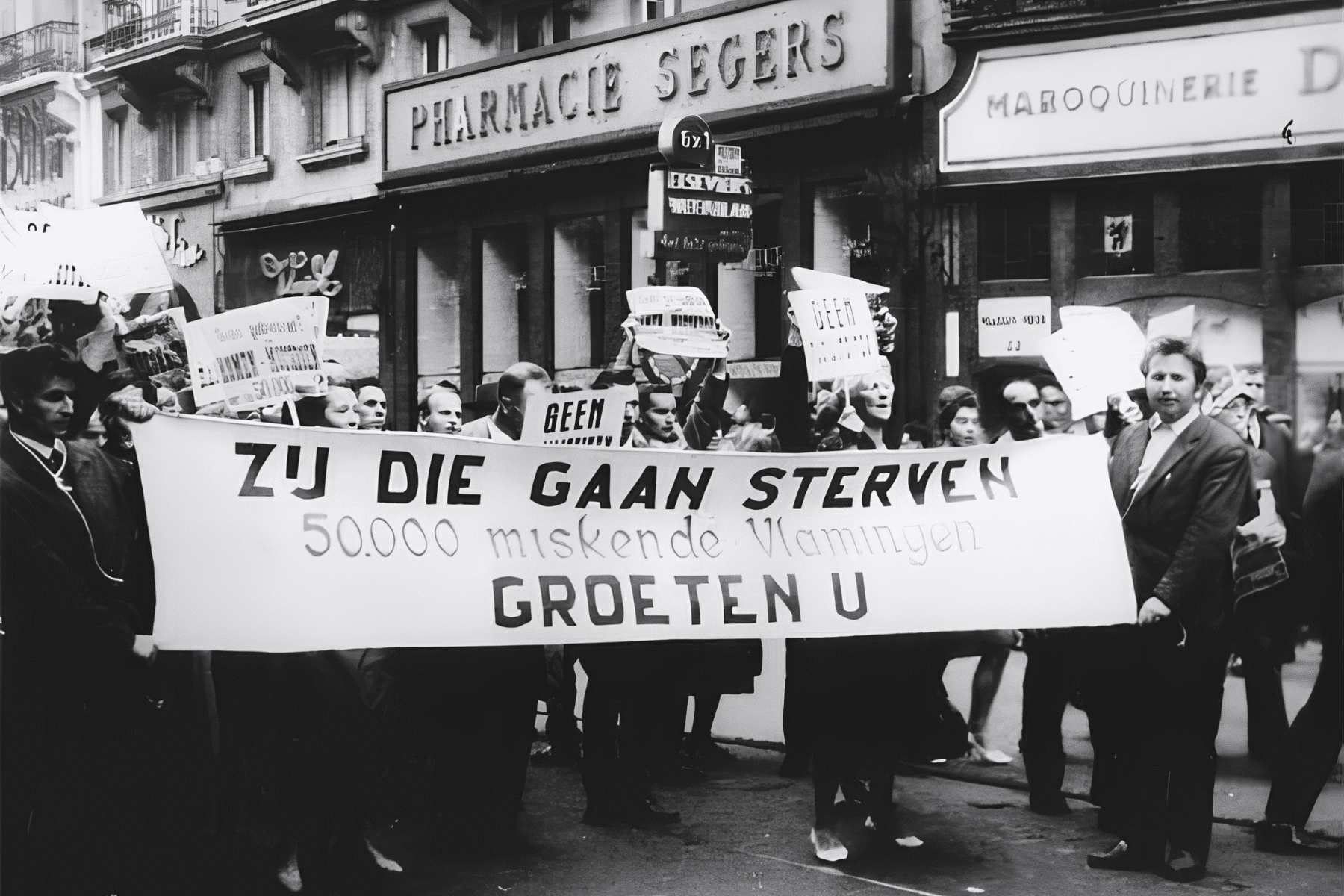 Jozef Deleu at the first Flemish March on Brussels, October 22, 1961
© Foto archive Deleu
Ons Erfdeel’s mission is to strengthen Dutch language and culture and promote cultural cooperation between Dutch speakers, wherever they might live. For this purpose, French Flanders, Flanders and the Netherlands were considered as a single cultural space, based on their shared language and common past.
But Deleu also believed that the culture of the Low Countries should be visible and recognized outside its own linguistic area. Following in the footsteps of the writer-politician August Vermeylen, whom he admired, Deleu defended a strong Flemish cultural identity that, instead of isolating itself, would serve with full openness and distinctiveness as a building block within the broader European culture. Moreover, Deleu argued that a culture can only come into its own when it engages in open dialogue with other cultures. According to him, a continuously nurtured dialogue would avoid ignorance and misunderstandings that could become sources of conflict.
Driven by Deleu’s ambition to promote Dutch-language culture globally, Ons Erfdeel began publishing in other languages in the 1970s. With the magazine Septentrion and the yearbooks De Franse Nederlanden/Les Pays-Bas Français (French Flanders), Dutch culture came to the attention of the French-speaking world. With the yearbook The Low Countries, a hand was extended to the English-speaking community. Thanks to these initiatives in other languages – today, the websites Les Plats Pays and The Low Countries – Ons Erfdeel grew into an internationally recognized institution that has introduced the richness and vitality of Dutch-language culture to a global audience and built a solid bridge between north and south, between local tradition and an international perspective, between introspection and openness towards Europe and the world.
An open-minded Flemish cultural nationalist
Deleu consistently called himself a cultural Fleming, not a nationalist. ‘You will never hear me claim that Dutch-language culture is better than that of others,’ he stated. ‘I do not believe in flags; I believe in language.’ Deleu considered Flemish identity as primarily a language and culture project, not a political program. He believed that the Flemish Movement needed to become a cultural movement, rather than a political one. For him, language and culture formed the essence upon which a community builds its identity and which connects people to one another. He was convinced that everyone living in Flanders should be given the opportunity to emancipate themselves and to “elevate” themselves through language and culture.
Ons Erfdeel became the ultimate symbol of his ambition to use culture as a driving force for social and intellectual emancipation. He wanted to strengthen the self-confidence of the Dutch-speaking community in Flanders as well as in the Netherlands. Moreover, he viewed this Flemish cultural identity not as a closed bastion, but as a dynamic and pluralistic entity, open and self-aware, rooted in the Dutch language and literature, yet always focused on dialogue and exchange across borders.
Deleu proclaimed his cultural-political message whenever he could, which sometimes made him difficult to categorize. Politicians found him too independent, nationalists not radical enough, and cosmopolitans too Flemish. But precisely because of that position as a free, critical thinker, Deleu ensured his continuing relevance.
Public intellectual and critical thinker
From the 1980s onwards, Jozef Deleu established himself as an authoritative public intellectual. ‘He who writes must also dare to get his hands dirty,’ was one of his many mottos. With razor-sharp speeches and polemical publications, he regularly caused a stir when shedding light on cultural and social developments in an increasingly independent Flanders.
Thus, Deleu behaved like a lion capable of clawing those who, in his view, abused the Flemish cause for personal gain instead of placing it at the service of the community. His sharpest criticisms were directed against the complacency, provincialism, mediocrity and populism of those at the helm in Flanders. His blacklist included shortsighted technocrats, cynical ostriches, vulgar opportunists and merchants: the “Flandrocrats and Vlaamskiljons.”
Deleu’s most famous scathing work is De pleinvrees der kanunniken (The Canon’s Fear of Squares), a cultural-critical speech from 1985 in which he fiercely attacked Flemish cultural policy which, at the time, in his opinion, was too often fuelled by political or economic interests (“centennationalism”) rather than any substantive value for the benefit of the cultural creator or the public.
He argued against cultural paternalism and for the autonomy of the cultural sector. He espoused a Flemish culture that had to be pluralistic and unifying; a free space for creativity and critical thinking. Until his last day, he opposed the instrumentalization of culture as a handmaid to power, the market, or marketing.
He accused the Flemish intellectuals of complacency and subservience when they did not take their ‘rebellious role as corrective commentators on policy’ seriously enough. According to Deleu, political scheming had paralyzed intellectual life in Flanders.
He was convinced that only the continuous pursuit of the highest quality makes true human, social and intellectual emancipation possible – both for each individual and for society as a whole. His work was therefore a constant invitation to broaden the cultural debate towards self-aware, open, and responsible cultural policymaking.
Sustainable cooperation between Flanders and the Netherlands
Apart from internationally promoting the culture of the Dutch language, Deleu’s greatest achievement must be that, more than anyone else, he brought cultural Flanders and the Netherlands closer together in a lasting relationship. He is regarded as one of the most important architects of Flemish-Dutch cultural cooperation. However, he did not defend cooperation with the Netherlands based on any kind of romantic reunification; he preferred to speak of a marriage of convenience in which the forces join for practical, fruitful and future-oriented pursuits.
With Ons Erfdeel, Deleu created a structural platform that strengthened this “good neighbour” relationship with magazines, events and projects that transcended boundaries both literally and figuratively. He understood better than anyone that cooperation had to go beyond symbolic meetings and good intentions.
Through his vision and tenacity, Deleu helped establish a sustainable infrastructure of Flemish-Dutch relations, the impact of which spans generations and is still felt to this day. Thus, he supported and promoted dozens of initiatives with a Low Countries mission: the founding of deBuren, De Brakke Grond, the Taalunie, Poëziecentrum, the Flanders-Netherlands Cultural Treaty Commission, …. He also served as a board member of many other organizations, including the VRT.
Legacy and lasting relevance
Deleu was honoured numerous times at home and abroad for his many achievements. He particularly attached great importance to the Ark Prize for Free Speech, which was awarded to him in 2020. The jury praised his tireless commitment to Dutch language and culture while remaining ‘averse to all political influence and authoritarian populism.’ That distinction perhaps best summarizes what Deleu stood for: an independent cultural politician who viewed language and culture as instruments of emancipation and freedom.
His was significant for being that rare combination of thinker and doer. Deleu defended Dutch-language culture not out of nostalgia or nationalist reflexes, but from the conviction that language and culture enable people to develop themselves and enter into dialogue with one another. As a bridge-builder, he gave the Flemish Movement and cultural policy in the Low Countries an open, European horizon and stimulated cultural cooperation between Flanders, the Netherlands and the world beyond.
What he leaves behind goes far beyond an impressive oeuvre of essays, speeches and polemics. As a non-partisan dissident in a deeply segmented landscape, he built up magazines, networks and institutions that are still shaping cultural exchange between Flanders and the Netherlands today. In doing so, he proved that a sustainable cultural infrastructure does not have to rely on political power, but can also grow out of vision, perseverance, and substantive conviction.
His ideas are still relevant. In a time when public debate is often reduced to contradictions and a battle of symbols, Deleus’s plea for quality, dialogue, and independent and critical thinking stands firm. His work reminds us that culture, rather than being some kind of luxury product, is, in fact, a prerequisite for a free, open and democratic society. That is perhaps the most important legacy he has left us.
You might also like



Leave a Reply
You must be logged in to post a comment.