
“Donating Makes People Happy”: Philanthropists Wim Pijbes and Ludwig Forrest on Good Causes

A philanthropic surge is sweeping the Low Countries, according to Wim Pijbes of the Droom en Daad Foundation and Ludwig Forrest of the King Baudouin Foundation. You don’t have to be rich to donate, they believe: ‘If you do something for the common good, you’re a philanthropist.’
The greater the challenges, both locally and globally, the deeper the Flemish and Dutch dig into their pockets. Whether it is a modest donation or a staggering amount: each contribution reflects the belief that giving rather than receiving will make the world a better place. Nation states have a duty to their citizens to invest in social areas such as culture, welfare, the fight against poverty, environmental and climate issues, democracy and development aid. However, given that needs generally outstrip the available means, private philanthropic gifts – selfless donations to a good cause – will always be welcome.
That said, they are not just a necessary complement, but they also serve a democratic function. This is the firm conviction of Wim Pijbes, director of philanthropic foundation Droom en Daad, and Ludwig Forrest, chief philanthropy officer at the Belgian King Baudouin Foundation.
Droom en Daad is a private charitable foundation with a special focus on Rotterdam. It funds activities that are meaningful to the city: anything from art, culture and the design of public space to fostering talent. The foundation funded the Fenix Museum for art and migration and the well-known bronze figure of a woman on Stationsplein. Heritage is a major focal point for them in this city that was heavily bombed during the Second World War, and people are at the centre of every single project. The King Baudouin Foundation (KBF) is a public-interest foundation that initially concentrated on heritage and the fight against poverty but soon evolved into a philanthropic platform covering everything to do with the “common good”. Under this umbrella, individuals, businesses and families can establish a “named fund” – or a “private charitable fund”, as the Dutch would call it – with a specific purpose. Today, KBF manages 1600 active funds that operate locally, nationally and internationally.
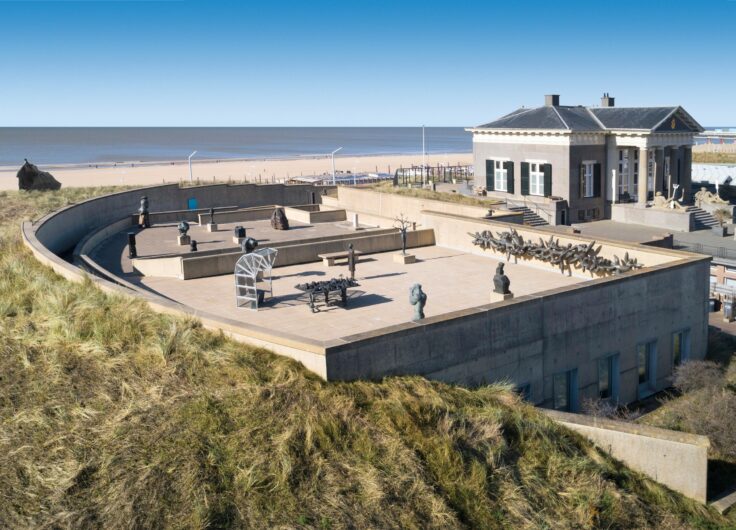
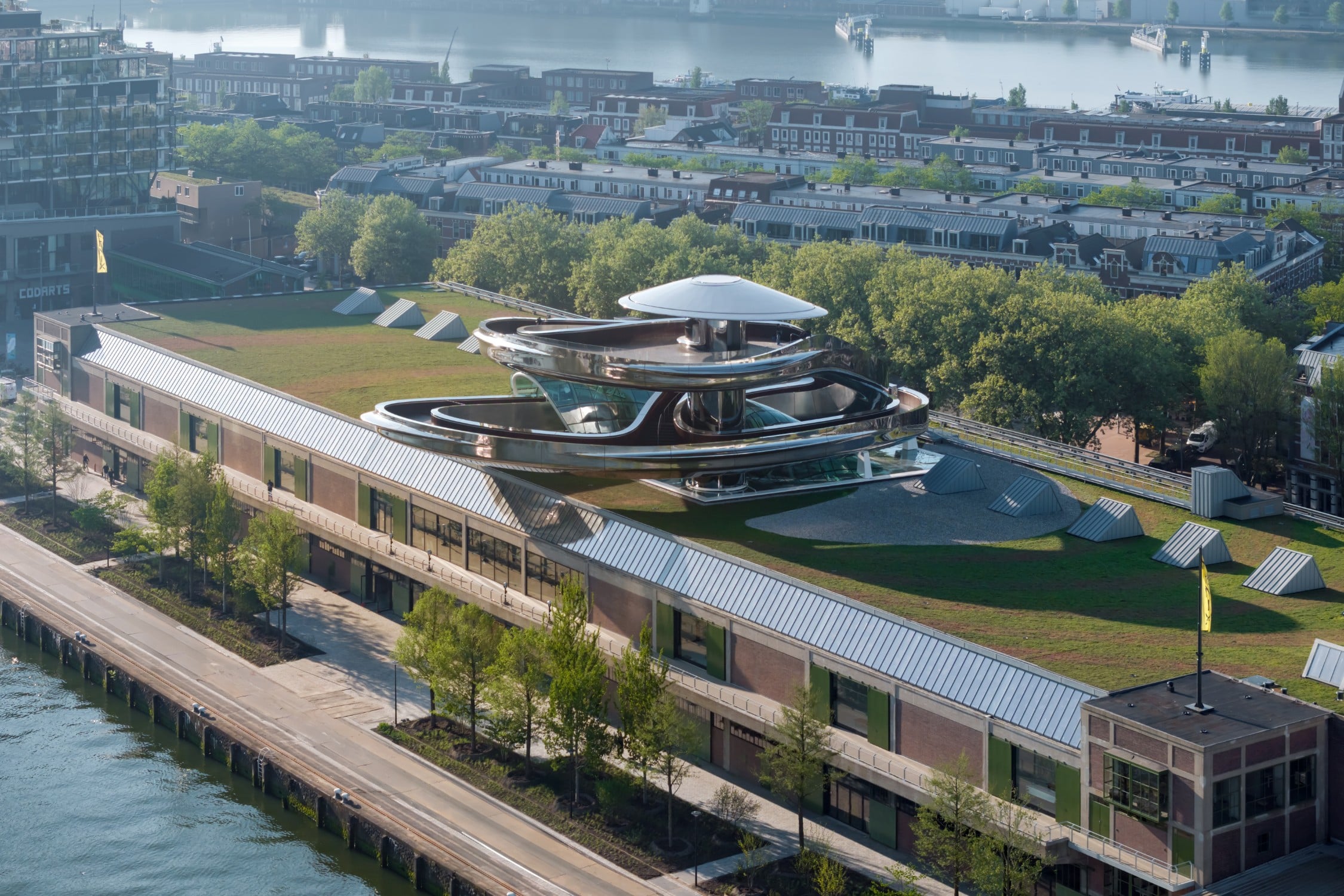 The Droom en Daad Foundation funded Fenix, the art museum focused on migration that opened its doors in Rotterdam in May 2025
© Iwan Baan / Fenix
We sat down with Wim Pijbes and Ludwig Forrest to talk about their vision of philanthropy.
What is the true purpose of philanthropy? Critics often suspect motives other than pure charity and altruism. Are rational, strategic motivations behind donations, such as power, influence or reputation, ever acceptable?
PIJBES: “We’re not after power in any shape or form, but influence is an inevitable by-product. Power implies a particular agenda, personal gain and putting other parties at a disadvantage. Philanthropy will always prioritise the area we work in. The aim of Droom en Daad is simple: to make Rotterdam a better, more beautiful city. We’re not always namechecked in our endeavours; we are a silent sponsor. Our influence lies in setting things in motion, preserving or initiating things that a government isn’t capable, prepared or allowed to do. But we have no political agenda, let me make that clear. We’re here for the common good and make our own choices. Take the restoration of the Park, for instance, the national monument that was derelict for years. During that time the city council drew up lots of policy documents, evaluations and plans, but never had the means to realise any of them. Then finally, in 2018, we jointly agreed on a privately managed public city park, based on the Central Park Conservancy in New York.”
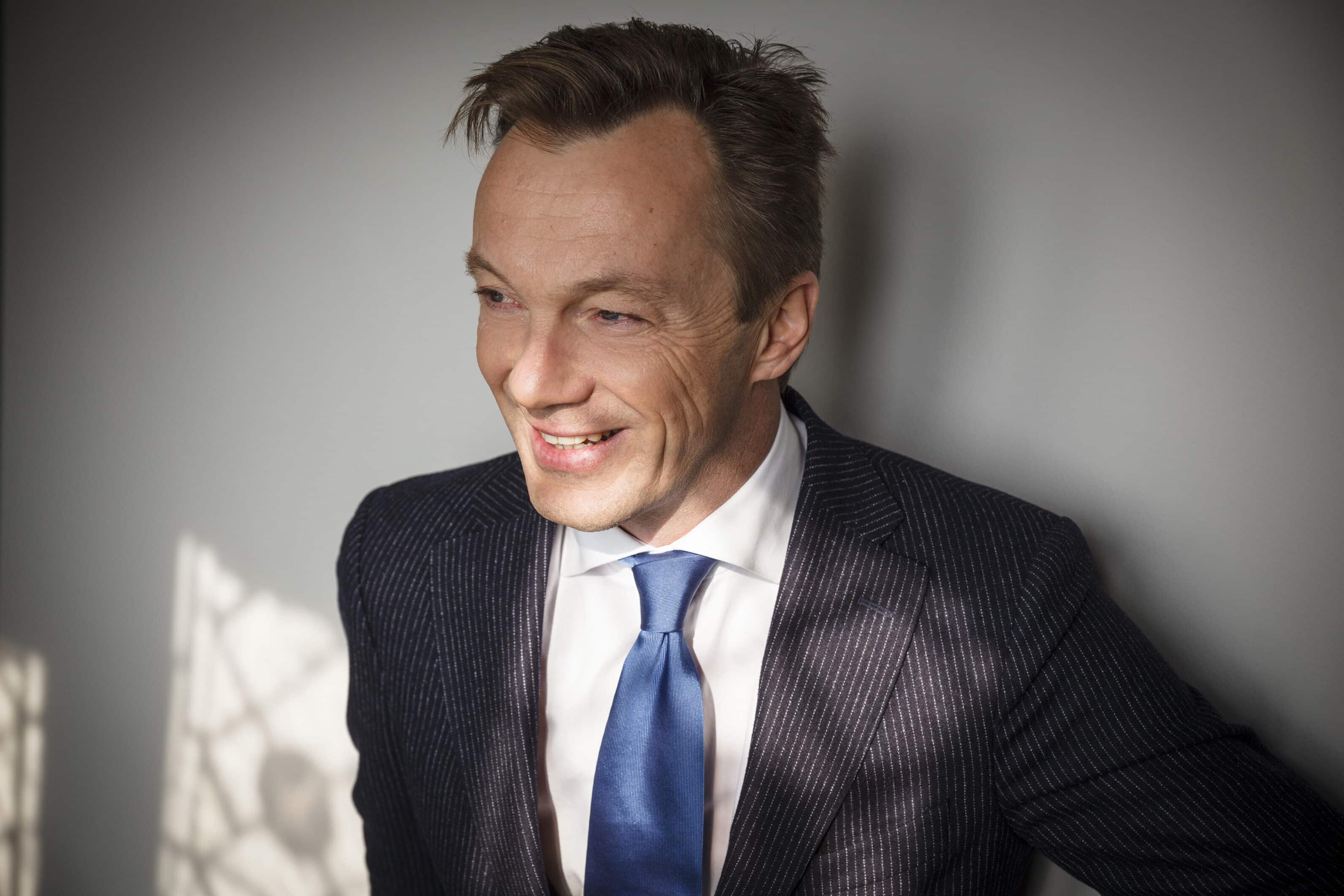 Wim Pijbes: “With its greater appetite for risk, philanthropy is sometimes referred to as society’s Research and Development department”
© Vincent Mentzel
Aren’t you relieving the government of its responsibilities? Would something like a fairer tax system not remove the need for philanthropy?
PIJBES (vehemently shaking his head, just like Forrest): “Absolutely not. Because we don’t have to justify our actions to the public, we have more clout: we can make decisions and take action at much shorter notice, albeit with a high risk profile. There had long been a desire for a museum about migration in Rotterdam, but it was a politically sensitive issue. That didn’t stop Droom en Daad from taking the initiative and now we have full responsibility for Fenix, the new art museum about migration, which opened its doors in May 2025. Our approach – conveying the message through art – has been very well received. If an initiative fails, we may be said to have misjudged the situation or we may lose money, whereas a minister can lose his job. We live in a risk-averse world that rejects everything in advance. It flies in the face of entrepreneurship, where things can play out differently than anticipated, either because things are misjudged or because of external factors. With its greater appetite for risk, philanthropy is sometimes referred to as society’s Research and Development department.”
FORREST: “Philanthropy complements the state precisely because it’s innovative and agile. Philanthropists love to try out an idea. If it fails, they’ll admit to it, to stop others from making the same mistake. A few years ago, our CEO launched the Best Failure Award. All the teams had to present their mistakes; those that didn’t received the award regardless, because it meant they hadn’t taken any risks. That award fostered the culture of enterprise by taking away the fear of making mistakes. We also bring selected projects together, so people can learn from each other. By sharing mistakes, we can avoid needlessly wasting money. But when an initiative succeeds, philanthropists take it further and scale things up, where possible. Some approach the government to see if the state wants to take over, which then frees them up to invest in other innovations. The fact that we have philanthropy is a huge boon for this region. Some countries no longer have it or never had it in the first place. The Netherlands and Flanders have favourable policies to encourage philanthropy, such as inheritance tax and the system of dual legacies in Flanders or tax-deductible donations in Flanders and the Netherlands.”
Are there limits to what a philanthropist may do with his or her money? In other words, should philanthropy be regulated?
PIJBES: “I would steer well clear of that, because it touches on the very heart of philanthropy. Philanthropists can do things for the common good that a government doesn’t get round to. Obviously, some billionaires do weird stuff – like buying yet another yacht or flying to the moon. But we shouldn’t allow ourselves to be distracted by those excesses. Quite a few philanthropists want to donate quietly. In the Netherlands there’s a taboo around presenting yourself as a benefactor. It’s bound to have something to do with our reformed Protestant culture. Philanthropy is often understood as a biblical way of giving, as something you don’t flaunt. Restrictions would kill philanthropy. Some time ago, we had the anti-foundation debate in the Netherlands, which called for all information on Ultimate Beneficial Owners to be made public, so that money-laundering practices and drug proceeds could be identified. But by distrusting good folks we risk missing out on an awful lot of philanthropic resources!”
Wim Pijbes (Droom en Daad): “In the Netherlands there’s a taboo around presenting yourself as a benefactor.” Ludwig Forrest (KBS): “In Flanders, too, very few want to be mentioned by name”
“The philanthropic income stream is huge and set to increase exponentially in the next twenty, thirty years because of the ageing population. I like to believe – and history proves me right – that society is perfectly capable of making its own decisions. Both the Netherlands and Flanders have a strong tradition in this field. The medieval almshouses (small houses for the poor, elderly and infirm, SW) are a great example, as is the poverty relief provided by churches, another expression of community spirit. The government ought to trust its citizens, or else they in turn lose faith in the government. It’s a tricky balance, one that hinges on the degree of government regulation. Sure, some things are bound to go wrong, but I’m happy to take that small risk.”
FORREST: “On a European level, we are urging PHILEA, the European Philanthropy Association, to create an enabling environment: a context that provides opportunities for those wanting to do something for the common good. We’re not naïve, we’re just arguing for a proportionate approach that doesn’t go down the route of placing restrictions on all organisations just to prevent one in a thousand from misbehaving. There’s a happy medium and that’s dialogue between the government and the sector. In Belgium we have the Belgian Federation of Philanthropic Foundations for this. And the Netherlands has even better structures in place.”
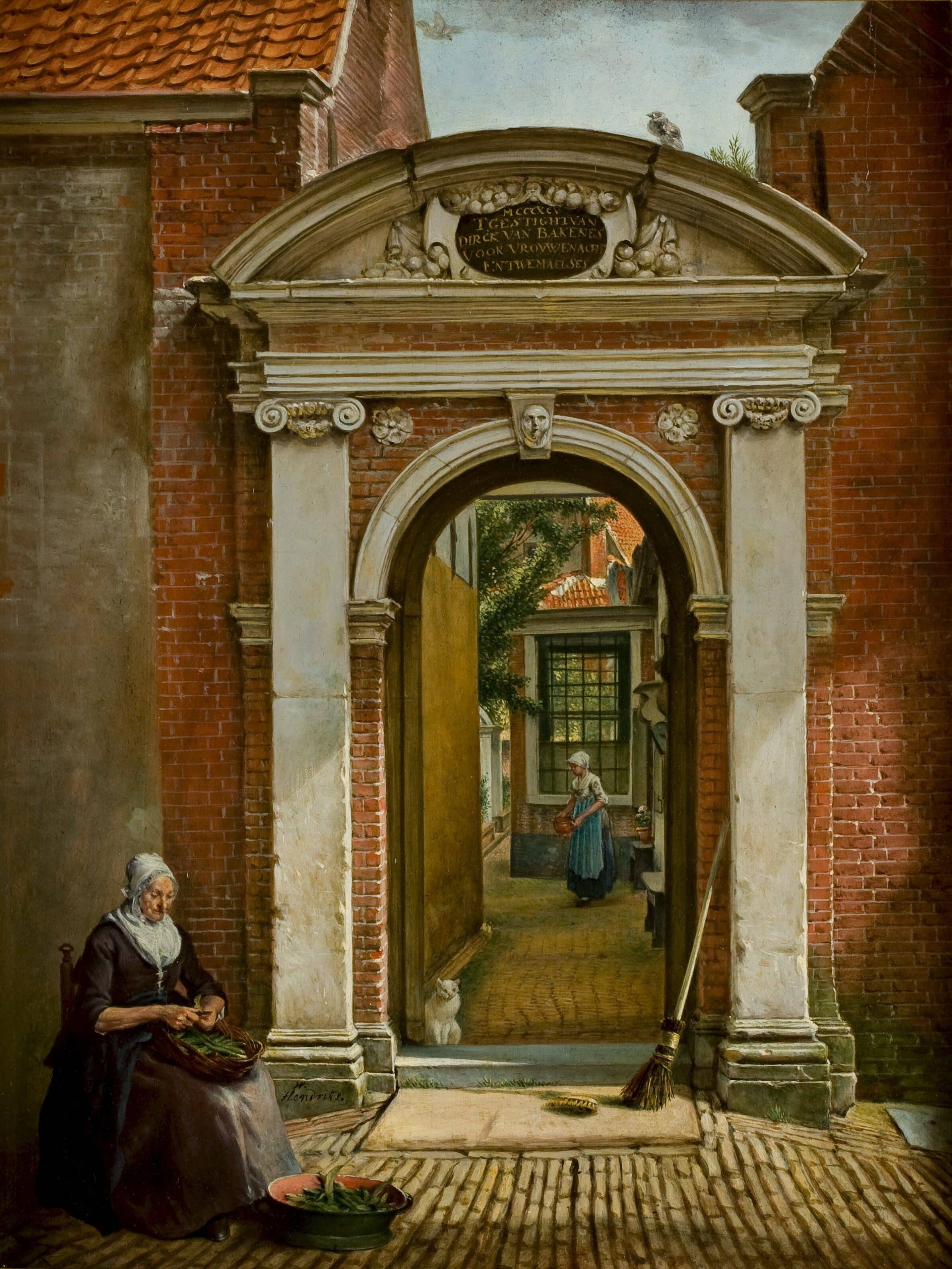 Medieval almshouses, which served as a form of social welfare, are a prime example of the long-standing philanthropic tradition in the Low Countries. This painting depicts the entrance to the Hofje van Bakenes in Haarlem, captured on canvas by Wybrand Hendriks in the early nineteenth century
© Rijksmuseum Twenthe, Enschede
Wim was referring to the Dutch national character, that Protestant ethic that insists on a degree of discretion around donations. What’s the situation in Flanders?
FORREST: “People often think of the United States when they hear the word philanthropy, forgetting that the social structures and systems in Europe and the US differ hugely and that Americans speak far more openly about philanthropy. Beneficiaries tend to give a lot more publicity to the philanthropist. They might name a meeting room after the donor, for instance. In that respect, Flanders and the Netherlands are similar: very few here want to be mentioned by name. At the KBF people sometimes choose to name a fund after a star, or they create a public-interest foundation or establish a private foundation with a shortened version of their name. Discretion is the norm in Europe. There’s less demand for recognition.”
The word philanthropy immediately evokes associations with wealth. Is a philanthropist expected to have serious money?
PIJBES: “Not at all. As far as I’m concerned, even spare time can be donated. The super-rich, like Bill Gates or the Rockefellers, capture people’s imagination, but philanthropy is not limited to the wealthy. The Netherlands has a very successful crowdfunding platform for the arts, where any amount, however small, is welcome. The satisfaction that comes from donating is often underestimated. It’s so much better to give than to receive.”
FORREST: “I wholeheartedly agree. Philanthropy ought to be accessible. I see someone who does voluntary work, who gives some spare change to a street collection or who helps their community – in short, someone who does something for the common good – as a philanthropist. This was evident during the coronavirus pandemic. That awful period had some positives as well. People sewed masks or took time out to support others in need. The Belgian state increased the tax benefits, allowing people to donate more than they’d normally do. It led to great generosity. We’re indebted to Bill Gates for putting the word philanthropy back on the agenda. But he too would confirm the importance of small donations and local engagement anywhere in the world.”
Wim Pijbes: “The super-rich, like Bill Gates or the Rockefellers, capture people’s imagination, but philanthropy is not limited to the wealthy”
Does the social and political climate in the Netherlands and Flanders have an impact on philanthropy?
PIJBES: “In the Netherlands, we have very little to do with the government. Because of the tax and legal implications of legacies, philanthropy comes under the remit of the Ministry of Justice. We’re not seen as a source of revenue and are therefore not part of Finance. The previous mayor of Rotterdam, Ahmed Aboutaleb, made philanthropy a mayoral portfolio, independent of party politics and elections. Such an approach leads to sustainability. On a national level, too, philanthropy should be covered by the Prime Minister’s office, removed from any departmental bickering. Philanthropy involves so many different social domains. There’s a lot of political incompetence resulting from ignorance, but there’s also room for an enabling environment. Philanthropy can step into the breach when certain investments are no longer a given, such as music education for children. And during the pandemic, Droom en Daad established an emergency fund, together with a few other players. It enabled us to help artists in Rotterdam who suddenly found themselves unemployed and ineligible for various benefits. Philanthropy can be very quick to respond to a social need.”
Pijbes: “In the Netherlands, philanthropists have very little to do with the government.” Forrest: “In Flanders, the relationship with the political sphere is characterised by dialogue”
FORREST: “In Flanders, the relationship with the political sphere is characterised by dialogue, dialogue and yet more dialogue. When resources are limited, we should think about how we can achieve more together than individually. More and more people want to do something. The figures confirm that we’re experiencing a big philanthropic surge. But at the same time, there is growing need. Philanthropy won’t be able to take care of everything. On the contrary. But the biggest impact will come from the cooperation between individuals, businesses, the government and the philanthropic sector.”
How do you explain this philanthropic surge?
FORREST: “A level of maturity on the part of the population. They’re no longer waiting for the government or the business sector to do something – they get stuck in themselves. People have come to realise that giving makes them happy. Among businesses, too, we’re seeing a trend towards wanting to combine profits with a positive impact on society. Some rich families have told the KBF that while their children appreciate the family fortune, they’re particularly concerned about the future – will there even be a world in fifty years’ time? They’re putting pressure on their parents to contribute to the common good.”
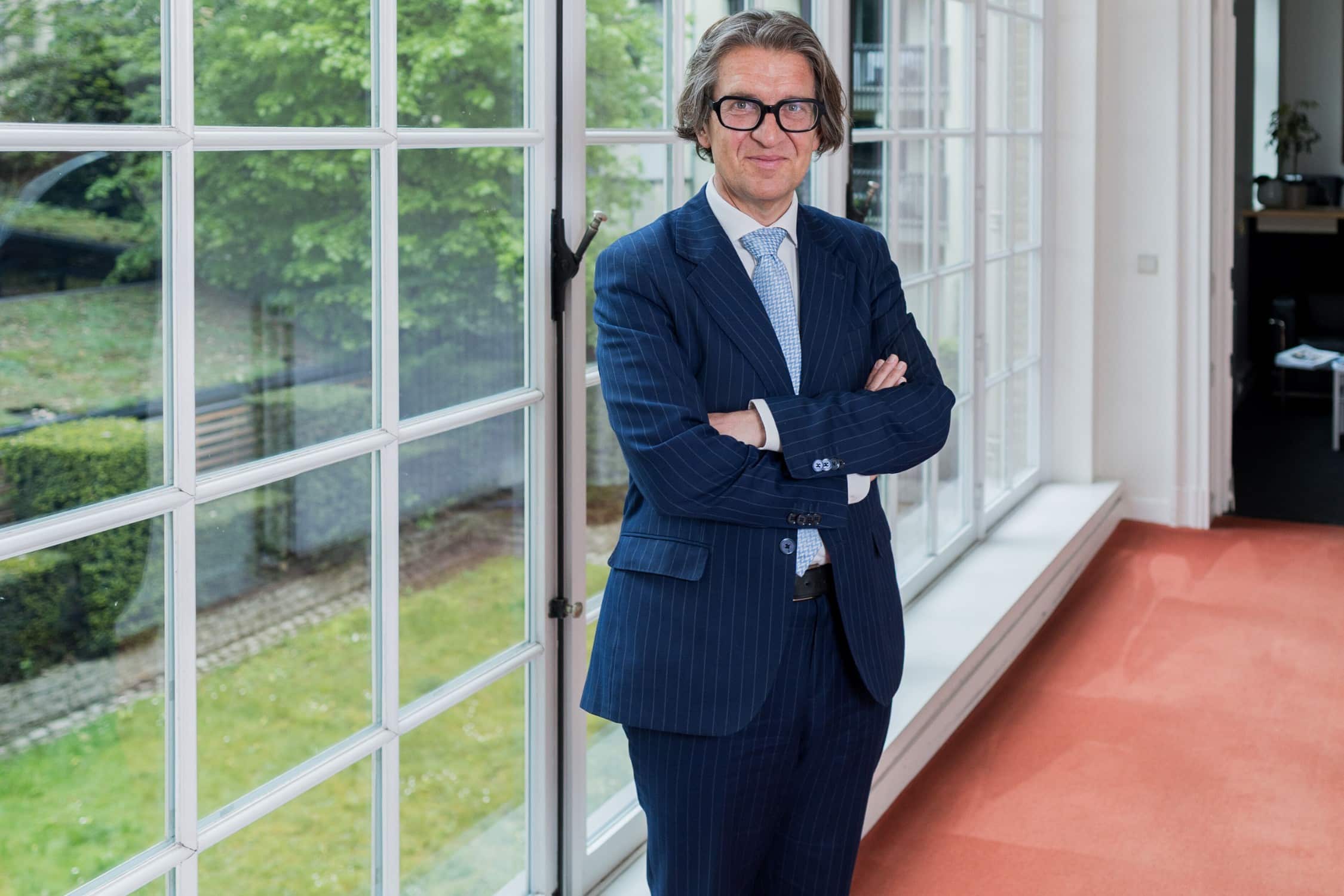 Ludwig Forrest (King Baudouin Foundation): “Among businesses, we’re seeing a trend towards wanting to combine profits with a positive impact on society”
© Lieven Van Assche
PIJBES: “Alongside changes in giving behaviour, there’s the aforementioned demographic shift towards an ageing population in Europe. The baby boomer generation, the richest ever, is over eighty now. That means that in the Netherlands alone, some 1,000 billion euros’ worth of legacies will become available. Another reason why that figure is so high is because, as mentioned earlier, parents no longer automatically leave 300 million euros to their children. Besides, the church used to be one of the biggest beneficiaries in the Netherlands – and probably also in Flanders – but now that we’re living in a more secular society resources are often spent differently. That said, the Dutch government is cautious about estimating legacies, because you never know how many people will die in a single year. All the money that’s released via legacies is extra funding that we can use to do new things that wouldn’t otherwise happen. It frees us up to explore options for future generations, for example. That’s why philanthropists, who aren’t tied to a political agenda, are the right players to manage those moneys.”
Ludwig Forrest: “The biggest impact will come from the cooperation between individuals, businesses, the government and the philanthropic sector”
Do philanthropists ever meet for consultation or the exchange of ideas?
PIJBES: “It happens sporadically and on an ad hoc basis. When I used to work at the Rijksmuseum (Pijbes was the museum’s director from 2008 to 2016, SW), I had a positive relationship with the KBF. To attract American private donors, we were able to draw on the special status that the KBF enjoys in the United States, so that we didn’t have to apply for it ourselves. And I always visit the Brussels Art Fair (BRAFA, of the most prestigious art fairs in Europe, SW), where I pop by the KBF stand. From time to time, we also exchange ideas with German foundations. But there is no structural partnership. At the end of the day, the differences between countries are considerable.”
FORREST: “We notice that a growing number of donors ask for a collective impact. For that we bring players together to generate the best ideas and scale them up. It enables philanthropy to cross borders. I’m thinking of the Tubbe model, a Scandinavian approach to nursing homes that gives residents a say in their lives. We looked at it in Sweden and tested the concept here. After a positive evaluation, we published a call for proposals with a view to implementing the Tubbe philosophy across the whole of Belgium. That got the ball rolling and then the idea spread to France. Alongside cooperation around a particular issue, there are transactional collaborations, which enable a philanthropist to provide the best support for a beneficiary in another country. The project between the Rijksmuseum and the KBF that Wim mentioned is one of them. Collaboration leads to greater impact, for instance in climate cases. But at the same time, local initiatives continue to be incredibly important. A combination of different methodologies will always produce the best results for society.”
The world of philanthropy is never static. What are the latest trends?
FORREST: “The sector has undergone huge change. Twenty to twenty-five years ago, people used to write a cheque for a specific project or for the organisation itself. That continues to be a good and necessary form of philanthropy. But some fifteen years ago, the techniques of venture capital (investments in start-ups with lots of potential for growth in exchange for shares, SW) were introduced to the sector to generate more impact. And today, we also have impact investing, with social investors buying shares in social enterprises. Some people say these two don’t constitute philanthropy in the strict sense of the word, but I disagree. Globally, there is no agreed definition of ‘common good’. We can only describe it. It can help broaden what we understand by philanthropy. The above methodologies reflect the evolution in transactional philanthropy. The fact that investors make profits isn’t necessarily a problem, as these profits are immediately reinvested. It’s not a question of ‘finance first’, but of ‘impact first’. And while the innovation may cause friction, these new concepts will also help bring the two worlds together. One thing is certain: philanthropy is changing.”

Leave a Reply
You must be logged in to post a comment.