
A Hidden Shell Full of Treasures: Museum Beelden aan Zee

The exclusive focus on three-dimensional art, the spartan architecture and the seaside location make Beelden aan Zee a unique museum. However, due to a somewhat inconsistent exhibition policy, it has largely remained under the radar of the art press. But that has changed in the past few years. Beelden aan Zee is on the cusp of an international breakthrough.
“A sculpture is something you trip over when you step back to look at a painting,” Ad Reinhardt once wrote. It will come as no surprise that Reinhardt was a painter. Many private collectors and museum directors share his opinion, however, especially in the Netherlands. In this quintessential country of painters, sculpture has been neglected for centuries. In the bourgeois republic, there was an aversion to royal or other authoritarian displays of power in the form of equestrian statues or busts, which form the foundation of sculpture in other countries.
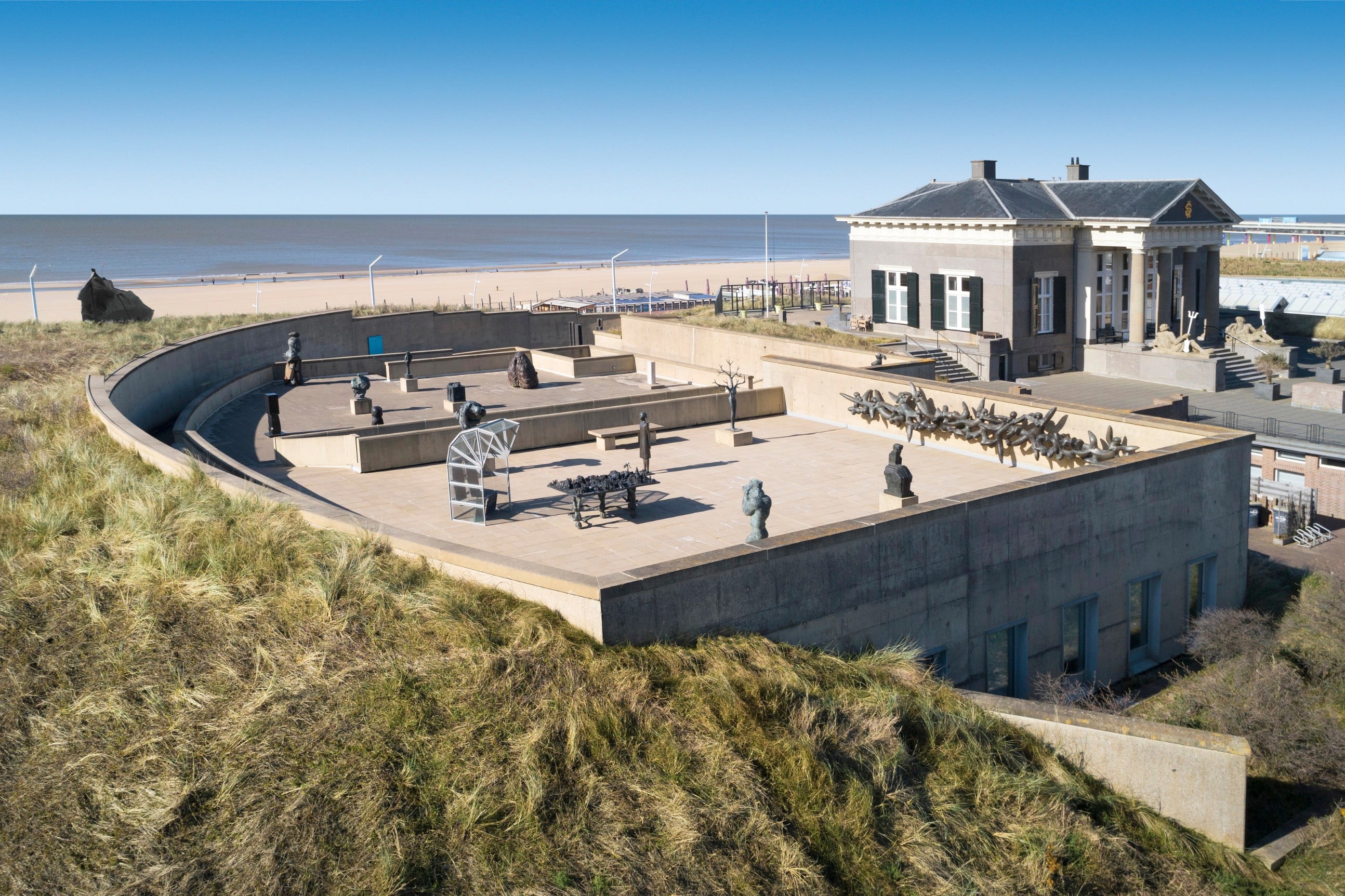 Outdoor area at Museum Beelden aan Zee
© Studio Gerrit Schreurs
It is therefore all the more remarkable that the Netherlands has a museum exclusively dedicated to sculptures: Beelden aan Zee in Scheveningen. This is thanks to the collector couple Theo and Lida Scholten. When the CEO of Dutch multinational SHV, later of asset management firm Robeco, and his wife bought their first sculpture in 1966, they were instantly hooked. Within thirty years, they had built a collection of over a thousand pieces. Inspired by American examples, they decided to share their collection with the public by starting their own museum. Former Queen Beatrix cut the ribbon in 1994.
Architectural masterpiece
The Scholtens enlisted the help of architect Wim Quist, ensuring that the new museum would be unique, not only in content, but also in appearance. The architect, with a marked geometric preference, combined two circles into a shell shape that is almost invisible from the outside. The beige-coloured exterior walls are deeply embedded in the dune, which has been raised further. Additionally, the museum building extends beneath the neoclassical Paviljoen Von Wied dating to 1827, which sits atop the shell like an extraordinary kind of barnacle.
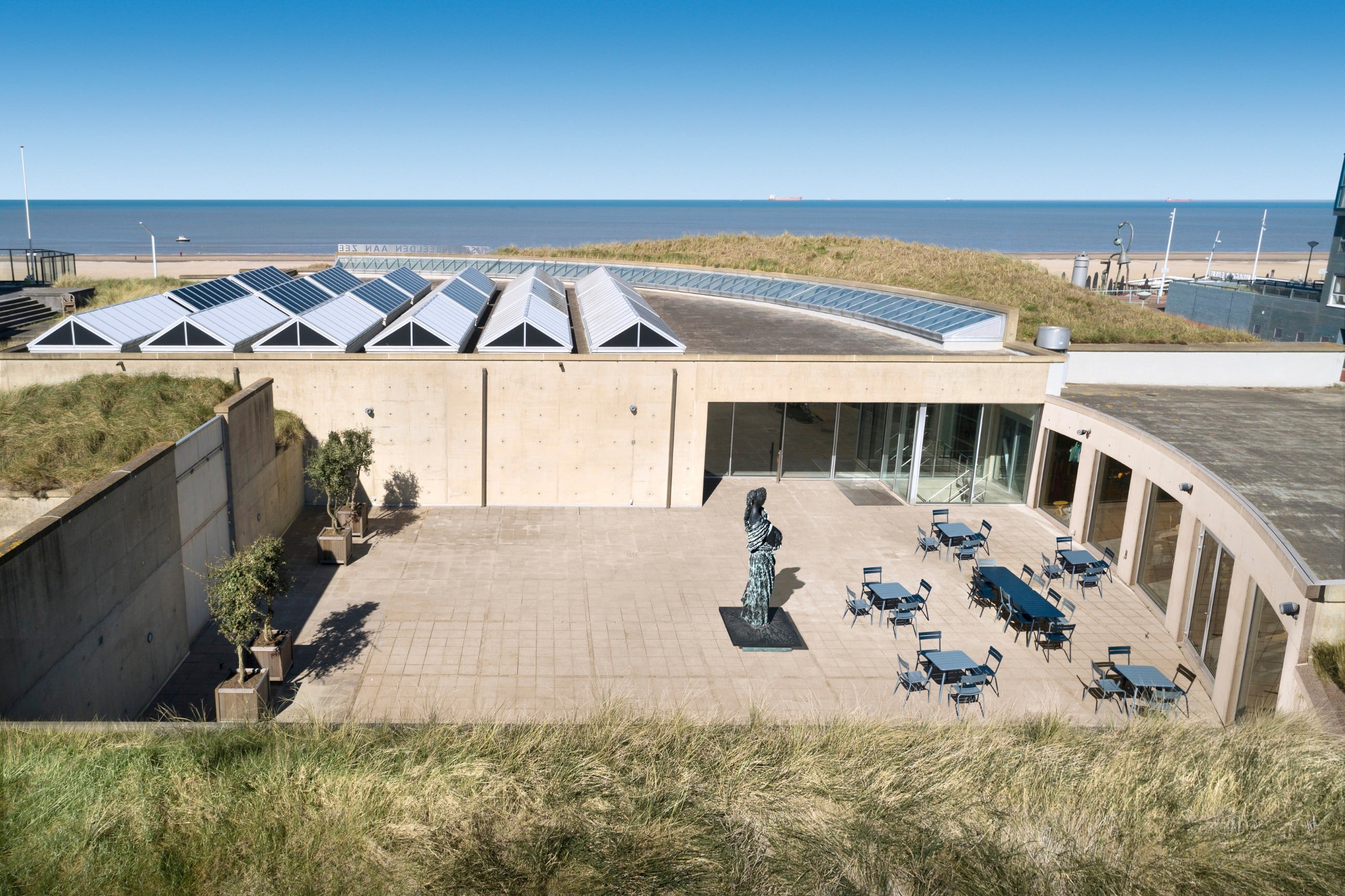 The beige-coloured exterior walls are deeply embedded in the dune. A constantly changing selection from the collection is partly displayed on the outdoor terraces
© Studio Gerrit Schreurs
Despite its closed facade, the interior of Beelden aan Zee is bathed in daylight. Almost the entire ceiling is made of glass, allowing visitors to feel constantly connected to the surrounding dune landscape as they move through the succession of halls, patios and terraces. This integration is reinforced by the yellow-grey sandy tones of the materials used, ranging from Italian granite to American pine. Ornaments are absent in Quist’s otherwise rather spartan design. Everything is functional and sleek. For instance, the screw holes in the concrete wall panels allow for the addition of small shelves or hooks to place or hang sculptures.
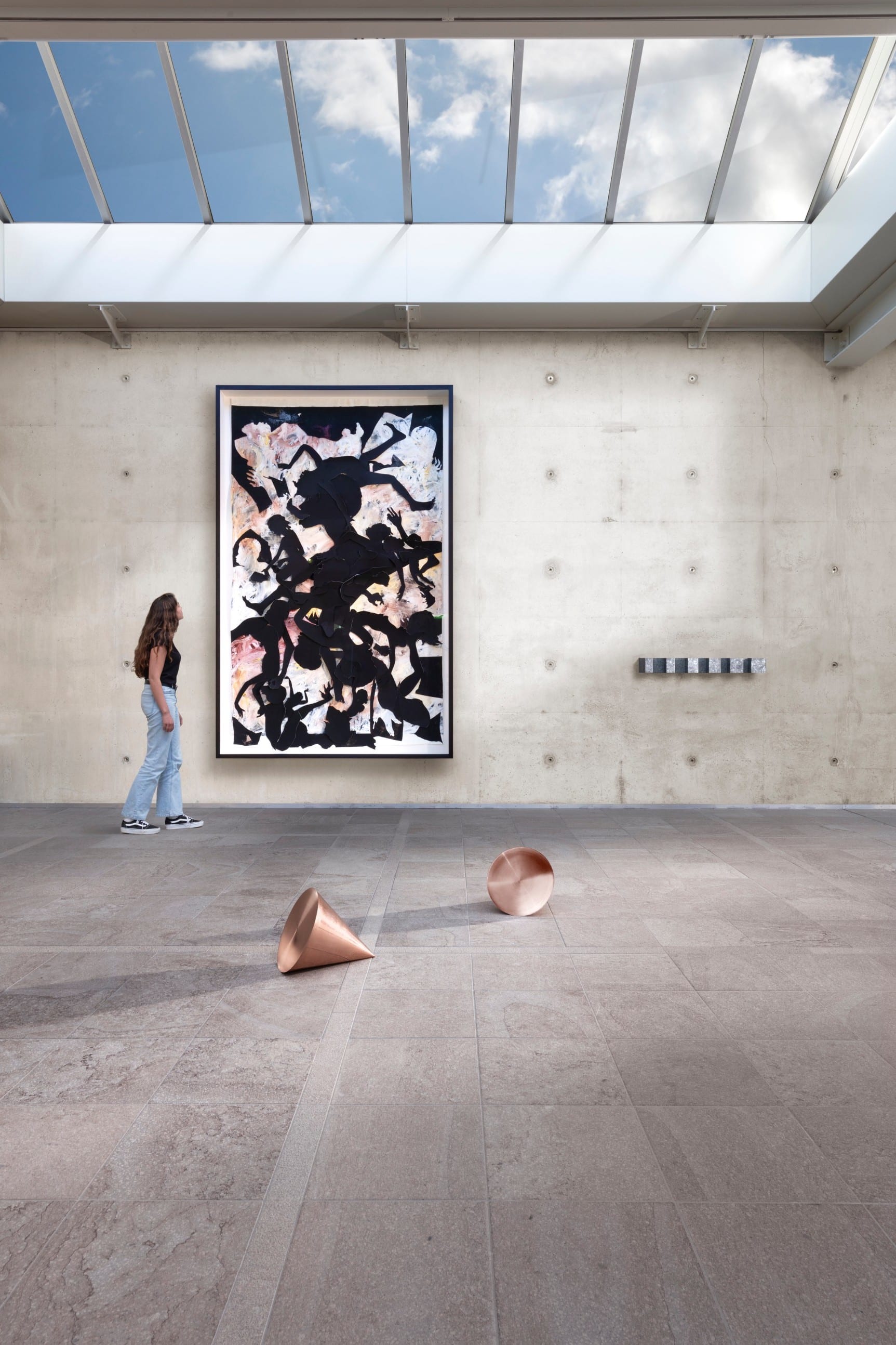 Exhibition If not now, when? Max Vorst Collection at Museum Beelden aan Zee, 2024
© Studio Gerrit Schreurs
In the early years, the Scholten collection consisted mainly of works by Dutch sculptors, whom they supported through their acquisitions. But their perspective gradually broadened. During business trips to the Americas, Asia and other European countries, they visited studios and galleries. Alongside works by Charlotte van Pallandt and Atelier Van Lieshout, they acquired sculptures by Berlinde de Bruyckere, Tony Cragg, Edwin Wurm and other international luminaries. A regularly changing part of that collection is displayed in the museum, partly on the outdoor terraces.
Art along the boulevard
Ten years after the museum opened, the founders donated 23 sculptures by Tom Otterness to the municipality of The Hague to enhance the adjacent boulevard, the busiest in the Netherlands. The cartoonish figures represent fairy-tale characters like Hansel and Gretel, Gulliver and Pinocchio. At first glance, it seems like innocent ‘art to please’, but, as is often the case with Otterness, something grim is lurking beneath the cheerful surface. The discerning observer can see critical commentary on mass consumption and propaganda packaged as entertainment. This hasn’t stopped the giant herring eater from becoming the unofficial mascot of Scheveningen, the former jewel of Dutch herring fishery.
The Scholtens intended their museum to be an alternative to the traditional, in their view, dull museums
The Scholtens intended their museum to be a dynamic exhibition platform, an alternative to the traditional, in their view, dull museums. The organisation is therefore lean and mean. A small professional staff is supported by a large group of volunteers, whom the founders refer to as ‘partners’. Lida Scholten continued to work at the documentation centre once a week, long after her husband’s death in 2005.
From regional to national ambitions
As a private enterprise, Beelden aan Zee must sustain itself financially. Overhead costs are kept low, and revenue is generated from the bookstore and the thoroughly pleasant museum café. Ticket sales, however, are the main pillar of the business.
With solid monographic exhibitions featuring giants like Ossip Zadkine or Pablo Picasso, attracting audiences has not proved difficult. But with increasingly rising costs for transport and insurance, you cannot fill a full annual programme with these kinds of crowd favourites on a limited budget. For a while, the museum worked with specific national themes, showcasing contemporary sculpture from countries such as Belgium and Romania. Group and solo exhibitions were alternated, with varying degrees of success. In 2017, for example, Tirzo Martha put on an astounding presentation with his No Excuses! But many other artists struggled with the intimidatingly large space of the main hall and saw their sculptures being swallowed up inside the concrete, giant tank.
Of course, this is not the fault of the artists but of the curators, who should be aware of the possibilities and pitfalls of their exhibition space. But they also could not succeed in delivering a consistently good programme. Combined with fluctuating directions in content, this gave Beelden aan Zee an unofficial B-status among national critics. The museum gradually descended to the level of a regional institution, despite having national ambitions, particularly due to the research institute’s affiliation with Leiden University.
This changed a few years ago with the appointment of Brigitte Bloksma as general director. She had small but impactful modifications done to the building, allowing ‘the shell’ to reopen to the public with renewed presence. The small cinema was modernised, the plaster room transformed into a space where visitors can witness the creative process from sketch to wax to plaster, and the former guest studio was converted into an additional, third exhibition hall. Its connecting corridor houses the significant coin collection amassed by the Scholtens. With Arthur Spronken’s Royal Monument on loan to Palace Soestdijk for five years, space on the terrace became available for rotating exhibitions. The installation ‘Sun and Sea Listening House’ (a replica of the opera-performance space that won the Golden Lion at the 2019 Venice Biennale) was put on display.
Renowned exhibitions
The exhibition programme was also given an ambitious quality boost. Bloksma’s first significant achievement was Henry Moore: Form and Material, which brought together eighty works by the British sculptor spanning sixty years. Visitors were guided through Moore’s oeuvre in an associative manner, with his creations also being linked to his thought and experiential world. For example, alongside Three Way Piece No 1: Points (1964–1965) – an almost two-metre-tall and over 1200-kilogram colossus resembling a dinosaur vertebra – there was a display case containing pieces of driftwood, prehistoric hand axes, bones and pebbles that the artist found during his long walks. Among this inspirational material was also the flint that must have served as a model for the eye-catcher of the exhibition.
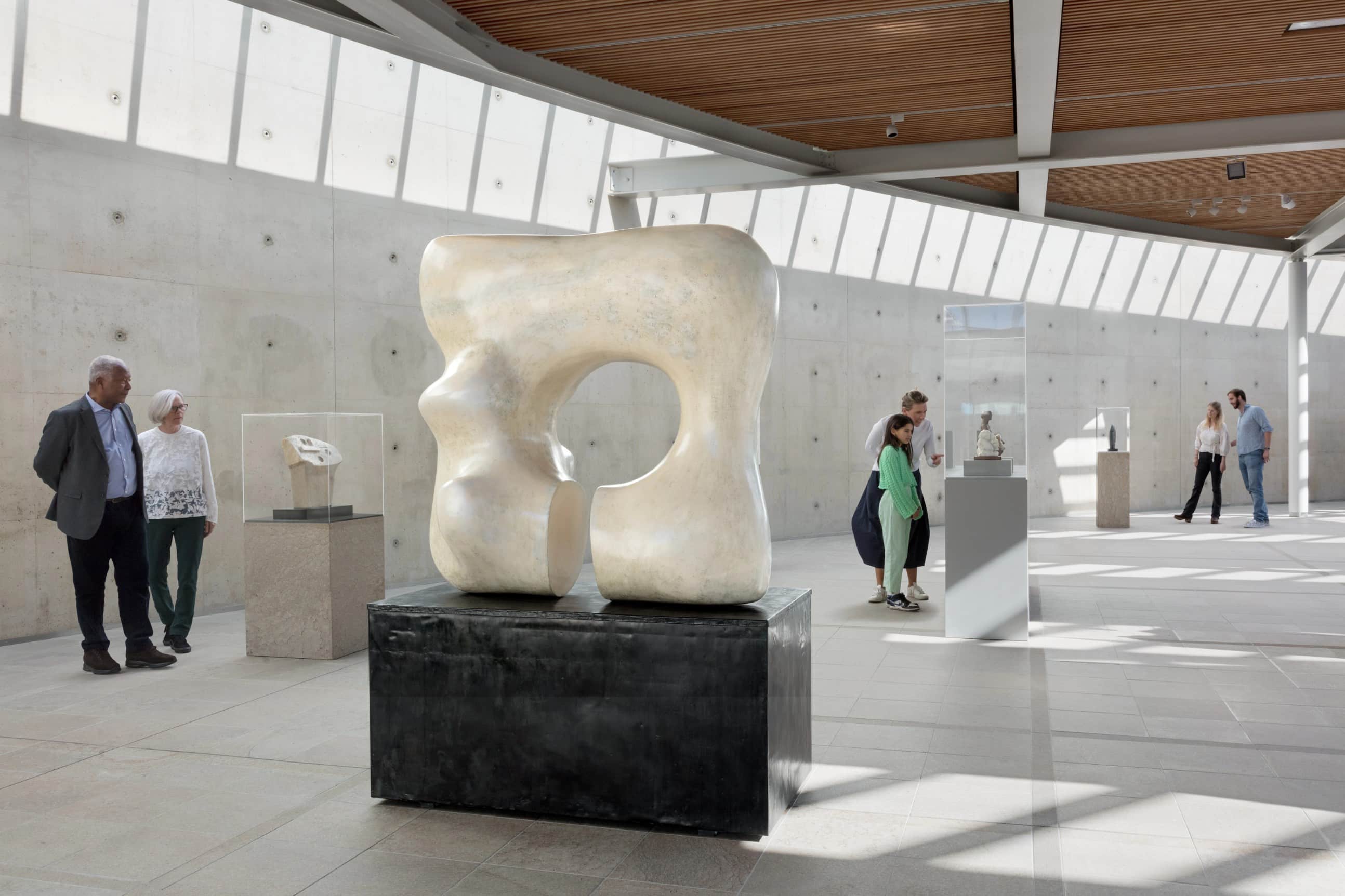 Exhibition Henry Moore: Form and Material at Museum Beelden aan Zee, 2024
© Studio Gerrit Schreurs
During the Moore exhibition, a few plaster models by Hans Arp (1886–1966) were on display in the plaster room. These were part of a donation that Beelden aan Zee, along with four other international museums, received from the foundation managing the legacy of the Franco-German Dadaist. The donation included one bronze and 21 plasters, which were exhibited in the back room until the end of 2024. Placed on wooden blocks and, despite the fragility of the plaster, without glass covers, the setup allowed you to feel as though you were in Arp’s studio. Meanwhile, a large-scale research project has been launched in collaboration with the other selected museums, aiming to culminate in an unparalleled Arp retrospective in 2027.
Alongside the Arp presentation, Beelden aan Zee also showcased a selection from the never-before-exhibited collection of private collector Max Vorst. The many international masterpieces included a bright yellow electric chair by Sterling Ruby, a marble safety helmet by Ai Weiwei and Cyprien Gaillard’s brutal crane grab with a suspension system made of semi-precious stones. These kinds of presentations, along with the promise of a consistent, multi-year programme line-up, signal a new phase for Beelden aan Zee. One in which the museum’s influence extends far beyond the dunes of Scheveningen.
All exhibitions and further information can be found on the Museum Beelden aan Zee website.

You might also like




In Jozef Deleu’s Poetry, Nothing Was Lost



Leave a Reply
You must be logged in to post a comment.