
Hot Off the Press: The Low Countries’ Contribution to Printing

In the main square in Haarlem, in the province of North Holland, there is a statue to Laurens Coster, who, we are told, introduced metal movable type printing to Europe several years before the German, Johannes Gutenburg, did so in the fifteenth century. Recently, however, significant doubt has been cast on this claim, with some commentators even asserting that Coster did not exist. Be that as it may, over the years people from the Low Countries have made a significant contribution to the development of printing.
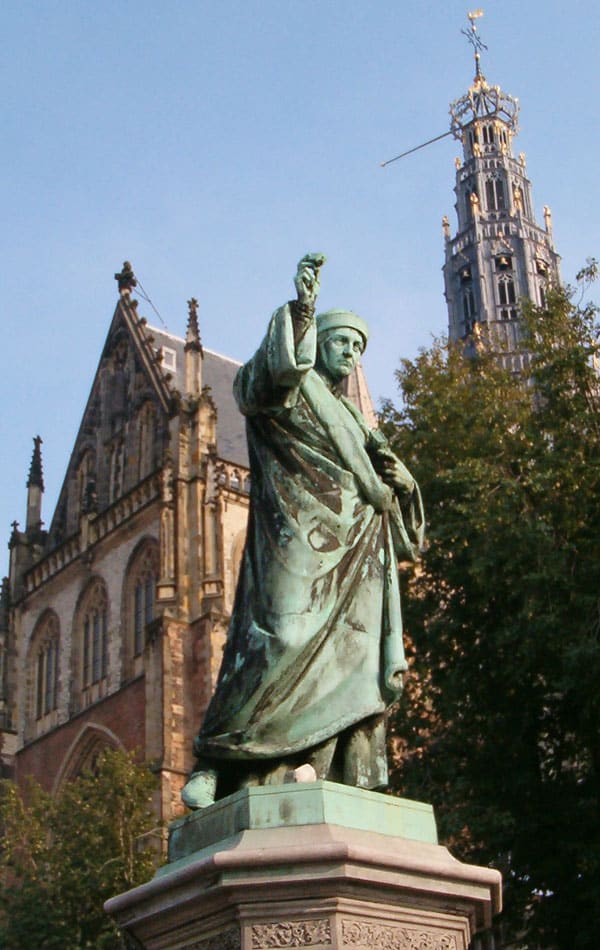 Statue of Laurens Coster on the main square in Haarlem
© Guusbosman / Wikimedia Commons
A recent analysis of the largest centres for printing in Europe between 1450 and 1650 includes several towns in the Low Countries: Amsterdam, Antwerp, Leiden, Leuven and Deventer. A recent publication on the book trade refers to Amsterdam as the bookshop of the world. There was also printing in other towns such as Delft. Migration plays an important role in this story. For example, members of the Elsevier family, who established their publishing business in Leiden, had previously worked in Leuven and Antwerp. But it is not just in the Low Countries where printers have made their mark.
As a result of the activities of the Dutch East India company (VOC), in the seventeenth century, the Dutch introduced printing to Java and in the eighteenth century to Ceylon. Here, Tamil and Sinhalese print types were used to print dictionaries and bibles in the local language. In other cases, however, the VOC deliberately did not introduce printing for fear that a press would give too much power to one area. For this reason, although there were books in the Cape Colony, there was no printing press there prior to 1795 when the British invaded during the Napoleonic Wars. In the seventeenth century, missionaries in Taiwan had asked the VOC leaders in Batavia for a printing press in order to print bibles and other material with which to convert indigenous Formosans to Christianity. Again, their request was refused for fear that they would have too much local autonomy.
In some cases, the VOC deliberately did not introduce printing for fear it would give too much power to one area
Turning to Europe, one example of a Dutch printer publishing in Germany is Nicolaes van den Berghe. In the 1550s, Protestants in London had been forced to go into exile during the reign of the Catholic queen, Mary I. Several of them went to the relatively safety of Emden in northwest Germany. Using the pseudonym Collinus Volckwinner, in Emden in 1554 Van den Berghe printed the Christian Ordinances for the Dutch community in London. In 1566, the first edition of Johannes Utenhove’s Dutch New Testament was printed in Emden, as the Low Countries (the Seventeen Provinces) were still under the control of the Catholic king of Spain, Phillip II.
Printers from the Low Countries also worked in England. The Oxford University Press employed Dutch typesetters. In Norwich between 1568 and 1570, the Brabanter Anthonie de Solempne ran a printing press with the assistant of a typesetter from Holland Albert Christiaensz. The main work of De Solempne’s press was to print books for use in the Dutch and Flemish exile church in Norwich in the county of Norfolk. These included a Dutch psalter, a catechism and a confession. However, De Solempne also printed bills for the city corporation in English and so contributed in some small way to the administration of his adopted town. Dutch printers may also have been active in Ipswich, in the neighbouring county of Suffolk.
Dutch typesetters were employed by the Oxford University Press
A Dutch printer who worked in London was Steven Mierdman. He had previously worked in Antwerp and arrived in London in the late 1540s as a Protestant refugee, eventually becoming a denizen. In 1551 he printed an early psalter by Utenhove. Like other Protestants he was forced to flee to Emden in 1553 on the accession of Queen Mary. An earlier arrival from the Low Countries was Reynier or Reginald Wolfe. He was one of the founding members of the Royal Stationers’ Company, which for many years operated a monopoly on printing in England.
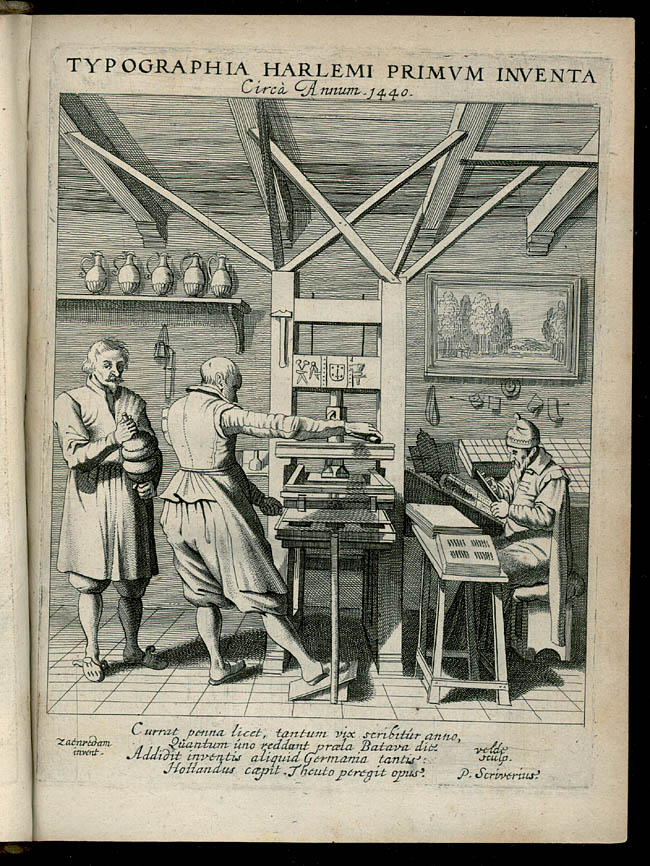 An illustration depicting Laurens Coster's printing press
© Royal Library of the Netherlands / Wikimedia Commons
In conclusion, then, although the figure of Laurens Coster may sadly belong to the realms of mythology and national pride, people from the Low Countries have made an important contribution to the development of printing in their own territory, in neighbouring countries and in several parts of the world colonised by the Dutch East India Company. This adds yet another chapter to our story of what the Dutch and Flemish have done for us!










Leave a Reply
You must be logged in to post a comment.