
From Holland With Love: How the Dutch Mapped East Asia

Gerardus Mercator gave the world a way to flatten the globe onto a map. Willem Blaeu and his son Joan turned that skill into an atlas empire. Their names are still attached to the maps and globes that shaped how people in Japan and Taiwan first pictured the world beyond their shores, and left behind traces, from a Taiwanese fort still called “Red-hair fort” to place names that are, in effect, still Dutch.
This expertise in cartography was not just a matter of pride. It was one of the reasons the Dutch East India Company (VOC) could sail, trade and wage war in East Asia as effectively as it did. Here’s how Dutch and Flemish maps shaped contact with Japan and Taiwan.
From Holland with Love
The first Dutch ship to reach Japan was the Liefde (Love) in 1600, likely navigating with Portolan charts produced by the Dutch cartographer Cornelis Doedtsz. of Edam. After 1639, the Dutch were the only Europeans allowed to trade with Japan, and since the Japanese themselves were forbidden from leaving the country, they came to rely on the Dutch for information about the world outside East Asia. The Dutch brought in new objects like telescopes and globes to feed that curiosity.
The Dutch were the only Europeans allowed to trade with Japan
In 1700, Gerrit Valk of Amsterdam and his son Leonard produced a pair of globes, one terrestrial, one celestial. In 1737, the Japanese astronomer Kitajima Kenshin wrote a book explaining them, with a title that translates roughly as “Explanation of Dutch celestial and terrestrial globes.” In 1774, the translator and scholar Motoki Yoshinaga produced “The Use of Celestial and Terrestrial Globes,” a translation of a Dutch handbook first published by Willem Blaeu in 1634. A year earlier, in 1773, Yoshinaga had also completed a translation of the introduction to Louis Renard’s Atlas van zeevaart en koophandel door de geheele weereldt (“Atlas of Navigation and Trade through the Whole World,” Amsterdam, 1745).
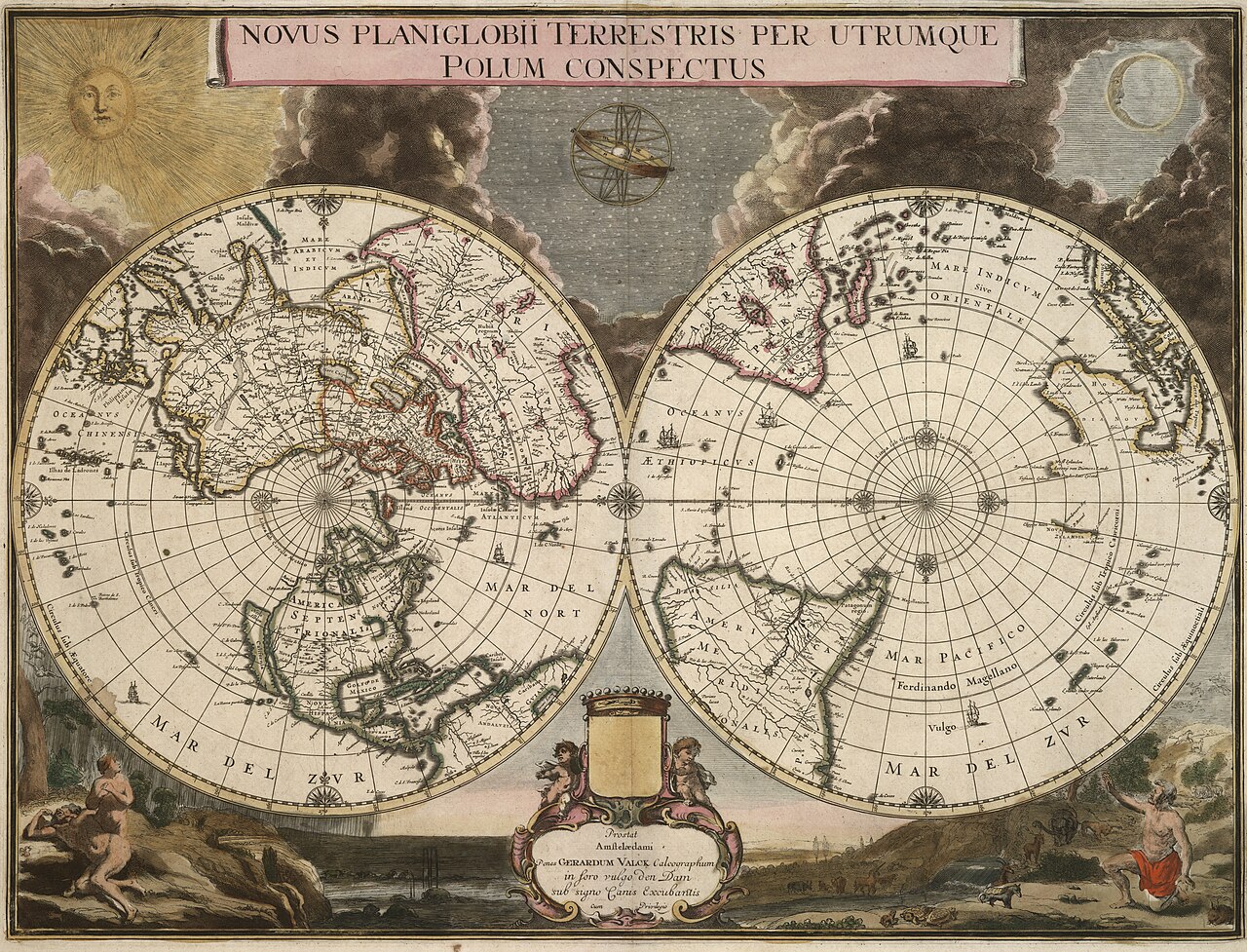 Planiglobe, 1672, showing California once again as an island, and the unknown coast of East Australia. Reissued in 1695 by G. Valck
© Public Domain
In 1786, the Edo scholar Katsuragawa Hoshū, who had studied Dutch, produced an “Illustrated Explanation of the New Map of All the Countries in the World.” It was derived from the explanatory text attached to Joan Blaeu’s 1648 world map, the Nova totius terrarum orbis tabula. Many of Blaeu’s place names were in Latin, so Hoshū had to render both these and various Dutch names into the Japanese katakana syllabary.
Some Japanese maps of Europe even carried Dutch place names written phonetically in Japanese script, though it isn’t always clear which specific source map they drew on. Others were Dutch reproductions of maps originally made by cartographers elsewhere in Europe: a world map in Inleidinge tot de geographie (Amsterdam, 1730), for instance, was based on work by the French cartographer Alexis-Hubert Jaillot, while the German Johann Hübner’s (1668-1731) maps and geographical descriptions reached Japan only after being filtered through Dutch printers and mapmakers. In this roundabout way, Dutch cartography, sometimes original and sometimes borrowed and relabelled, helped shape the Japanese view of the wider world.
Taiwan: a Dutch island
Taiwan’s story is different. The VOC ran a trading post there for just 38 years, from 1624 to 1662, but its surveying and cartography skills let it map the island as it gradually extended control over it, including ejecting the Spanish from their short-lived colony in the north between 1626 and 1642.
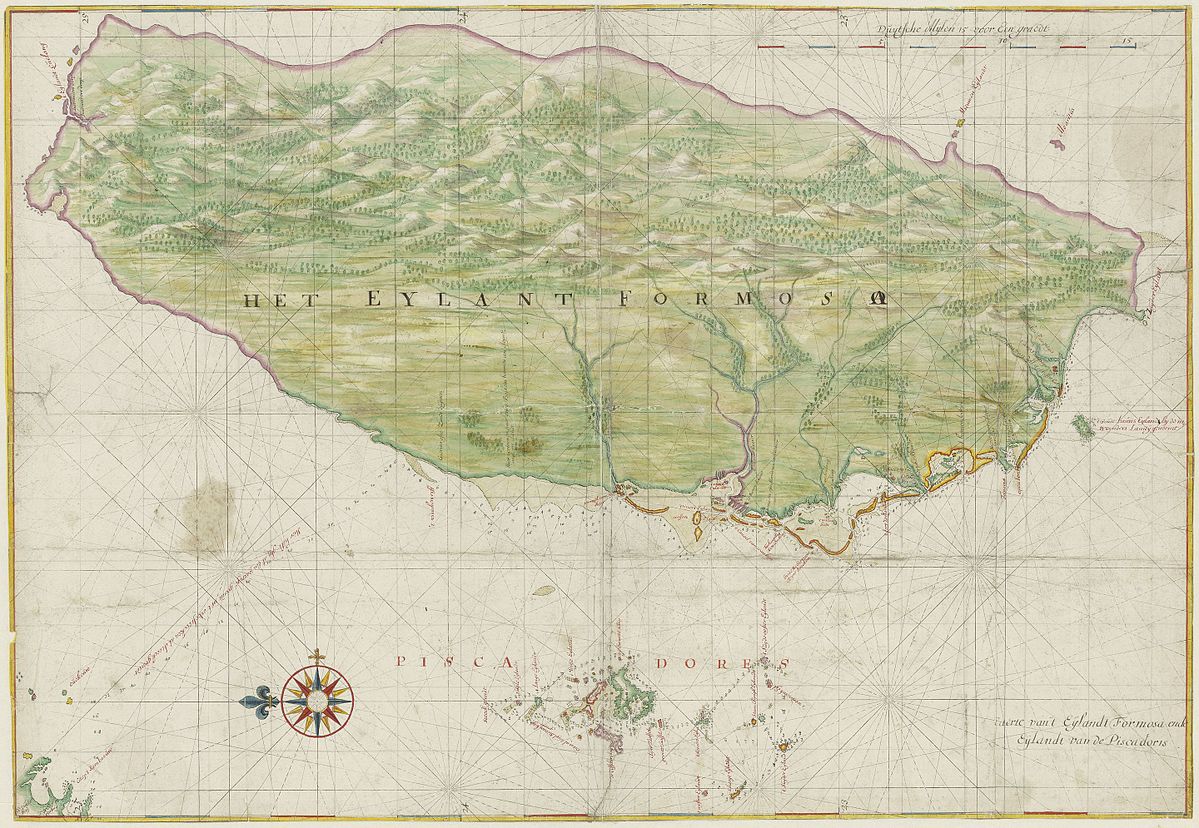 The Island Formosa and the Pescadores by Johannes Vingboons (ca. 1640)
© Public Domain
At least 16 Dutch maps of Taiwan survive from this period, some drawn on site, others compiled back in the Dutch Republic from information sent home. One of the most notable is a map of Taiwan (then usually called Formosa) made around 1640 by the Amsterdam cartographer Johannes Vingboons (1617-1670), which doubled as a navigation chart.
The Dutch were quietly turning Taiwan into a Dutch island: an island off the coast was called Rovers Eiland (Robbers Island), and a bay was named Kerkbaai (Church Bay)
What stands out is how many of its place names are Dutch. In some sense, the Dutch were quietly turning Taiwan into a Dutch island in the tropics: polders, another Dutch import, carried Dutch names, an island off the coast was called Rovers Eiland (Robbers Island), and a bay was named Kerkbaai (Church Bay).
That process of “Dutchification” ended abruptly when the Chinese warlord Koxinga expelled the Dutch in 1662, but a few traces survive. A fort the Dutch took over from the Spanish in 1642 is still known locally as “Red-hair fort,” a nod to how red-haired the Dutch appeared to local people. Taiwan’s northernmost point, Fuguijiao or Cape Fugui, is thought to preserve a corrupted version of the Dutch word for cape, hoek.
Dutch mapmakers, explorers and traders left their mark on Japan and Taiwan in ways both grand and small, from an entire visual language for picturing the world to a fort name that still carries the memory of a red-haired visitor centuries after he left.

You might also like

In Jozef Deleu’s Poetry, Nothing Was Lost






Leave a Reply
You must be logged in to post a comment.