
How Flemish Refugees Rewove England’s Fortunes

Few things seem more quintessentially English than wool. Yet the transformation of English fleece into fashionable, saleable cloth owed a great deal to newcomers from across the North Sea. In the second half of the sixteenth century, thousands of Protestant refugees from the Low Countries settled in England, bringing their skills and new types of fabric with them. In doing so, they helped revive struggling English towns and left a mark on the country’s textile industry that outlasted their own communities.
In England’s ‘green and pleasant land’ there has been an abundance of sheep since time immemorial. The importance of their wool to the English economy is symbolized wonderfully by the ‘Woolsack’, the wool-stuffed seat in the House of Lords traditionally occupied by the Lord Chancellor, which is thought to date from the fourteenth century. However, although England produced woolen cloth of its own, much of its wool was exported to the Low Countries and France, where weavers turned it into other types of cloth for the Continental market. This state of affairs changed significantly in the sixteenth century for several reasons.
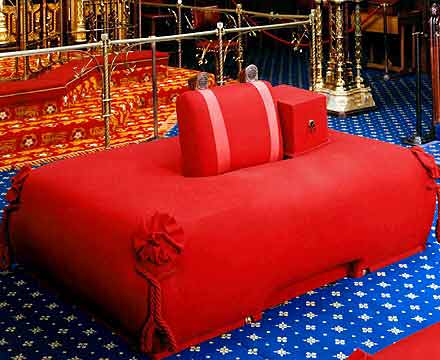 The woolsack, in the British House of Lords
© Explore Parliament
First, in 1558, England lost the last continental possession it had gained during the Hundred Years’ War, Calais. Queen Mary I famously said on her deathbed that it would be engraved on her heart. The English crown had been operating a wool staple in Calais and so after its loss, the English needed to produce more of their own textiles. Second, at about the same time, the Low Countries were undergoing economic and religious turmoil, in part brought about by the rise of Calvinism in areas controlled by the Spanish Catholic monarchy. In the wake of the Beeldenstorm in 1566 and the subsequent arrival of the Duke of Alva in Flanders, thousands of Calvinists including many involved in the textile industry were forced to leave their homes.
While some moved to the northern provinces such as Holland, others jumped into boats and made their way to England. There, several towns were experiencing economic hardship as a result of uprisings against what were considered unjust laws. In order to resuscitate the fortunes of these towns, local leaders therefore invited the refugees from the Low Countries to settle and use their skills to turn English wool into saleable textiles.
The case of Norwich in Eastern England, at that time the second largest town of the kingdom, is instructive in this regard. It had suffered from a rebellion in 1549 against land enclosure led by a local yeoman, Robert Kett. Local leaders such as the Duke of Norfolk decided that skilled weavers from the Low Countries should be invited to settle in Norwich. Although initially in 1565 only thirty master-weavers and their families were invited, by 1570, largely as a result of Alva’s oppressive measures, there were well over 1,000 textile-workers from the Low Countries in Norwich. At its height, the Stranger community, as it was known locally, was 7,000-strong comprising some 40% of the population of Norwich.
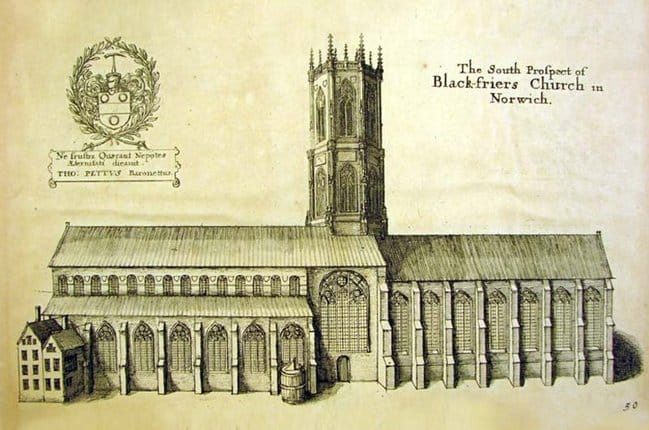 The south side of Blackfriars Church, illustrated by Wenceslaus Hollar (1607–1677). The nave (left) is now St Andrew's Hall, and the chancel (right) is Blackfriars' Hall
© Public Domain
They had several occupations covering the whole process of textile production and selling including weavers, woolcombers, cardmakers, hosiers and merchants. Of particular note is the fact that the textiles they produced were lighter than the heavy worstead textiles that had been produced in Norwich before this. These newer textiles, known as the ‘new draperies’, such as says and bays were particularly popular. The incomers taught local people the necessary skills to make these new products and contributed significantly to the economic revival of Norwich. As a token of their thanks for being offered a safe haven, the textile workers from the Low Countries made an Easter altar frontal in 1573 for the Church of St. Peter Mancroft, which can still be viewed there today.
Another town in Eastern England which benefited from the arrival of skilled textile workers was Colchester in Essex. The Dutch Stranger community in Colchester numbered over 1,000 members in the late sixteenth century. As in Norwich, many of these were involved in producing the newer types of cloth such says and bays. Say-making had been developed in the Low Countries and employed many thousands of people there. For example, it is reckoned that in the late sixteenth century over 3,000 people were involved in the say-making industry in Hondschoote in the Westhoek, now in French Flanders. In the seventeenth century, a Royal tapestry works was established at Mortlake in Surrey on the banks of the Thames. This initially employed some 50 Flemish and Brabant weavers. A Dutch/Flemish church was established there which functioned for several decades.
Scotland, too, benefited from the arrival of skilled textile workers from the Low Countries. In 1601, in the city of Edinburgh indentures were made between Alexander Hunter and textile workers from the Stranger communities in Norwich and Colchester who had been invited to move to Scotland to weave Scottish wool. Textile workers were also invited from Leiden, whose Lakenhal is a reminder of the important role of the textile trade in its history. Whether any workers moved from Holland to Scotland to work in the textile trade would require further investigation.
In conclusion, then, the arrival of thousands of textile workers from the Low Countries was of benefit both to them and to English towns. It allowed them to escape religious persecution and economic hardship and helped the English towns revitalize their economies. Furthermore, the textile workers introduced new types of cloth, which continued to be produced long after the incomers had integrated into the local communities. This therefore adds another chapter to our story of what the Dutch and Flemish have done for us!

You might also like







Leave a Reply
You must be logged in to post a comment.