
‘On Our Terms’: Helen Kamperveen and Marcel Pinas on Art in Postcolonial Suriname

The Netherlands still has a colonial debt to repay, say actress Helen Kamperveen and artist Marcel Pinas. They call the deplorable state of the Surinamese cultural sector a direct result of past relations. Support is therefore desperately needed. ‘It is so important to introduce young people to culture.’
Helen Kamperveen (Curaçao, 1949) welcomes Marcel Pinas (Pelgrimkondre, 1971) and me on the balcony of her newly completed house, on the edge of South Paramaribo. “I made sour water with fresh limes; if you find it too sweet, I can dilute it a bit more.”
Kamperveen and Pinas consider it an honour to be able to get to know each other a bit better. She is still full of admiration for his new exhibition, for which she travelled a week earlier to Moengo in the east of Suriname. As with his previous, often spectacular, installations of symbolic everyday objects such as pangi’s (coloured fabrics), pagaaien (paddles), and kokolampu’s (oil lamps), Pinas’ background as a Maroon (descendant of escaped slaves) once again plays a crucial role. He has exhibited successfully in the United States, Cuba, France, Germany, Belgium, and the Netherlands. According to Kamperveen, Suriname can be proud of this distinguished son.
Like almost every Surinamese, Pinas has known his conversation partner since childhood. Kamperveen, along with Jetty Mathurin and Gerda Havertong, belonged to the very first group of Black actresses on Dutch stages, who made a deep impression across the ocean. In 2022, she received the Colombina, the theatre award for best supporting actress, for What is Love, a theatre and dance performance by director Casper Vandeputte.
Helen Kamperveen lived alternately in the Netherlands and Suriname, depending on the political situation in Paramaribo. She therefore knows what it is like to be on stage or in front of the camera in one country and earn a living from it, while in the other country having to rely on private initiatives just to be able to produce theatre at all. After all, cultural subsidies from the Surinamese government are considered something of a mirage. Pinas can first-hand experience of this. He was only able to get the museum, the studio for emerging artists, and the international art festivals in Moengo, near his hometown, off the ground thanks to financial support from major cultural funds abroad.
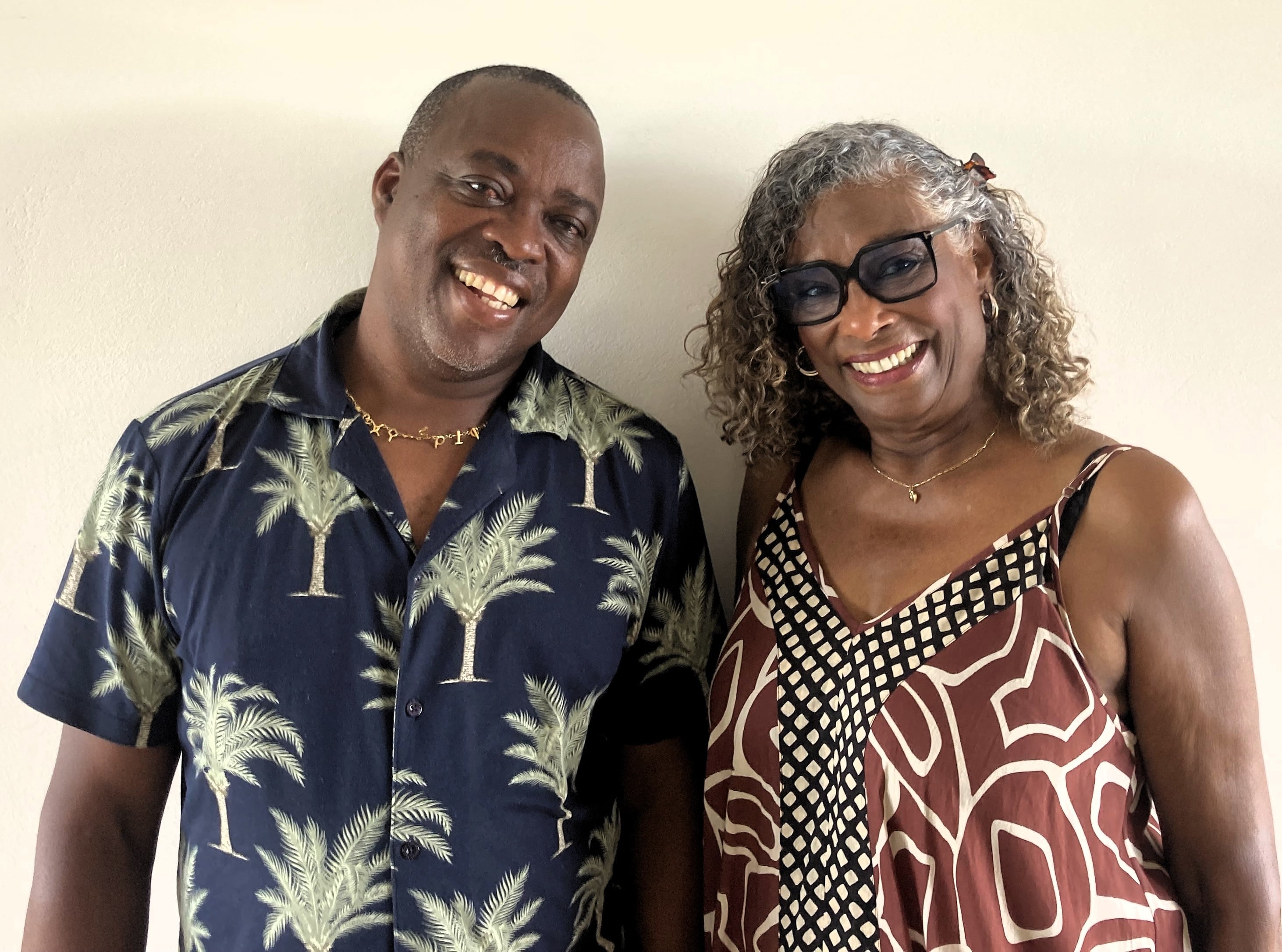 Marcel Pinas and Helen Kamperveen. Pinas: 'It hurts to be able to realize projects only with money from the Netherlands.' Kamperveen: 'As if we are always just begging'
© Diederik Samwel
How did the two of you come up with the idea of starting to make art?
KAMPERVEEN: “I don’t come from a family where my parents took me to the theatre. I saw a performance for the first time when I was twelve. I saw it as a real profession, but I didn’t immediately feel that I wanted to do it later. In the Netherlands, I worked as a model from the age of eighteen, and only after I had been in Suriname for a few years did I come into contact with the theatre world. I was able to perform in a politically critical play at one point, and I found that much more interesting. After that, I decided I was done being beautiful for the camera.”
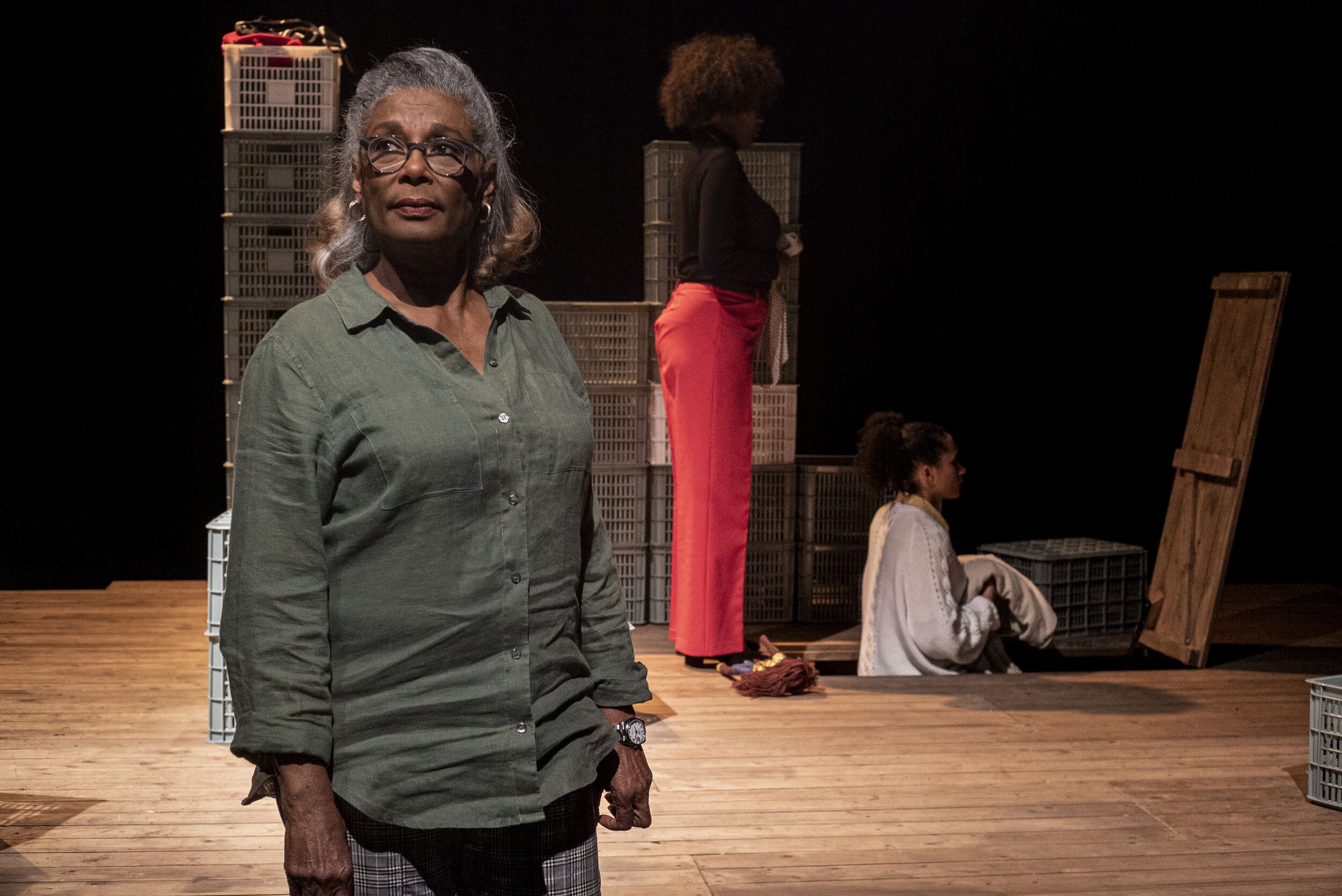 Helen Kamperveen in the performance Decemberdagen (December Days) by Via Rudolphi Productions and Bijlmer Parktheater
© Ben van Duin
“After the December murders in 1982, we fled to the Netherlands (her father-in-law André Kamperveen, a journalist and media man, was one of the fifteen victims, while her husband Johnny Kamperveen, a radio presenter, narrowly escaped the soldiers, DS). There I was able to build a career as an actress.”
Marcel Pinas: ‘My time in Jamaica made me realize that, through my art, I can represent our own people’
PINAS: “In my village, I loved watching men paint wooden boats. That started when I was seven. I found it fascinating. Later, at the boarding school, one of the brothers encouraged me to keep drawing. Even though at first, I wanted to become a mining engineer. (laughs) But in Paramaribo, after school, I went straight to Nola Hatterman, the art institute, every day. There, I made drawings and paintings of Surinamese yards, women in koto dresses, often in bright colours. Tourists loved them, and I could make a lot of money from it.”
“At that time, I was allowed to go to the art academy in Jamaica, and there they asked me what I was working on. ‘What you create is fried fish, like you’re working made to order. But who are you?’ They thought my work was indistinguishable and not authentic. ‘Go back to Suriname, but if you continue with this, you don’t need to come here anymore.’ That made me think about where I come from. It brought me back to my culture and my ancestors. When I returned to Jamaica, they said: ‘Wow! You’re a Maroon! That’s so special.’”
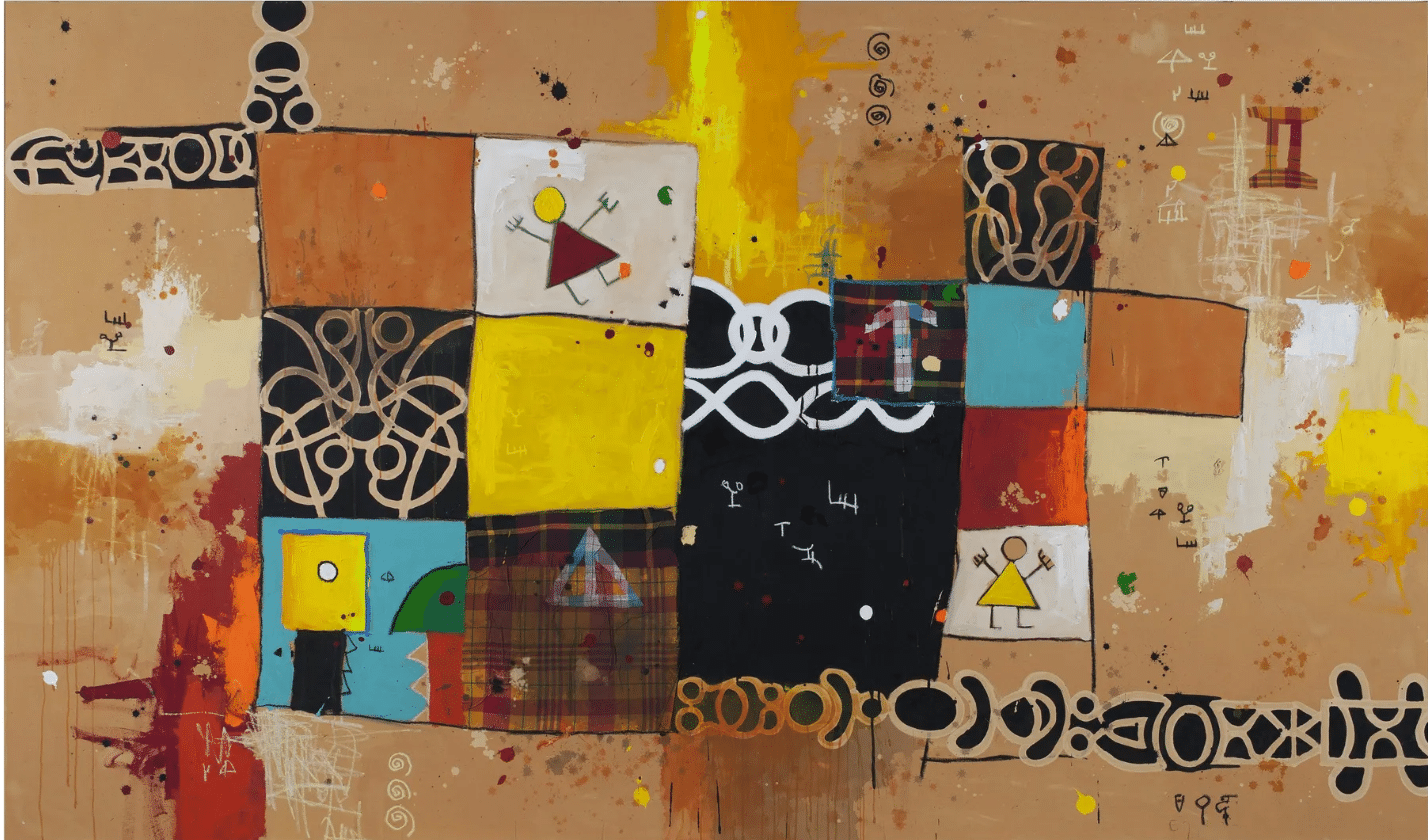 Pikien nengee pee / Djompo futu anga / Schopsteentje (2008) and Pinas Fositen Once (2016) by Marcel Pinas
© Stedelijk Museum, Amsterdam / US Department of State
KAMPERVEEN: “Really? While Maroons in Suriname are looked down upon by many people…”
PINAS: “That was when a whole new world opened up for me. It made me realize that, through my art, I can represent our own people. As the voice of my community, addressing the issues we face, from slavery to the present. In Jamaica, I learned how to create an installation from a well-thought-out concept. After that, I returned with new work in Paramaribo, and people said, ‘Nah, you were better before.’ People need time to understand what you are doing.”
Where does your drive come from to inspire younger generations to get excited about art?
KAMPERVEEN: “In the late 1980s, after democracy was restored, we returned to Suriname. After the death of my husband Johnny in 2003, I had to move on, and that wasn’t possible within his family’s media company. I was determined to continue living in Suriname. I was born in Curaçao, worked in the Netherlands for a long time, but I mostly identify as Surinamese. At one point, I was commissioned in the Netherlands to cast children for a youth series: De taxi van Palemu. About one hundred and seventy children showed up, while I was only allowed to choose twelve. Wow, I thought, if there are so many children that want to do something with acting… That’s when I started looking for funding for a youth theatre school. That became On Stage. It was a fantastic time; it was actually the highlight of my career. And the fun part is that several children who attended our school are now making a name for themselves on Dutch stages. Especially Daniël Kol is doing great.”
PINAS: “You must not forget what happened in my native region during the Surinamese Interior War (from 1986 to 1992, DS). Villages were destroyed, people were killed, the infrastructure ruined. In the years that followed, very little was done for us; there was no office where traumatized people could go. People were left to their own devices. Many boys my age ended up in the crime world, got hooked on drugs, or wandered around as vagrants. Our people were stigmatized: as djukas (Maroons, DS) we are blamed for everything throughout the rest of the country.”
“As an artist, I wondered what I could do to bring about change in that image. I still clearly remember what it was like when I was encouraged to draw at the boarding school. But young people didn’t come to my exhibitions, nor could I reach them with spatial objects in public spaces. So, I went back to Moengo to work within the community, to encourage boys and girls in a playful way. Eventually, this led to the Tembe Art Studio, a cultural platform for young people, the Contemporary Art Museum Moengo, the Marowijne Art Park, and a research centre.”
How were you able to finance your projects?
KAMPERVEEN: “I’ve been lucky with my theatre school; we were largely able to set it up with Dutch support. Plus, contributions from Curaçao and the aluminium company Suralco. We got zero money from the Surinamese government. Yes, they had allocated a budget for a cleaner, but we supplemented that ourselves: you can’t have someone clean for so little money.”
Kamperveen: 'They should still make it mandatory for revenues from gold, wood, and oil to be at least partly spent here as well'
PINAS: “It still hurts to only be able to realize projects with money from the Netherlands.”
KAMPERVEEN: “As if we’re always begging from others. But there’s simply too little appreciation for art here; unfortunately, that’s a fact.”
PINAS: “Sometimes something is possible, but you need the right connections and the right friends for that. The Canadian company IAMGOLD operates a huge gold mine in Brokopondo, where they earn tons of money. But there’s a lack of government policy to ensure that money benefits the community.”
KAMPERVEEN: “They should still make it mandatory for revenues from gold, wood, and oil to be at least partly spent here as well, shouldn’t they?”
PINAS: “In the end, you have to work with what’s available. Even if it comes from the Netherlands. Doing nothing is not an option. I don’t believe in large sums of money, but rather in small amounts and then working together to make it happen. Because as soon as a big player drops out, you have a problem. By collaborating with the community, the project grows and you grow along with it.”
“We have been able to set up art festivals with support from the Dutch embassy, the Mondriaan Fund, and the Prins Claus Fund. That has now become much less. The Mondriaan Fund still sends artists as artists in residence. For them, I am a foreign studio. I’ve received a lot of flak because of that by the way. They hiss, ‘you work with those foreigners’. But hey, they simply have the money. And I explained to them that these artists come to carry out our ideas.”
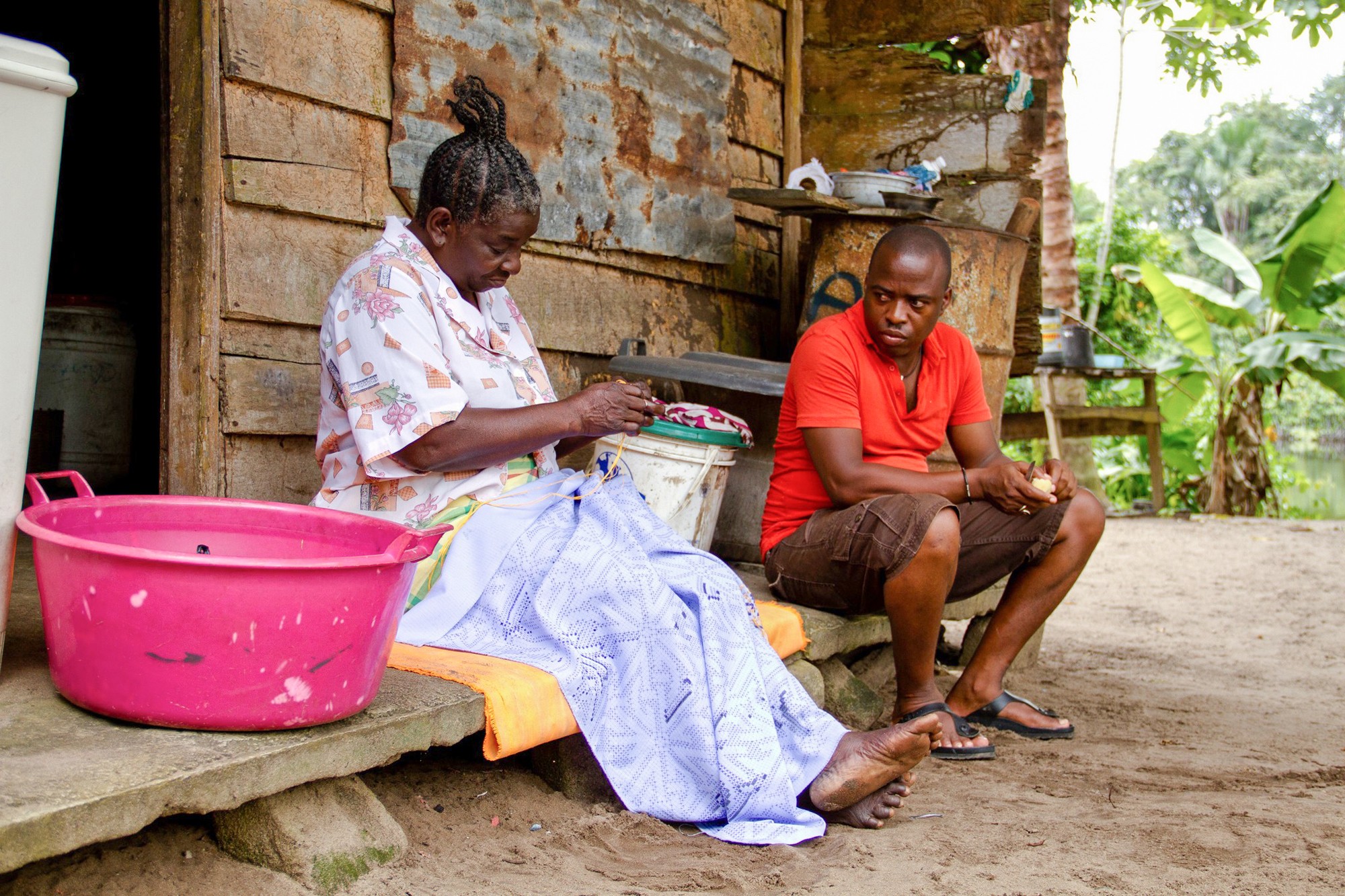 Marcel Pinas in the Surinamese village of Lantiwee. Pinas: 'I don’t believe in huge sums of money, but rather in small amounts and then working together to get the job done'
© Marcel Pinas
KAMPERVEEN: “So recognizable. I can still hear one of my people say: ‘Helen, there are white people at the gate; it must be for you.’ My God, I paid for that entire theatre school, all the salaries with white money. Because the government gave me nothing. I could also have said: then I won’t do it. There was also criticism of what they were learning with us based on what I had experienced myself: plays by Pirandello and Shakespeare that I adapted to the Surinamese context. At the time Bouterse was becoming increasingly popular, we performed Richard the Third, about power and how it is not right that it falls into the hands of a few people. That meant walking on eggshells: the community in Paramaribo is small and not everyone appreciated it. But our artistic freedom was still guaranteed.”
How would you describe the cultural relationship between Suriname and the Netherlands? Is there still a colonial debt to be repaid?
KAMPERVEEN: “I think so. I understand that quite a few cultural subsidies were discontinued because support for the Netherlands was no longer considered interesting. But hang on a minute; this country has been interesting for the Netherlands for centuries. So, can we please have something now that is interesting for us? The current situation in the country is a direct result of our colonial history. Absolutely! You can’t end that with a single signature on the transfer of sovereignty. With some great lump sum of money, the so-called treaty funds, the Netherlands then took its hands off Suriname. That is very different from supporting the development of a country. If you look at how dire the cultural sector in Suriname is… We can’t expect anything from the government; it mainly depends on private initiatives. Change can be brought about here through art education, and that is something foreign funds can specifically do. It is so important to introduce young people to culture.”
Kamperveen: 'But hang on a minute; this country has been interesting for the Netherlands for centuries. So, can we please have something now that is interesting for us?'
PINAS: “The Netherlands suddenly let us go while they themselves caused all that misery. Foreign funds should look at art institutions that are already active in Suriname and that have proven their right to exist. They should receive a structural amount of subsidy. But I wouldn’t start it with an open call. Then you see people applying who know very well how to meet all the criteria of a cultural fund. If I’m already working on a project in Moengo, do I suddenly have to comply with externally set conditions? No, it must be on our terms. In the collaboration with the Prince Claus Fund, I could sit and consult with someone who knew how best to distribute the money across the various categories. I don’t have that experience.”
KAMPERVEEN: “You mustn’t be bull-headed about it; of course we want to learn something. Surely, they have plenty of knowledge and insights in the Netherlands. I was very much supported by the Youth Theatre School in Rotterdam, which was incredibly helpful; I was an actress and had never run a school before.”
PINAS: “With some of the criteria from the Netherlands, you automatically exclude young artists from Moengo. They then have to bring someone in to properly draw up their plan. But what percentage then remains for the artist themselves?”
Pinas: 'I think the academy was afraid of something new. That we would switch roles and that they would learn something from me'
What can the Netherlands learn from Suriname?
KAMPERVEEN: “Our expressive nature. Since Black Lives Matter, a great deal has changed. In the past, Surinamese actors in the Netherlands first had to properly learn standard Dutch. Daniël Kolf, who now receives fantastic reviews everywhere, performed as an actor at ITA (International Theatre Amsterdam) just as he is: Surinamese. That makes him much more authentic. In the play Branden (Fires), I got a role where I made it a condition that I would perform it as a Surinamese, not as a Dutch person. That makes us ourselves. You have to see and feel that actors use their strengths and are allowed to be who they are: walking naturally on the balls of their feet and not tiptoeing around.”
“Before that time, we received a lot of criticism about our attitude. It wasn’t until the wave of Belgian actors on Dutch stages that this changed. They gave expressive performances with great presence. Then suddenly it was allowed. Romana Vrede and Yannick Jozefzoon also represent the new self-confidence among Surinamese actors. You are always at a disadvantage if you cannot be yourself. I am therefore very happy with young, Black actors who ask for make-up artists who can also do our hair. In my time, I looked like a grey mouse with that layer of make-up. At the time I would just go to the bathroom and do my own make-up.”
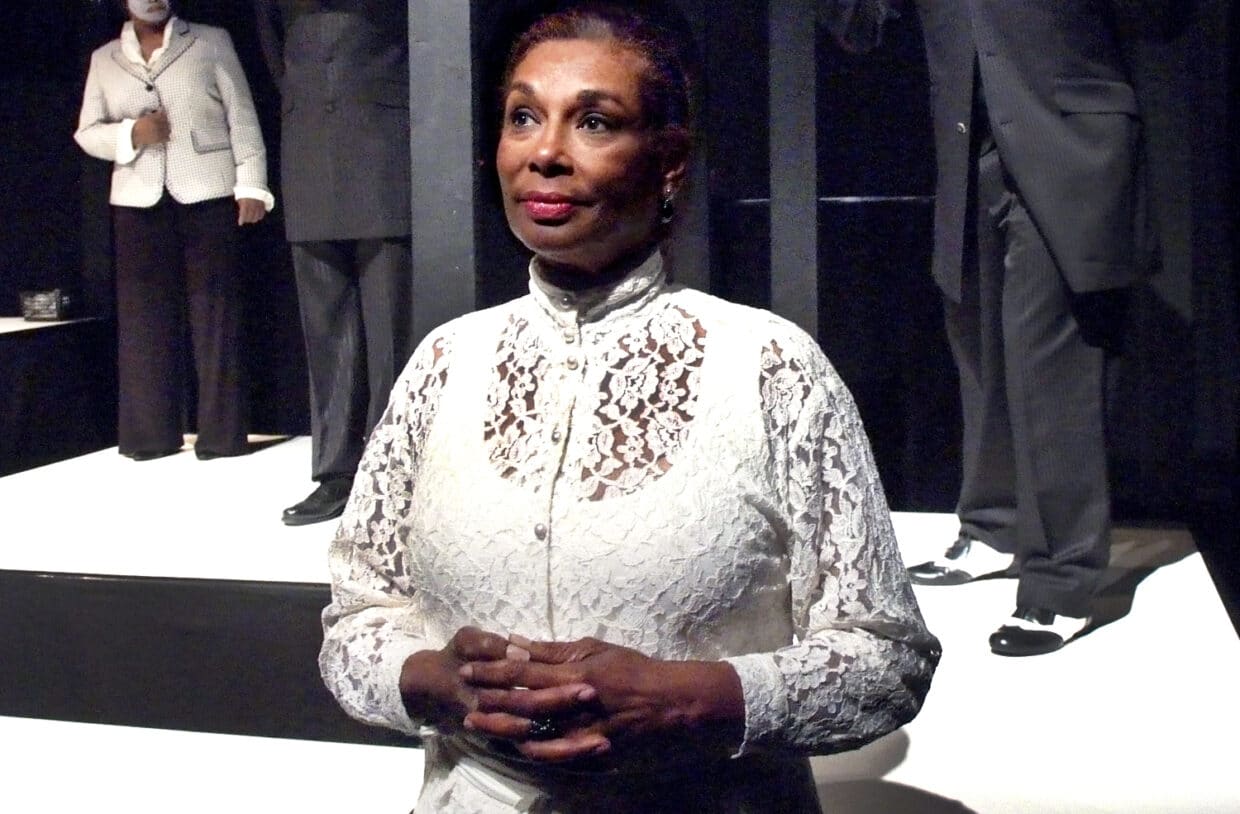 Helen Kamperveen in the performance Elisabeth Samson by Urban Myth. Kamperveen: 'The wave of Belgian actors on Dutch stages changed a lot for Surinamese people. Suddenly we were also allowed to expressive performances with great presence'
© Urban Myth
PINAS: “That’s so Dutch, isn’t it. During my time at the Rijksakademie (National Academy) in the Netherlands, I experienced the same thing. Back then it led to a clash because they didn’t understand me. Why didn’t I let myself be inspired by Picasso, Corneille, or Karel Appel? ‘No,’ I would say, ‘I am Marcel Pinas.’ Because I had learned that in Jamaica: as an artist, to create things with added value and stay true to your own identity. Besides, you can never match Picasso. But I think the academy was afraid of something new. That we would switch roles and that they would learn something from me. And they weren’t open to that. From that moment on, I took a pragmatic stance: I could use the facilities there to visualize my ideas. After that, I went back to Suriname.”
You might also like
In Jozef Deleu’s Poetry, Nothing Was Lost


Leave a Reply
You must be logged in to post a comment.