
Fawaka? Bun! Dutch-language Teen Talk Borrows Vocabulary From Sranantongo

Young people in the Netherlands and Flanders are increasingly using words from Sranantongo, the second language of Suriname. According to lexicologist Vivien Waszink, this is more of a fissa than a fittie. Confused by that last sentence? Keep reading.
Comedian Jan Jaap van der Wal comes onstage with an enthusiastic “Fawaka?” He is hosting the closing session of Nederlands Centraal, an event held in late May 2025, organised by the Dutch Language Union to explore the current state and future of the Dutch language. “Bun!” a few people in the audience respond, somewhat hesitantly. ‘Fawaka’ means “how are things?” (similar to “how’s it going?”) and is a well-known greeting in Sranantongo, one of the primary languages spoken in Suriname. ‘Bun’ is the standard reply – provided, of course, that things are going well.
Many words from Sranantongo pop up in today’s slang – particularly in the Netherlands. Yet, at the Taaluniedag (Dutch Language Union Day), the word ‘Fawaka’ doesn’t get much of a reaction. Probably because there are very few people under the age of twenty in the room.
Sranantongo – often spelled as Sranan Tongo or shortened to Sranan – literally means something like ‘Surinamese language’ and has been spoken in Suriname since around 1650. A precursor to the language was initially used primarily by enslaved people, who developed it as a practical, common language among themselves. Consequently, Sranantongo contains many words derived from African languages. After the onset of colonisation, words from English, Portuguese and Dutch were also incorporated. Consider, for example, tamara (tomorrow), which is very similar to the English word, and neti (night), which isn’t a huge jump from ‘night’. The word tongo (language) bears a striking resemblance to the English word ‘tongue’.
At that same Dutch Language Union Day, business expert and author Wesley dos Santos (who is of Cape Verdean descent) takes part in a panel discussion. On his website, Dos Santos writes about his book, which is “full of inspiring entrepreneurial stories about how you can make your dreams come true through tinkering, hosselen (hustling), and circular thinking”. The moderator, Hasna El Maroudi, asks for a definition of hosselen. The term originates from Sranan and is loosely based on the English word ‘hustle’. In the Van Dale dictionary ‘hosselen’ is defined as “earning money through a side job, casual work, or occasional small-scale trading”. Though it sometimes carries the idea of illicit dealings, in this context Dos Santos uses it to describe a wide variety of imaginative ideas.
Sranantongo contains many words derived from African languages, but also English, Portuguese and even Dutch – for example, the word ‘wortubuku’ (dictionary; ‘woordenboek’ in Dutch: word book)
There is a significant amount of English in Sranantongo, but Portuguese is also evident. For instance, the word fissa (‘party’) is likely derived from a Portuguese word. There is a Dutch influence as well, seen in wortubuku (dictionary; ‘woordenboek’ in Dutch: word book). Another term frequently heard in the language of young people today is skowtu (police) – often spelled as skotoe or scotoe. This can be traced back to the Dutch word schout, which historically referred to a high-ranking police official.
Sranan and Dutch Suriname
Sranan is the second language in Suriname, following Dutch, which is the official language and is taught in schools. Sranan is often referred to simply as ‘Surinamese’, but that is imprecise. Sranantongo is not simply a Surinamese variety of Dutch. There are many varieties of Dutch, such as Flemish or the Dutch of the Netherlands, each with its own distinct characteristics. Surinamese Dutch, in particular, has many unique features – for instance, in its pronunciation. Additionally, certain verbs are used in slightly different ways: in Surinamese Dutch, the verb gaan (to go) often functions a bit differently than it does in the Dutch of the Netherlands. It appears more frequently as an auxiliary verb, for example, in a sentence like Het gaat leuk zijn (It’s going to be fun). While you may hear this in the Dutch spoken in the Netherlands, it is less common. Similarly, the verb zetten (to put/place) is often used in contexts that differ from those in Belgium or the Netherlands: consider the phrase Laat me eten voor je zetten (Let me put some food out for you). There are also other terms considered typical of Surinamese Dutch, such as kousenband (stocking-band) – referring to a specific type of long bean often served with meat – or buitenvrouw (outside woman), a term for a mistress or paramour.
Many words from Sranan have begun to appear in the language used by young people – and not only by those with a Surinamese background
The Netherlands is home to a large Surinamese community, many of whom speak Sranan at home and among family and friends. In Belgium, too, there is also a Surinamese community, though not as large, who use the language. Especially in the last ten to fifteen years, though the trend existed long before that, many words from Sranan have begun to appear in the language used by young people, especially in the Netherlands – and not only by those with a Surinamese background.
Sranan in Dutch hip-hop
In Nederhop – Dutch-language hip-hop – we find an abundance of words from Sranan. Ten years ago, the Rotterdam-based hip-hop group Broederliefde (Brotherly Love) scored a major hit with the track Mi no Lob. In the chorus, the group raps: “You shouldn’t shout at me / Mi no lob deng bari.” That last phrase is Sranan and means ‘I don’t like that shouting’. Lob comes from lobi, which means not only ‘love’ but also ‘to like’ or ‘to love’. None of the members of Broederliefde has a Surinamese background, yet they use Sranan words with seamless ease. Indeed, they incorporate many terms from a wide variety of other languages, such as English, Portuguese, Crioulo (Cape Verdean Creole) and Arabic alongside, of course, a great deal of Dutch.
 None of the guys in the Rotterdam hip-hop group Broederliefde have a Surinamese background, yet they use words from Sranan effortlessly
© Broederliefde
Sranan has been a feature of Dutch-language hip-hop for quite a while. As early as 1999, the late Def Rhymz reached number one of the Dutch Top 40 with his track Doekoe – because, after all, “everyone loves doekoe”. In Sranan, the word is actually spelled duku, as modern Sranantongo typically avoids double vowels. Doekoe means ‘money’, and it is common enough to have been included in the Van Dale dictionary for years. Yet, there are many other synonyms for doekoe in Dutch-language hip-hop and youth slang – rappers, after all, have a hundred words for money. On the other hand, those who aren’t rappers might be skir (or skeer), meaning broke, skint or poor. Skeer can also be used to describe something shabby or worn-out. If someone asks, “what kind of skere trainers are you wearing?” they are referring to old, tattered footwear.
But let’s get back to the topic of money: many slang terms for cash actually come from Sranantongo. A donnie, for instance, refers to ten euros (or ten Surinamese dollars). Doezoe (officially dusun in Sranan) means one thousand, and barki means one hundred. The term barki is used to refer to a 100-euro (or, in the past, 100-guilder) banknote or amount, as well as 100 Surinamese dollars. But barki can also be used to describe someone who isn’t quite ‘all there’. If you aren’t entirely barki, it means you aren’t quite one hundred percent – in other words, you’re not entirely right in the head.
A whole lot of Sranan
Nowadays, many words from Sranan have transitioned from Dutch hip-hop to the daily slang of young people in the Netherlands. While some of the borrowed words do indeed refer to alcohol and drugs – such as bierie (beer), wierie (weed), jonkos (joints) and batras (bottles of hard liquor) – they also cover a wide range of other topics. Fissa (party), for instance, is a popular term, as is fittie (an argument, fight, or commotion) – which clarifies the mystery sentence at the start of this article! Other, more general examples include osso (house), skoro (school), wroko (work) and libi (life).
Kaolo (sometimes spelled kaulo or koulo) is also a hit: young people primarily use it as an intensifier, meaning something like ‘very’ or – to put it less politely – ‘fucking’. For example, in phrases like “You are kaolo stupid” or “It’s raining kaolo hard”. In Sranan, kaolo (also spelled kaoro) actually means something else: ‘ass(hole)’ or ‘arsehole’. It’s not a particularly polite word. Even so, it’s not surprising that kaolo also appears in expressions like kaolo stupid or kaolo hard – a common pattern for such phrases. Take the Dutch word reet (ass/arse): it has various meanings but is also a somewhat cruder term for ‘buttocks’ or ‘rear end’. For quite some time, reet has been used as an intensifier in informal language; it can even be inflected and placed before an adjective. Just as you might say “kaolo hard”, you could also say “rete hard” (or “retehard”) – meaning “fucking hard” – when describing rain. Similarly, you could make a rete stupid remark.
Names, especially those of cities and neighbourhoods, are often adapted in youth slang. Alongside informal, shortened forms like Eindje (Eindhoven), IJtje (IJburg) or Antje (Antwerp), you’ll also encounter many place names derived from Sranan. The most well-known examples are those for the largest Dutch cities: Roffa (Rotterdam), Damsko (Amsterdam), Utka (Utrecht) and Agga (The Hague). And there are more, such as Alli (Almere) and Grontjie (Groningen).
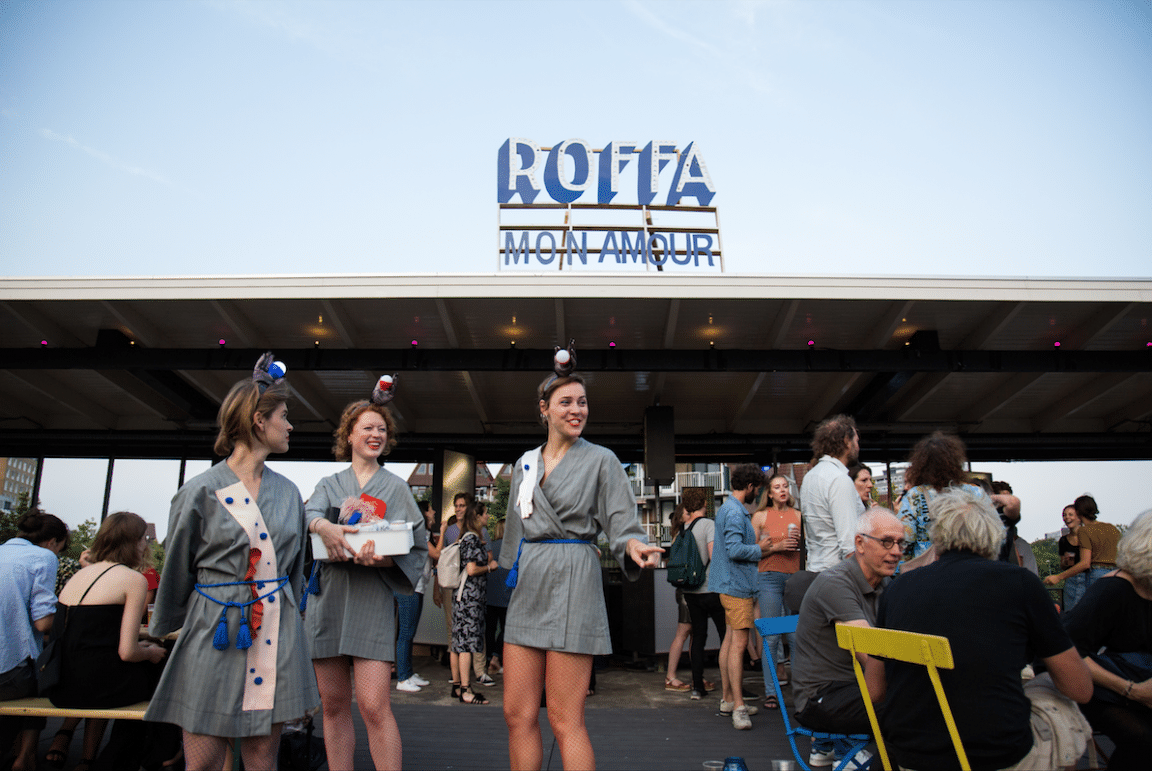 In youth slang, Rotterdam becomes “Roffa”. Sometimes, this name also pops up in settings not necessarily frequented by many young people. For instance, at the annual open-air film festival Roffa Mon Amour
© LantarenVenster
Sometimes, these terms are also used deliberately in settings not typically frequented by young people. In Rotterdam, for instance, there is the annual open-air film festival called Roffa Mon Amour, which focuses on independent arthouse cinema (and is not necessarily targeted towards a teenage audience). Sranan words also appear periodically in advertisements or job postings. At one point, the employment agency Manpower was looking for baggage handlers and used the term doekoe (money) in the job description. Manpower was roundly mocked for this as being a bit like an older uncle at a party who, after a drink or two, is trying a little too hard to sound cool and connect with the younger generation. Still, it certainly grabbed people’s attention, which is precisely what a company wants when they’re trying to recruit new staff. Occasionally, a stray piece of youth slang appears in a newspaper headline. In 2023, during a debate between Dutch political party leaders – which, as usual, devolved into some rather crude bickering – the newspaper NRC ran the headline: “Not that same old fittie [squabble] again,” evoking the feeling of a long, bored sigh.
In Flanders, too, young people’s conversations are influenced by Sranantongo, mainly by Dutch-language YouTube videos or hip-hop tracks
In Belgium, too, where the Surinamese community is much smaller, young people’s conversations are influenced by Sranantongo. This is probably due to Dutch-language YouTube videos or hip-hop tracks. In 2019, the Dutch broadcaster FunX produced a street-interview segment on youth slang, testing young people in Antwerp on terms that are very well-known in the Netherlands. According to FunX.nl, the reporter, Nixon, “certainly had a good laugh”. While some of the words were only common in the Netherlands, almost all the Antwerp youths featured in the segment recognised skotoe (“Cops, right?”) and barki. The feature did veer into the realm of cringe TV when one girl from Antwerp assumed that poku (or pokoe) – meaning ‘song’ – had something to do with Pokémon. And fatoe does not mean ‘fat’, as one person suggested, but rather ‘joke’ or ‘funny’.
Code switching
There is no doubt that Sranantongan words are increasingly finding their way into the Dutch vernacular. Surinamese people of all ages use these words, whereas among speakers of other languages, it’s mainly the young people who do. Of course, slang is not appropriate for every situation. It is typically used when speaking with friends, or perhaps in songs – when the setting is informal. Using a distinct vocabulary serves a purpose: it signals belonging to a particular group and becomes part of your individual identity within that group. And there is, no doubt, a certain appeal in having a language that teachers, bosses and other older people do not fully understand. As early as 1999, linguist Rene Appel interviewed young people about their own specific language use asking, in essence, why they used it. The answers? Slang is “cool”. It’s “not boring”. One interviewee mentioned that he would sometimes change his way of speaking if others – by which he meant older people – began adopting his catch phrases. His reasoning was that “once everyone is using it, it’s no longer fun”. And that is how it still works today.
Using teen talk, whether in conversations, text messages or rap, does not imply any lack of a solid command of standard Dutch. There is also no evidence that using borrowed words contributes to a degradation of language. Young people are generally very well aware of which register is appropriate for a given situation and are unlikely to use their own informal, youth-oriented language when speaking to teachers, bosses or older people, especially those they do not know well. Young people are, in fact, highly skilled at shifting between these different varieties of Dutch – a process known as “code-switching”.
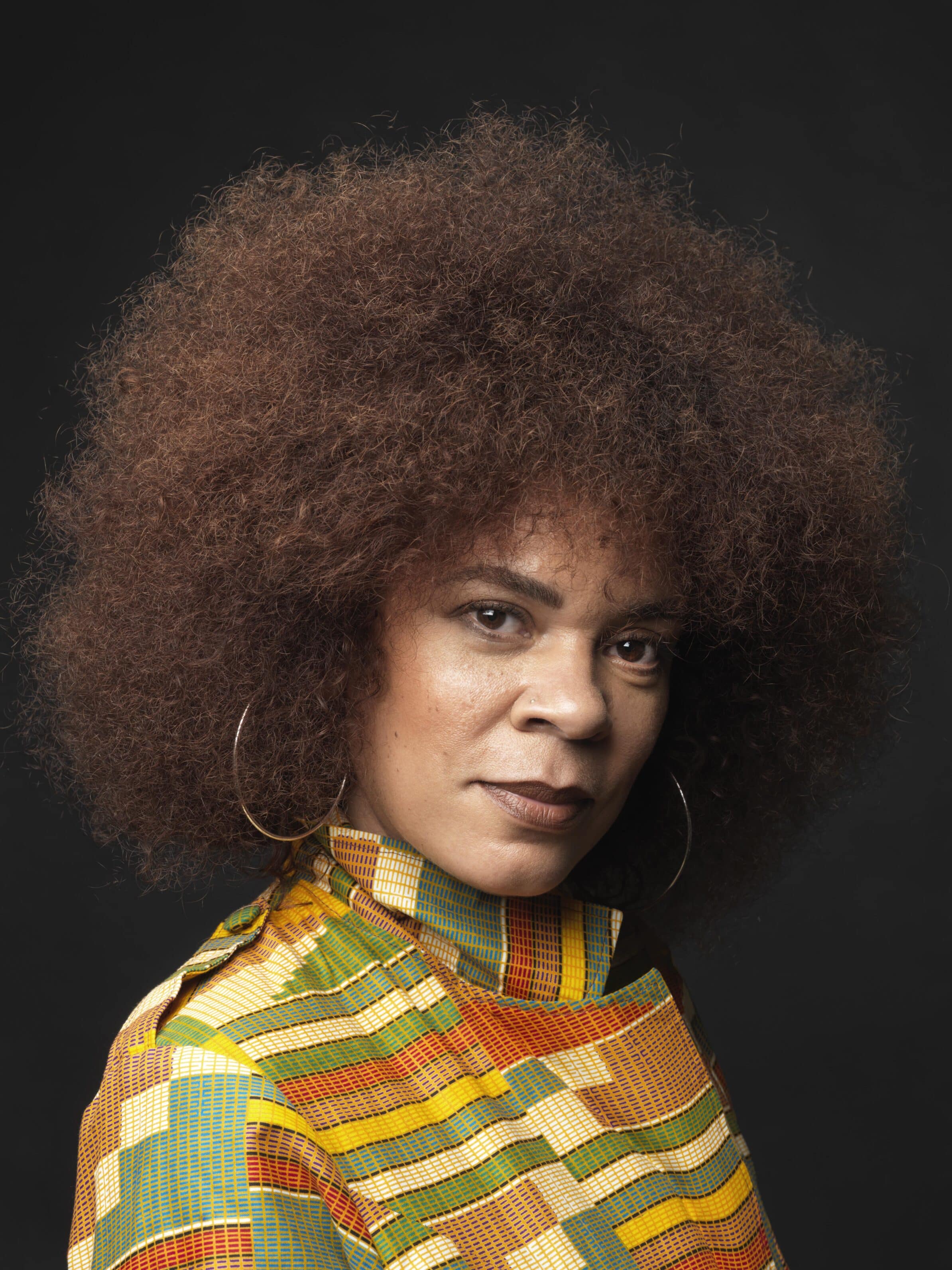 Poet Laureate of the Low Countries Babs Gons wonders how much longer we will continue to label words like Fawaka? as ‘street language’
© Annaleen Louwes
These various forms of Dutch exist alongside one another, and that is precisely how they should be viewed: side-by-side. They are not arranged like rungs on a ladder, from high to low, or better to worse, but rather like a fan.
Do you remember the Dutch Language Union Day, when Jan Jaap van der Wal greeted his audience with “Fawaka?” In an earlier debate during the same event, Babs Gons, the Poet Laureate of the Low Countries, questioned how much longer such words and phrases will be considered as ‘street language’ (straattaal). The word ‘street’ carries a negative connotation, and it seems odd to categorise a form of youth language in that way simply because it includes words of non-Dutch origin. Why not simply call it ‘teen talk’? Or, to highlight the borrowing from different languages, a ‘mixed’ language?
In any case, Gons believes that all these different versions of Dutch should be cherished. And rightly so! Linguistic variation is something to embrace – it’s more of a fissa than a fittie.
Sranantongo in Dutch
- Agga – Den Haag
- Barki – hundred (euro or percent)
- Batra – (bottle) spirits/strong drink
- Bierie – beer
- Bun – good (in answer to the question “Fawaka?”)
- Damsko – Amsterdam
- Doekoe – money
- Doezoe – thousand (euros)
- Donnie – ten euros
- Fatoe – joke, funny, humorous
- Fawaka – How are things going?
- Fissa – party
- Fittie – squabble/argument
- Jonko – a joint
- Kaolo – really bad, fucking
- Libi – life
- No spang – Don’t worry about it.
- Osso – house
- Poku – music
- Roffa – Rotterdam
- Skeer – skint/broke/poor
- Skoro – school
- Skotoe – police
- Utka – Utrecht
- Wierie – weed/cannabis








Leave a Reply
You must be logged in to post a comment.