
Frozen Canals, Open Water: How the Low Countries Taught the World to Play

Lace up a pair of skates, hoist a sail or watch a football team swap positions mid-attack, and you’re doing something the Low Countries had a hand in. Flat land, a long coastline and water everywhere, frozen in winter and liquid the rest of the year, gave the Dutch and Flemish an unusual playground, and they made full use of it. Not every claim they make is undisputed, and some of what they came up with stayed local. But a good deal of it travelled: to the court of Charles II, to the Olympic Games and, in one case, as far as Japan.
Let’s start on the ice. Frozen canals and lakes have always given the Low Countries a ready-made rink. People have strapped animal bones to their feet for thousands of years, but it was the Dutch who pushed skating technology forward. Even the patron saint of ice skating is Dutch: Saint Lidwina of Schiedam. A fifteenth-century woodcut shows her falling on the ice while, behind her, a man glides along on one leg, which suggests skates were by then sharp enough to carry him.
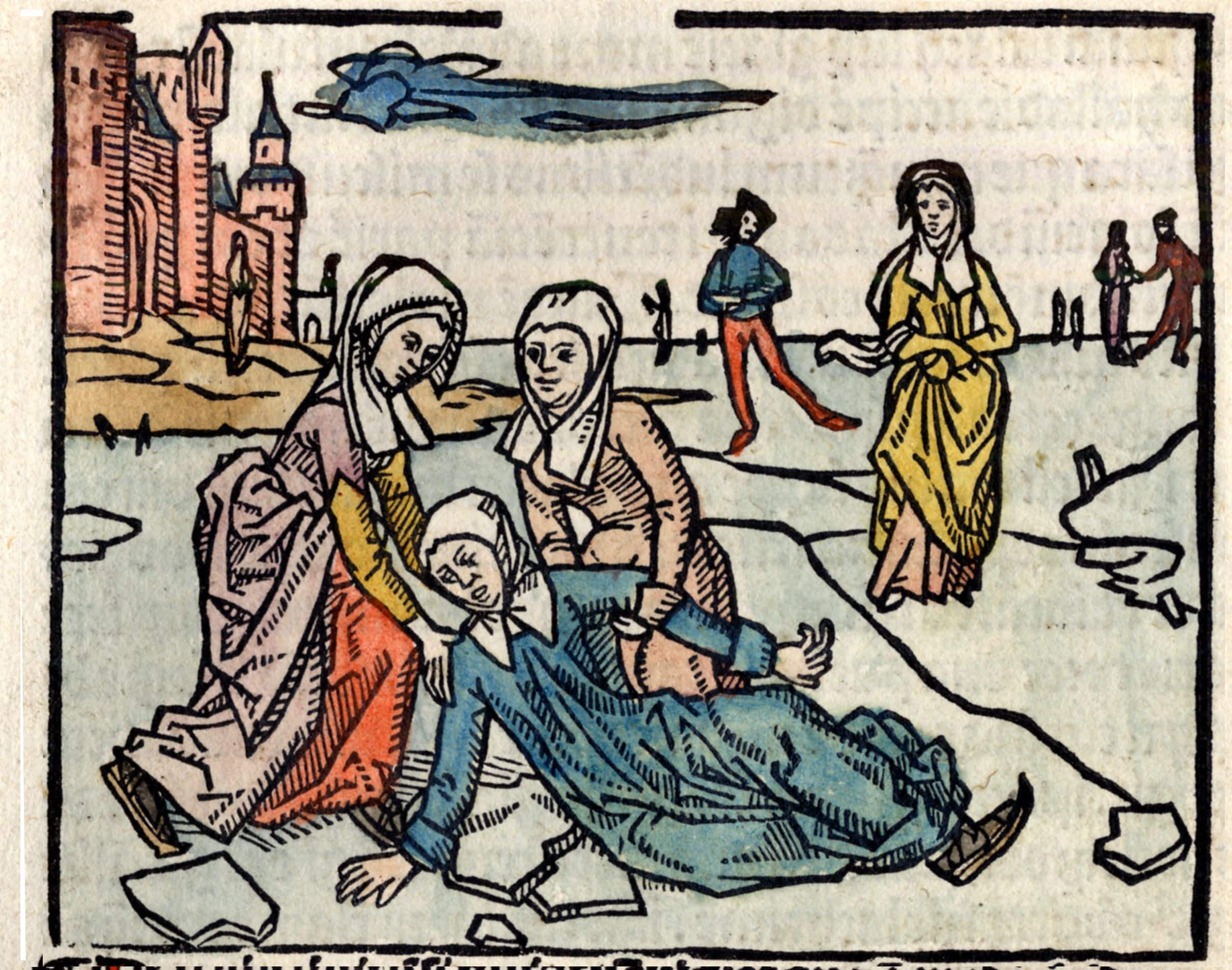 Even the patron saint of ice skating is Dutch: Saint Lidwina of Schiedam
© Public Domain
From there, the habit spread through royalty. During his exile in the Dutch Republic, Charles Stuart, the future Charles II, appears to have picked up skating as a pastime, and he took it home with him. In the winter of 1662, the diarists Samuel Pepys and John Evelyn both recorded watching skaters on the canal in St James’s Park. Charles and his court brought two Dutch novelties with them: metal skates and the Dutch roll, the gliding stroke those sharp blades made possible.
Organised competition followed. The International Skating Union was founded in Scheveningen, near The Hague, in 1892, and held its first world championships in Amsterdam a year later. Dutch speed skaters have dominated the sport for decades: first the likes of Sven Kramer and Ireen Wüst, and more recently Jutta Leerdam and Femke Kok, who both took gold at the 2026 Winter Olympics in Milan. No country has won more Olympic medals in speed skating. Part of that edge came from the ‘klapschaats’, the clap skate. A German invented it, but the Dutch reinvented it in the 1980s and refined it until it made their skaters hard to beat. And then there’s the Elfstedentocht, the ‘eleven towns tour’, an endurance race across Friesland that may date back to the eighteenth century. Sadly, it hasn’t been held since 1997: the ice has not been thick enough along the whole route.
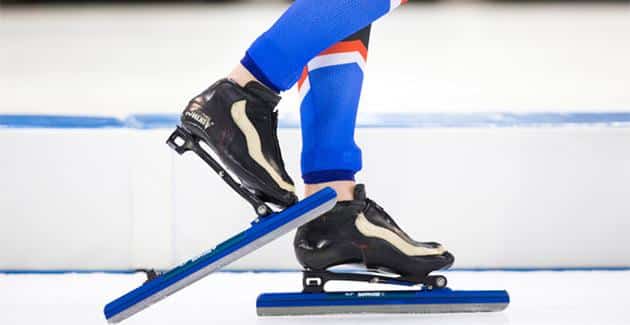 No country has won more Olympic medals in speed skating. Part of that edge came from the 'klapschaats', the clap skate
When the water isn’t frozen, the Dutch and Flemish sail on it. Boats are part of everyday life in the Low Countries. People trade from them, race them and, not uncommonly, live on them. In the early seventeenth century, Simon Stevin built a sand yacht for Maurits, Prince of Orange. In the same century, the Dutch began racing sailing boats, above all yachts, a word that comes from the Dutch ‘jachtboot’, or hunting boat. Charles II was once again taken with the idea and introduced it to England. Sailing still seems to be in the blood. The Dutch-New Zealand teenager Laura Dekker became the youngest person to sail around the world single-handed, and the Ghent-born yachtsman Jacques Rogge went on to lead the International Olympic Committee. The Flying Dutchman, a Dutch-developed racing boat, made its Olympic debut in Rome in 1960.
On dry land, the claims become more contested. Did golf begin in the Low Countries or in Scotland? Supporters of the former point to a tradition dating to 1297, when a game of ‘kolf’ is said to have been played at Loenen aan de Vecht, between Amsterdam and Utrecht. Players hit a leather ball with a club, the ‘kolf’, and tried to reach a target several hundred yards away in the fewest strokes. Anyone familiar with sixteenth and seventeenth-century Dutch painting will recall figures on a frozen lake, knocking a ball towards a hole. The Scots can only show that golf was known there in the late fifteenth century. On dates, then, the Low Countries win, although it was probably the Scots who developed the game we now call golf.
Cricket is an even longer shot. A Flemish scholar has suggested that the word itself is Flemish in origin, though the argument rests on how the word is formed, not on any documents. The game remains firmly English. Still, it has been gaining ground in the Netherlands, and in 2009 the national side, in its distinctive orange pyjamas, scored a famous victory over England at Lord’s in the World Twenty20.
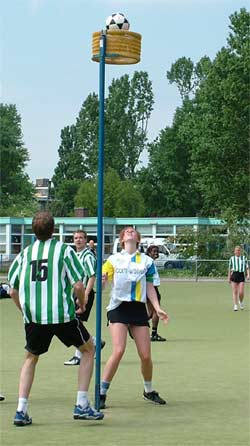 Korfball resembles netball and basketball, but the teams are mixed. The Amsterdam teacher Nico Broekhuysen invented it in 1902
© WikiCommons
No such doubts surround korfball (Dutch ‘korfbal’, literally ‘basket ball’). It resembles netball and basketball, but the teams are mixed. The Amsterdam teacher Nico Broekhuysen invented it in 1902. It is most popular in the Netherlands and Belgium, but is now reportedly played in more than sixty countries.
These days, the sport most closely associated with the Netherlands and Belgium is football, or soccer for Americans. It wasn’t invented in the Low Countries, but some of its most distinctive ideas were. The best known is Total Football, in which players don’t hold one position but swap them throughout the match. An Englishman, Jack Reynolds, laid the foundations as coach of Ajax. One of his players, Rinus Michels, later coached the club himself, refined the idea and took the Dutch national team to the 1974 World Cup final with it. The player most strongly associated with it is the Ajax and Dutch great Johan Cruyff. He gave his name to the Cruyff Turn, which left defenders at sea, and he is often credited with inventing tiki-taka, the short-passing game that FC Barcelona, which he coached for several years, used to such effect. The Dutch men’s and women’s teams have enjoyed great success in orange, and Belgium’s Red Devils have had their moments too.
Finally, back to the water. Dyke jumping, known in Frisian as ‘fierljeppen’ (‘far-leaping’), looks a little like pole-vaulting and comes from Friesland. The story goes that poachers first used the technique to cross dykes and steal eggs from farmers. In the twentieth century it became a sport with championships of its own. It has caught on elsewhere too: Britain has held national championships, and even the Japanese, despite a shortage of dykes, have given it a go.
Not every claim here would survive a referee’s review: the Scots can keep golf, and cricket remains stubbornly English. But skates, yachts, korfball and a whole way of playing football make a respectable haul for two small regions on the edge of the North Sea. Water explains much of it, though not all. Nobody needed a canal to invent korfball or to rethink football, only the habit of looking at a game and wondering whether it could be played differently.

You might also like






Leave a Reply
You must be logged in to post a comment.