
The women missing from Dutch and Indonesian colonial history lessons
Who fought for Indonesian independence? If you were educated in either Indonesia or the Netherlands, you might picture Sukarno, Prince Diponegoro, or a parade of male generals and colonial administrators. You would be unlikely to picture Christina Martha Tiahahu, Maria Walanda Maramis, or Cut Nyak Dhien, women who played significant roles in the independence struggle.
This invisibility is not accidental. One goal of history education is to teach adolescents to think critically about the past, which means confronting colonialism and its effects honestly and completely. Yet research shows that when it comes to the Indonesian-Dutch colonial past, the teaching materials themselves are part of the problem. Despite decades of criticism and growing awareness, remarkably little has changed. Recent textbooks in both countries continue to rely on dominant frameworks that centre the same voices while pushing others to the margins. Women, and particularly women of colour, are among the first to disappear, their roles as freedom fighters, political actors, and historical agents simply left out of the story students are taught to call history.
The lack of multiperspectivity in history textbooks has become increasingly subject to criticism.
The lack of multiperspectivity in history textbooks has become increasingly subject to criticism. Multiperspectivity takes into account the experiences of different historical actors and their contemporaries. It must also represent the views of several historians and includes the addition of alternative narratives alongside the more traditional master narratives. To explore the formative role of history education in understanding the colonial past and its aftermath, generation after generation, we have recently analysed multiperspectivity in Indonesian and Dutch history textbooks.
Such books often rely on master narratives, dominant frameworks that shape how we understand historical events, cultural identities, or social phenomena and the manner in which those elements are presented within a particular community. Master narratives often marginalise other perspectives by presenting a one-sided, authoritative version of events. In contrast, multiperspectivity in textbooks makes an important contribution to an inclusive history education in which all students can optimally participate. For example, psychological studies show that girls who see pictures of women in their textbooks understand the lesson content better than when they see only men depicted. Furthermore, multiperspectivity can help students develop “critical historical thinking” skills, a central goal of history education.
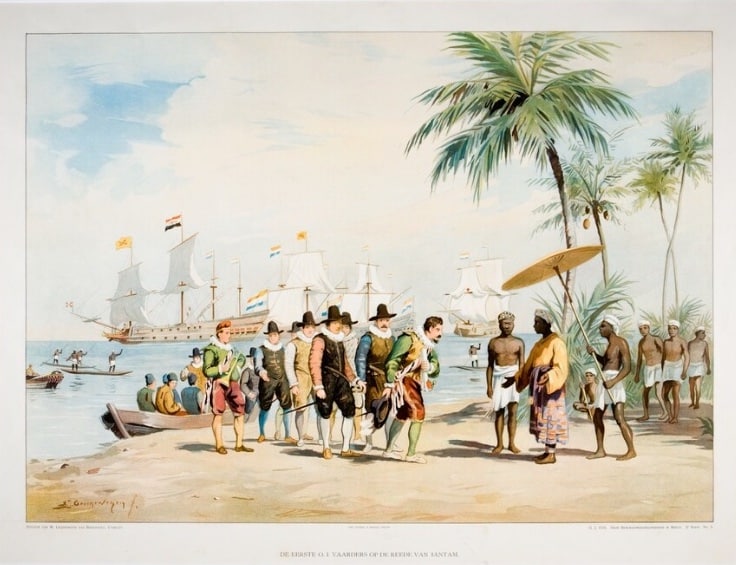 In Dutch and Indonesian textbooks, usually only men (of color and white) are depicted, as in this school poster showing residents of Bantam receiving Dutch colonists. This image appears in Tijd voor Geschiedenis (2022) and Sejarah Indonesia (2014)
© Wereldmuseum, Amsterdam
Our study focused on the representation of historical actors in texts and images in textbooks about the Indonesian-Dutch colonial past. How many women and men of color and how many white women and men were there? Which roles did they play (civilians, clergy, freedom fighters, etc.)? How are they described? By analysing textbooks published between 1948and 2022, we were able to investigate whether any changes have occurred. We also documented similarities and differences between Indonesian and Dutch titles.
Asia- and Eurocentrism
Since 1990, postcolonialism has increasingly inspired textbook research with the aim of changing dominant narratives about Western and non-Western societies and counteracting the global inequalities that result from (neo)colonialism. Previous research shows that European and Asian history textbooks are characterised by Euro- and Asiacentrism, respectively: students, instead of being offered a multitude of complex perspectives, are primarily introduced to historical events, developments, places, sources and actors from the perspective of the majority group(s) in their own national or continental context. Their own context is usually shown in a more positive light than other contexts. Do these findings also apply to Dutch and Indonesian titles?
To find out, we selected sixteen textbook chapters on Dutch-Indonesian colonial history, starting with books published around the time of the Indonesian declaration of independence in 1945. All titles were aimed at adolescents (aged twelve to eighteen), almost all were written by male authors, and the two most recent (from 2021 and 2022) were in digital form.
Titles researched
| Time Period | Indonesia (year) | The Netherlands (year) |
| 1940-1950 | X | Geschiedenis der volkeren (History of Peoples (1948) |
| 1950-1960 | Zaman Dahulu (1956) | Economische ontwkkelingsgang der volkeren (Economic Development of Peoples (1959) |
| 1960-1970 | Nusa dan Bangsa 1 (1962) Nusa dan Bangsa 2 (1962) |
X |
| 1970-1980 | X | Speurtocht door de eeuwen heen (Quest through the Ages (1977) |
| 1980-1990 | Sejarah Berdasarkan (1989) | Achter het heden (Behind the Present (1981) |
| 1990-2000 | Sejarah 2/3 (1993) | Sprekend verleden deel 2 (Speaking Past – Part 2 (1994) |
| 2000-2010 | Sejarah Indonesia (2014) Sejarah Indonesia (2015) |
Sfinx (Sphinx (2001)
|
| 2010-2024 | Sejarah SMA Kelas II (2021, digitaal) | Geschiedeniswerkplaats (History Workshop (2018) Tijd voor Geschiedenis (Time for History (2022, digitaal) |
Euro- and Asiacentrism, nationalism and patriotism can be found throughout the period. Dutch textbooks focus on political-military historical successes that were important to the Netherlands and vice versa for Indonesian textbooks. We also often see sources of Dutch/ Indonesian origin, such as paintings by Dutch/Indonesian artists or interviews with Dutch/Indonesians.
On a linguistic level, both the Indonesian and Dutch titles repeatedly use a ‘we/us’ versus an imaginary ‘they/them’ approach. In the Indonesian books, colonisers are described as ‘cruel’ and ‘violent’, while Dutch textbooks regularly portray Indonesian resistance fighters and rulers negatively. Exceptions to the Eurocentric discourse in the Dutch titles are found in descriptions of (the film adaptation of) Max Havelaar. And both Indonesian and Dutch books thematise Indos (people with an Indonesian and a Dutch parent) and their complex multi-ethnic position in (post)colonial society.
Sprekend Verleden (Speaking Past (1994) and Sejarah Berdasarkan (1989) contain more multiperspectivity, but they are exceptions, rather than the rule. However, the more recent textbooks we examined do not follow this trend (or at least not to a substantial extent). In Speaking Past (1994) the authors explicitly state that they want to sketch an image of Indonesia that contrasts with exoticising narratives from the nineteenth century. They provide a substantial amount of information about social and religious diversity within precolonial communities in Indonesia, use Asian sources (charters, memories of Prince Diponegoro, an interview with an Indonesian politician) and express subtle criticism by using quotation marks (for example, “ethical politics”).
In addition to the political-military developments, extensive attention is given to the way in which the lives of farmers changed during the colonial occupation. The authors also mention both Indonesian and Dutch perspectives on events, and sometimes explore differing opinions within the Indonesian or Dutch communities. At the end of the chapter, students are explicitly asked to put themselves in different shoes by reading (translated) Asian and European sources, and to think about the impact of skin color in (post)colonial communities.
The 1989 book Sejarah Berdasarkan breaks binary thinking by providing an example of political collaboration between indigenous actors and a white person
Sejarah Berdasarkan (1989), written by a woman, breaks through binary thinking by giving an example of political cooperation between indigenous actors and a white person in the Indische Sociaal Democratische Vereeniging (Indian Social Democratic Union). Furthermore, the textbook avoids judgments and refers instead to shared perceptions, for example through words such as “dianggap” (considered as), “dicap” (described as) and passive sentence constructions. The book also avoids using the pronouns we/us, as it is written in the third person. Finally, the digital textbook Tijd voor Geschiedenis (Time for History (2022) also offers important opportunities for multiperspectivity through the inclusion of video interviews with Indo-Dutch people who lived through the colonial period and its aftermath.
Gender and Ethnicity
In addition to analysing the us/them element, our research also focused on the representation of gender (the characteristics and behaviours with which we categorise ourselves and others as female, male, or otherwise) and ethnicity (the ways in which we see ourselves and others as belonging to (multi-)ethnic communities, in which skin color, language, nationality, and cultural practices also play a role). Scientist Kimberlé Crenshaw already pointed out in the 1980s that the intersection of gender and ethnicity is an important mechanism for systematic exclusion; for example in legal systems, but also in education. According to intersectionality theory, women of color are most often disadvantaged because of their gender and ethnic characteristics, while white men are least likely to experience disadvantages.
We found a strong male bias in texts and images in textbooks from both Indonesia and the Netherlands. Indonesian textbooks feature men of colour in political-military roles (President Sukarno, Prince Diponegoro), while Dutch textbooks focus on white men in those roles (Jan Pieterszoon Coen, General Van Heutsz). This is clear when we count the number of recognisable individuals in images: men (white and of color) appear most often. In the digital Tijd voor Geschiedenis (Time for History (2022), the male bias was further reinforced by the fact that it was continuously repeated in the additional reading texts, questions, images and titles via the digital format.
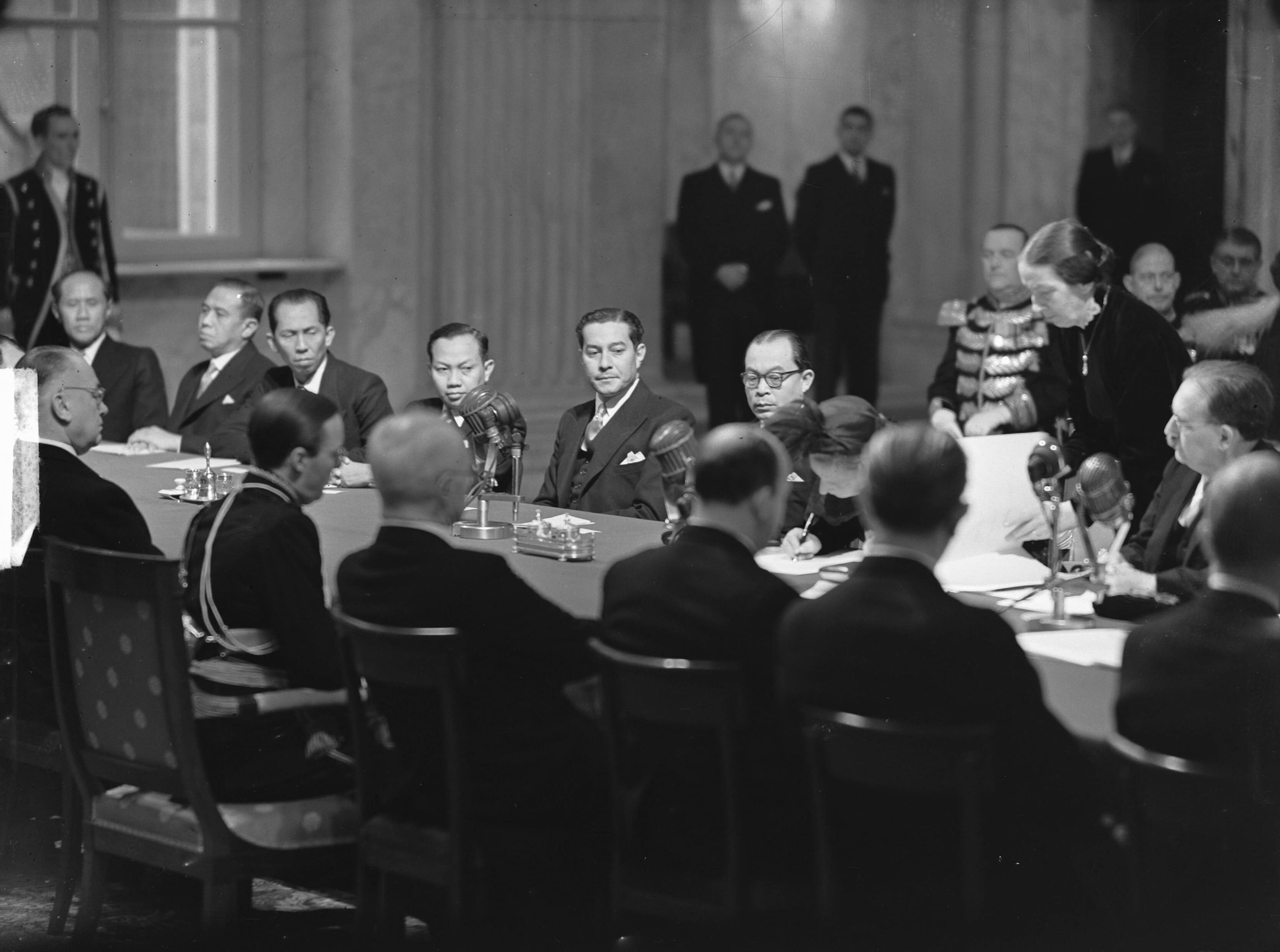 One of the rare white women who appears in textbook images: Queen Juliana signs the transfer of sovereignty. A similar image with a seated Juliana can be found in Time for History (2022)
© Nationaal Archief
The selection of images used in the titles we examined almost erases white women from history. In the additional reading texts there are only sparse references to European queens (Queen Victoria, Queen Juliana), who are mainly described in passive tense, as in “Queen Wilhelmina was also present” (Tijd voor Geschiedenis – Time for History 2022).
When it comes to women of colour, we noted an interesting difference: in Indonesian textbooks, they appear as political-military leaders or women’s rights activists (Raden Adjeng Kartini) or, alternatively, as agricultural workers, mothers or victims of violence. Twenty-five women are depicted in Sejarah 2 Melawan Kolonialisme (1993), while other textbooks only depict between one and eleven women. There is, therefore, no discernable trend of including more women of colour.
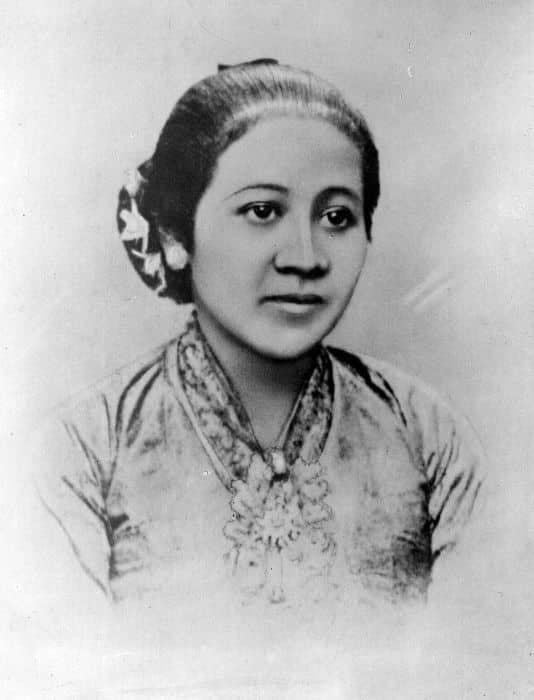 Portrait of Raden Adjeng Kartini, who was depicted in several Indonesian history textbooks, including 'Zaman Dahulu' (1957). Similar images appear in 'Nusa dan Bangsa' (1962) and 'Sejarah 2/3' (1993)
 © Wereldmuseum, Amsterdam
In Dutch textbooks, not a single Indonesian female freedom fighter is mentioned or shown. Women of colour only appear as agricultural workers, mothers or victims of (sexual) violence. There were a few striking photos of women of colour serving or encouraging men; the opposite situation is never depicted.
Inclusive Education
How can we explain the strong and persistent nationalist trends, the male bias and the – with few exceptions – continuing erasure of women from colonial histories in Indonesian and Dutch textbooks?
Well, history education is strongly influenced by political and cultural agendas. In (post)-colonial times, when nations or nation-building are central, the emphasis is often on “strong” leadership and military successes. Patriarchal societies associate such successes mainly with men. The very slow processes of reform and the lack of diverse perspectives can also be explained by the basically conservative attitude prevalent in education. Textbooks tend to stick to traditional (and mainly male-authored) historiography while less attention is paid to socio-cultural history, which tends to include contributions by women.
Our findings suggest there are opportunities for researchers and education professionals who want to include multiperspectivity in history education. Studies over time show the way master narratives erase certain groups and voices. To avoid this, collaboration between scholars, publishers and authors is needed; along with the collaboration of teachers and students. Mixed author teams are indispensable for the development of teaching materials with more multiperspectivity. Our study suggests that Dutch textbook authors can follow the lead of their Indonesian colleagues by including more women of colour in their role as Indonesian resistance fighters. On the other hand, there are opportunities for Indonesian authors to make use of digital media (such as the video interviews in Tijd voor Geschiedenis – Time for History 2022) in order to make history education more inclusive and avoid the pitfall of duplication of male bias.
But even if textbooks themselves change little or not at all, students and teachers can enrich their discourse by, for example, critically questioning the master stories or by introducing alternative source material in class. The Black Archives draws attention to suppressed stories in the poster ‘Ten Times More History’. Recent research in secondary education suggests that this has only happened in incremental amounts so far. Continuous training of teachers and development of citizenship education in various subjects can contribute to change.
Future generations of secondary-school students in Indonesia and the Netherlands may then have the opportunity to learn that Christina Martha Tiahahu, Maria Walanda Maramis and Cut Nyak Dhien made important contributions to the Indonesian struggle for independence. Or that Anna van Gelder was one of Michiel de Ruyter’s wives and that, without her friendship with wives of prominent VOC generals, he might not have acquired so much power and fame. Future generations might undertand that multiperspectivity and critical historical thinking are assets – both in school and the wider society.

You might also like
It’s all double Dutch to ChatGPT

The Struggle to Establish Dutch as the Language of Business in Flanders




Leave a Reply
You must be logged in to post a comment.