
Architect Léon Stynen, a Lyrical Modernist
He had a predilection for concrete, but never lost sight of elegance. His slender, tall buildings embodied the economically booming Belgium of the sixties, but at the same time art and architecture remained intertwined for him. Three books reintroduce us to the modernist work of Léon Stynen.
Like all architects, Léon Stynen (1899-1990) lives on through the oeuvre of buildings he left behind. He built three casinos: in Knokke (1930), Chaudfontaine (1938) and of course in Ostend (1953). The Kursaal is perhaps Stynen’s most famous building. Its monumental aluminum windows capture the reflection of the sea and demonstrate his architectural mastery. He executed complex and large-scale coastal architecture in a clean and controlled way. In addition to casinos, Stynen is also associated with retail buildings. In the 1960s, he built nine clothing shops in the Belgian central and provincial capitals for the C&A chain. He gave the typical concrete shop facades a modernist appearance through the spacing and rhythm of the windows, and he ensured that the series formed a recognisable architectural whole.
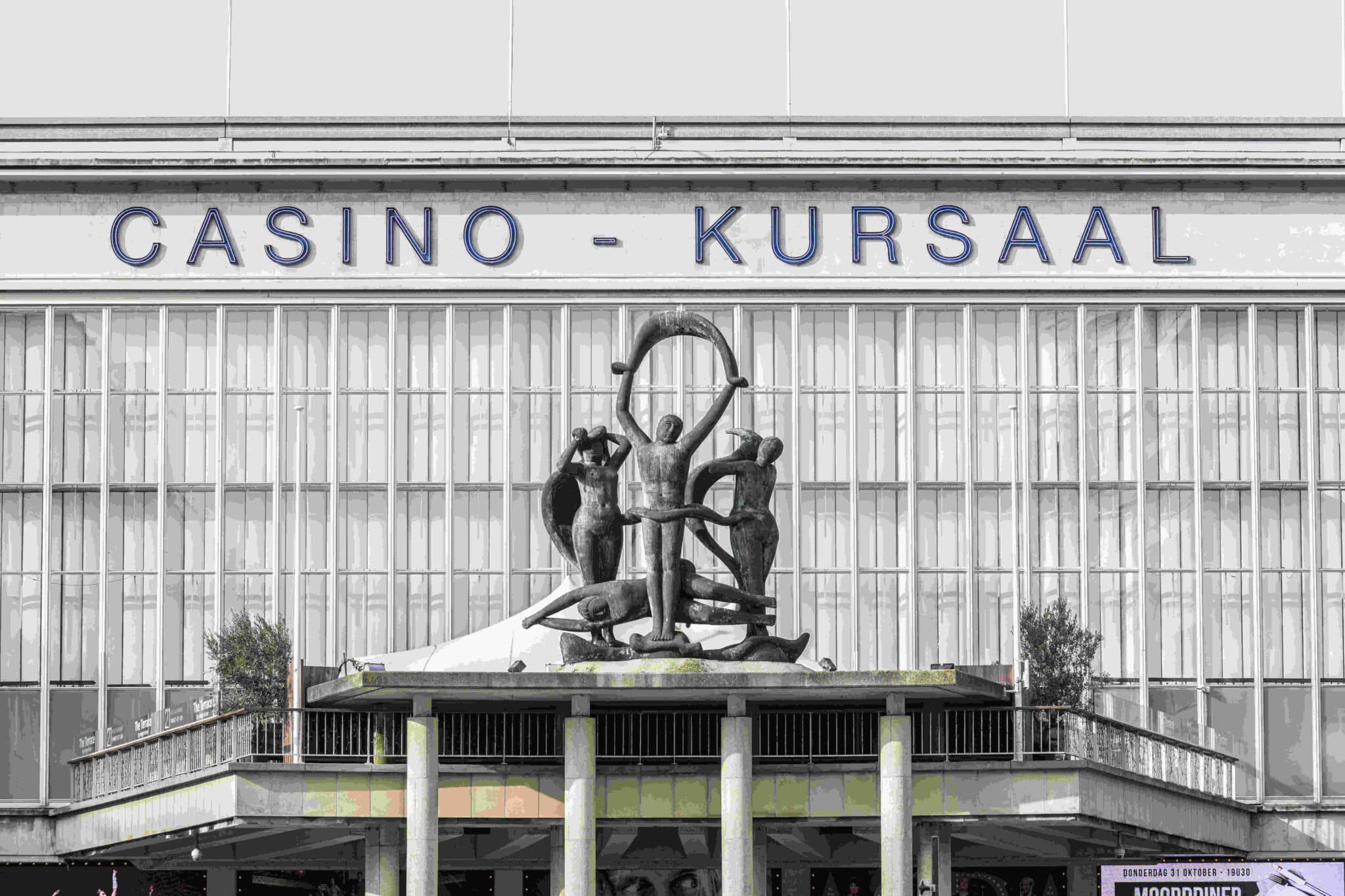 Façade of the Kursaal with work by Oscar Jespers, 'The Four Winds', 1955
© Oscar Jespers
The consumer society that emerged in the 1950s and 1960s and the economic progress (of which Expo 58 in Brussels was the starting point) determined Stynen’s oeuvre. Commercial and leisure architecture occupies an important place within that oeuvre, and he shaped the image of the golden sixties with slim, elegant buildings that expressed themselves completely vertically – examples include the BP office building (1959-1963), the Esso Motor Hotel (1969) and the Riverside Tower residential complex (1967-1972). Stynen realised all three of these projects in his native city of Antwerp, together with Paul De Meyer, who had been a partner at his office since 1947. Lesser known is that Stynen was also a designer, for example, he designed his SL 58 chair for the Expo 58 in Brussels. For some assignments, such as the Kursaal, he created a completely coordinated architecture and interior.
Before the Second World War, Stynen also built classical-modernist interbellum homes, comparable to those of his contemporary Gaston Eysselinck and inspired by the great and admired Le Corbusier. He had his home architecture photographed in the leading Belgian magazine with his own convertible car parked in front of it – showing an interplay of streamlined shapes.
The design of his temporary exhibition buildings were also charismatic, for example, the Pavilion of the Decorative Arts for the World Exhibition in Antwerp (1930) and the Belgian pavilion for the World Expo in New York (1939). The latter was a prestigious government contract awarded to the modernists Stynen, Van de Velde and Victor Bourgeois, and was a way for Belgium to show itself off as a progressive country. Exhibition commissioner Jan Albert Goris (Marnix Gijsen) sold the pavilion to Virginia State University during the Second World War, in a diplomatically charged context. The former pavilion still stands as the Belgian Friendship Building in Richmond today.
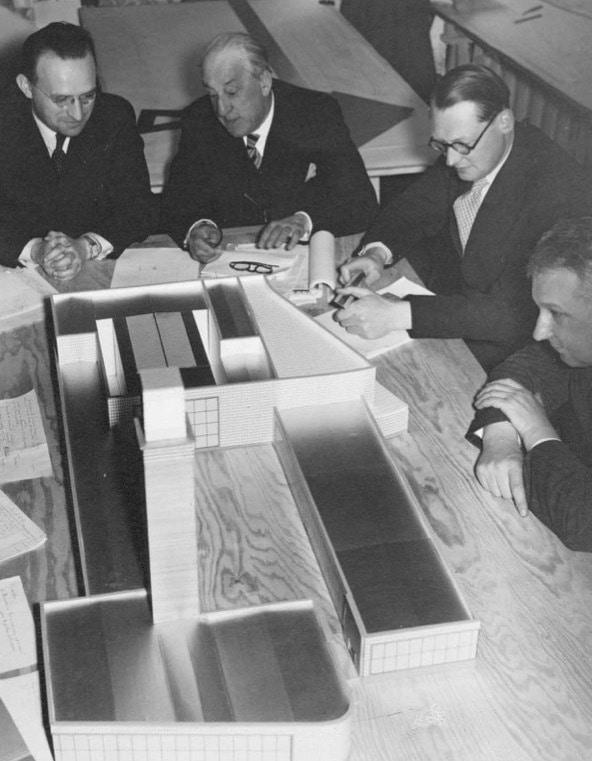 Stynen, Van de Velde and Bourgeois with the model of the Belgian Pavilion for the 1939 New York World's Fair
© Archieven Stynen-Wolski
But Stynen’s legacy is more than the sum of its parts. He was also the third director of La Cambre, the leading art college in Brussels, following in the footsteps of Herman Teirlinck and the college’s founder Henry van de Velde. He was part of an extensive international network that placed him at the center of the modernist movement. There were many similarities between Stynen and Van de Velde, including a preference for the use of concrete, the interweaving of interior and exterior, the emphasis on a pure, rational architecture, and the integration of art and architecture. Stynen’s Kursaal and Van de Velde’s Book Tower are equals as ‘Gesamtkunstwerk’. Stynen became the first chairman of the Brussels Van de Velde Society in 1960. Much like Van de Velde, Stynen also designed a postal boat. Van de Velde designed the interiors of the Prince Bauduin and Prince Albert, while Stynen designed those of the Baudouinville and the Leopold III.
Stynen had a broad international network that placed him at the centre of the modernist movement
Three books are presenting the modernist architecture of Léon Stynen to the public again. Edited by Tania Wolski and Luc Vincent, Architect Léon Stynen is a collaboration with his family, evidenced by the rich selection of photos from the family albums. Sepia-toned photos of Tre Cipressi, the country residence that Stynen built on Lake Garda, show what modern living was like within his private circle. In his contribution, architectural historian Marc Dubois reviews Stynen’s oeuvre and characterises his style as ‘lyrical modernism’.
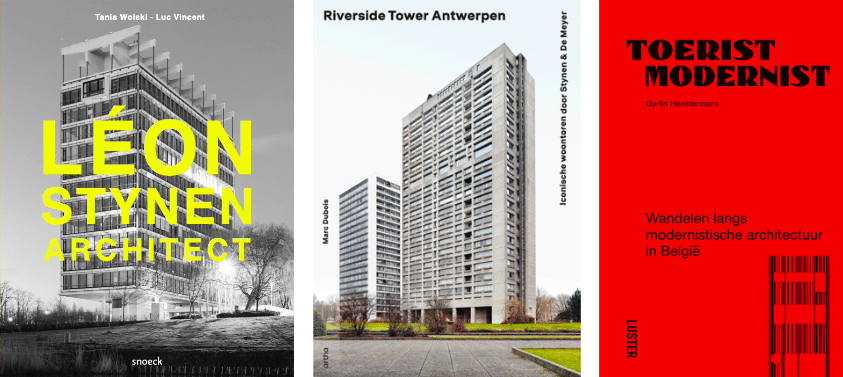
The book highlights the man as an architect, teacher and designer, and devotes a great deal of detail to his tour de force, the Kursaal, still the pride of Ostend, a work of art on the sea dike, and still a spectacle, also on the inside.
Dubois writes a complete monograph about another architectural highlight – the Riverside Tower, the iconic residential tower designed by Stynen and De Meyer. He situates the building in the long history of Antwerp’s Left Bank and talks about it incisively and up close simultaneously, through visual essays by Filip Dujardin and Jean-Pierre Gabriel. The penthouse, renovated by Glenn Sestig, is especially sublime, with its concrete brutalism, softened by a roof terrace of green pine trees and a phenomenal view of the skyline.
More than anything, Architect Léon Stynen and Riverside Tower Antwerp allow us to look at the architect’s work and rediscover the formal language of his modernism. In her book Tourist Modernist, Gerlin Heestermans lets us explore the work of Stynen and his contemporaries step by step. Anyone who follows Heesterman’s walks past modernist architecture in Belgium will not only encounter Stynen in Ostend, but also Louis Geirnaert (Eeklo), Dan Craet (Mariakerke and Kortrijk), Paul-Amaury Michel (Uccle), Gaston Eysselinck (Oostende and Mechelen), Yvon Falise (Liège, with a touch of Le Corbusier), Paul and Jozef Schellekens (Turnhout), Renaat Braem and Walter Van den Broeck (Deurne) and Willy Van der Meeren (Heizel).
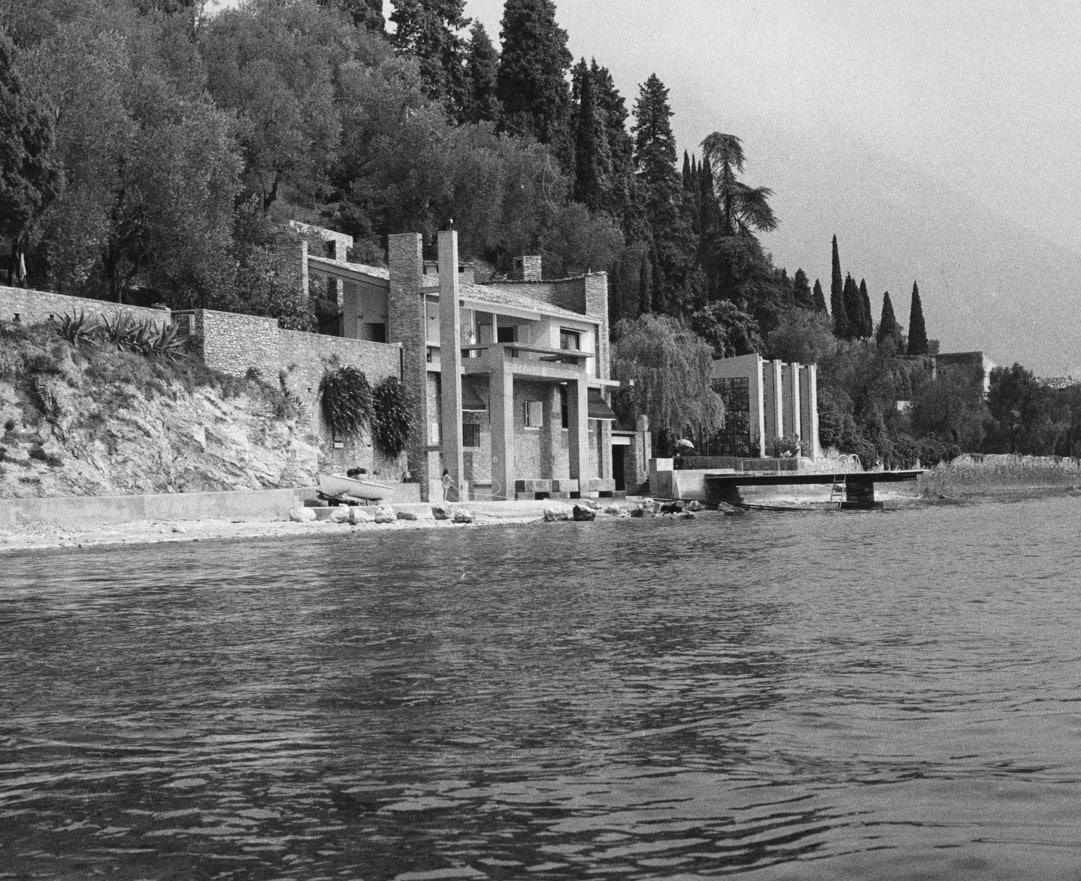 Tre Cipressi, Stynen's Italian home
© Archieven Stynen-Wolski
Back to Stynen. He had three cypress trees planted around his Italian home, which represented the reason, beauty and wisdom that had formed the basis of architecture since classical antiquity. These trees say something about the architect – even throughout the modernist experiment, Stynen never lost sight of the rational, elegant, and in terms of construction, the solid, well-built form.
You might also like




Leave a Reply
You must be logged in to post a comment.