
Dutch Needs Its Own AI Models
ChatGPT and other AI applications are highly proficient in Dutch, but lack an understanding of our cultural context. Flanders and the Netherlands are working together to develop sustainable alternatives rooted in local culture.
Artificial intelligence: commonly abbreviated as AI. For years, it was a term you would occasionally come across, but it was not yet widespread. It was mainly something computer specialists talked about. Until, all of a sudden, it was everywhere. A series of interconnected developments and rapid innovations, such as deep learning and more powerful computer chips, enabled AI developers to make major advances from around 2012 onwards.
Since the 2020s, AI applications have become available to everyone with an internet connection. With just the press of a button, you can now create new paintings in the style of Picasso, generate entire stories or speeches, and place actors in scenes they never actually filmed. Every student, content writer, translator, lawyer, researcher, and policymaker can use AI, and, above all, must do so.
The consequences of AI’s rapid rise in recent years are not yet clear. What is certain, however, is that they will be profound. It is therefore important to reflect on the impact of AI on the Dutch language. Is the Dutch language ready for what lies ahead? What about Dutch large language models (LLMs)? What is the government doing?
Generative AI
Let’s first take a step back and look at the terminology. AI in particular is used so widely that it has become almost impossible to capture what we mean by AI in a single definition. In the most basic sense, artificial intelligence is simply a computer system created by humans to perform tasks we would normally associate with human intelligence, such as reasoning, creating art, producing text, or analysing data. Computers have been able to do some of these things for much longer, but widely accessible applications for some of these tasks have only emerged in the past five to ten years.
When people use the term AI in everyday language, they often mean something much more specific. For example, someone might say, “I used AI to write my cover letter,” or, “AI is a major threat to translators.” In both cases, they use the term AI to refer to a piece of software or an application that produces, processes, or modifies text, images, or video in a way that appears human-like. This is what we mean by generative AI. It can be used for all kinds of purposes, but more broadly, this form of AI is relevant to the Dutch language, culture, and literature. In this article, we focus primarily on language. And when you talk about language, you inevitably have to talk about LLMs, or Large Language Models.
For sensitive topics, such as politics or gender relations, it's definitely undesirable for us to be using Anglocentric AI models here
An LLM generally refers to a specific type of computer model that is based on how biological neural networks, such as those in our brains, are structured and function. Exactly how they work is fascinating—and complicated. An LLM always has, at a minimum, these components: a large amount of data, a component that analyses that data, a set of learned (language) rules, and a component that can generate output. An LLM needs to be tested, trained, and evaluated. A user interface then needs to be built for it, or it needs to be integrated into existing computer programs. Once you have done all that, you usually end up with a chatbot. At the moment, ChatGPT, Claude, Gemini, and Copilot are the most well-known chatbots.
The good and the not-so-good news
That covers the theory. Now let’s look at how existing LLMs work in practice and where Dutch stands. We’ll start with the good news. As AI experts Tanguy Coenen from imec (Flanders) and Dr Saskia Lensink from the Netherlands Organisation for Applied Scientific Research (TNO) showed in a recent presentation to the Taalunie, most LLMs can understand and produce Dutch quite well. This is good news in itself, but it also has two other important positive implications. First, this shows that the commercial companies behind these LLMs have access to enough Dutch-language data for their chatbots to perform well in Dutch. This means that Dutch currently has a strong position in the digital world. That is no small thing, given that there are many languages for which this is not a given. Second, at a more fundamental level, this demonstrates that these companies consider Dutch important enough to train their models to handle Dutch. In other words, Dutch has enough status as a language to keep up with other languages online.
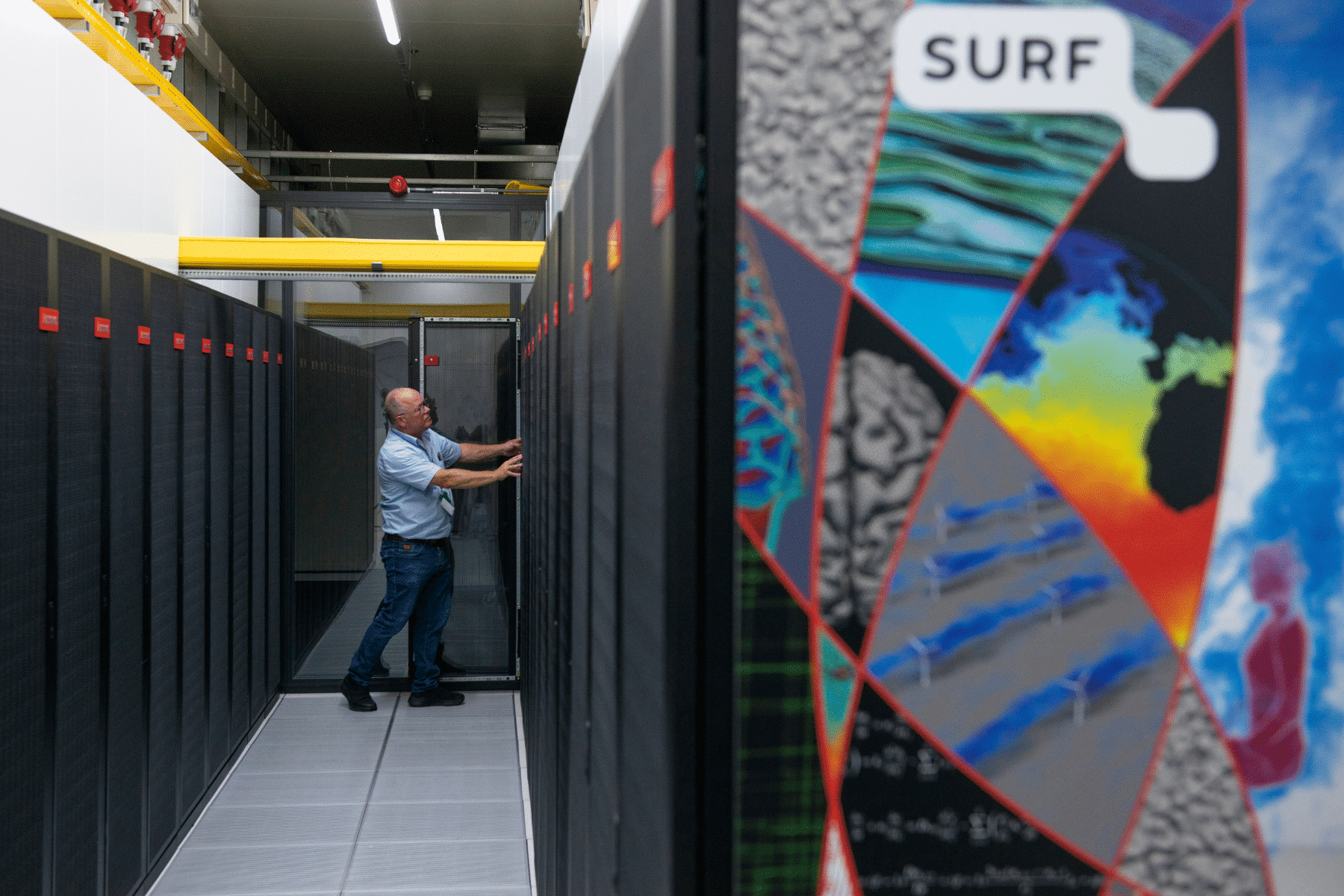 GPT-NL, the Dutch generative language model, runs partly on servers hosted by SURF, the ICT cooperative association of Dutch educational and research institutions
© SURF
There is a downside, however. It is well known that all commercial language models, including ChatGPT, are based on large-scale copyright infringement. This has resulted in lawsuits, including a lawsuit filed by The New York Times. None of this has led to real solutions, though, for Dutch or any other language. What is specific to Dutch (or effectively any language that isn’t English) is that existing LLMs struggle with Dutch and Flemish culture. This has to do with the data the LLMs are trained on. Although some of the data is in Dutch, most of it is in other languages, particularly English. How you can get reasonably accurate Dutch output from this data is a story in itself. More importantly, the source of the data inevitably introduces certain biases or preferences. In this case, the data tends to reflect an Anglocentric worldview, which can differ in some respects from Dutch or Flemish perspectives. This is particularly undesirable when it comes to sensitive topics, such as politics or gender relations.
In 2023, the Dutch government commissioned the development of its own LLM, GPT-NL, partly to address issues of bias and copyright. The aim was to develop an ethically responsible and culturally embedded alternative to existing language models, many of which are developed by commercial American companies. GPT-NL is a joint project of three independent organisations: TNO, the ICT cooperative for Dutch education and research institutions (SURF), and the Netherlands Forensic Institute. They aim to be transparent, legally sound, energy-efficient, and respectful of privacy. Their success is evident from the praise they received from the expert jury of the Dutch AI Award, which honoured the model in March 2026 for precisely these qualities. At the time of writing, GPT-NL is being cautiously tested with a few selected users.
Flemish-Dutch cooperation
That brings us up to the present. What does the future hold? AI is receiving an extraordinary amount of attention. Every sector seems to have an AI plan, and every institution seems to have an AI advisory group. The sector itself also keeps pushing for more funding and attention, for example in the National AI Delta Plan published in the Netherlands in November 2025.
Existing AI models struggle with Dutch and Flemish culture because they are largely trained on English-language data
The topic is also receiving political attention, especially in the context of digital autonomy. Politicians have deep concerns over the excessive dependence on primarily American digital service providers, such as the Dutch government login system DigiD. For this reason, Flanders established the AI Expertise Centre in early 2024, as part of the Digital Flanders Agency. In March of that same year, the Flemish government also presented the Flanders AI Policy Plan 2024–2028. As part of this initiative, the government is encouraging businesses to use AI and has invested in what it calls “top strategic basic research”. In January 2024, the Dutch government also presented a Government-wide vision on Generative AI. In recent years, it has also invested in a number of major projects, such as a Dutch AI factory in Groningen. Finally, European cooperation has also resulted in the development of the multilingual TildeOpen LLM.
Cooperation is essential for both the Netherlands and Flanders, as their governments cannot do this alone. The investment required is simply too great, both in manpower and financially. But at what level should this cooperation take place? Working together at the European level makes sense, but there are concerns that decision-making at this level may be too slow to keep up with developments.
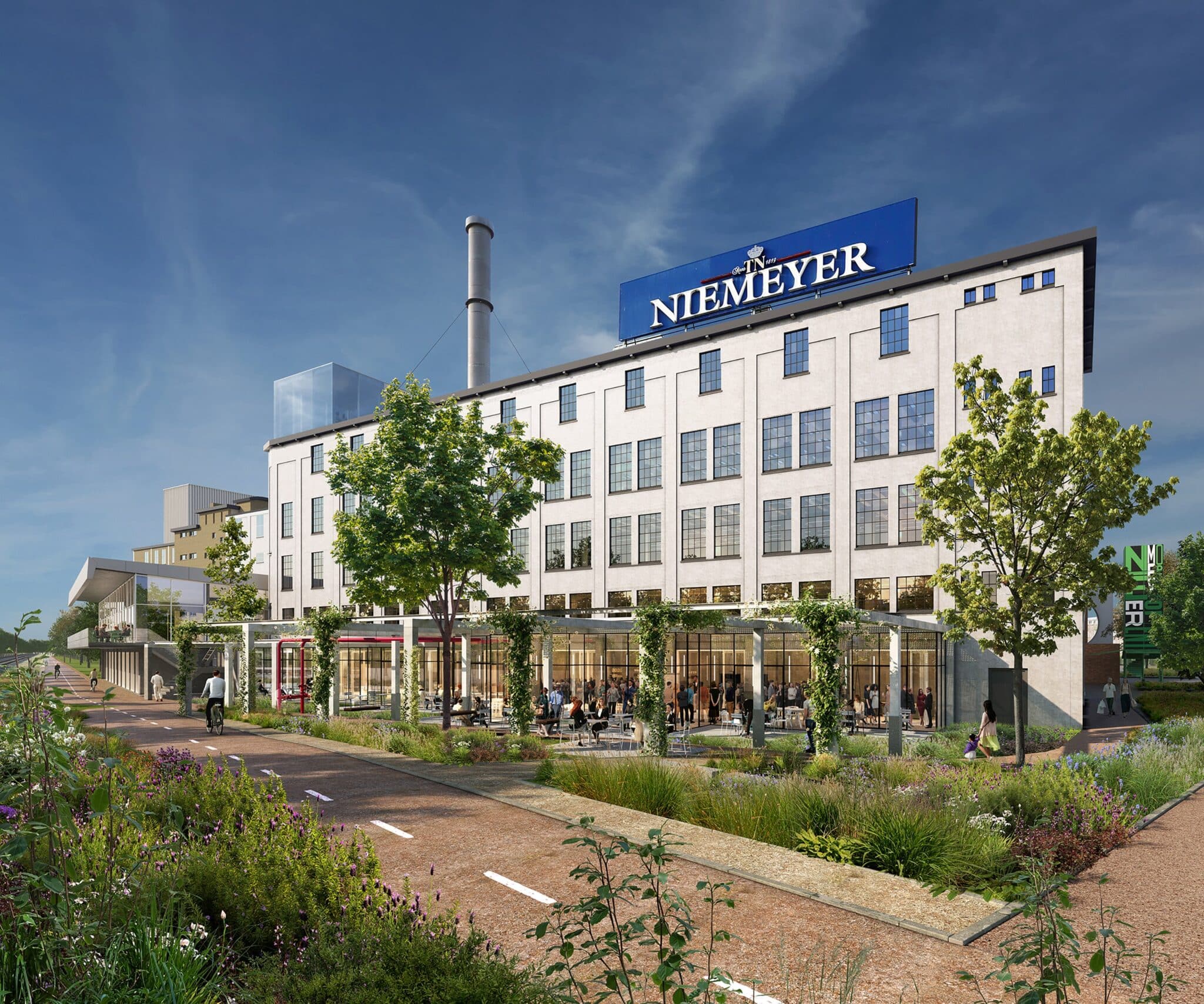 The old Niemeyer tobacco factory in Groningen, where a digital hub is set to arise in the future
© Niemeyer Opent
For that reason, cooperation at the language level is an obvious choice, and so is the Taalunie’s role in it. Under the auspices of this organisation for Dutch language expertise and policy, a working group on AI for Dutch was established in January 2026, consisting of representatives from several Dutch and Flemish stakeholders and universities. In May 2026, the working group presented the first version of its action plan. Its aim is to create “a modular and federated infrastructure to move from individual projects towards a sustainable AI ecosystem for the Dutch language.” Put simply: bringing separate projects together and making sure they align. In even fewer words: cooperation and alignment. We have to invest across five pillars: data, infrastructure, AI development, knowledge transfer (valorisation), and knowledge sharing.
In concrete terms, the working group intends to set up an expertise centre, strengthen and connect data infrastructure across borders, and focus more on practical applications for different sectors, including healthcare and the public sector. As promising as it sounds, for now it remains just a plan. Time will tell if and how governments will put it into action. That it will require substantial funding is only to be expected.
The ideal
So, all kinds of plans are being drawn up for how to deal with AI. But before we think about where we want to go, we should first consider how the use of AI is affecting everyday life. The impact is substantial: there are serious questions about the sustainability of the financial model underpinning AI, the environmental and energy costs of data centres are astronomical, and the social consequences are almost impossible to foresee. In education, for example, there are growing concerns over how AI affects assessment and the way students learn to write and research. This has led to increasing calls for a more critical approach to AI and the use of AI applications. These concerns show how important it is to keep raising awareness of AI as its use continues to grow. They also demonstrate the importance of GPT-NL. Ideally, this model will become widely available to all language users.
AI applications should reflect the full breadth of the Dutch language and culture as accurately as possible
Generative AI is almost certainly here to stay. So what should it ideally look like? From a linguistic point of view, the most important thing is that AI applications reflect the full breadth of the Dutch language and, above all, its culture. This matters particularly for Dutch, because linguists agree that digital representation is crucial to a language’s long-term survival. A recent report on Dutch as part of the European Language Equality project showed that Dutch is in a relatively strong position, but that we cannot afford to be complacent. This makes the Taalunie’s action plan AI for the Dutch Language a great place to start. Specifically in terms of language, it is important to continue digitising sources and making them accessible, especially for varieties of Dutch that are currently underrepresented, such as Surinamese Dutch and regional varieties such as dialects.
These technologies have a lot to offer, both to us and to the Dutch language. But we should remember that all that glitters is not gold. Rather than getting carried away by the latest developments, we need to remain critical yet constructive. Wouldn’t it be great to see that distinctly Dutch and Flemish attitude reflected in AI?

You might also like








Leave a Reply
You must be logged in to post a comment.