
Special Delivery: How One Family Made Brussels Europe’s Post Office
The sun is setting as a relay rider urges his horse onward towards a small stone building in the distance. The man blows a loud blast on his horn and a light appears in the window. After a bit of commotion in the building, a fresh horse and a courier stand ready and waiting, when the rider pulls up in front of the building. The rider hurriedly hands over the bag of letters he has carried for forty kilometres to his successor, who attaches the pouch behind his saddle and rides off into the night.
Horses and riders did the work in the sixteenth century. Today, five centuries later, letters and parcels reach their destinations thanks to tracking systems and motorized vehicles. Despite – or perhaps partly because of – these and other technological innovations, traditional postal delivery services seem doomed to disappear. The Danish national postal service stopped delivering letters at the end of 2025 and postal companies in Belgium and the Netherlands have seen a steady decline in revenue for years. Currently, shares in the Belgian company Bpost are worth just €1.22 – down from €28 in 2018. It may be that only our appetite for online shopping will be able to save the traditional postal services.
In the sixteenth- and seventeenth centuries, an international, European postal system had become essential to the work of government. Fortunately, by that time a network of connections spanning the entire continent had been developed and mapped out by a single family; a family that received a noble title in recognition of its services. To get to know them, we must go back to a small, twelfth-century village in northern Italy.
The Badgers
Sometime in the twelfth century, a family settled in the hamlet of Cornello dei Tasso in the Bergamo region. They adopted the village’s name as their surname, Tasso – the Italian word for ‘badger,’ the animal that also features on their coat of arms – and began providing services as mule-mounted couriers. The Tasso family turned out to be exceptionally reliable and, over the years, they built and maintained a strong reputation as couriers down the generations.
In 1490, the family was given a major commission: Maximilian I, Archduke of Austria and later Holy Roman Emperor, wanted Francesco de Tasso to establish a postal link between the ducal court in Innsbruck and the court in Mechelen where the royal children resided. In response, de Tasso established an effective connection between the two cities. A carefully planned route running from Brussels via Augsburg in Germany ensured that letters and parcels arrived at their destination in Austria in just five days (or six in winter). While other couriers were frequently robbed or turned out to be dishonest themselves, de Tasso’s services were exceptionally reliable and efficient.
While other couriers were often robbed along the way or turned out to be crooks themselves, de Tasso's services were exceptionally reliable – and efficient
It was Maximilian’s son, Philip the Handsome, who rewarded Francesco de Tasso for his work, appointing him Captain and Master of the Postal Service in 1501. From that point on, de Tasso oversaw the organization of all the imperial postal routes within the Habsburg Netherlands – a vast patchwork of territories. When Philip the Handsome subsequently inherited his Spanish territories a few years later, the network was complete: Francesco Tasso – who, by then, had changed his name to the more German-sounding Franz von Taxis – expanded his postal routes across Europe to link the Habsburg courts with other key centers of royal power. Deliveries went from Brussels to the court in Innsbruck, to the Spanish seat of power in Burgos and on to Rome and Naples in the Italian territories. Taxis’ postal routes even ran through France, notwithstanding the fact that it was ruled by a rival monarch, Francis I.
The palace in Brussels
The rapid and accurate exchange of information facilitated by von Taxis made governing the vast Habsburg Empire both possible and significantly easier. In 1512, Maximilian I rewarded Franz von Taxis with a noble title in recognition of his “loyalty, expertise, and speed – working day and night.” By this time, the newly minted Count von Taxis had moved to Brussels, close to the court in Mechelen where the royal grandchildren lived. In Brussels, von Taxis built a lavish palace with a magnificent garden on the Sablon, where he rubbed shoulders with other aristocratic families, such as the Egmonts and the Arenbergs.
Brussels thus became the nerve centre of European postal connections. From that headquarters, the master of the postal service oversaw the entire system. The speeds at which it operated were unprecedented. A letter from Brussels could reach Paris in 36 hours (in summer) or 40 hours (in winter). A letter to Burgos? Just seven days would suffice. Deliveries could arrive in Rome – the longest route – within ten-and-a-half to twelve days, depending on the season. Suddenly, the Mediterranean no longer seemed quite so distant to the people living in Innsbruck or Augsburg.
Relay station
But how did Franz von Taxis manage to transport mail at such a dizzying pace in the sixteenth century? A rider covering the more than three hundred kilometres between Paris and Brussels on a trained horse could travel an average of sixty kilometres a day. However, both horse and rider also need to eat, rest and sleep. Consequently, a one-way trip between Brussels and Paris would take about six or seven days. That was too slow for von Taxis, so he devised an ingenious system that improved postal delivery by leaps and bounds: relay points.
Along every postal route in his network, von Taxis established a stopover every thirty kilometres, where the courier and horse could be swapped out. Upon coming within earshot of the next station, the courier would blow his horn. (Incidentally, a post horn was featured in the Taxis family coat of arms and remains a symbol for many national postal services to this day, including Belgium’s Bpost (in a stylized form). At the station, the next rider and horse had been readied with lightning speed to ensure a seamless relay: the load of letters had to be handed over as quickly as possible. An estimated twenty thousand employees kept this relay system running, allowing for unprecedented speed in the delivery of information throughout Europe.
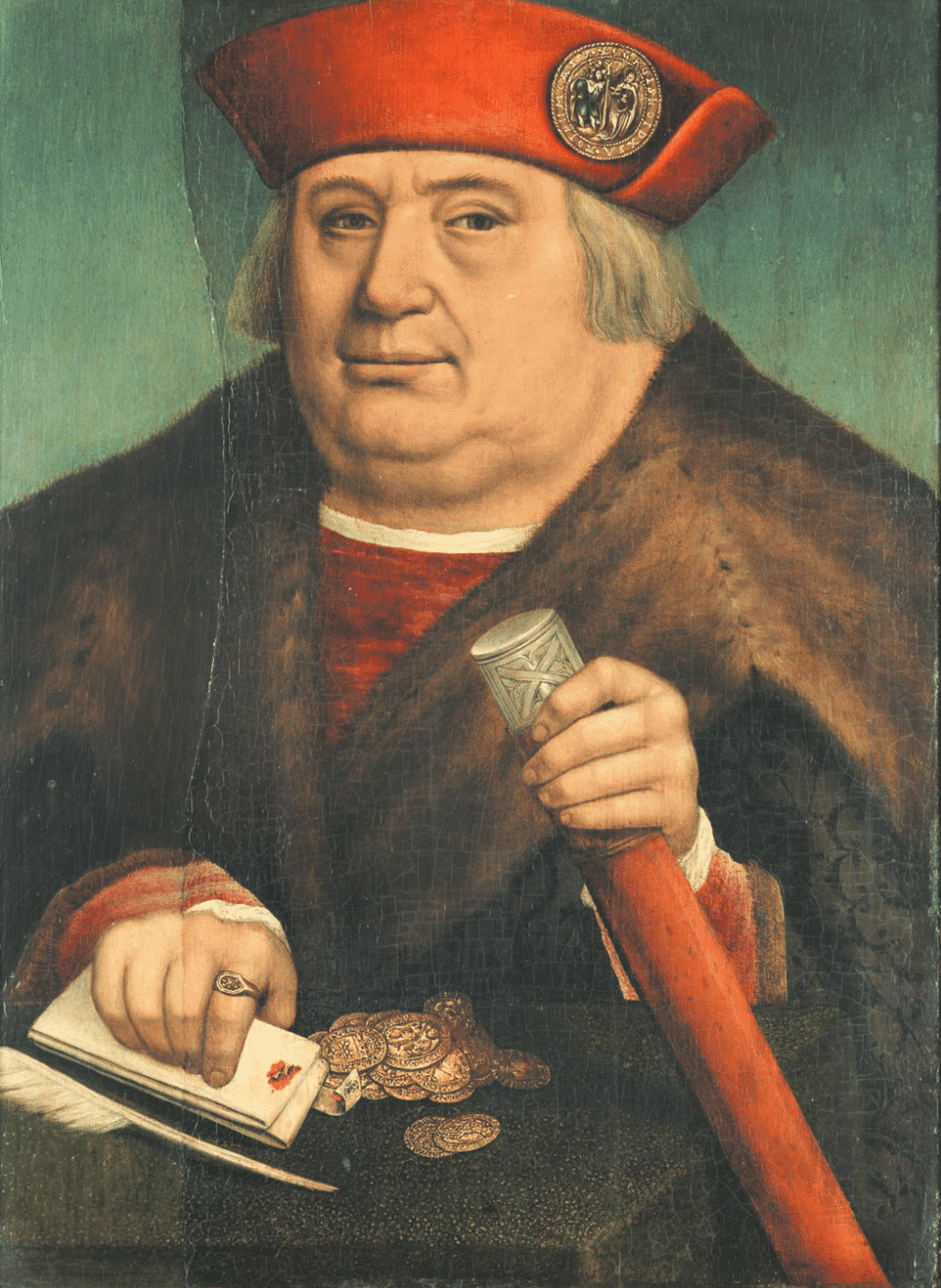 Franz von Taxis devised an ingenious system that took mail delivery forward in leaps and bounds: relay stations. Oil portrait attributed to the Master of Frankfurt, c. 1514
© rv
But the relay system was not von Taxis’ only clever innovation. Until the early sixteenth century, the postal service had been the sole preserve of kings and emperors, who were not always as wealthy as they pretended to be. Payments were sometimes slow to arrive… yet, financing such a sophisticated system naturally cost a fortune, so von Taxis decided to let everyone use his network. Provided they paid in cash, of course.
The postal service still remained primarily the preserve of the wealthy, but the move towards a system for private use did democratize the dissemination of information. Commercial, religious, diplomatic and scientific organizations could exchange information via this new courier relay. The newly available postal service played a crucial role in the spread of newspapers and periodicals – another key method of information dissemination. Franz von Taxis deserves all the credit for this innovation.
The Magna Carta of the postal service
The financial rewards for that gruelling day-and-night labour poured into von Taxis’ coffers. Then, in the winter of 1516, his postal monopoly in Europe was further consolidated: Charles I – the new king of Spain and later Holy Roman Emperor – re-appointed von Taxis Captain and Master of the Posts with an accompanying decree explicitly stating that no other companies were permitted to deliver mail within the Habsburg territories without the authorization of von Taxis or his nephew Johann Baptista. That decree came to be known as the “Magna Carta of the postal service” due to its immense significance. A postal empire had truly been born.
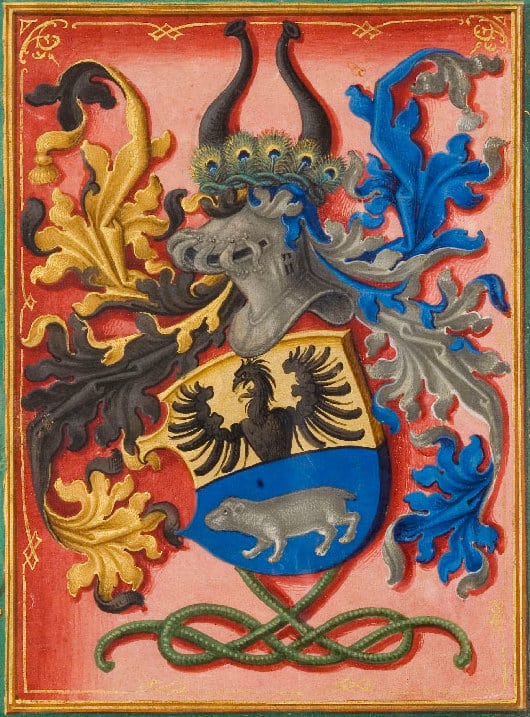 The coat of arms of Franz von Taxis after he was ennobled in 1512. The badger was later replaced by a double-headed eagle
© rv
Franz von Taxis died a year after having been granted this Magna Carta, but his family had no cause for concern about their postal empire. In 1520, Charles V granted the rights to the network connecting the Habsburg courts to Johann Baptista. Sometime later, another ambitious scion of the Taxis family, Leonard, took over the role, and presided over the family’s monopoly with an iron grip and great insight.
Loss of the monopoly
It was not until the early eighteenth century that the family faced a setback when a change of rulers in Spain forced the von Taxis’ to surrender their postal network to the Frenchman Léon Pajot d’Onzembray. Eugen von Taxis did manage to reacquire the postal rights a few years later but, naturally, the family’s success story could not last forever. The Industrial Revolution upended all the monopolies of the Ancien Régime, including this one. Amidst rising nationalism, every country started to desire its own postal service, rather than a unified European system controlled by a single family. In the nineteenth century, the advent of the railways and competition from other postal operators gradually caused the von Taxis family to loosen its grip on its postal monopoly.
Yet the family’s centuries-long involvement in the postal service proved highly lucrative. The family retained its noble status and, after merging with the equally noble Thurn family, became known as von Thurn und Tassis. They exchanged their postal rights for vast tracts of land and breweries across Europe. The current head of the family, Albert II von Thurn und Tassis, is one of the largest private landowners in Europe.
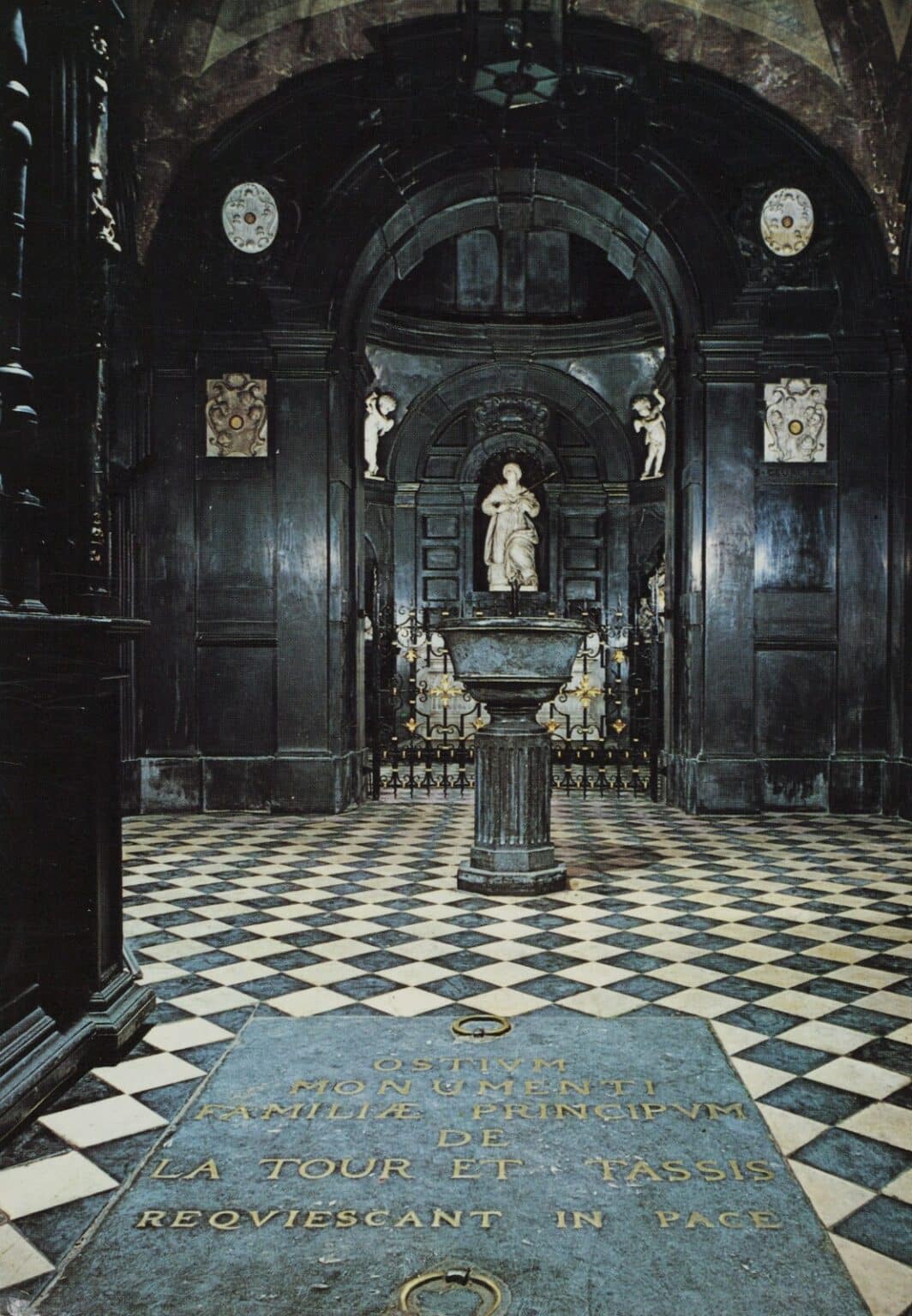 The Chapel of St Ursula in the Church of Our Blessed Lady of the Sablon, Brussels, where twelve members of the Thurn und Tassis family are buried
© Monument Heritage Brussels
Can we visit that magnificent palace on the Sablon in Brussels? Alas, nothing remains. The family was forced to flee in the early eighteenth century due to the War of the Spanish Succession and the Hof van Tassis was ruthlessly demolished in 1872. However, anyone curious about the traces of this once-enterprising family can step inside the Church of Our Blessed Lady of the Sablon. There, on either side of the choir, a Baroque funerary monument dedicated to the family has been erected and twelve members of the Thurn und Tassis family are buried there.
For those who want to delve deeper into the history of this illustrious clan, there is the Thurn & Taxis site in Brussels. Legend has it that the family’s post horses were allowed to graze and rest on this very land before being put back to work carrying fresh batches of international post. What was once marshy grassland in the sixteenth century has become a trendy, urban neighbourhood.

You might also like







Leave a Reply
You must be logged in to post a comment.