
Because we’ve had enough: Shattering the Glass Ceiling of Literature
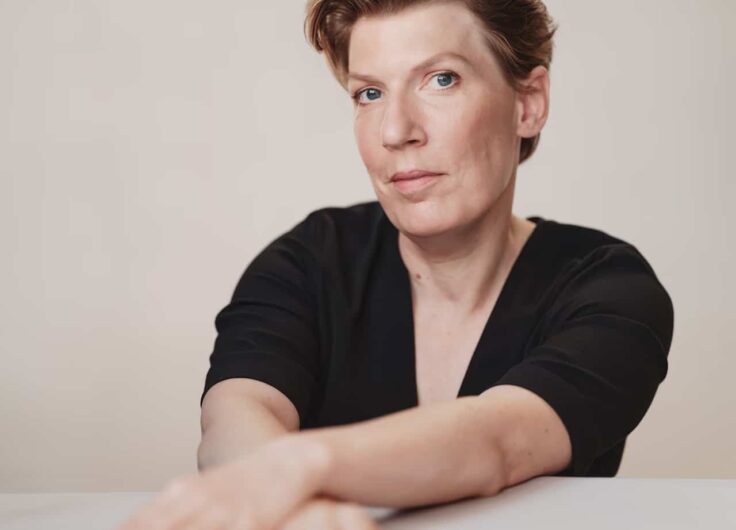
Sexism continues to shape the literary world—determining which stories are told, who gets published, and whose voices are heard. Against this backdrop, Flemish (screen)writer, journalist, and librettist Gaea Schoeters stands out as a fierce advocate for change. Best known for her novel Trofee, winner of the EU Prize for Literature, she is a member of the writers’ collective Fixdit, which confronts gender inequality in literature head-on. Their manifesto Optimistic Rage—and Schoeters’s essay “Because we’ve had enough”—call on publishers, juries, booksellers and readers alike to challenge bias and help close the gender gap in writing, one novel at a time.
“There’s only one way for a woman to achieve anything in the arts: stay in the room until you’re seen, even if you’re told to leave.” These words were part of Finnish composer Kaija Saariaho’s acceptance speech in Venice in 2021, when she won a Golden Lion for Lifetime Achievement. It was a noteworthy honour: only one other woman had ever received the award in the history of the Biennale. Are geniuses only ever men, then?
Things are no different in literature. The Great Authors are always men. Even though women make up roughly half of all writers, they still win considerably fewer prestigious prizes than their male colleagues. It’s a vicious circle: the writings of the A-list men define the literary norm, and with the bar set like that, women seldom come out on top. Which in turn means it’s rarer for them to reach the upper echelons of literature. They’re translated less frequently and get smaller grants, less prominent commissions, and less media attention, all things that go hand in hand.
 Gaea Schoeters
© Departement Cultuur, Jeugd en Media
The consequence? To this day, a deep gender gap cuts straight through the literary landscape, which is capped by a sturdy glass ceiling. The cause of the disparity: structural sexism. I know, it’s a dangerous claim to make, especially as a woman writer. Before you know it, you’re ‘a spiteful bitch’. But as Thomas Mann once said: “If something’s hard to discuss, it has to be questioned.” The fact that I just quoted a man and not a woman is due to the so-called Matilda effect, which occurs in every scientific field: articles, research, and theories are automatically considered more valuable when attributed to a man. Men as well as women view ideas ascribed to men as superior, more innovative, and more important.
You’ve undoubtedly witnessed the phenomenon whereby women’s suggestions are dismissed at meetings, only to be lauded when repeated by a man. This happens so frequently there’s even a word for it now: hepeating. (In the same vein, hurricanes with a female name aren’t taken seriously: fewer precautions were taken for hurricane Jeanette than hurricane Jason, with disastrous consequences.) My entire essay gains in credibility because of that one Thomas Mann quote. No one would tell Mann to ‘stop whinging’.
So let’s follow Mann’s advice and pose a question: are women really worse writers than men, as Jamal Ouariachi once claimed, or is there another explanation for their lack of success? Sadly, there is. More than one, even.
Men as well as women view ideas ascribed to men as superior, more innovative, and more important
Virginia Woolf was well aware of it already: literature is simply a reflection of society. Which means ‘male’ topics are taken more seriously than female ones. Or, as the 2007 jury of the Libris Literature Prize put it: women so rarely win any prizes because their writing “only focuses on insignificant subjects, private fiddle-faddle, and relationship drama”. When Bernard Dewulf’s novella Small Days took home the Libris in 2010, however, the jury suddenly had nothing but praise for him for daring to write about the vulnerabilities of his everyday life. Double standards, in other words. And let’s not forget that, for centuries, Mann and his chums could focus on pursuits like philosophy because they never had to iron a single shirt. Meanwhile, most women artists had to run a whole household on the side. These men were also paid more and thus had to work less. The imbalance is gradually being evened out, but it’s a painfully slow process.
Novels with a male main character are also more likely to win awards, much like men’s poetics are considered the definitive style guide. But women who write that way get a slap on the wrist: if they publish a novel of ideas, they’re accused of prattling and tabloid-philosophising. Women are only allowed to theorise once they’re no longer considered sexually attractive. They need to stay in their lane and write about what they know – preferably about themselves. When a woman’s book reflects her own identity, she has a better shot at prizes, grants, and media coverage, Dutch researcher Corina Koolen concluded in Dit is geen vrouwenboek (‘Not a Women’s Book’).
Novels with a male main character are also more likely to win awards
The press also has a clear preference for a certain type of woman. Just look at all the pictures of authors in newspapers, you’ll spot the pattern right away: young and pretty debutantes are at an advantage. No publisher would ever dare launch a woman over forty. The stereotypes are often reinforced by well-intentioned equality initiatives. Take the way literary figures are paired up in the media and by programmers trying to address the gender imbalance. Duos invariably consist of an older, male intellectual and a sensitive, youthful woman. The opposite – an established seventy-something female writer with a strapping young toyboy – is practically unheard of. As author Marianne Vogel wrote in Recensies!, a historical analysis of literary reviews: thinking is for the misters, feeling for the misses.
Even our language itself contains insidious inequalities. Take words like ‘oeuvre’, ‘Great Novel’, or ‘genius’. How often are these terms used for women authors? There are no female geniuses, because we simply don’t label women that way. But every generation seems to produce dozens of male prodigies: the new Marquez, Chekhov, or Mulisch. (Another crafty way to reinforce the male canon: be sure to become a brand. No one ever talks about the new Yourcenar or new Woolf. But then doing so, Woolf smiles through gritted teeth, would be unbecoming: “‘The chief glory of a woman is not to be talked of,’ advised Pericles, himself a much-talked-of-man.”) Mulisch was an utter peacock, but the epithets used for men tend to refer to their cerebral qualities. Up-and-coming women, on the other hand, are consistently and without a trace of irony described as ‘beautiful young goddesses of literature’. Doesn’t matter what you write, as long as your hair looks good.
Young and pretty debutantes are at an advantage
The same reductio ad formam occurs in reviews. Women’s looks are discussed much more frequently than men’s, as is the autobiographical nature of their work. Their books are read differently too: the focus is on subject or plot, while male authors are praised for form, structure, and style. Men also automatically attract better reviews, simply because they are men (remember Matilda?). The privilege-thanks-to-prejudice that men enjoy also manifests itself in other ways. When asked about their literary role models, men and women almost invariably list men, as this is the only way to join the canon of literary credibility, which in turn remains male. And then there are the recommendations on book covers. A blurb by a male colleague is gold for a woman author, while no man would ever put a woman’s recommendation on his cover. You wouldn’t want your novel to become a women’s book, after all! That all of this negatively affects the careers of women authors is no surprise: women may have caught up in terms of visibility, popularity, and output, they’re still not as highly valued.
Women may have caught up in terms of visibility, popularity, and output, they're still not as highly valued
Is it all one big conspiracy? Male monkeys puffing up their chests to keep the females out of their territory? Of course not. If only – because then it would be easier to fix. Unfortunately, the reality is more complex. These painful inequalities are the product of a cultural legacy of centuries during which white, heterosexual men drew all the parameters, based on their own frame of reference. This led to an everyday social reality that all of us, men and women, are so entangled in we can barely see it. Battling your own blind spots is hard. So we need to keep ‘whinging’. It’s precisely because we have had enough of it that we need to keep talking about it.
Fortunately, things are slowly moving in the right direction, albeit with baby steps. Just think of the free novella handed out to book buyers during the annual Dutch-language Book Week. Male and female authors now take turns writing the gift, the result of a steady campaign. Programming, longlists, and residencies are more aware of gender equality these days (although the efforts are sometimes clumsy). Reading lists for students are increasingly diverse. And then there are hard-won additions to the canon, a shift Fixdit contributed to by helping to republish books by long-forgotten women and writing online articles about female authors.
Programming, longlists, and residencies are more aware of gender equality these days
We still have a long way to go, though. Age-old patterns don’t change through evolution: it takes a revolution. The best solution would probably be for women around the world to take a leaf out of Lysistrata’s book. Keep our legs shut, turn off the stove, and leave nappies unchanged until men realise that equal rights means redrawing the map together, from scratch. Not just in literature, but everywhere. For as long as the world order is dictated by men, diversity policies in the cultural sector are nothing but window dressing. The system probably won’t change any time soon, though.
What can we do, then? Start with ourselves. Each and every one of us. Every jury member, every publisher, every reviewer, every bookseller, every reader. Pay more attention to the women in literature. View the world differently, through their eyes. Because here’s the thing: girls read male authors from a young age, which teaches them to not only adopt the perspective of men, but also to consider that perspective universal. Boys on the other hand rarely read work by women, while that’s exactly what would lead to change. So my advice? Read more women authors and let them broaden your horizons.
translation by Eva Corijn
www.maybepurple.com

You might also like

In Jozef Deleu’s Poetry, Nothing Was Lost







Leave a Reply
You must be logged in to post a comment.