

Jan de Vries was the son of a Dutch captain and an enslaved woman who lived in the free Black community of seventeenth-century Manhattan. His descendants continued to speak Dutch long after they had moved to a remote area of New Jersey. Their story reveals the deep roots of the Low Countries in the United States, while also showing how complex identity can be.
Albert Payson Terhune’s novel Treasure (1926) is hardly the most brilliant diamond in the crown of American literature. The tale of a search for hidden treasure in New Jersey is not especially convincing and is further marred by racist language. Nevertheless, it is worth reading because Terhune uses the language spoken by the inhabitants of the Ramapo Mountains in his dialogue. According to Terhune, this isolated community descended from three mercenaries from the German region of Hesse, named Devries, Groot and Man. They had deserted from the British army during the American Revolutionary War and hid in the mountains, where they later mixed with escaped slaves and members of the indigenous Lenape people.
This multiracial community developed its own language, saying ‘shoon’ instead of ‘shoes’ and ‘housen’ instead of ‘houses’. They also used peculiar expressions such as ‘ak bedank ye’, ‘var je wel’ or ‘vaul dief, hont!’ and sang songs such as ‘de kutse’z an ed klaver, de pertse’z an de haver, de entse’s an de waterplas.’
In 1910, John Dyneley Prince had already established that this language did not derive from Hessian German but had Dutch origins. In his history of the Jersey Dutch dialect, the linguist claimed that a Black community still speaking Dutch lived in the Ramapo Mountains. Years later, Edward Franklin Frazier sought to learn more about this population group in The Negro Family in the United States (1939). As one of the first Black sociologists in America, Frazier was deeply interested in so-called ‘racial islanders’, multiracial groups that had developed on the margins of society. He explained the fact that almost everyone in the Ramapo community had names such as De Groat, Van Dunk, De Freese or Mann by claiming that they all descended from South African Boers who had once been brought to New Jersey by the British to search for iron ore and had mixed with the indigenous population and former slaves.
It wasn’t until 1974 that these myths were dispelled when David Steven Cohen demonstrated in The Ramapo Mountain People, through archival research, that these families actually traced their origins to the free Black community of seventeenth-century New Netherland.
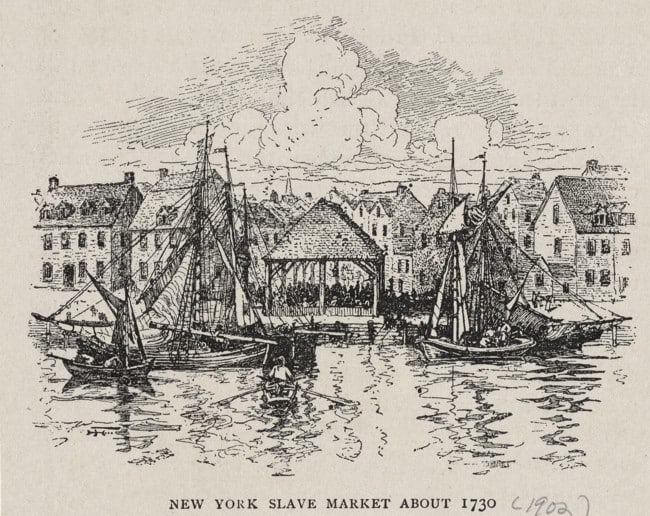 An illustration from 1730 of the slave market in New York. Slaves had already been brought to New Netherland a century earlier. Originally, all slaves in Manhattan belonged to the Dutch West India Company
© The New York Public Library
Human trafficking
The first enslaved Africans had already been brought to the Dutch colony in Manhattan in 1627, and in the following decades the slave community there grew to several hundred people. In the summer of 1664, a ship from Curaçao brought more than three hundred new slaves to Manhattan, but Director-General Petrus Stuyvesant’s ambition to turn New Netherland into a centre of the slave trade was crushed when an English fleet arrived only days later and claimed the Dutch colony.
Originally, all slaves in Manhattan belonged to the Dutch West India Company (WIC). They had been captured from Iberian ships seized by the Company. That changed in 1636, when privateers appeared and introduced private slave trading. New Netherland governor Willem Kieft not only legitimised this trade but in 1643 also permitted the colony to be used as a base for privateering, a state-sanctioned form of piracy. Residents were even given the opportunity to invest in it.
In 1656, the WIC expressed concern that an increasing number of slaves was ending up in private hands as a result. The warning did little to prevent slave ownership from spreading across almost all layers of society, except among the very poorest. Some inhabitants even purchased slaves as investments and rented them out to others. The fact that this development originated in privateering shows how quickly the normalisation of stealing other people’s property also normalised the stealing of another’s freedom.
Free Black community
Some slaves in New Netherland eventually obtained their freedom and became landowners in Manhattan in exchange for services rendered. The growth of a free Black community had consequences for both religion and language. The community originated from regions in Africa with a long history of Portuguese influence, such as Angola, Kongo, São Tomé and the Cape Verde Islands. Some were even born in Portugal or had arrived in Manhattan via Dutch Brazil and Curaçao. They were all baptised Catholics and originally communicated in an Iberian pidgin.
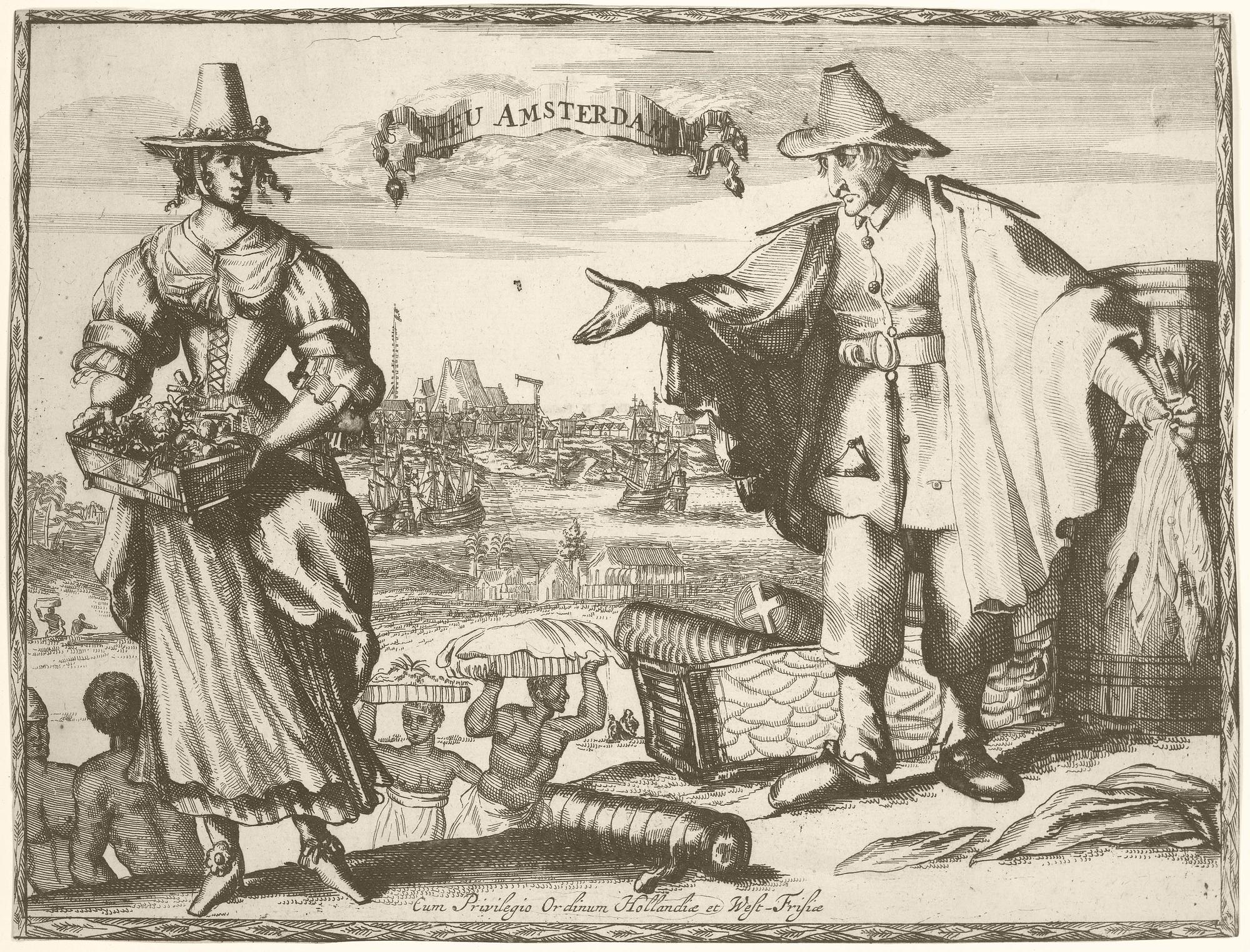 Seventeenth-century engraving mentioning New Amsterdam, with enslaved Africans depicted in the background
© The New York Public Library
Unlike in Curaçao, where the Black community remained Catholic and continued to use an Iberian pidgin from which Papiamentu would later develop, the influence of the Reformed Church and the Dutch language grew steadily stronger in Manhattan. Members of the Black community married in the Reformed Church and had their children baptised there, meaning that they no longer identified with the (Catholic) Portuguese language but with (Protestant) Dutch.
The greatest challenge in the history of New Netherland was the war with the Lenape that broke out in 1643. During that same period, the Dutch colony in Brazil also came under severe strain from Portuguese attacks, causing increasing numbers of colonists and soldiers to leave. Among them was Captain Johan de Vries, who arrived in Manhattan via Curaçao together with other soldiers urgently needed for the defence of the colony. De Vries also brought several slaves from Brazil, whom he granted freedom in New Netherland. With one of them, named Swartinne, he had a relationship and fathered a child, Jan.
Shortly afterwards, when Johan de Vries fell out of favour with the colonial authorities and was summoned to answer to the WIC (Dutch West India Company), he was shipwrecked on the way to Amsterdam. His son Jan inherited a piece of land from his father and later married the equally multiracial Adriaentje Dircks. Together they had four children; the eldest son was named J(oh)an de Vries. They lived near the Versche Water, a lake in Manhattan where Collect Pond Park now stands. Their neighbours included Claes Manuels and Augustine Van Donck, other members of the free Black community.
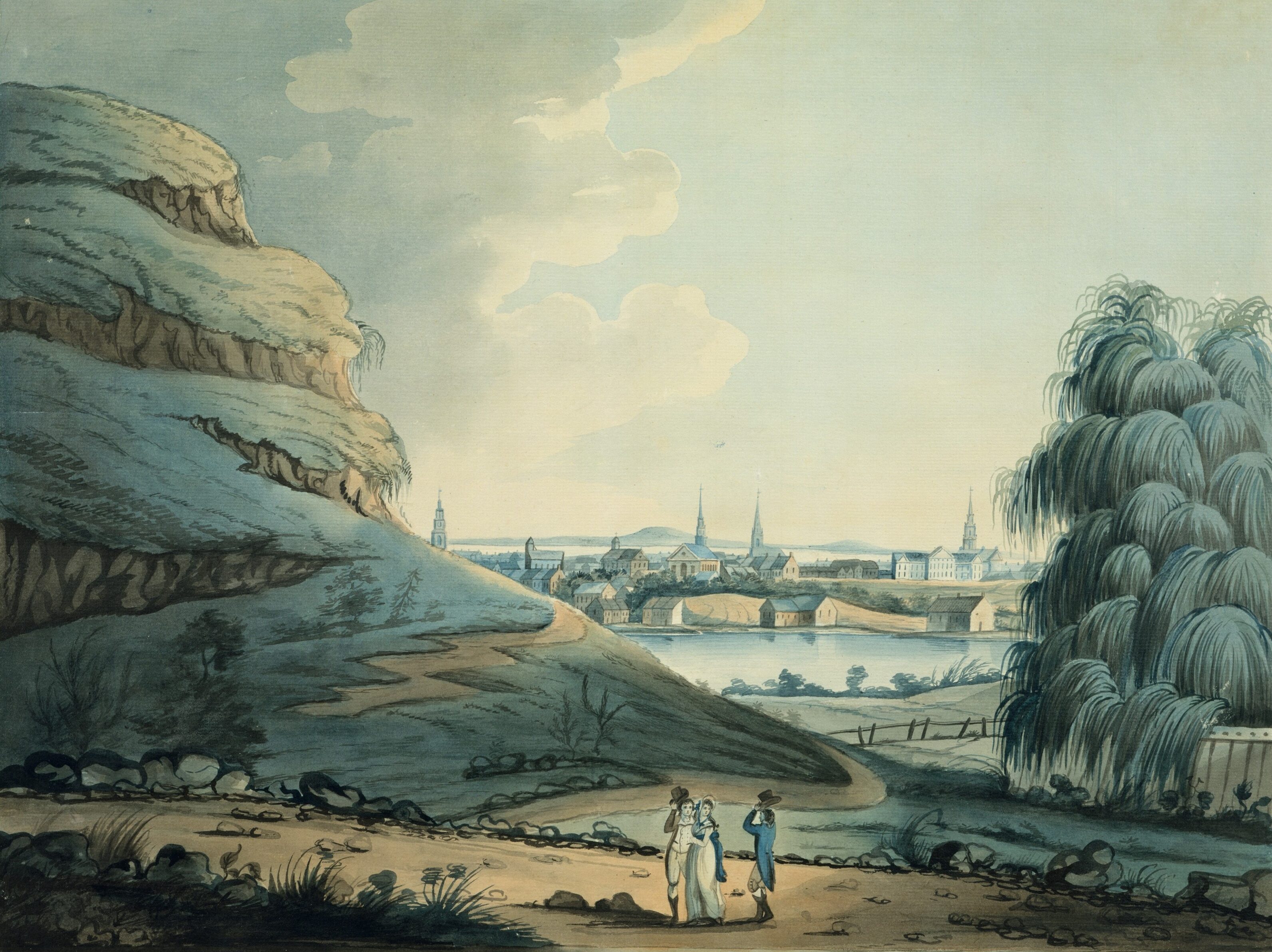 Jan de Vries married the equally multiracial Adriaentje Dircks and lived with her and their four children near the Versche Water, a lake in Manhattan where Collect Pond Park now stands
 © Wikimedia Commons
Towards the end of the seventeenth century, these three families left Manhattan as it became increasingly Anglo-Saxon. Together they purchased land across the Hudson River in what was then sparsely populated New Jersey, where they themselves also became slave owners. Their neighbours included members of the De Groot family, and they too were, as indicated in a marriage certificate, Aethiopes (Black).
Culturally, these families were Dutch. They had Dutch names, spoke Dutch, belonged to the Reformed Church, had their children baptised there and were “as Dutch as the Flemish, Walloons and French Huguenots.
Following the independence of the United States, the free Black community in New Jersey also came under increasing pressure. From 1798 onwards, every free Black resident was required to possess a certificate issued by two justices of the peace confirming their free status. This may explain why descendants of the De Vries, Van Donck, De Groot and Man(uels) families adopted a strategy of ‘passing’ and identified themselves as white. Around 1800 they moved further inland and settled in the rugged Ramapo Mountains, where life was harsh, but where they were left alone.
With industrialisation in the nineteenth century, iron mining began in the Ramapo Mountains, where many local families found work. At the time, little thought was given to the soil contamination caused by mining. When the last mines closed around 1950, the Ford Motor Company spent two decades dumping industrial waste into the abandoned quarries, once again releasing thousands more tonnes of lead, arsenic, cadmium and other heavy metals into the mountains.
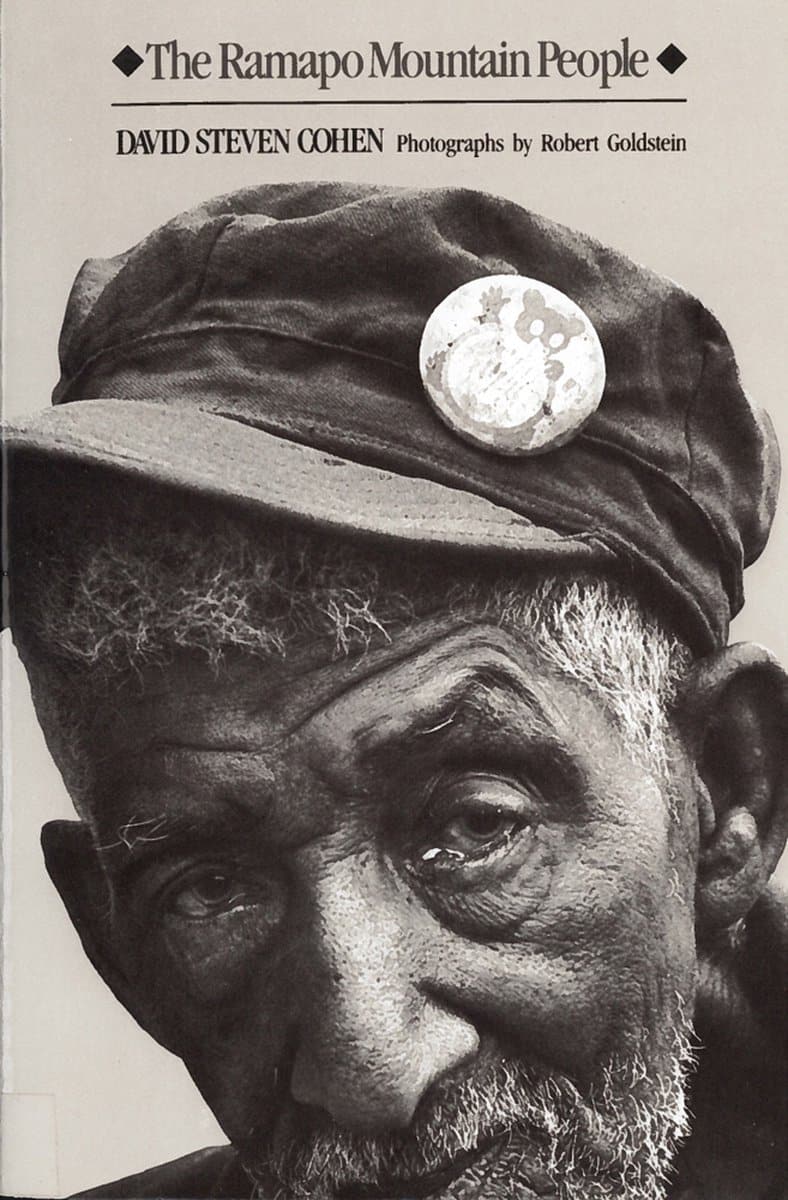 In his book, David Steven Cohen demonstrated that the multiracial Ramapo Mountain People originated in the free Black community of seventeenth-century New Netherland
 © RV
Meanwhile, the wildest rumours circulated about the inhabitants of the region, who had become known as the Jackson Whites. It is telling how Appleton’s Journal described them in 1872 as people who “buried themselves deep in the […] mountains and reared children, wilder and more savage than themselves”, and who spoke a “strange an idiom” with such a strong “guttural sound” that “one readily believes himself fallen among madmen”.
The realisation that ‘jacks’ had once been a derogatory term for Black people was lost over time. The nickname was misinterpreted by the amateur historian John Storms. In The Origins of the Jackson Whites of the Ramapo Mountains (1936), he claimed that the name derived from a certain Jackson, a man supposedly tasked during the Revolutionary War with recruiting prostitutes for British soldiers. This fabrication was picked up by the poet William Carlos Williams, who in the famous Paterson (1946–58) referred to the Jackson Whites as “Hessian deserters from the British Army, a number of albinos among them, escaped negro slaves and a lot of women […] picked up in Liverpool and elsewhere by a man named Jackson”.
When in 1974, after years of archival research, David Steven was able to demonstrate that their ancestors originated in the free Black community of New Netherland, the reaction was hostile. There were two reasons for this. Cohen came from a progressive academic background, where the racist stereotyping of Black people was perceived as a problem of the past. The population in Ramapo saw matters differently, and Cohen was accused of slandering entire families: “How would you like it if someone had proven you were Black?” was hurled at him.
Another reason for the hostility was that a group of residents had come up with a plan seeking recognition of their community as an Indian tribe, only to see this ambition threatened by Cohen’s conclusion that “there is no genealogical proof of early Indian ancestry”. This very proof is a crucial requirement for recognition by the Bureau of Indian Affairs (BIA). The struggle continues to this day. Although the states of New York and New Jersey now recognise the Ramapough Lenape Indian Nation as a tribe, the BIA still refuses to do so, partly on the basis of Cohen’s research. This not only deprives the community of various forms of federal support but also of the coveted Indian Gaming Regulatory Act, which would permit the construction of a casino on tribal land. The latter explains why the community encountered resistance in its struggle for recognition as a tribe from the powerful casino lobby, which did not want any new competition. Among them was a certain Donald J. Trump, whose army of lawyers was all too eager to cite passages from Cohen’s book.
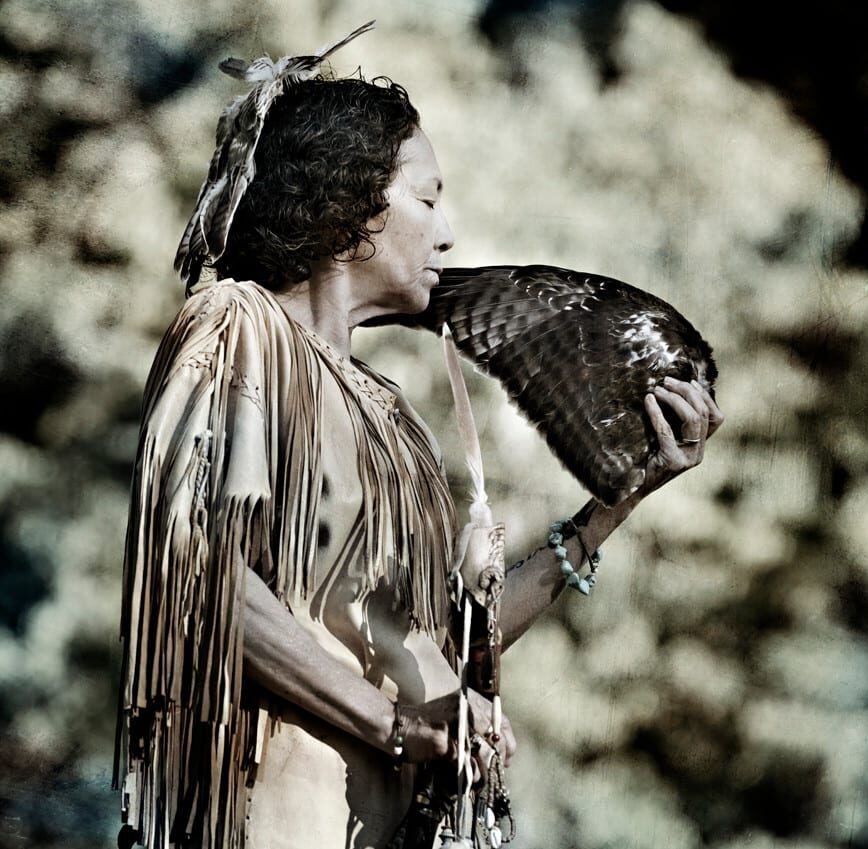 Some inhabitants of the Ramapo Mountains seek recognition of their community as an Indian tribe but encounter difficulties because of research pointing to their descent from the free Black community of seventeenth-century New Netherland
 © RV
The saga of Jan de Vries shows how the descendants of a small group of inhabitants of New Netherland retained elements of Dutch identity for a remarkably long time, though changing social developments resulted in the community deciding to adopt a different identity. Cohen discovered that identity formation may not be a matter of objective reality, yet it has real consequences. He demonstrated that the Low Countries had left deep traces among the descendants of Jan de Vries but had to conclude that those traces no longer fit the new identity the community had created for itself.

You might also like




Leave a Reply
You must be logged in to post a comment.