
Miet Warlop and Dries Verhoeven at the Biennale: Two Artists Who Refuse to Reassure
For the first time, Belgium and the Netherlands are sending artists who blur the boundaries between visual art and performance to the Venice Biennale. Miet Warlop and Dries Verhoeven on their place at the iconic festival: “We’re part of a national image-boosting campaign. At the same time, we get to expose its problematic side.”
The sixty-first Biennale is a remarkable edition for the Low Countries. In the Rietveld Pavilion, Dries Verhoeven makes the Dutch self-image fall apart six times a day. And Miet Warlop transforms the Belgian pavilion into a hopeful temple filled with ritual movement. For the first time, both neighbouring pavilions in the Giardini are being entrusted to artists who stand with one foot in performance and the other in the visual arts. How do these uncompromising creators, with their erratic signatures, view their selection for this prestigious arts festival?
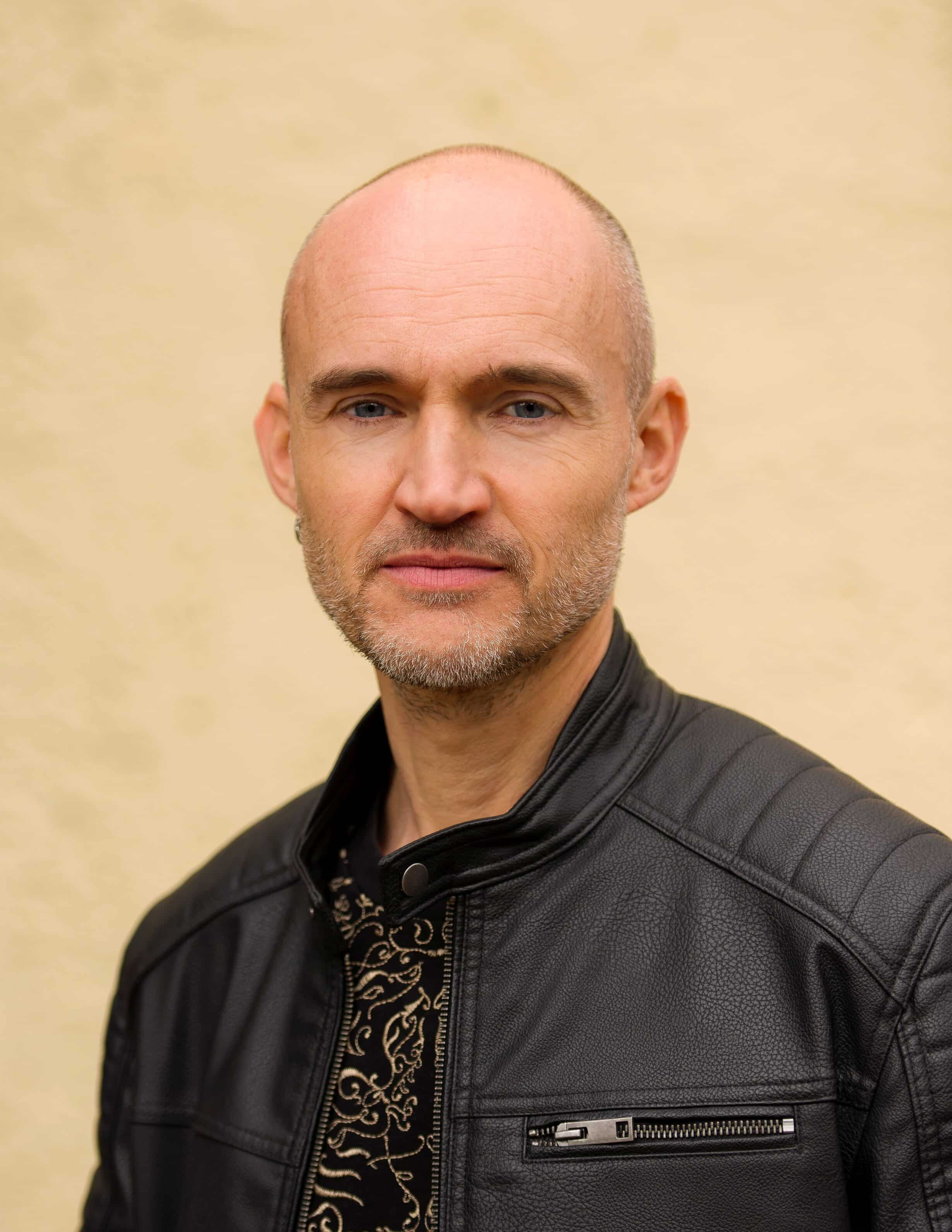 Dries Verhoeven represents the Netherlands at the Venice Biennale: “I’m always delighted by artworks that don’t reassure but instead terrify us.”
 © Willem Popelier
Dries Verhoeven (1976) trained as a scenographer and spent his early professional years in theatre circles before deciding to make his own work, mainly outside the theatres. In that work, space is never merely a backdrop but always a place where something can happen. Something dangerous, something exciting that makes the spectator “tremble”, as he puts it. From the very start of his career, this has led to performances and installations that, to put it mildly, attract attention. For Ceci n’est pas… (2013), he arranged window displays containing living “abnormalities” in a busy shopping street: a woman with dwarfism, a half-naked father with his daughter on his lap. In The Narcosexuals (2022), he lets the spectator peer into a flat where six naked men indulge in ecstatic sex and uninhibited drug use. Yet Verhoeven’s aim is never blatant provocation or a straightforward political statement. Rather, he tries to tempt the viewer into questioning themselves and their own way of seeing.
Today, it is becoming increasingly difficult to achieve that kind of moral disruption, he notes: “I feel how my refusal to take a moral stance makes programmers nervous. Art institutions are looking for clear proposals through which they can unconditionally align themselves with, say, a queer or sustainability agenda. Projects in which all spectators, including those in a marginalised position, can feel safe. Well, I don’t go to an art institution to feel safe. I want to be put on edge. I’m always delighted by artworks that don’t reassure but instead terrify us.”
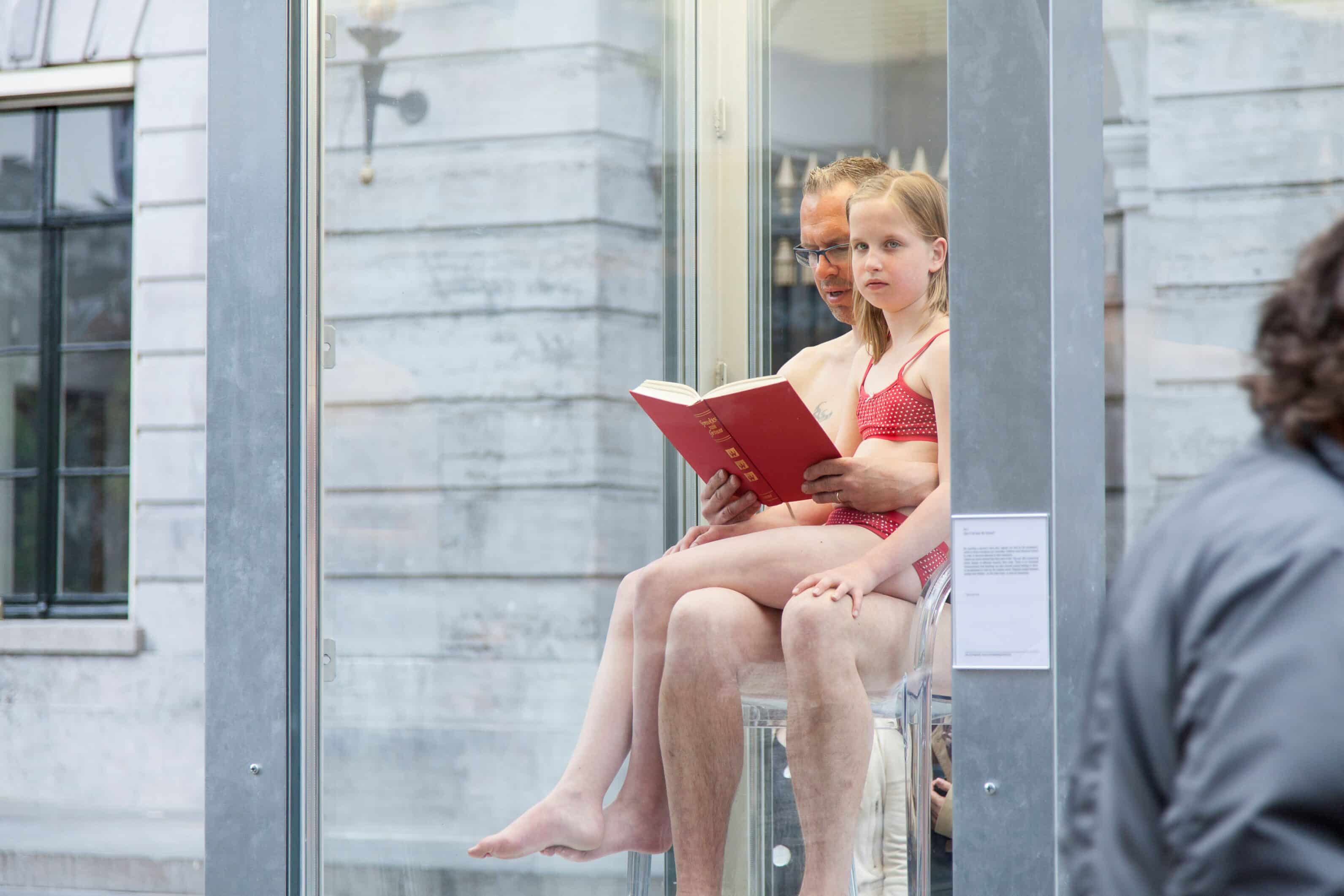 Ceci n’est pas… by Dries Verhoeven, a performance from 2013
© Willem Popelier
In Miet Warlop’s work (1978), the disruptive energy seems mainly to coalesce on stage. Her performances are explosive choreographies in which bodies, materials and music merge into an intoxicating universe of beauty, togetherness and exhaustion. Trained as a visual artist, surprisingly, she won the Young Talent Award at Theater aan Zee (Theatre by the Sea) in 2004. She discovered that the auditorium was the place where her work could grow into a “group conversation”, as she describes it, under the gaze of others. Early performances such as Springville (2009) and Mystery Magnet (2012) presented hybrid beings between human and object, while later works often centre on a specific material, such as plaster in Dragging the Bone (2014) or silk in the recent Inhale Delirium Exhale (2025). With ONE SONG (2022), she created a signature piece that served as a retrospective of twenty years of work.
Warlop does not aim so much for disruption but prioritises joy and connection between audience and performers as the fundamental condition for engaging in dialogue. Warlop: “I think I’ve evolved in that respect. In the past, my work was more destructive, driven by an inner turbulence for which I sought solutions. Today it reaches out to the viewer much more. When the Brussels attacks happened in 2016, we were in the middle of rehearsals for Fruits of Labor. We threw everything overboard and thought: let’s stay together and make it lighter. Let’s connect – in loss, without denying the emotions.”
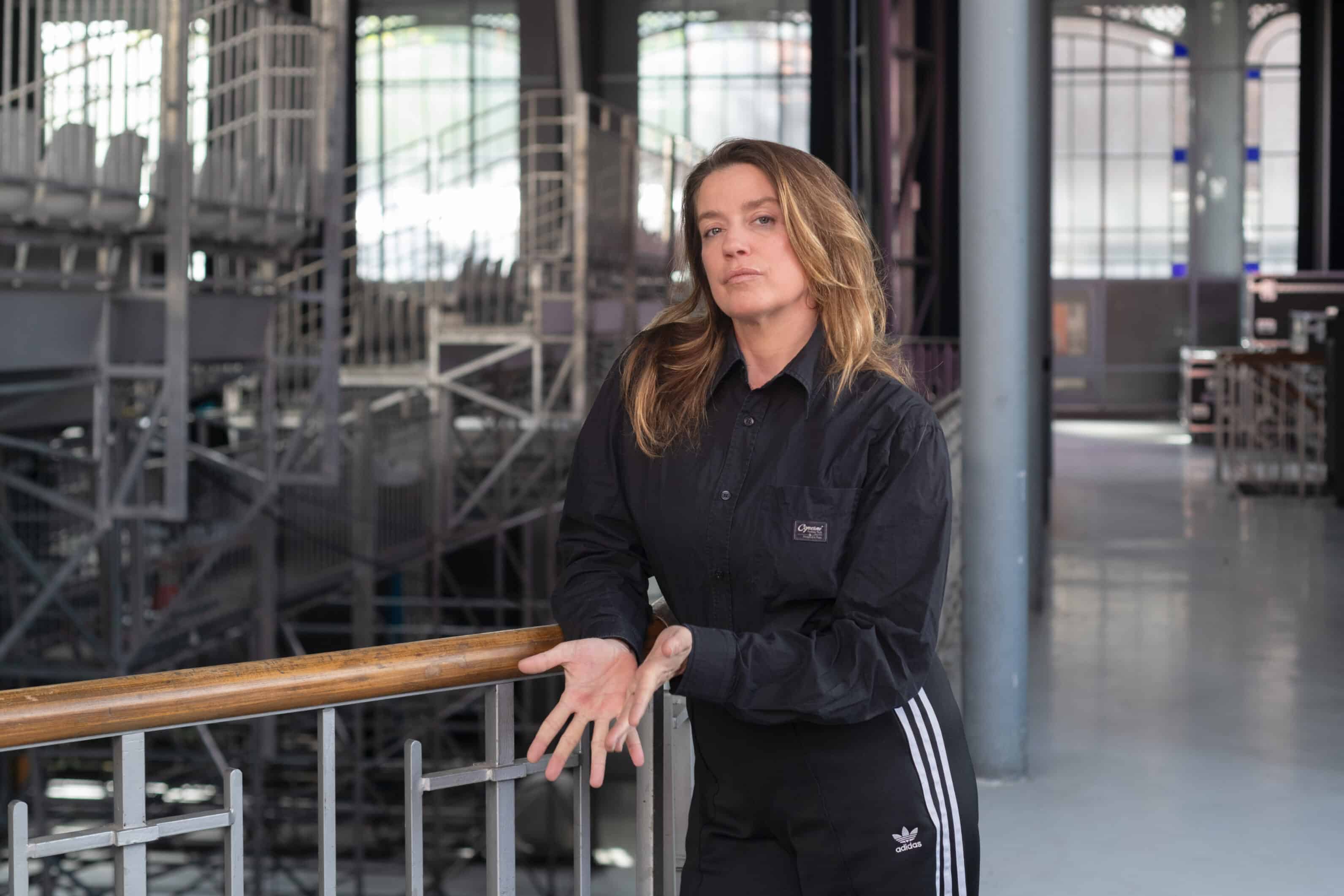 Miet Warlop represents Belgium in Venice: 'I try to show a world in which you can, literally, move something together. In which you have to carry something together, even if it is heavy.'
© Bea Borgers
Verhoeven recognises that desire: “I think that in recent years, I’ve also started working with a more subtle touch. Partly because you lose a spectator if you shock them too much. The shock can form a barrier for the viewer to think further. So connection: certainly. But reconciliation? No. With reconciliation we’re symbolically trying to glue back together what is fundamentally broken in the world, whereas I believe that the art institution is the place where we are allowed to contemplate that broken world.”
In terms of disciplines, you have travelled opposite paths. Dries, you come from the world of theatre but in recent years have opted more for ‘mobile spectatorship’, in which the viewer, as in a museum, is free to determine their own viewing experience. Why?
Verhoeven: “The question of whether something is theatre or visual art doesn’t really interest me. When determining the form of a work, the central question is always: what should this work evoke in the viewer, and how can I ensure as precisely as possible that it has that impact? If I mainly want you to tremble, then in many cases it’s more effective to let you decide for yourself how long and from what perspective you are present with the artwork.”
Verhoeven: 'With reconciliation we are symbolically gluing together what is fundamentally broken in the world, while I believe that the art institution is the place where we are allowed to behold that broken world'
Warlop: “Something definitely has to happen – but for me, that can easily be a reason to choose the venue. I strive for everyone to experience something: the performers, but also the audience. There has to be something at stake for all of us together. In Springville, there’s a figure of a walking table, set with plates and glasses. We could have discreetly taped those plates and glasses onto the performer’s back. But then, for me, everything is lost: it’s about her being aware of those fragile objects on her back, feeling the cutlery shifting, moving differently and having to find peace within herself. That’s exactly why the audience is on the edge of their seats.”
Verhoeven: “In our own way, we bring audiences into spaces charged with energy, with excitement. Spaces that lack excitement don’t interest me.”
To what extent do your oeuvres stem from your own personalities?
Verhoeven: “I never think, ‘I want it to be about this.’ Usually it begins with the question: ‘Why do I feel so uncomfortable about something?’ and the desire to translate that discomfort to the viewer. Ultimately, the viewer is the central figure, not me.”
Warlop: “That’s different for me. I don’t feel that I ‘develop projects’, I simply live. And while I live, I work, and while I work, I live. In that sense, works are always reflections of periods in my life, of evolutions in my thinking and feeling. Sportband, with which I once ended up at Theatre by the Sea, was the raw, unfiltered processing of my brother’s death, but I didn’t tell anyone that at the time. When I made ONE SONG in 2022, it was a conscious remake of that performance, in complete openness: yes, this happened; this is how it is; this is me. Yet those two performances are not the same: there are twenty years of lived grief between them, with everything I learned during that time, about art and about life.”
That autobiographical root is probably what makes the ‘politicising potential’ of your work different. Dries’s work is explicitly political, even though it never adopts a clear political stance. Miet, you’re not especially fond of statements.
Warlop: “I exist in the world; it affects me too. It’s not as if I’m unaware of the political reality. But as an artist you can choose whether or not to respond to it. My work is about people, not about statements. I’m concerned with existential reality: what it means to be human, how you hold your own in the world. Being alive is already a lot, although perhaps that isn’t political enough for some people. But I think the pressure on artists to make statements is very harmful.”
Warlop: 'Sportband, which once brought me to Theater Aan Zee, was the raw, undiluted processing of the death of my brother – but I didn't tell anyone that at the time'
Verhoeven: “I completely agree. For me, politicising lies precisely in not making statements, in pulling and pushing at the same time.”
Warlop: “After all, we don’t know either. I’m also just following a somewhat unclear path, without knowing where it will lead me in this life.”
What you are saying now indicates, in my eyes, a profound difference between your bodies of work. Both of you create worlds-behind-the-supposedly-normal-world. Dries shows how behind everyday normality all forms of social and political ‘deviations’ are suppressed. Beneath that same paper-thin layer of daily life, in your case, Miet, lurks above all an existential abyss.
Warlop: “Yes. Tangible reality is unsafe and unreliable, fate can strike at any moment. That idea still lingers undiminished in my work. But where it used to be a cruel observation with which you as a spectator were left alone, I now try to provide an answer, by staying together. Perhaps only now, by growing older, can I accept that there are people who are ready, who help me when I ask for it. And I dare to trust in that connection.”
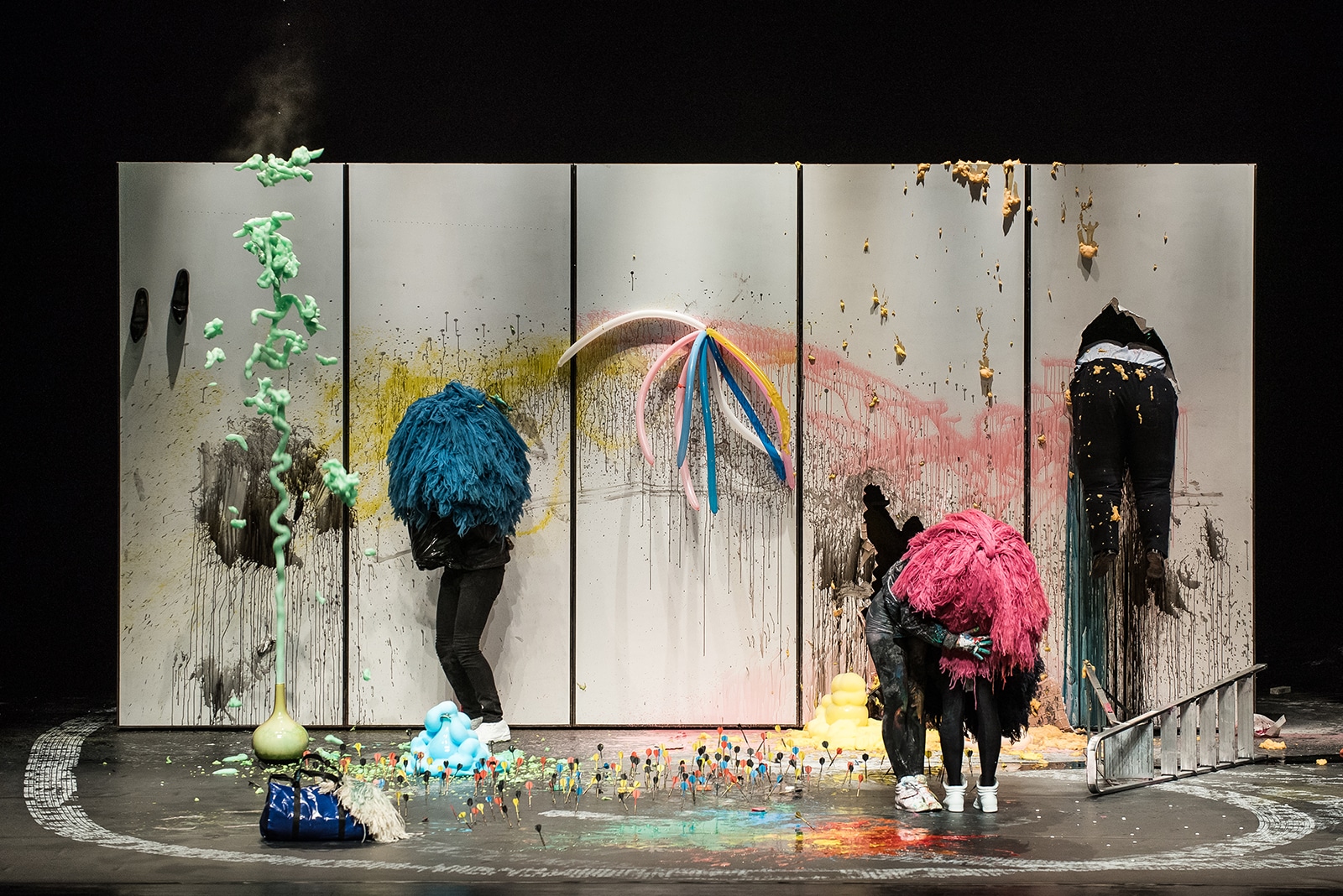 Image from Mystery Magnet, a performance by Miet Warlop from 2012
© Reinout Hiel
Worldview
Verhoeven and Warlop are bringing performance to the Biennale, a seven-month exhibition devoted to visual art. Moreover, both are known for being highly uncompromising. But how do you remain uncompromising within a machine like the Biennale, which, due to its history and prestige, is perhaps one of the world’s most important arts festivals?
Verhoeven grins. For an artist constantly searching for the “weak spots” – of spaces, audiences and institutions – such a bastion is a wonderful challenge: “It’s always about looking at what is already present in a place and how you can then turn that around. That’s essential for an artist not to become encapsulated.”
During his intervention The Fortress, the light, high, modernist Rietveld Pavilion periodically transforms into its opposite. The post-war optimism that reinforces the Dutch self-image of tolerance and open-mindedness changes six times a day into a directionless, chaotic darkness. And within it: the presence of a performer.
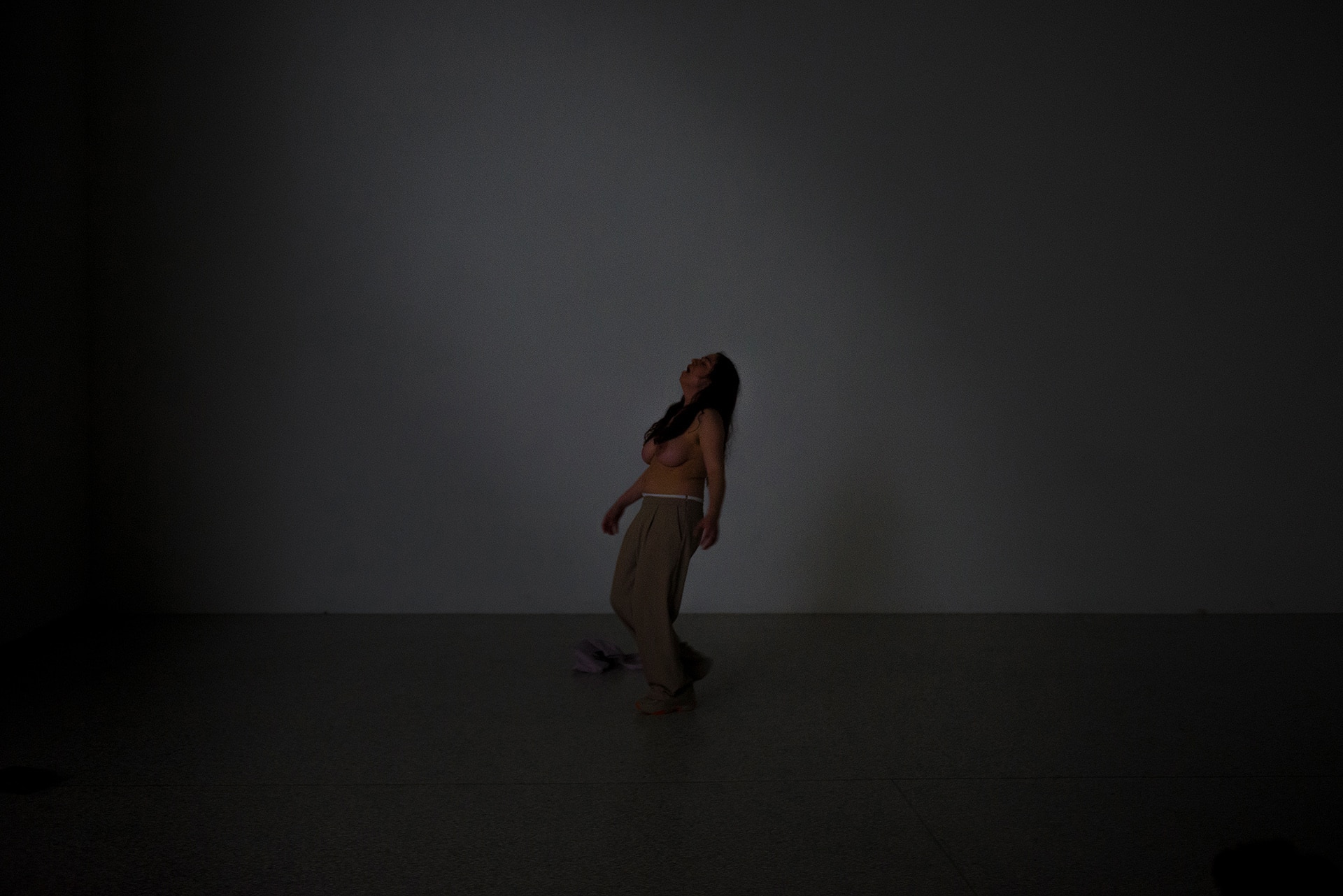 An image from The Fortress, the performance at the Biennale with which Dries Verhoeven periodically transforms the Dutch pavilion into a directionless, chaotic darkness
© Willem Popelier
Verhoeven: “I absolutely wanted to work with the pavilion itself. A monument is a way of holding on to time, but that is precisely the problem. We’re all standing there fraternally side by side, the Western colonial powers of the post-war period. What worldview are we actually looking at? The art in those pavilions may be very progressive; it’s the political constellation itself that I hope to question. And yes, of course my plans have been a battle with the Biennale. The pavilion is a protected monument; you’re not allowed to move a single stone.”
With IT NEVER SSST, Miet Warlop transforms the Belgian pavilion into a contemporary temple, a chant room where six performers and a sculptor respond to the call of the world. In a ritual movement, hundreds of square stucco alto-reliefs are passed down, thrown to one another, handed to visitors and ultimately hung on the walls. Fragments of words in four languages can be read on the stuccos. The words dance through the space, sung to life by the performers accompanied by live music.
Warlop: “I’m trying to show a world in which you can, literally, move something together. In which you have to carry something together, even if it’s heavy.”
The performers will not be permanently present; they will perform around sixty “shows” during the Biennale.
Warlop: “For me it’s very refreshing to be pulled back towards the sculptural side of my work. IT NEVER SSST is an autonomous image that also tells a story without performers.”
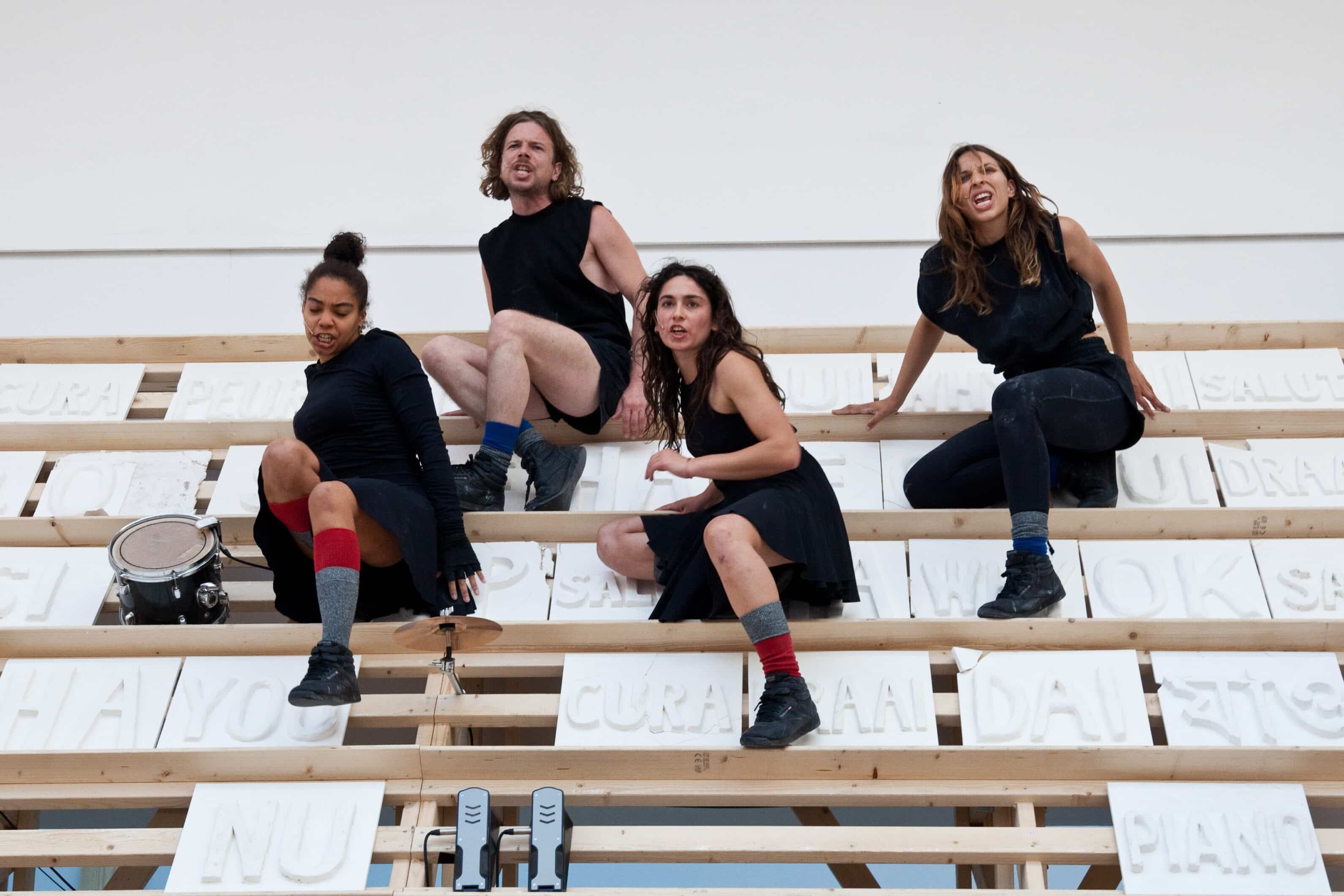 mage of Miet Warlop's IT NEVER SSST, the performance with which she transforms the Belgian pavilion in Venice into a chant room
© Reinout Hiel
Warlop: “It’s striking that this year there are so many pavilions with performance, such as Austria with Florentina Holzinger. I feel audiences have a huge need for direct physicality, for the concreteness of the performance. We spend all our time here (points to phone, EC) and not in the here and now, not in our bodies.”
Verhoeven (nodding): “We are so connected to our devices, and our consumption of art is also individual. This year it will be very special to encounter so many living, breathing bodies.”
Do you experience your selection for the Biennale as recognition or as a crowning achievement?
Warlop: “Certainly. Suddenly I realise that ‘the system’ , that elusive combination of committees, civil servants, a minister, which I’ve spent twenty years wondering whether it even saw me, has been following me all along. That feels good.”
Verhoeven: “I feel ambivalent about the whole idea of national representation. Whether we like it or not, Miet and I are part of national image-building and, more broadly, of the apparent nature of the nation-state. At the same time, we are also given the space to expose its problematic aspects. If they asked me to stand in front of a glitter curtain pretending genocide wasn’t taking place, as with Eurovision, I would politely decline. But now? Bring it on.”
You might also like



Leave a Reply
You must be logged in to post a comment.