
The Witch Swoops Back Into the Spotlight
One local authority remembers the victims of the witch hunts, another organises a festive parade, including witch burning. Feminists, spiritualists and folklorists are all commemorating witches. Where has this rekindling of interest come from, and what does it mean?
“There are always people weeping when they see the model of the witch go up in flames,” reads the website Intangible Cultural Heritage in Flanders, on the annual witch burning in the Limburg municipality of Lanaken, concluding the carnival. The popularity of the event is growing, as is the biennial witch parade in Beselare in West Flanders, which once began at the fair and also always finished with a pyre. In Hasselt, too, tears were shed when the witch festivals were revived after years of silence.
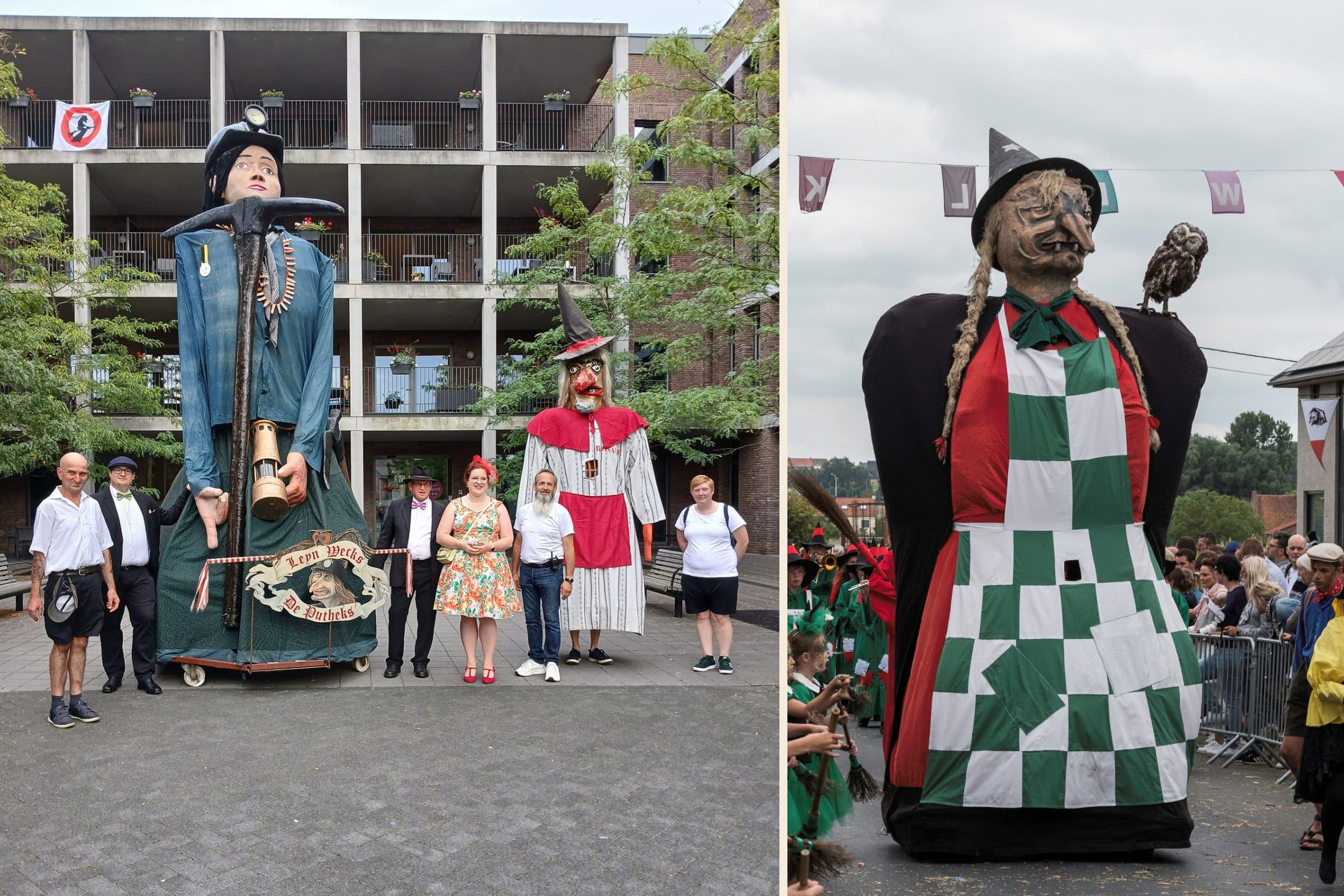 Witch parades are gaining popularity in Flemish municipalities
© Wikimedia Commons
Belief in witches in the Southern Netherlands, particularly in the seventeenth century, cost innumerable women as well as men their lives. They were slandered, tortured and burned. Witch festivals, however, are not primarily about lamenting the unjust, cruel fate of local victims. Folklore, entertainment and social cohesion are the main factors. Together against the witch, who still personifies evil vanquished.
In early 2023 ninety volunteers signed up to re-enact the witch burning in Hasselt “as historically correctly as possible”, including torture. The organisers also claimed to wish to commemorate “so many innocent people who were convicted”. A doll was made to represent midwife Elen Aegten, labelled a witch in 1540 when she gave birth to a stillborn child, and this was set alight during the event. But when a phantom was seen in the smoke in photos, people again suggested that witchcraft was at work.
The witch is back
It is not only at Flemish folk festivals that the witch can count on renewed interest. All over the place, modern witches are rising up to breathe new life into a pre-Christian nature religion. They emphasise that the enchantresses also used their supposed traditional magical powers for good, as did Carice van Houten when she played the powerful witch in the series Game of Thrones (2014). “Good” witches similarly feature in popular children’s and young adult books and films, with blockbusters Wicked (2024) and Wicked: For Good (2025) among the most watched films in the Low Countries. For children there are stories about a cheerful Fuchsia the Mini-Witch, and for teenagers since 2022 there has been the series about the headstrong witch’s daughter Wednesday.
In 2021 and 2022 the Amsterdam Tropenmuseum hosted the exhibition about witchcraft Healing Power. Around the same time Heksen avant la lettre at the Royal Library of Belgium demonstrated that the cliché of the mediaeval witch did not exist, but that being a woman in the fifteenth century was indeed connected with magic, healing and the practice of crafts.
In Bruges the Museum of Witchcraft opened in 2024 with a witches’ scale (a device for weighing witches) dating back to 1638 as its centrepiece. The Netherlands has long had the Museum de Heksenwaag in Oudewater, focused on the same item.
Rehabilitation
In many places in Flanders and the Netherlands meanwhile memorials for the victims of the persecution of witches have been set up and commemorations have been organised. On the Geselberg hill in the village of Wedde in Groningen since 2018 there has been a memorial stone for more than twenty people burned as witches there. In 2019 Battel, a hamlet in Mechelen, had a street named after Katlijne Janssens, an emotionally unstable woman who was charged with witchcraft based on rumours, tortured, strangled and burned in 1642. There are many more examples. In the Netherlands the Stichting Nationaal Heksenmonument (the National Witch Monument Foundation) is active, with the aim of convincing people to see “the only large-scale historical massacre we still joke about” for what it really is. If it raises enough money through crowd funding, a monument will be built this autumn at the Rattentoren in Roermond, where sixty-four suspects were executed in 1613. That was at the depths of the persecution in a city which still belonged to the Southern Netherlands at the time.
The return of interest in the witch is the consequence of various trends. #MeToo has stoked the feminist consciousness, leading women to (re)discover their history. That has led to interest in pre-Christian traditions, where there was a prominent place for nature goddesses and magic. They were banned due to misogyny and the sterility of Christianity, with its male god, inferiority of women, reverence for virginity and repudiation of female sexuality.
Furthermore, the era of rationality and capitalism ushered in by men, has led to disappointment for many people, given climate change and the destruction of the earth. There is a need for spirituality which recalls a sense of connection with nature, which humans do not control but are part of.
Just as in the age of the witch hunts, we live in turbulent times and old instincts are rearing their heads once more
In addition, as in the era of persecution, we live in turbulent times, when old mechanisms are rearing their heads once again, helped by the platform which social media offers: mass hysteria and the search for scapegoats. So many heads, so many witches.
Feminists point to the stigmatising traces left behind by the witch hunts in contemporary relationships between men and women. For instance female media figures such as the VRT journalist Lisbeth Imbo or politicians with an outspoken opinion, such as the mayor of Amsterdam Femke Halsema or ex-leader of the BIJ1 party Sylvana Simons, are dogged by digital witch hunts. They are also labelled witches by opponents, still a powerful accusation when attempting to silence someone. In one of his tweets Geert Wilders paired politician Sigrid Kaag with the hashtag hexit, playing on the Dutch word heks for ‘witch’ along with Brexit.
North and South
Along with renewed interest there is attention for the historical roots of the hatred of witches. In the Northern Netherlands, the focal point of the persecution of witches in the sixteenth century, around two hundred people were executed for sorcery. Under the Reformation persecution of witches simply continued, as happened around Amersfoort towards the end of the sixteenth century. But due to the separation from Spain (in 1588 the Republic was proclaimed), stricter rules on persecution and a growing economy, the witch hunts in the Northern Netherlands came to an end: with the dawn of the Golden Age the need for scapegoats decreased. Critical minds picked apart the assumptions behind hatred of witches, among them Jan Wier (forerunner of psychiatry) and Balthasar Bekker (a pastor who rejected the existence of witches, ghosts and devils).
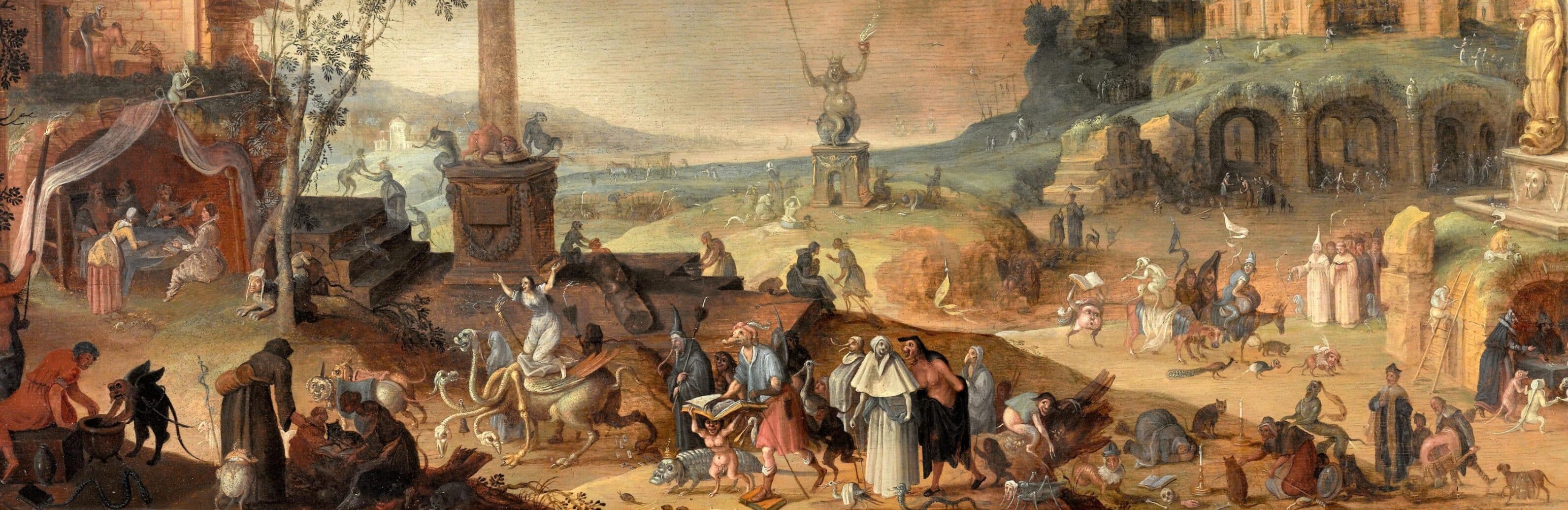 Claes Jacobsz. van der Heck, Witches’ Sabbath, 1636
© Rijksmuseum, Amsterdam
But in the Southern Netherlands after the separation from the Northern Netherlands the worst was yet to come. According to recent estimations one to two thousand people there fell victim to the furore, most of them in the seventeenth century.
In 1592 the Spanish King Philip II declared “witchcraft the worst form of heresy” and in 1595 he determined that “Satan’s accomplices are largely old, decrepit women”. A self-fulfilling prophecy reminiscent of the Dutch child benefit scandal, in which Minister Henk Kamp determined that citizens with a migrant background should be targeted for investigation for a fraudulent sum determined in advance, based on society’s (unjustified!) gut feeling. In 1606 a new Witch Law provided a final period of torture just before execution, to elicit names of accomplices, which caused a snowball effect.
Three quarters of all victims were women and although they came from all ages and walks of life, single elderly widows were in the majority. Powerful women could sometimes count on support, whereas it generally cost the poorest their heads.
Historical witch hunt
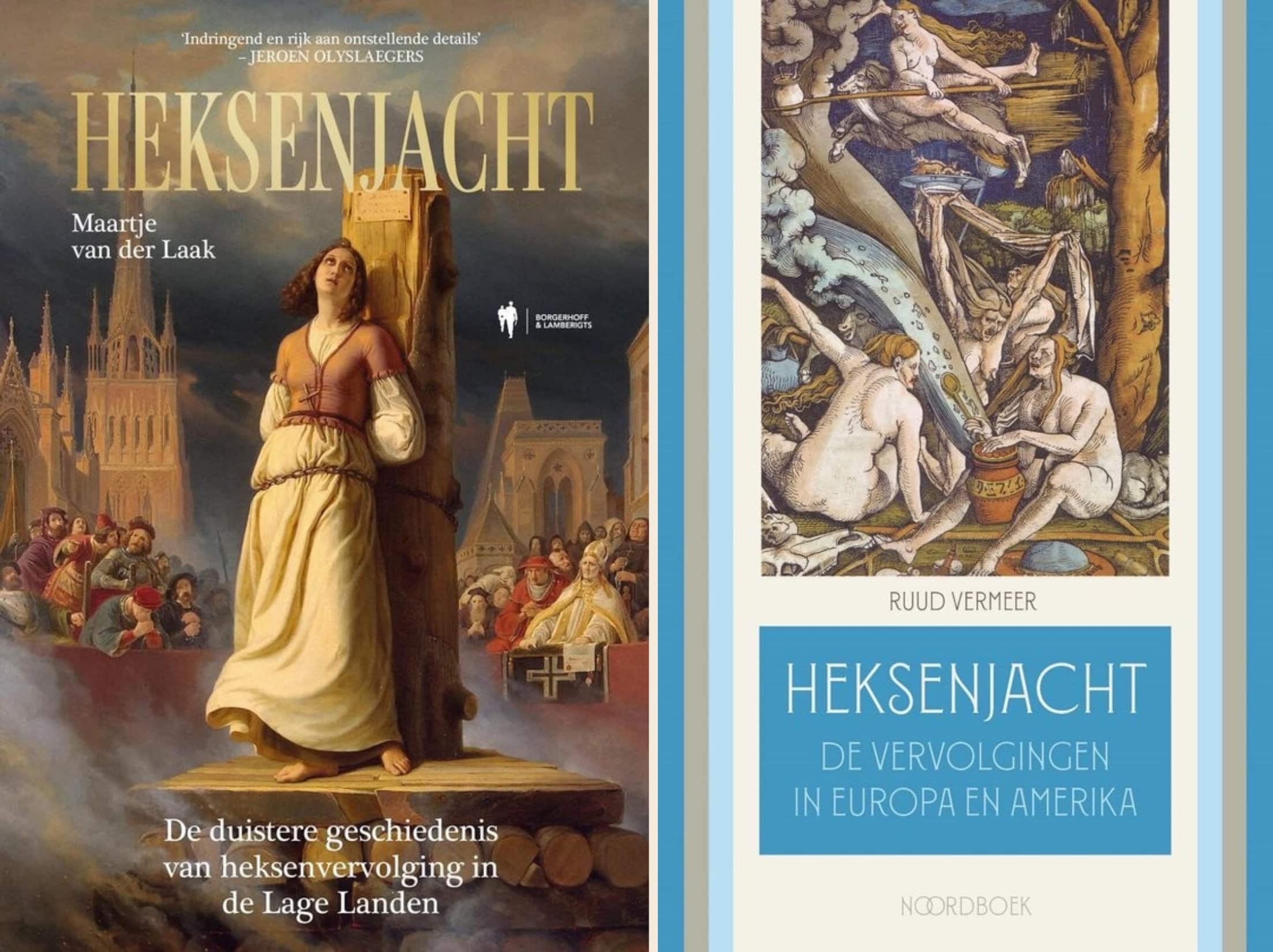
Two books recently appeared on this topic by historians, both with the title Heksenjacht (‘Witch Hunt’). The cover of Ruud Vermeer’s book, which also gives an account of persecution of witches in America, boasts a coloured engraving from 1508 with frightening, naked witches practising magic in a forest. The front of Maartje van der Laak’s book, which focuses on the Low Countries, reveals a romantic print of a young, beautiful martyr in chains on the pyre, her eyes cast melodramatically towards the sky, while the spiritual and secular authorities – all male – look on. The image has an almost sadomasochistic, erotic charge to it. That’s no coincidence: the persecution of witches turns out to be closely linked to an obsession with female sexuality.
Both authors point to the way this culminates in the publication of a book in 1486 that remains notorious as one of the most misogynistic of all time: Malleus Maleficarum (‘Hammer of Witches’), written by a German Dominican monk and inquisitor who contends that “all witchcraft springs from desire of the flesh, which is insatiable in women”. He includes a list of questions for witch hunters, which, with the assistance of torture, should serve to force confessions by the suspects of sexual intercourse with the devil. Thanks to the printing press and support from the pope, this witch manual achieved broad uptake. Arrested women were undressed, shaved and examined for signs of the devil. Over time secular courts adopted the same procedures.
Vermeer’s book is a somewhat sensational collection of largely gruesome stories with sexual undertones with a generally well known historical background, and it refers to bizarre-sounding magical practices: “Give a cat with its feet bound only bread soaked in its own urine to eat for two days and your husband will love you again.”
Van der Laak makes a much more serious attempt to explain belief in witches and to outline their roots in the history of the Low Countries. For instance the “flying ointment” made by women turns out sometimes to have a hallucinatory effect, shedding a very different light on the ability to fly so often associated with witches. Her work emphasises the defamatory aspect and heartrending scenes caused by the persecution, with some whole families murdered. She makes an insightful link with the way that past has shaped our present and continues to resonate in areas such as male-female relationships.
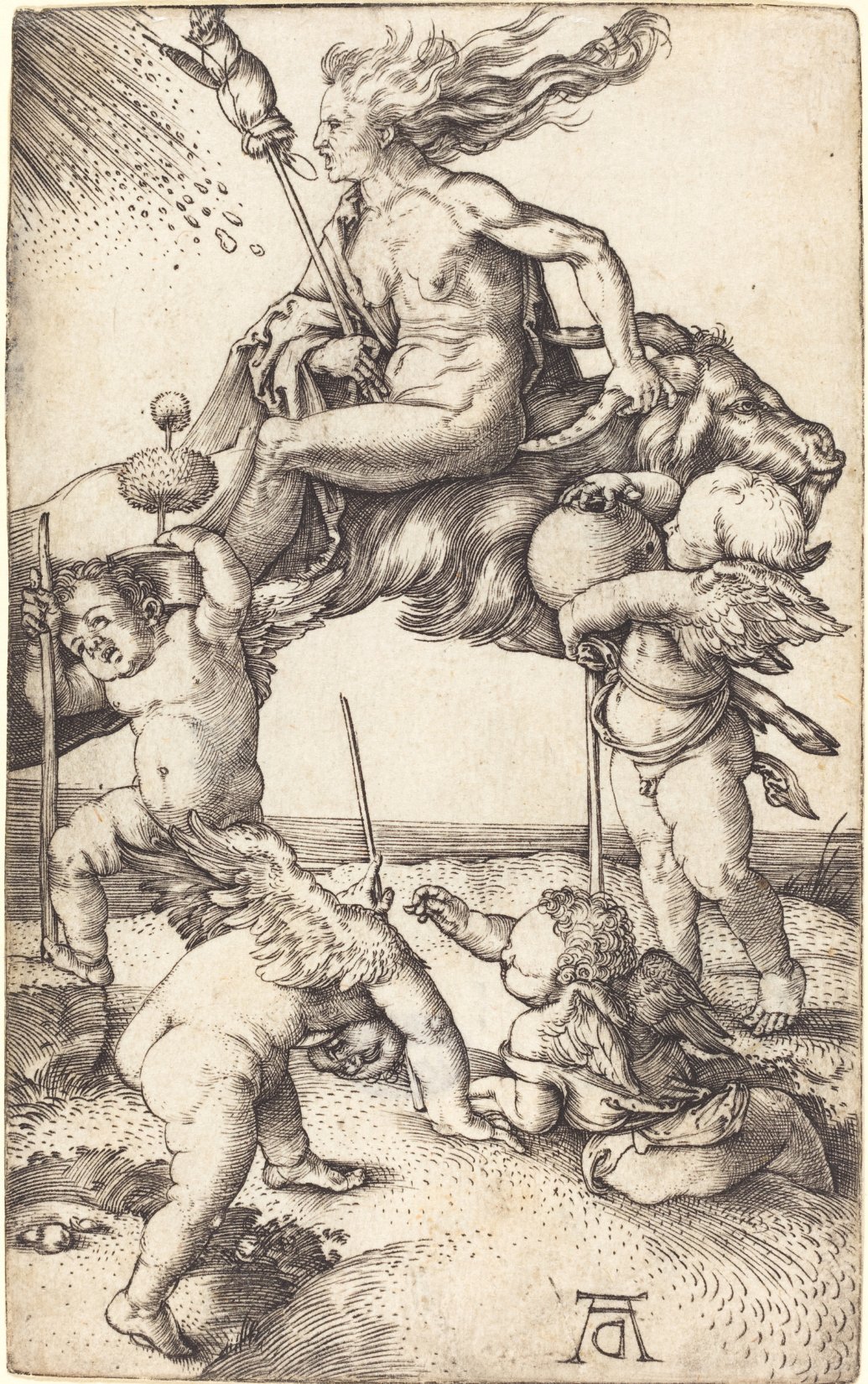 Albrecht Dürer, Witch Riding Backwards on a Goat, c. 1498–1502
© Rijksmuseum, Amsterdam
Both Vermeer and Van der Laak note that women were seen as creatures who could enchant men (something that was sometimes genuinely attempted with love potions): a man who fell in love with a woman was under her power. A noteworthy difference between Vermeer and Van der Laak is that he observes a male fear of failing to fulfil female desire, which manifests itself in stories with features such as the theft of penises by witches: “Older, sexually experienced women who could no longer have children were perhaps even more threatening to men, who were less potent after their turned fifty.”
Writer Daan Heerma van Voss makes a similar observation in Het geval Hekse Falsema (‘The case of Witch Falsema’), a study of the hate campaigns suffered by Dutch female politicians. There he points to “an ancient male fear of being the outsider”, becoming marginalised, superfluous, “because women can do everything men cannot, for instance having children”.
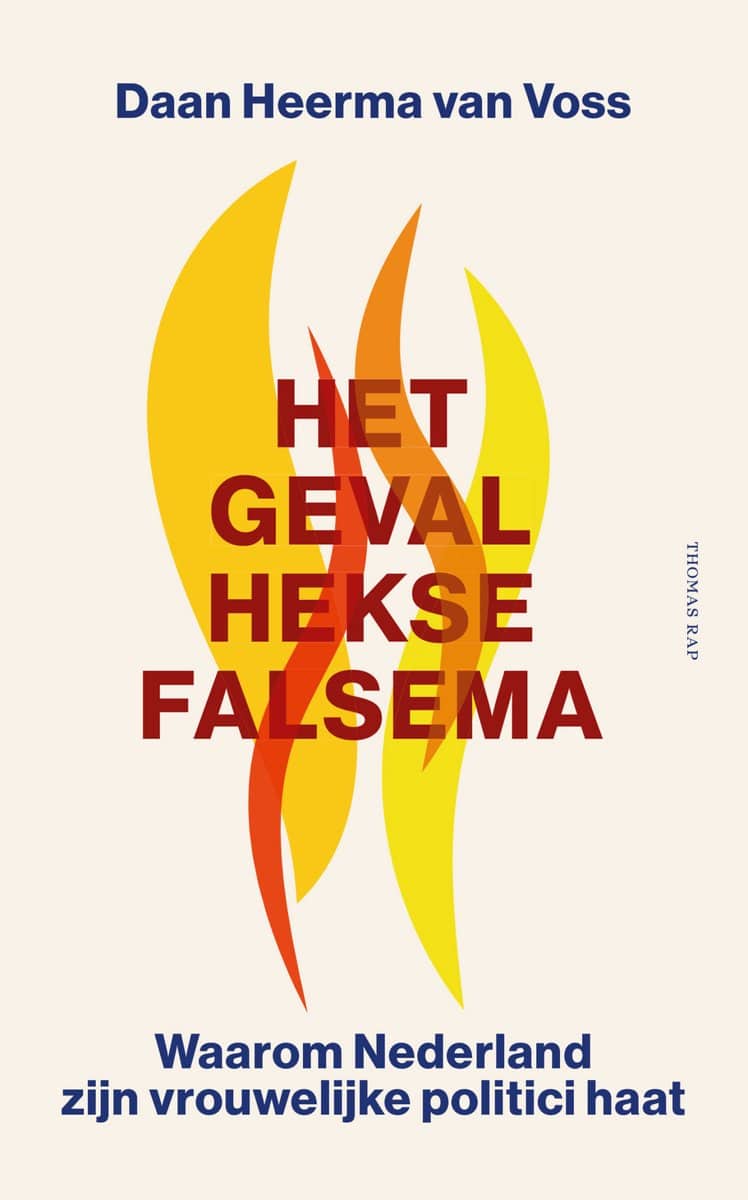
Van Voss outlines how the initial reverence for women for their creative force gave rise to a drive to compensate, with men drowning out their sense of insignificance (both the creator and the saviour became men!) and setting up a patriarchy in which female sexuality was subjugated to rules enforced by men. Now that women are penetrating that bastion of social power in every possible way, they feel threatened in their “superior” manliness – which derives its identity from distinguishing itself from the “other”. Given that vulnerability is seen as unmanly, there is no space to process this failed sense of superiority. Those who take revenge on the witch – hold the other down, paint them as the villain and flame them as scapegoats – avoid facing their own shortcomings.
Like Van Voss, Van der Laak points out that it was not the suspected witches who are the problem, but their persecutors: those who place evil outside themselves, who project it onto others, avoid addressing their own problems. Note the obsession with asylum seekers that has taken over political debate. As long as people point to that “other”, awkward conversations about serious problems eating away at Belgium and the Netherlands, such as pollution and the derailed climate, housing shortages, the faltering democracy and growing gap between rich and poor can be postponed.
Projecting evil onto others is a way of avoiding your own demons
Director Isa van der Wee of Museum de Heksenwaag in Oudewater knows how ingrained the reflex to stigmatise can be in daily life. “I regularly see couples come in where the man says, as if joking, ‘Well, I’ve come to weigh my wife, because there’s a witch in my house.’ Just to be clear: our museum is not about witches. Witches don’t exist.”
Back to the pyre
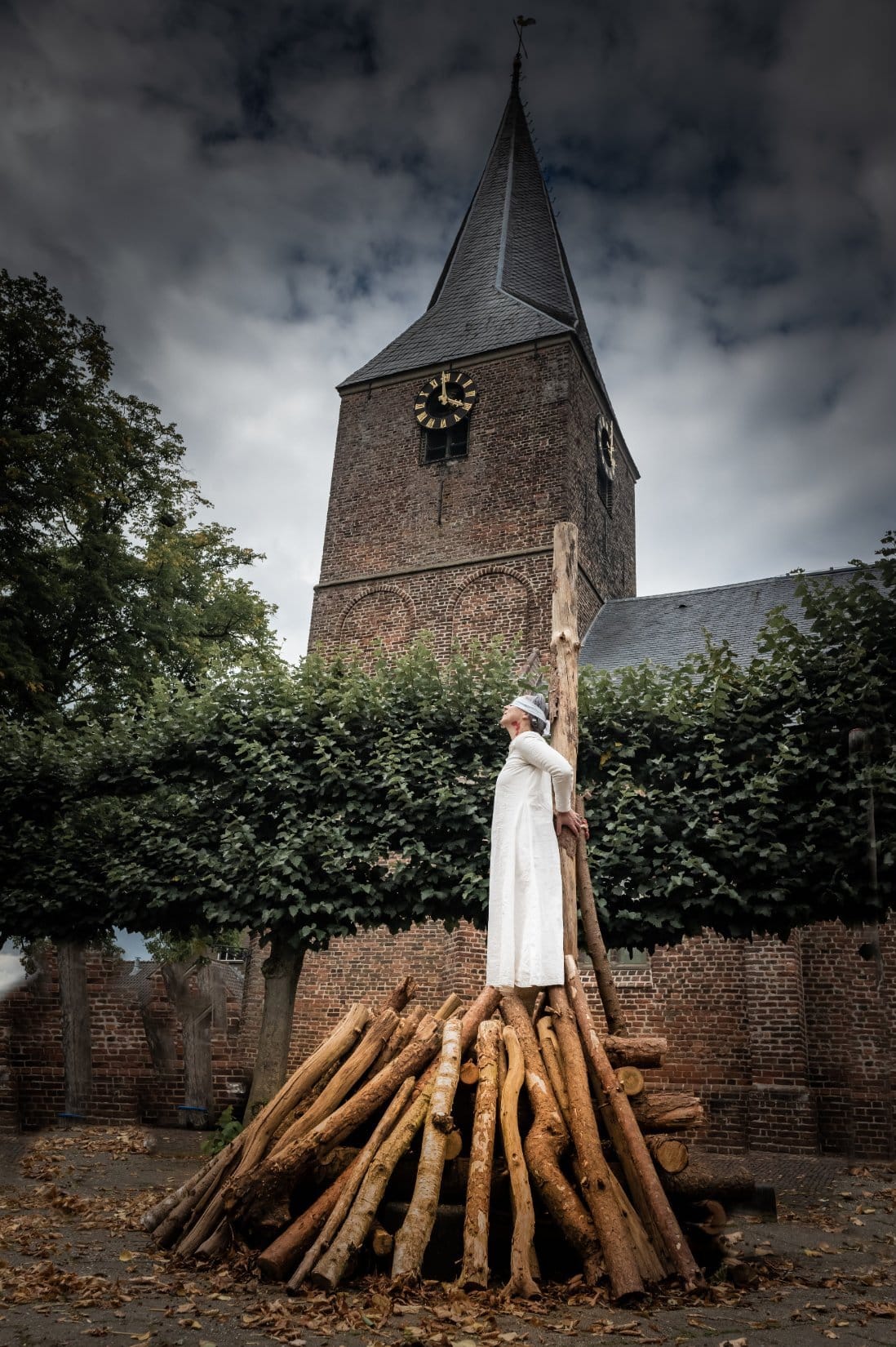 Scene from De Heks van Almen, a travelling theatre performance about the first woman burned alive as a witch in the Netherlands
 © Theatermakers Achterhoek / Vincent Tollenaar
Theatre maker Manja Bedner, one of the people behind the initiative of the Netherlands Witch Monument, has been performing De Heks van Almen (‘The witch of Almen’) since 2020. There she follows in the footsteps of the first woman burned alive as witches in the Netherlands, in 1472 in a village near Zutphen in the Achterhoek region. She thinks it strange that the festive witch burnings in Flanders are on the rise again. “This perpetuates the negative image of the vicious fairy-tale witch, created by the church as an archetype for female evil. But the point is that this loses sight of the human tragedy behind the witch hunts. The fact that history is written by men, that women are barely mentioned, that we have no sense of where we come from. I would like to find a balance between men and women, working together and complementing one another.”
Bedner’s performance, a moving story in which there is also space for humour and light-heartedness, ends with the midwife Aleyda standing blindfolded on a pyre. But there’s a twist. “She doesn’t get burned!” Bedner notes. “Instead she receives an important message that liberates her from her victimhood. That’s the key to the performance and to the future. She’s a woman of flesh and blood: a human being.”

You might also like





Leave a Reply
You must be logged in to post a comment.