

When the still newly formed United States began developing their prison system at the end of the eighteenth century, they drew inspiration from a Ghent house of correction. Inspiration made its way back across the ocean: the differing treatment of prisoners in Pennsylvania and New York influenced prison systems in Belgium and the Netherlands
When we think of punishment today, we almost immediately imagine a prisoner behind bars. Yet incarceration as a form of punishment is a relatively recent phenomenon. The development of the modern prison system is a bumpy story of Enlightenment thinkers, successful and failed experiments, and transatlantic exchange between Western Europe and the United States, with a prominent role for the Low Countries
Before the French Revolution – the so-called ancient régime – prisons were used for the temporary detention of people awaiting trial. The main forms of punishment included banishment, monetary fines, the pillory, corporal punishments, or the death penalty. The government’s goal was not rehabilitation, but deterrence and retribution.
Before the French Revolution, the government aimed to deter and punish, not to correct
Around 1760, this began to change gradually under the influence of the Enlightenment. Across Europe, criticism grew of the existing criminal law, particularly the arbitrariness of judges, the brutal methods of investigation such as torture, and the cruel punishments. Efforts were made to establish a new criminal law based on the principles of legality (crimes must be defined in advance by law), equality (everyone is equal before the law), and proportionality (punishment must be proportionate to the seriousness of the crime).
Ghent’s house of correction
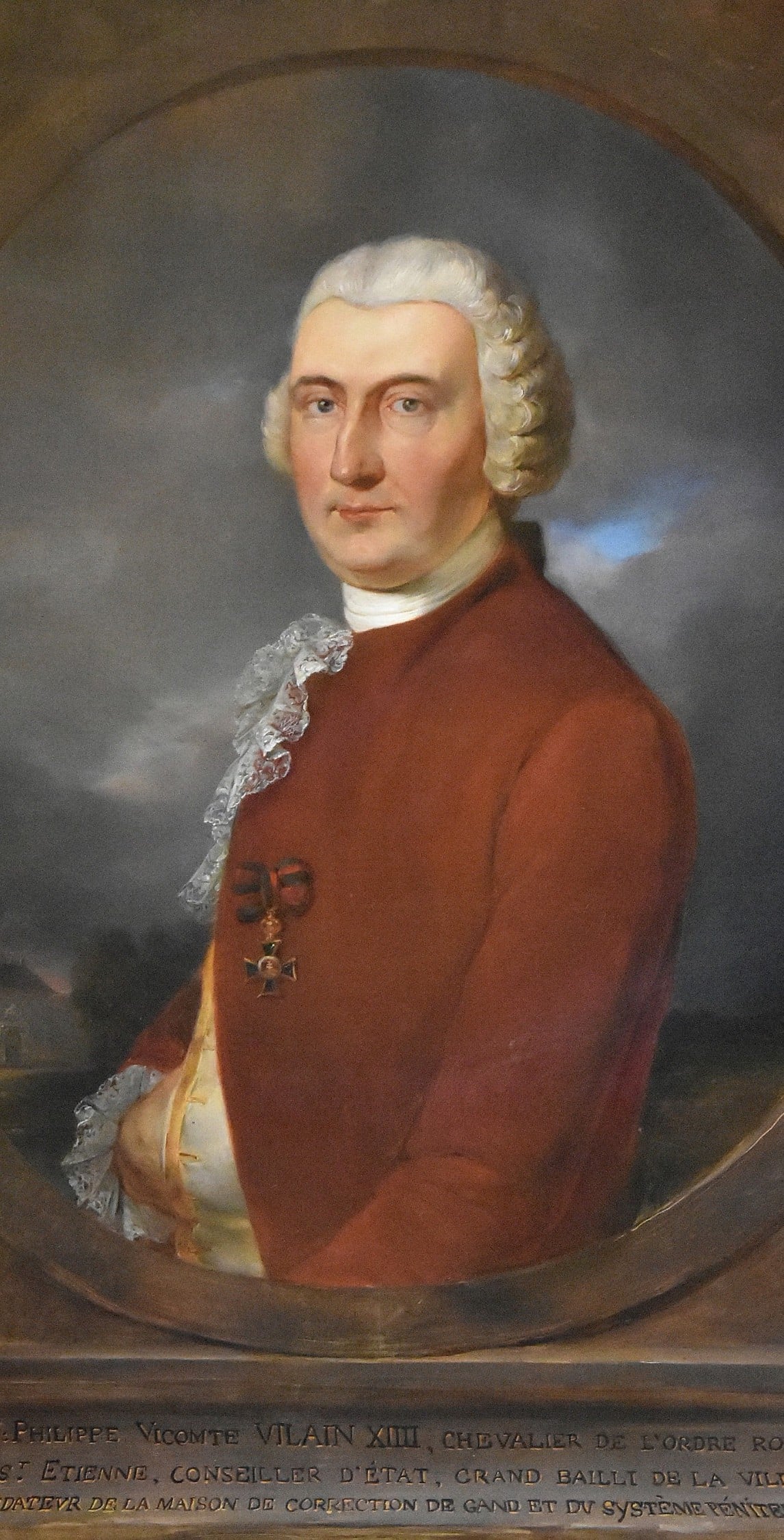 According to Jean Jacques Philippe Vilain XIIII, a politician from Aalst, only imprisonment combined with forced labor could reform people. He therefore proposed confining criminals in a house of correction or 'maison de force'
© Wikimedia Commons
During this period of shifting views, the Aalst-born politician Jean Jacques Philippe Vilain XIIII wrote his Mémoire sur les moyens de corriger les malfaiteurs et fainéants (treatise on the means of reforming criminals and idlers). Vilain XIIII was asked to draw up a plan for reforming the criminal justice system because, at the end of the eighteenth century, Flanders was struggling with a significant rise in vagrancy, begging, and crime.
Vilain XIIII had little faith in the punishments of his time, such as banishment or corporal punishment. He believed that only imprisonment combined with forced labour could truly reform people. Simply locking up people was not the solution. In his view, criminal behaviour originated in “idleness”: doing nothing. He therefore suggested placing offenders in a house of correction (maison de force), where they would be forced to work. He took his inspiration from urban workhouses that first appeared in the sixteenth-century in London and Amsterdam and were later also adopted in the Southern Netherlands. They were designed to address poverty and begging by putting vagrants, beggars, and minor offenders to work; rasp houses for men (where they ground wood into powder for the dye industry) and spin houses for women (where they spun fibre into thread).
In 1773, the States of Flanders founded a provincial house of correction in Ghent at the Coupure, following Villain XIIII’s suggestion. The institution was regarded at the time as the prototype of the modern prison. Prisoners were confined according to sex, age, and offence. During the day, they worked in groups, and at night they slept in individual cells.
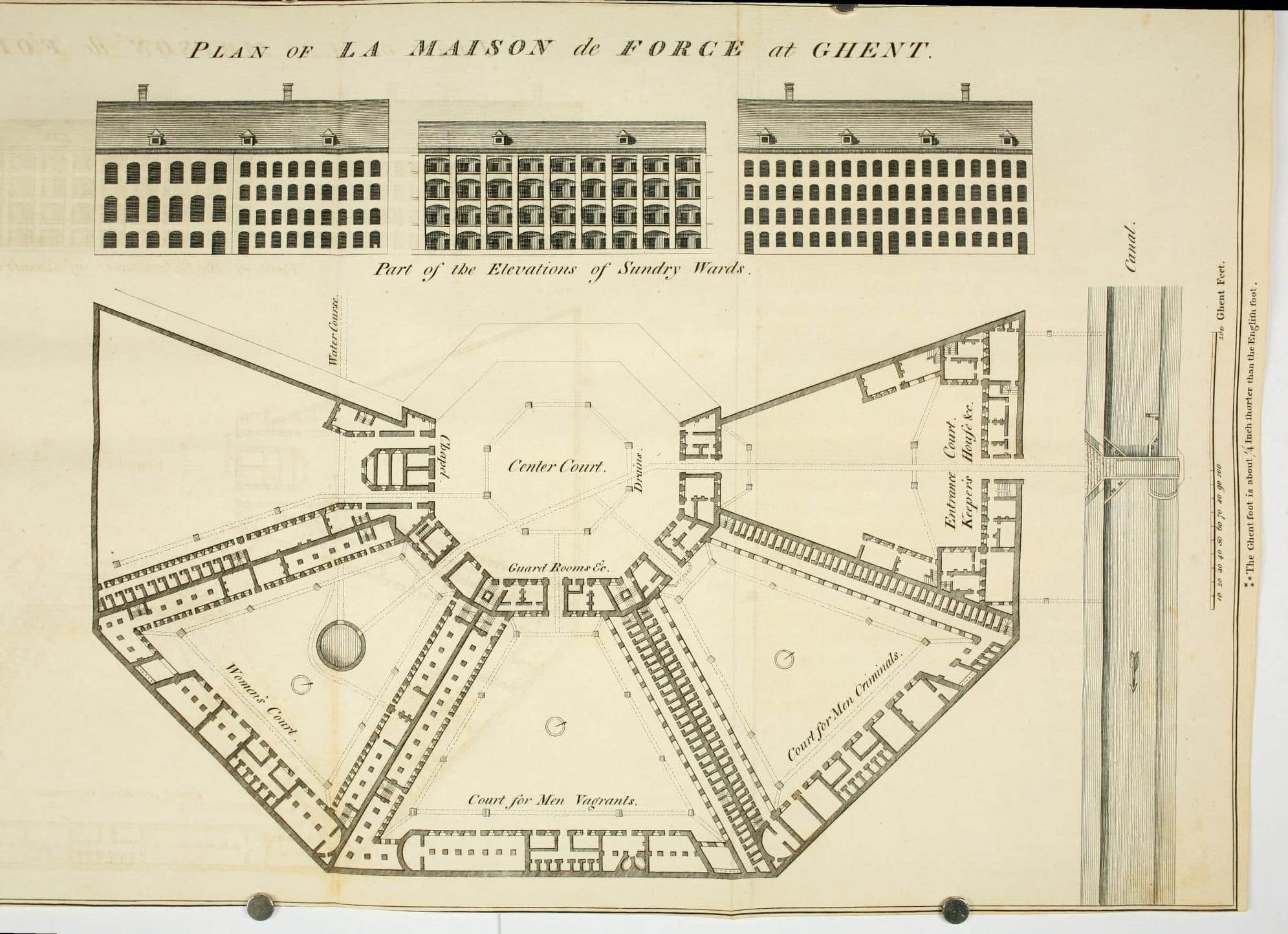 The Ghent house of correction had an octagonal central courtyard, with separate wings housing different categories of detainees. By the late 18th century, it was regarded as the prototype of the modern prison and an international model
© Public Domain
The Ghent house of correction soon became an international example. The famous English philanthropist and prison reformer John Howard visited the prison several times and praised it in his influential book The State of the Prisons in England and Wales (1777). The Ghent model crossed the Channel to England through Howard and was largely implemented in the prison at Wymondham in Norfolk. From there, it made its way to the United States, which had just gained independence.
Auburn versus Pennsylvania
Inspired by European thinkers such as John Howard and institutions such as the Ghent house of correction and Wymondham, the state of Pennsylvania passed several laws between 1786 and 1794 that formed the basis for the modern prison system in the United States.
Imprisonment replaced corporal punishment, and the principle of solitary confinement was introduced. The city prison on Walnut Street in Philadelphia was transformed into a state prison and given a separate wing with sixteen cells for the solitary confinement of serious and repeat offenders. By separating them from the other prisoners, all communication would be avoided and they could not morally corrupt one another. Poor infrastructure and overcrowding prevented successful implementation: most prisoners were crammed into communal areas, and even in cells multiple inmates were housed together.
Even so, policy makers of the neighbouring New York State adopted the Walnut Street model of solitary confinement. In 1797, Newgate Prison, the first state prison, opened there, but soon became too small and suffered from overcrowding, poor hygiene, and prisoner uprisings. In 1816, authorities decided to build a new state prison in the city of Auburn. Between 1821 and 1823, a system of solitary confinement was experimented with here, where prisoners were held in small cells day and night, without human contact or any opportunity for recreation, labour, or exercise. This experiment in total isolation failed completely: prisoners were literally driven insane by loneliness and boredom.
In Auburn, a total isolation experiment went horribly wrong: prisoners literally went insane from loneliness and boredom
This led to a radical shift and the abandonment of this form of confinement. From then on, the Ghent model of Vilain XIIII was adopted: prisoners were grouped according to sex, age, and ability to work; they worked during the day and they were kept in separate cells at night, all in complete silence. Silence was enforced through beatings or flogging.
Nearly all prisons in the United States implemented the Auburn system. Except in Pennsylvania, where authorities held firmly to the principle of solitary confinement. In 1829, a new state prison opened in Cherry Hill. At the time, it was the largest and most costly public building ever built in the United States. Prisoners remained in individual cells at all times. They worked, ate, and slept in their cells, where they were visited by a chaplain and a teacher. Each cell opened onto a small walled outdoor space where prisoners were allowed an hour of daily exercise.
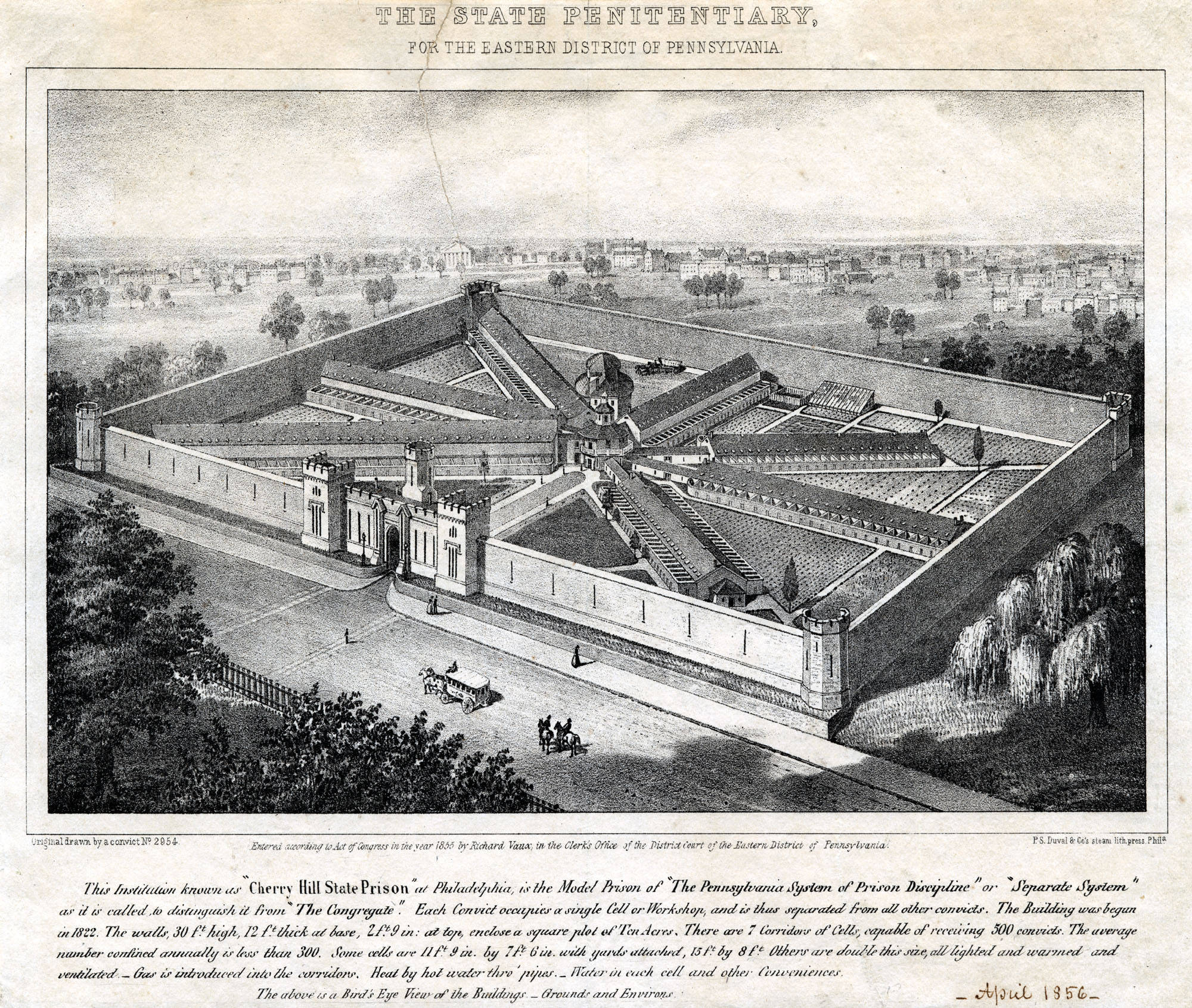 Cherry Hill State Prison, later better known as Eastern State Penitentiary, opened in 1829
© Public Domain
In this system, prisoners had no contact with one another, making “moral contamination” impossible. Prisoners were encouraged to engage in self-reflection and penance (hence the term penitentiary). The Bible was the only allowed form of distraction.
Return to the Low Countries
Many European philanthropists and prison experts visited both institutions and published their findings. As a result, the debate between proponents of the Auburn and Pennsylvania systems in the United States was taken up across the Atlantic from the mid-1830s onwards.
In Belgium, Edouard Ducpétiaux joined the international debate. He was appointed Inspector-General of Prisons shortly after independence and remained in office until 1861. From the start, he was a strong opponent of any form of congregate system. Under Dutch rule, Ducpétiaux had come into contact with this system after serving a prison sentence for a press offence. He strongly favoured the Pennsylvania system of solitary confinement.
Although the Belgian parliament was at first reluctant to fully support Ducpétiaux’s ambitions, it eventually set aside its reservations in the 1850s and adopted prison reform based on solitary confinement as official state policy. The implementation and expansion of the cellular regime were accompanied by a large construction programme, resulting in twenty-three new cellular prisons between 1850 and 1875. Ducpétiaux and prison architect Joseph Dumont were inspired by Pentonville prison near London, a refined version of the Pennsylvania model.
The prisons shared the same characteristic architecture: a castle-like neo-Tudor gatehouse, fully enclosed, and a main building with a central observation post overlooking star-shaped cell wings on three floors. The architecture fully met Ducpétiaux’s spatial requirements for the implementation of his cellular system. Prisoners spent the entire day alone in their cell. The only breaks in this extreme isolation were the daily yard walk, as well as lessons and Sunday services in the chapel. During all movements, prisoners were required to wear a hood and walk in silence in single file. During religious services and lessons, wooden partitions prevented any contact.
Belgium was the only country where the cellular system was implemented so extensively and on such a large scale. Internationally, it was even referred to as le système belge.
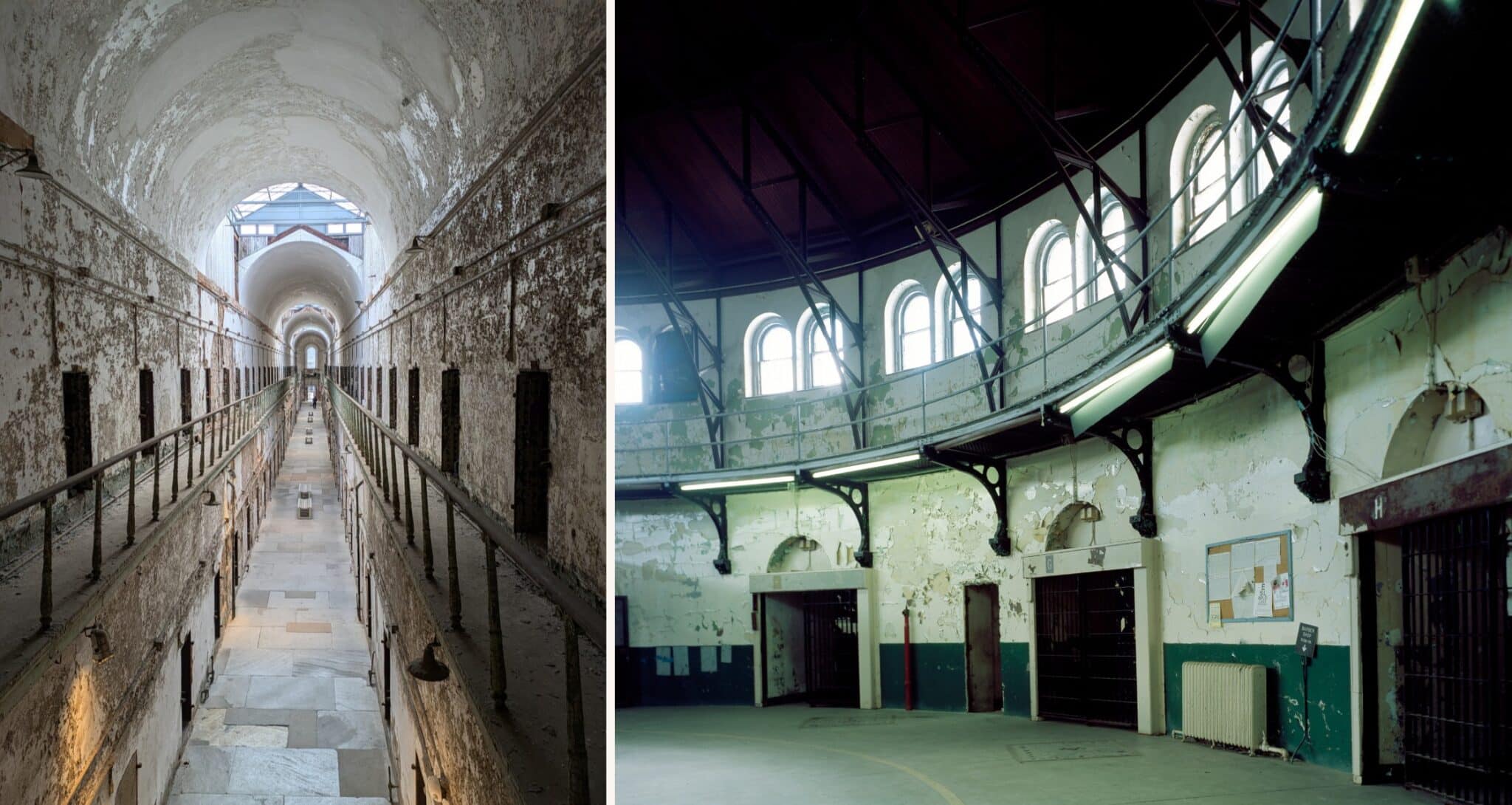 At Eastern State Penitentiary, the strict Pennsylvania system of cellular separation was implemented, complete with a corridor of cells on two floors and a central space. Belgian Inspector-General of Prisons Edouard Ducpétiaux (1804–1868) was also an advocate
© Wikimedia Commons
In the Netherlands, the introduction of solitary confinement was somewhat more difficult. In 1840, the parliament initially approved the Auburn system. In 1851, solitary confinement was introduced, but only for short-term sentences. As there were simply not enough cells, the congregate system remained the prevailing practice. The cellular system was only fully introduced in 1886 with the new penal code. During this period, the number of cells expanded significantly with the opening of new prisons, including the three dome prisons in Breda, Arnhem, and Haarlem.
At the turn of the century, criticism of the cellular system grew in the Netherlands, whereas in Belgium it had already been heard since the late nineteenth century. Rising recidivism rates challenged the rehabilitative effects of prison life, and calls for a more humane and differentiated treatment of prisoners grew louder. Although some reforms were introduced in the early twentieth century, it was not until after the Second World War that both countries definitively abandoned the system of solitary confinement.
Further reading
Harry Elmer Barnes, ‘Historical Origin of the Prison System in America’, Journal of Criminal Law and Criminology, Chicago, Illinois, vol. 12, no. 1 (1921), pp. 35-60
Herman Franke, Twee eeuwen gevangen. Misdaad en straf in Nederland, Aula, The Hague, 1990
Eric Maes, Van gevangenisstraf naar vrijheidsstraf. 200 jaar Belgisch gevangeniswezen, Maklu, Antwerp-Apeldoorn, 2009
Bert Vanhulle, ‘Dreaming about the prison: Édouard Ducpétiaux and Prison Reform in Belgium (1830-1848)’, Crime, Histoire & Sociétés / Crime, History & Societies, Milton Keynes, vol. 14, no. 2 (2010)

You might also like








Leave a Reply
You must be logged in to post a comment.