
Dutch Light in the Hamptons: Willem de Kooning Gave Direction to American Art

After leaving his home in Rotterdam for New York, Willem de Kooning plunged into the American art world, never forgetting his debt to the European tradition. He became a driving force behind the first typically American art movement of abstract expressionism.
The seventeenth-century Dutch masters never strayed far from home, but Vincent van Gogh, Piet Mondrian and Willem de Kooning did. They left the Netherlands, found their own styles elsewhere and became the most influential artists of their generations due to the fruitful interaction between their background and their new environment. De Kooning’s (1904–1997), Dutch background consisted only of his youth and education, an apprenticeship that lasted nearly ten years.
Because his parents – his father was a wine merchant, his mother ran a sailors’ pub – divorced early on, de Kooning became independent at a young age, starting an apprenticeship at the Gidding decoration studio in Rotterdam when he was just twelve years old. The Gidding studio created murals for the Tuschinski Theatre in Amsterdam, stained-glass windows for De Bijenkorf in The Hague and carpets for the House of Van Buuren in Brussels, among other commissions. At this time, de Kooning also attended evening classes at the Academy of Fine Arts, where he mastered the technical and academic disciplines and also came into contact with the ideas of De Stijl, an influential abstract art movement in the Netherlands that focused on absolute visual simplicity and harmony.
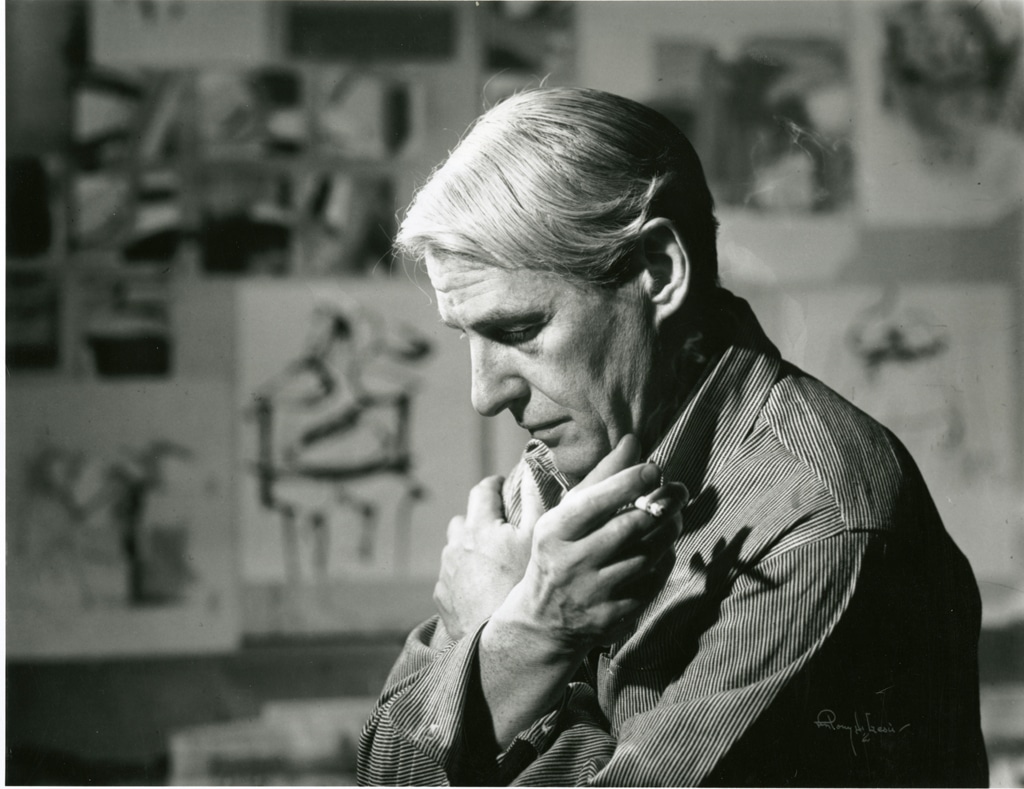 Willem de Kooning in his studio
© Smithsonian Archives, Washington
At sixteen, he began working freelance for Bernard Romein, artistic director of De Bijenkorf and the Belgian Cohn Donnay department store in Rotterdam. In 1924, de Kooning spent several months in Brussels, attending classes at the Academy. He discovered and admired the Flemish Primitives, Bruegel and Rubens at the Museum of Fine Arts.
Two years later, de Kooning travelled to America as a stowaway, arriving in Newport News (Virginia) on 15 July 1926. The landscape was like that of the Netherlands – it was certainly just as flat. But the big city beckoned and he had no intention of staying put. He befriended some sailors who directed him to a Dutch establishment in New York. Three days later he started work as a house painter in Hoboken (New Jersey), just across the Hudson River from Manhattan.
New York School
Around 1930, De Kooning met the Armenian artist Arshile Gorky (1905–1948), who introduced him to the Cubism of Picasso and the Surrealism of Miró. Gorky introduced him to Picasso’s method of breaking his figures down into lines and planes of colour, and Miró’s skill at creating a colourful dream world with biomorphic forms. But the most important lesson de Kooning learned was that the representation of reality is less important than the creation of one’s own visual language. Whether that language was figurative or abstract was of less importance.
Together with Gorky, de Kooning was part of a group of young artists. In many ways similar to L’École de Paris in the first half of the twentieth century, this highly heterogeneous group later became known as the New York School. Their common ground was not a shared style but, rather, a way of life. Their creed was that art had to be innovative and groundbreaking and expression had to be personal and original. Their goal was to develop an American avant-garde school with an international appeal.
They each did this in their own way. Colour Field painters such as Mark Rothko (1903-1970) and Barnett Newman (1905-1970) used monochrome colour fields to create a spatial effect with a spiritual and transcendent character that drew the viewer in. Action painters such as Jackson Pollock (1912-1956), Franz Kline (1910-1962) and Robert Motherwell (1915-1991) made the act of painting the subject of the painting. Capturing the way in which the paintbrush registers the movement of the body on the canvas is considered representative of the emotions and psychological state of the performer. Inspiration came from the écriture automatique of the surrealists.
Railway Junction
While his fellows quickly devoted themselves exclusively to abstract art, de Kooning constantly walked a fine line between figuration and abstraction. Compared to the Americans, who had developed a clearly recognizable visual language, de Kooning’s oeuvre is complex, diverse and multifaceted. While the Americans sought inspiration in indigenous culture: Pollock among the Navajo, Newman in Northwest Native American and pre-Columbian art, de Kooning never forgot his debt to the European tradition.
The Americans sought inspiration in indigenous culture. De Kooning remained indebted to the European tradition
If Gorky was the missing link between L’École de Paris and the New York School, then de Kooning was responsible for a shift towards abstract expressionism, the first truly American art movement to gain international recognition. Despite the sometimes recognizable motifs, the focus in this movement shifts from the object to the subject. The painting is not a representation of reality but, instead, an intuitive and emotional expression of personal impressions and experiences reproduced on the canvas with expressive brushstrokes and bright colours. British art critic David Sylvester was right to call Willem de Kooning the most important “painterly painter” of the second half of the twentieth century.
The purchase by MoMA of de Kooning’s Painting (1948), an abstract composition in black and white, established his reputation. In the 1950s, abstract expressionism was canonized and taken up by the next generation. Fellow painter Al Held noted that ‘de Kooning has devised a language with which everyone can write their own sentences.’ This new generation included not only disciples like Joan Mitchell, Alfred Leslie and Robert De Niro Sr., but also radical innovators such as Larry Rivers (1923–2002), Robert Rauschenberg (1925–2008), Cy Twombly (1928–2011) and Jasper Johns (1930).
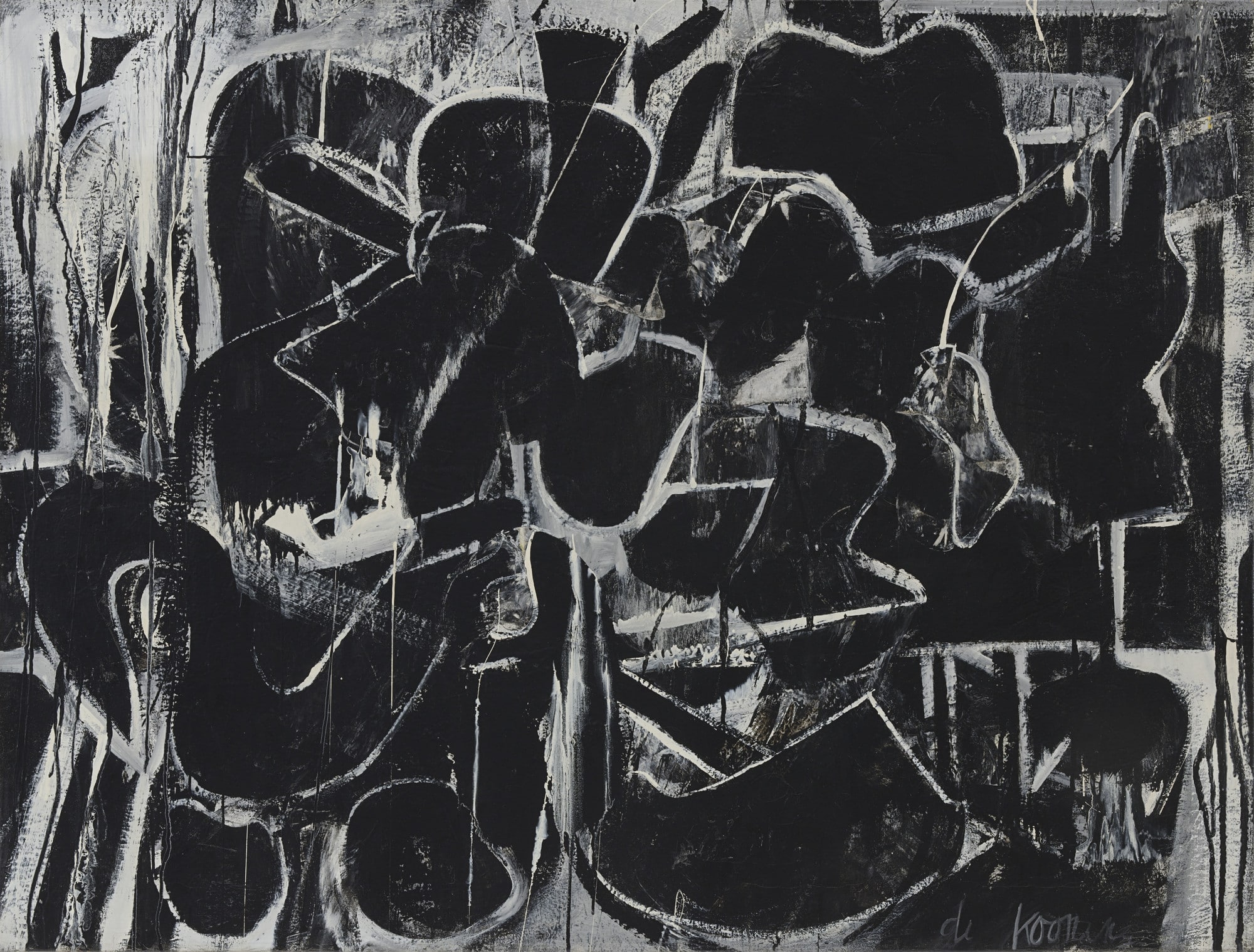 Painting (1948). When the MoMA in New York purchased this work by Willem de Kooning, his reputation was established.
© MoMa, New York / Sabam Belgium 2026
Things unfolded differently for Jackson Pollock. Like de Kooning, Pollock was considered a figurehead of abstract expressionism, but his drip paintings – liquid paint thrown onto canvases laid on the floor – more often inspired imitation rather than innovation. When LIFE Magazine declared Pollock the ‘shining new phenomenon of American art’ in 1949, de Kooning’s response was, ‘Pollock broke the ice.’ This was not agreement with the prevailing view that Pollock’s revolutionary methods had paved the way for other artists (including de Kooning), but rather a critical commentary on Pollock’s popular appeal. Pollock, for his part, regarded de Kooning’s culture and erudition as a sign of weakness: ‘You know more, but I feel more.’ Indeed, it was only after Pollock’s tragic death in 1956 that de Kooning became the undisputed leader of abstract expressionism.
His dual position – as consolidator and initiator – explains the importance of de Kooning’s work for the many generations of artists who came after him: his influence was as rich and diverse as his artistic legacy. According to Sylvester, his place on the map of twentieth-century art history is that of a ‘railway junction’ where lines converge from various points, then spread out and continue on to other destinations.
Women
That de Kooning could not abandon figuration had to do with his classical training and admiration for Picasso. The 1939 retrospective Picasso: 40 Years of his Art (MoMA) had a huge impact on de Kooning, particularly when it came to the uninhibited way in which Picasso depicted his women: the violently fragmented body of Olga, the eroticizing poses of Marie-Thérèse, and the weeping Dora. At the height of the abstract expressionism movement, de Kooning astonished the art world with a series of frighteningly grotesque depictions of women.
For example, in all her broken contours, we find the subject of Woman I (1950-1952) majestically crouched in an abstract landscape of swirling brushstrokes in various tonalities. With her penetrating gaze – wide-open eyes with bulging pupils in her greyish face, bared teeth in her grinning mouth – sturdy shoulders, pronounced bosom, broad hips and lifted skirt she gives a menacing impression. This is not your typical woman; this is a mixture of lust and violence, ugliness and seduction, awe and fear. When it was acquired by MoMA in 1953, the bright colours, distorted forms and aggressive brush strokes caused more than raised eyebrows. This human figure, which in no way conformed to the clichés of worn-out conventions and bloodless aesthetics, was perceived as misogynistic, objectifying, threatening and violent.
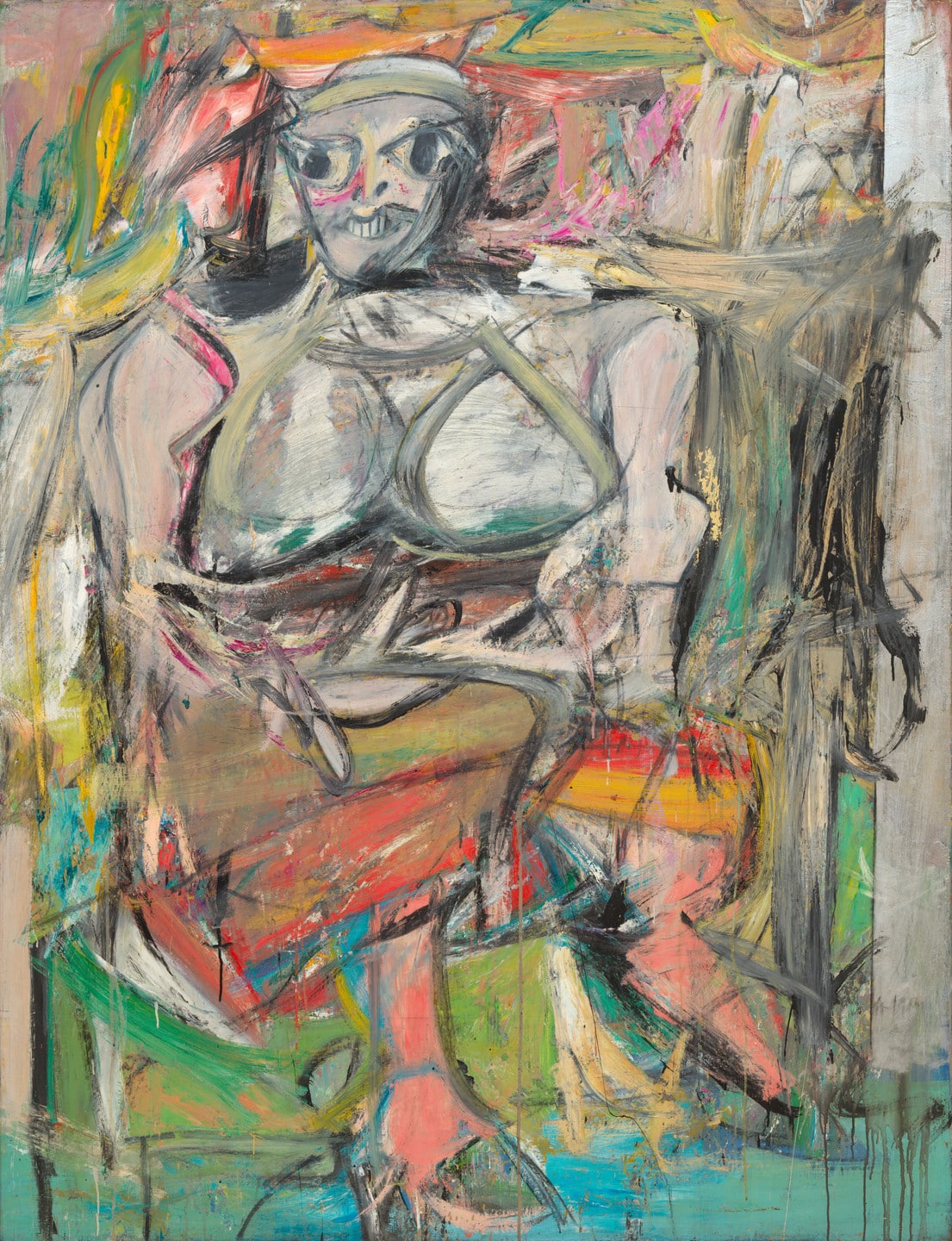 With his work Woman I, Willem de Kooning provoked strong reactions in the 1950s
© MoMa, New York / Sabam Belgium 2026
Although there is an impression that the painting was created quickly and intuitively, de Kooning, in fact, worked on it for two years. The result is a sample book of pictorial possibilities, ranging from thin to impasto paint, from smooth to rough texture and from opaque to translucent paint layers that are alternately sanded, scraped and overpainted. By using this unique method, de Kooning undermined the conventions of both iconography and execution.
With his series of women, de Kooning aligned himself with the post-war art of European existentialism and painters of the human condition such as Jean Dubuffet, Alberto Giacometti and Francis Bacon. Human values such as subjective experience and personal expression, self-affirmation and authenticity are woven together with loneliness, fear and trauma. The body ravaged by matter becomes a metaphor for dehumanization and alienation. De Kooning’s affinity with Giacometti is apparent in his bronze sculptures of the early 1970s.
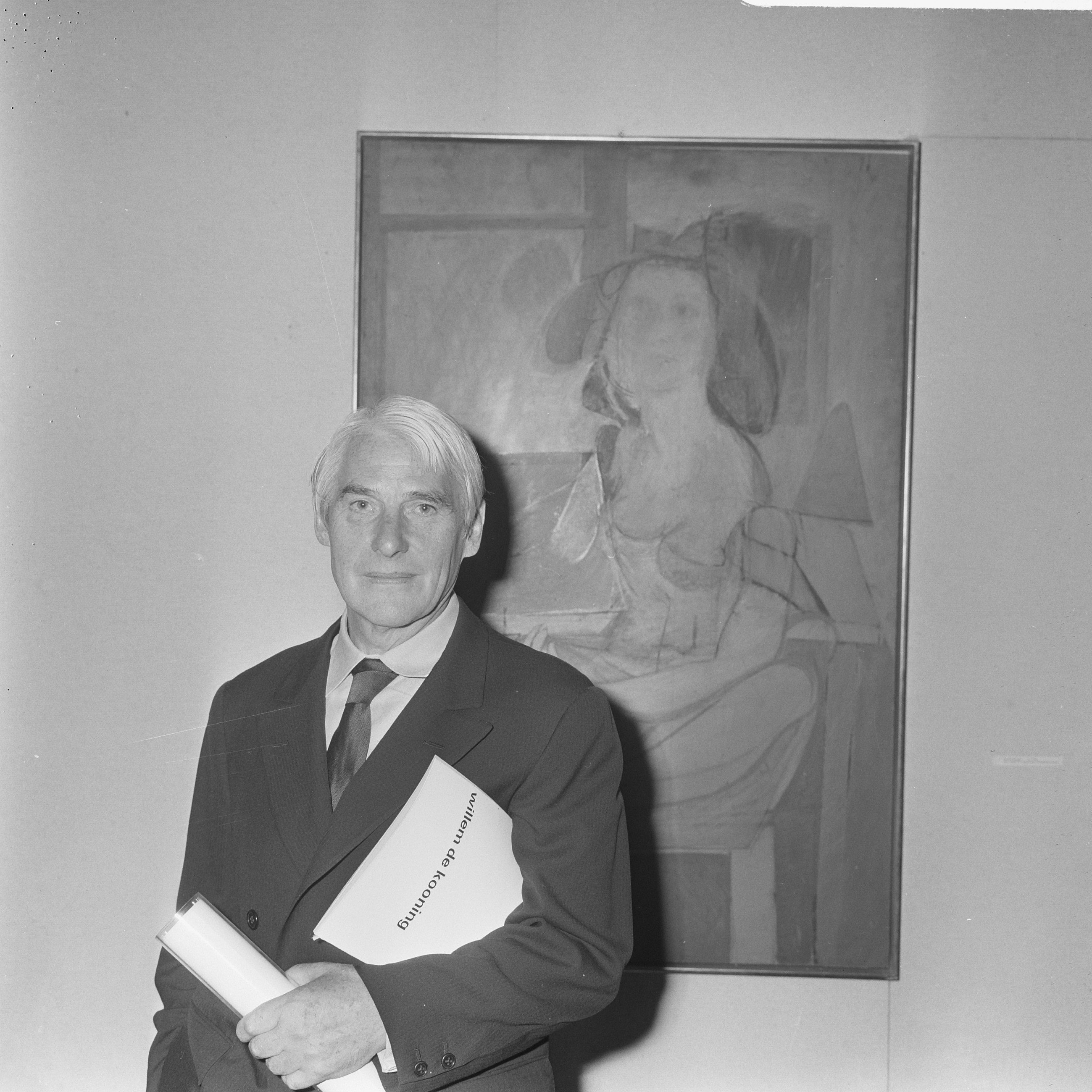 Willem de Kooning in front of one of his works in 1968
© Nationaal Archief, Den Haag
In the 1960s, a second series of women followed (1964-1971): dynamic nudes, white and pink with bright red outlines merging into a similarly dynamic background of roughly painted arabesques in subtle shades of yellow, orange, green, and blue. In de Kooning’s view, oil paint was the perfect vehicle for the vulgar, the fleshly and carnal aspect of Western art that he loved. The artist acknowledged that his nudes were regularly compared to the carnal types of Rubens.
Paint, Colour and Light
In the late 1950s, de Kooning began to gradually distance himself from New York. His focus shifted to landscapes and nature. When he observed the world around him, he was delighted to see ‘that the sky is blue and the grass is green’. He began to limit his palette to a just a few shades. The number of brushstrokes decreased, but because he began to use brushes instead of paintbrushes, they also became broader. In 1963, he moved permanently to Springs near East Hampton, Long Island. Because of its proximity to the Atlantic Ocean, the shoreline and the water-rich landscape, the region had ‘a certain air of Holland about it’. The light is also typically Dutch: cool, clear and changeable. It does not create harsh contours or dramatic effects. Instead, it is diffuse, expansive and atmospheric. His landscapes can be summarized as ‘all sun, sky, earth and sea’.
During the last three decades of his career, like the seventeenth-century Dutch masters, de Kooning did not stray far from home. In the familiar surroundings of the Hamptons, he struck a dynamic balance between figuration and abstraction. Just as Monet did in Giverny de Kooning, in Springs, focused inward on his own world and his own art. And just like Monet with his water lilies, de Kooning reached a career high point at an advanced age with his abstract landscapes.
In the familiar surroundings of the Hamptons, De Kooning found a dynamic balance between figuration and abstraction
A beautiful synthesis of de Kooning’s late period is North Atlantic Light (1977). This painting, which appears abstract at first glance, can be interpreted as a seascape in which the light of the title is reflected on the water’s surface. De Kooning achieves the oceanic atmosphere through the transparent effects of oil paint applied layer upon layer with strong nuances in shades of grey and blue, subtle transitions of cool colours, foaming waves and reflections. Swaying on the swollen sea and beneath storm clouds, the outline of a small sailboat is the only recognizably solid motif. All the rest is paint, colour and light.
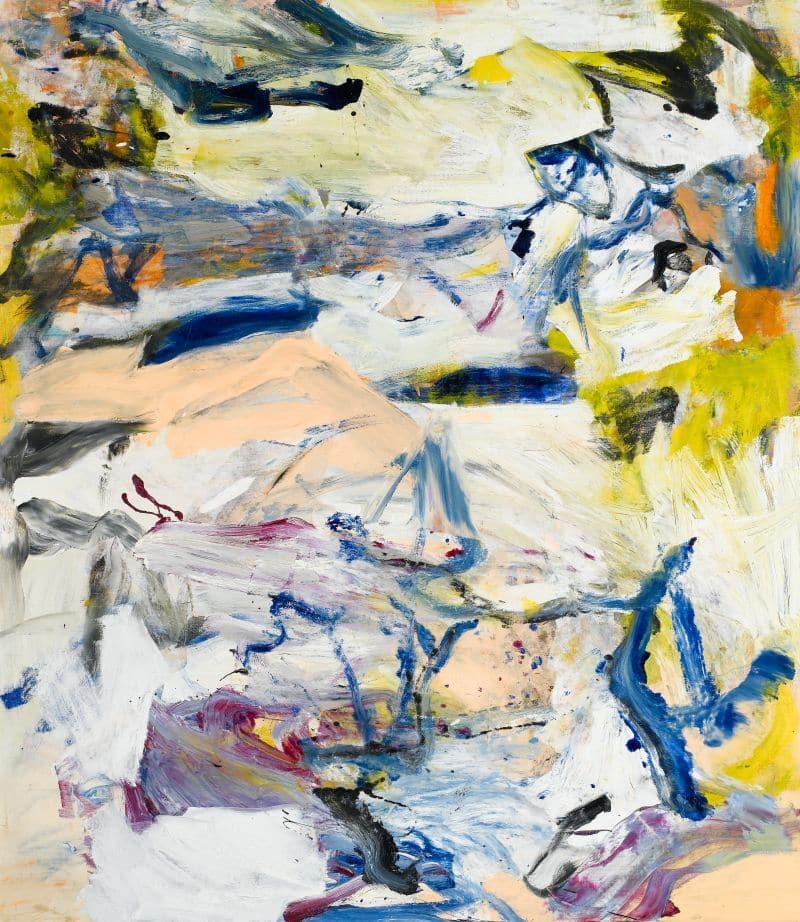 In North Atlantic Light, a synthesis of his later period and a highlight of his oeuvre, Willem de Kooning refers to the Holland of his childhood and to the seventeenth-century Dutch landscape painters
© Stedelijk Museum, Amsterdam / Sabam Belgium 2026
The late-career landscapes and seascapes are not literal representations of reality but, rather, expressions of how nature is experienced. They are sensory, emotional and mental memories of the Holland of his childhood, but also of the seventeenth-century Dutch landscape painters. The landscape does not provide a backdrop for a historical or mythological story. It is more about the sensing of an atmospheric reality that is simultaneously a personal transcription of a subjective, attentive observation: precise, subtle and direct.
Further Reading
Willem de Kooning, Centre Georges Pompidou, Paris, 1984
Willem de Kooning. Paintings, Tate Gallery, Londen, 1995
You might also like
In Jozef Deleu’s Poetry, Nothing Was Lost



Leave a Reply
You must be logged in to post a comment.