
From New Amsterdam to New York: Take a Walk on the Wild Side

Four hundred years ago, Europeans named their trading post in the New World New Amsterdam. Those who look closely can still find traces of that Dutch settlement in the bustling city of New York today.
STOP 1: Battery Park
Before the Europeans arrived
I am standing by the water in Battery Park, at the southernmost tip of Manhattan. I look out across the bay. I hear the piercing wail of sirens, the blaring of taxi horns and the thudding blades of a helicopter overhead. In the background, the Staten Island Ferry hums. Today, New York sounds loud, shrill and relentless. And you don’t only hear the noise, you feel it too: the sirens vibrate through your bones, and the roar of the underground makes your feet tremble.
What if you could filter out those sounds one by one and travel back in time?
Around four hundred years ago, this place sounded very different. Leaves rustled in the wind. Water lapped against wooden canoes. Gulls cried overhead as they flew above the dense forest that covered the entire island. Manhattan was then known as Manahatta, a word from the language of the Lenape, the people who had lived here for centuries before the Europeans arrived. Manahatta means “the place where there is wood for making bows”.
More than twenty thousand Lenape lived across a territory larger than the Benelux countries. Adriaen van der Donck, a Dutch lawyer and adventurer, was among the first to describe the people living in this part of the world newly encountered by Europeans. In his Beschryvinge van Nieuw Nederlandt (Description of New Netherland), he wrote that they possessed “great physical strength”. Yet no strength could protect them from the diseases brought by European settlers: most of the Lenape fell ill, while many others died in violent raids or were driven from their lands.
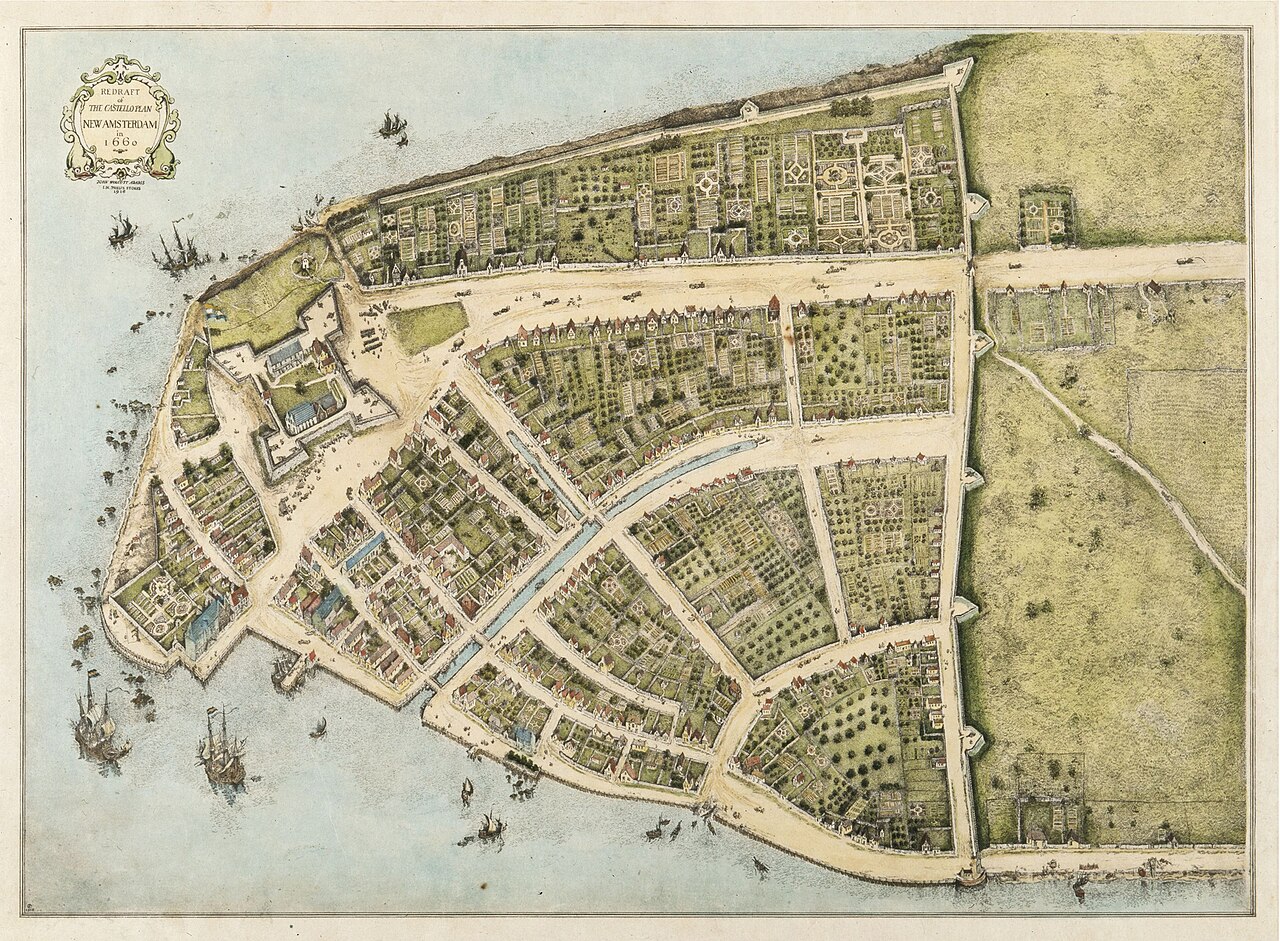 The Castello Plan, a historical map of the Dutch settlement of New Amsterdam (present-day Lower Manhattan in New York City) around the year 1660.
© RV
Today, several thousand Lenape still live in the United States. Their language survives in words such as skunk, derived from the Lenape word squunck. And, of course, the island’s name still recalls its first inhabitants: Manhattan. The Lenape lived there alone until 1624, when ships arrived from Amsterdam carrying people who would establish a trading post in the New World and name it New Amsterdam.
I walk away from the water through Battery Park, heading north towards Bowling Green. Today it is a modest park enclosed by railings.
STOP 2: Bowling Green
The market of New Amsterdam
Bowling Green stands in front of a vast neoclassical building, once the Customs House and now the National Museum of the American Indian. This was the site of Fort Amsterdam, a star-shaped fort with four points, much like those we know from comics.
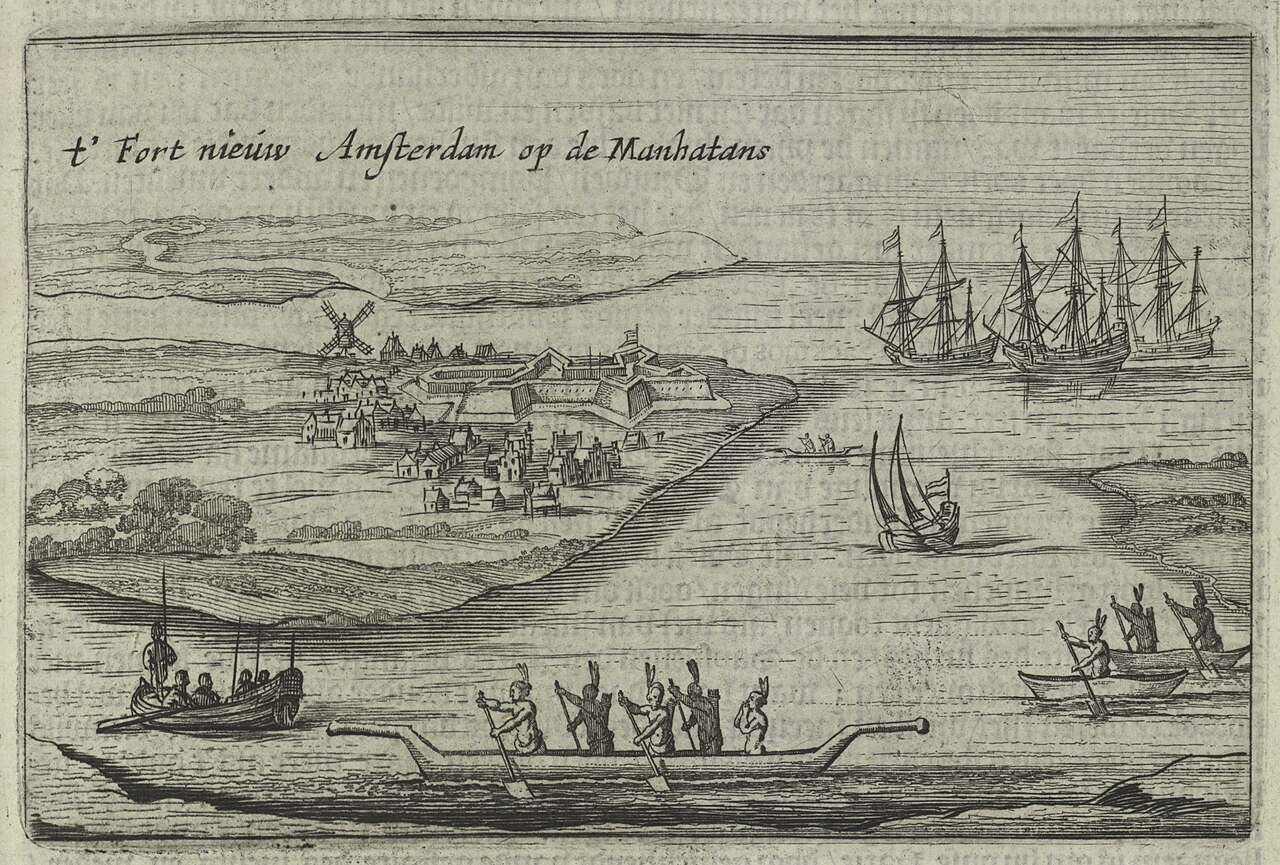 't Fort Nieuw-Amsterdam op de Manhatans', drawn by Kryn Fredericks, engineer of Fort Amsterdam. Adriaen Van der Donck included this image in his book about New Amsterdam
© The New York Public Library
In front of the fort, where Bowling Green now lies, was a market square. You would have heard traders shouting, horses neighing, chickens clucking and, every so often, a rooster crowing at the top of its lungs. Heavy carts rattled over unpaved ground. And above it all rose the murmur of voices speaking ten, twelve, perhaps even eighteen languages: Dutch, French, German, Swedish, Portuguese, Lenape and many more.
Trade was the driving force behind everything in this settlement. It was the reason the Dutch West India Company had sent people to this part of the world. They wanted beaver pelts to ship back to the Netherlands. Beaver pelts were the oil of the seventeenth century. Since beavers had nearly been wiped out in Europe, traders came here in search of them.
From the market square, an old Lenape path led north. The Dutch widened it into a road so carts and horses could reach the market more easily. They called it the Brede Weg, a street we now know as Broadway.
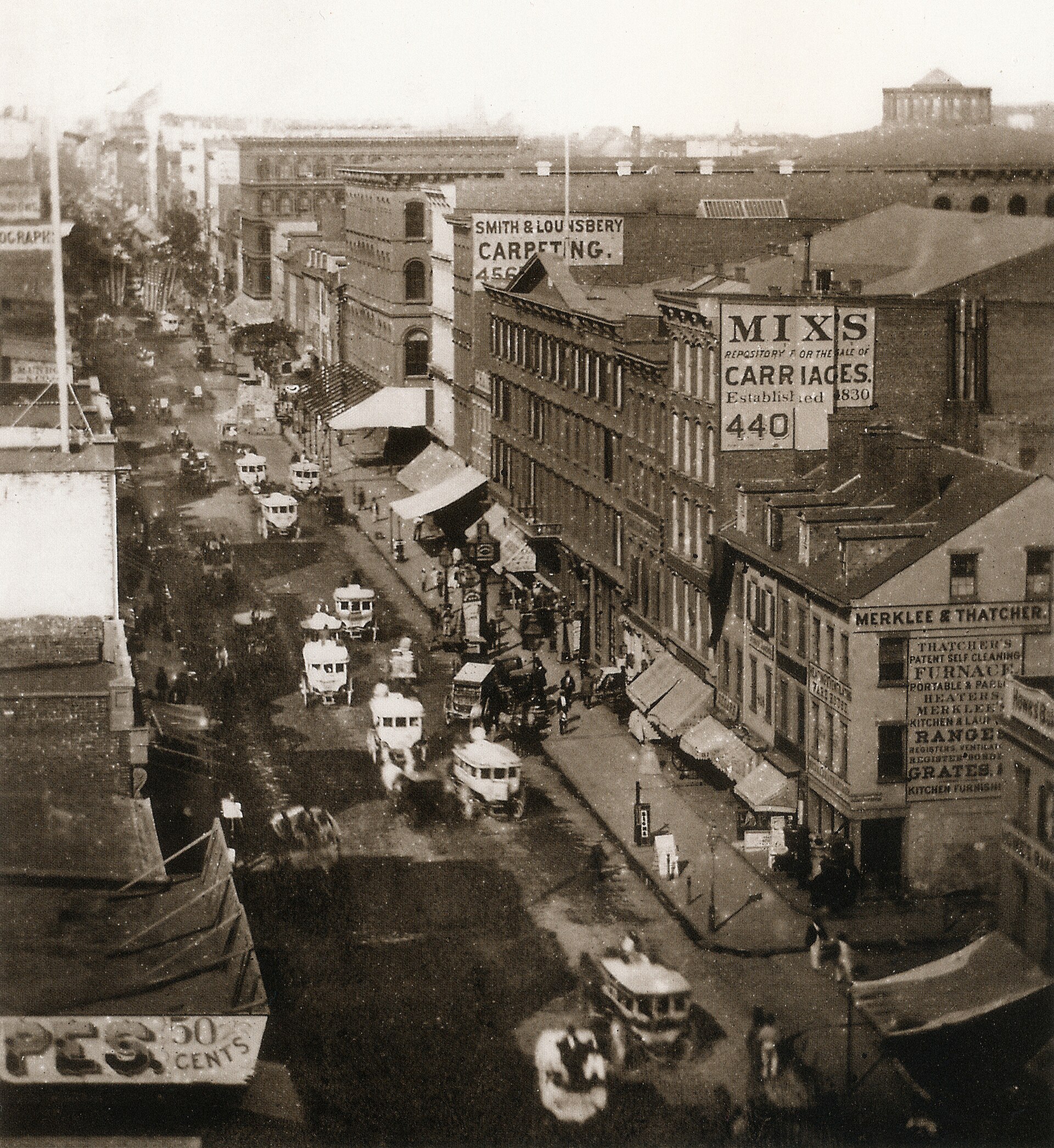 Broadway, 1859. The Dutch called this street the Brede Weg (the Broad Way).
© William England
From Bowling Green, I walk back south, passing the opposite side of the former Customs House. I emerge onto Pearl Street.
STOP 3: Pearl Street
The women of New Amsterdam
Pearl Street once ran directly alongside the water. It is one of New York’s oldest streets. Four hundred years ago, one of the houses here regularly echoed with the cries of women in labour: sometimes soft, sometimes louder than today’s sirens. This was where Trijntje Roelofs Jonas lived. She was a midwife brought from the Netherlands by the West India Company because a colony needs children.
But Trijntje was more than a midwife. She was effectively the village doctor, pharmacist and nurse all in one. She also wielded a certain influence, as people at the time believed women always spoke the truth during childbirth. As a result, Trijntje was frequently called to testify in court about what women had said during labour. Knowledge is power, and Trijntje possessed it.
Further along Pearl Street lived Catalina Trico van Rapelje. She was nineteen when she sailed from Amsterdam in 1624 with her new husband, Joris van Rapelje. They had fled the Spanish Netherlands, in what is now Belgium. Catalina gave birth to eleven children: Sarah, Marritje, Juditje, Jan, Jacob, Katrina, Jeremias, Daniel, Pieter, Annetje and Elisabeth. More than a million Americans are descended from them. For that reason, Joris and Catalina, that couple from present-day Belgium, are sometimes called the Adam and Eve of America.
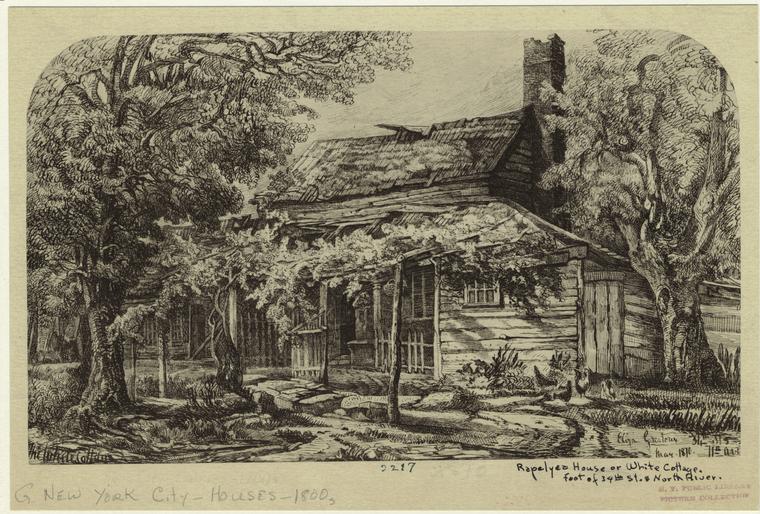 ‘Rapelyea House, or White Cottage, foot of 34th Street and North River’ by Eliza Greatorex, 1870
© the New York Public Library Digital Collection
I retrace my steps briefly, then walk from Whitehall Street to Bridge Street. Turning right, I continue towards the White Horse Tavern.
STOP 4: Bridge Street
Fun and entertainment in the city
When you step into the White Horse Tavern, you hear the murmur of conversation and the clinking of glasses. Four hundred years ago, it sounded much the same, only louder.
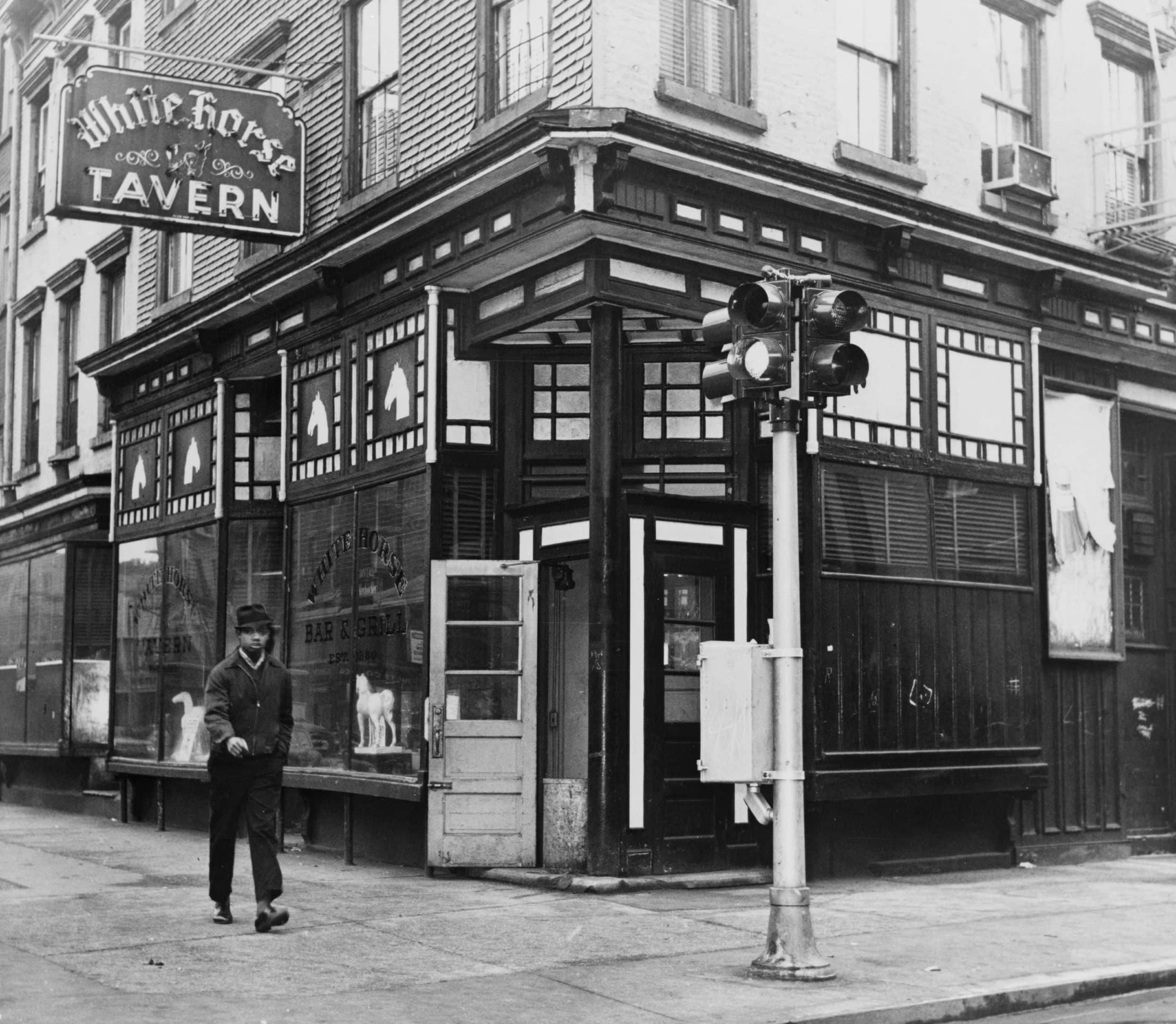 White Horse Tavern in New York City, 1961
© Phyllis Twachtman / New York World Telegram & Sun
In 1641, Philippe Gerardy opened New Amsterdam’s first tavern on Bridge Street: The Wooden Horse, named after a brutal punishment device on which he himself had once been strapped as a soldier. When customers objected to the name, it became The White Horse and later The White Horse Tavern. A tavern of that name still stands on the same site today.
New Amsterdam was a city that drank. Not merely out of indulgence, but necessity: the water was often brackish or contaminated. The West India Company built a large brewery, and people drank beer with every meal. After the White Horse opened, dozens of taverns soon appeared in the surrounding streets. Adriaen van der Donck wrote:
In the taverns there are lute players, violinists and sometimes even dancing masters. The people amuse themselves with dancing and cheerful songs, and many forget both time and rules. They delight in singing, and when one passes the houses in the evening, one often hears loud voices, the plucking of strings and merry revelry coming from the inns such that one might think oneself at a fair.
I continue along Pearl Street and arrive at the Belgian restaurant Le Pain Quotidien: in front of the door, under a glass panel in the pavement, you can see remnants of walls, and through white stones in the red bricks on the ground, those walls continue. They outline the contours of a seventeenth-century house. These are the last tangible remains of buildings of New Amsterdam. Four hundred years ago, you would have been standing inside a tavern or inn, right beside the water.
From the taverns, I walk towards South William Street, turn left into Broad Street and then right towards Wall Street.
STOP 5: Broad Street
The stock exchange
Broad Street is unusually wide for Lower Manhattan. That is no coincidence: a canal once ran here. The Dutch wanted a version of Amsterdam’s Herengracht in New Amsterdam, allowing goods to be transported directly to the city centre by water. But the canal soon became an open sewer. People dumped waste into it and used it to relieve themselves. In 1676, the canal was filled in, though the street retained its width.
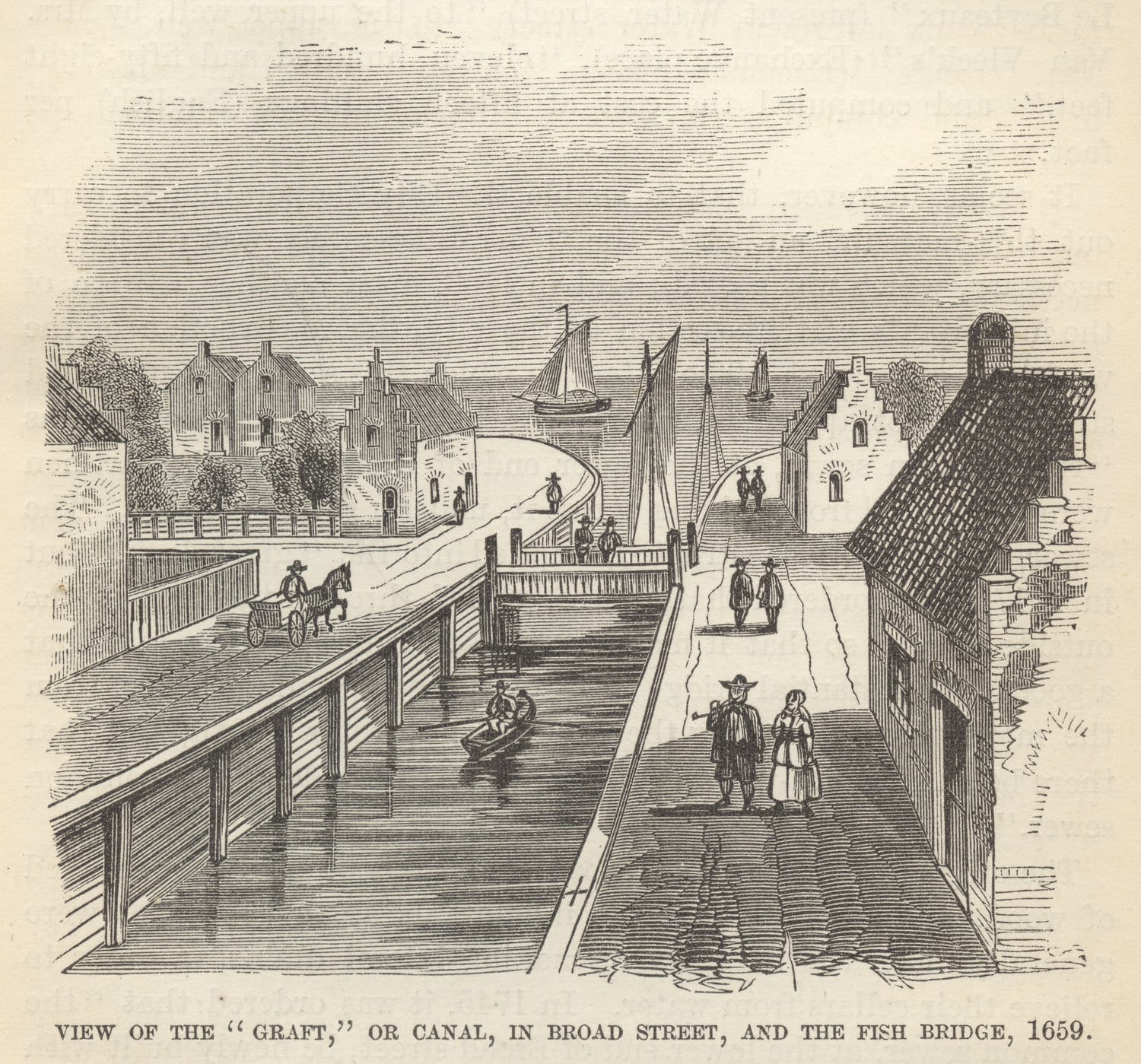 The Herengracht in New Amsterdam soon became an open sewer. In 1676 the canal was filled in, giving rise to Broad Street (illustration from 1905)
© Wikimedia Commons
At the end of that wide street stands the New York Stock Exchange. The principle behind what happens here (buying and selling shares) has its roots in New Amsterdam. Admittedly, not yet in such an imposing building, but simply in a tavern. Imagine being a wealthy resident of New Amsterdam. A sailor approaches you in a noisy inn and tells you of a voyage to an unknown land rich in gold, silver or spices. He asks you to finance part of the expedition. If he returns with treasure, you receive a share of the profits. And if the ship sinks or is hijacked by pirates? Then you lose your money.
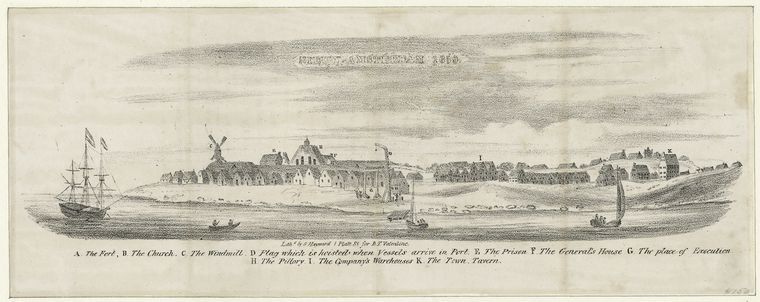 ‘New Amsterdam 1659’, litho by George Hayward, 1842
© RV
Despite the risks, people invested again and again. Adriaen van der Donck wrote: “Commerce is the life of New Netherland; without trade this country would be like a body without a soul.”
I walk a little further until Broad Street ends at the pedestrianised T-junction with Wall Street.
STOP 6: Wall Street
The end of New Amsterdam
On Wall Street, I glance down at the ground. In the middle of the street, between the cobblestones, small square markers have been laid out; they lie two metres apart in a long row. They mark the positions of the original posts of the wall, or rather, the palisade. It was a wooden wall nearly three metres high, fronted by a deep moat. Built in 1653, it was intended to protect the settlement from attacks by the Lenape and from other colonies, such as that of the English. Enslaved people were forced to construct the palisade, just as they had built the fort earlier.
The English colonies to the north, around Boston, had noticed New Amsterdam’s prosperity. They wanted the same. In August 1664, the inhabitants learned that the English were on their way. A few days later, four warships appeared off the coast, carrying three hundred soldiers and dozens of cannons each.
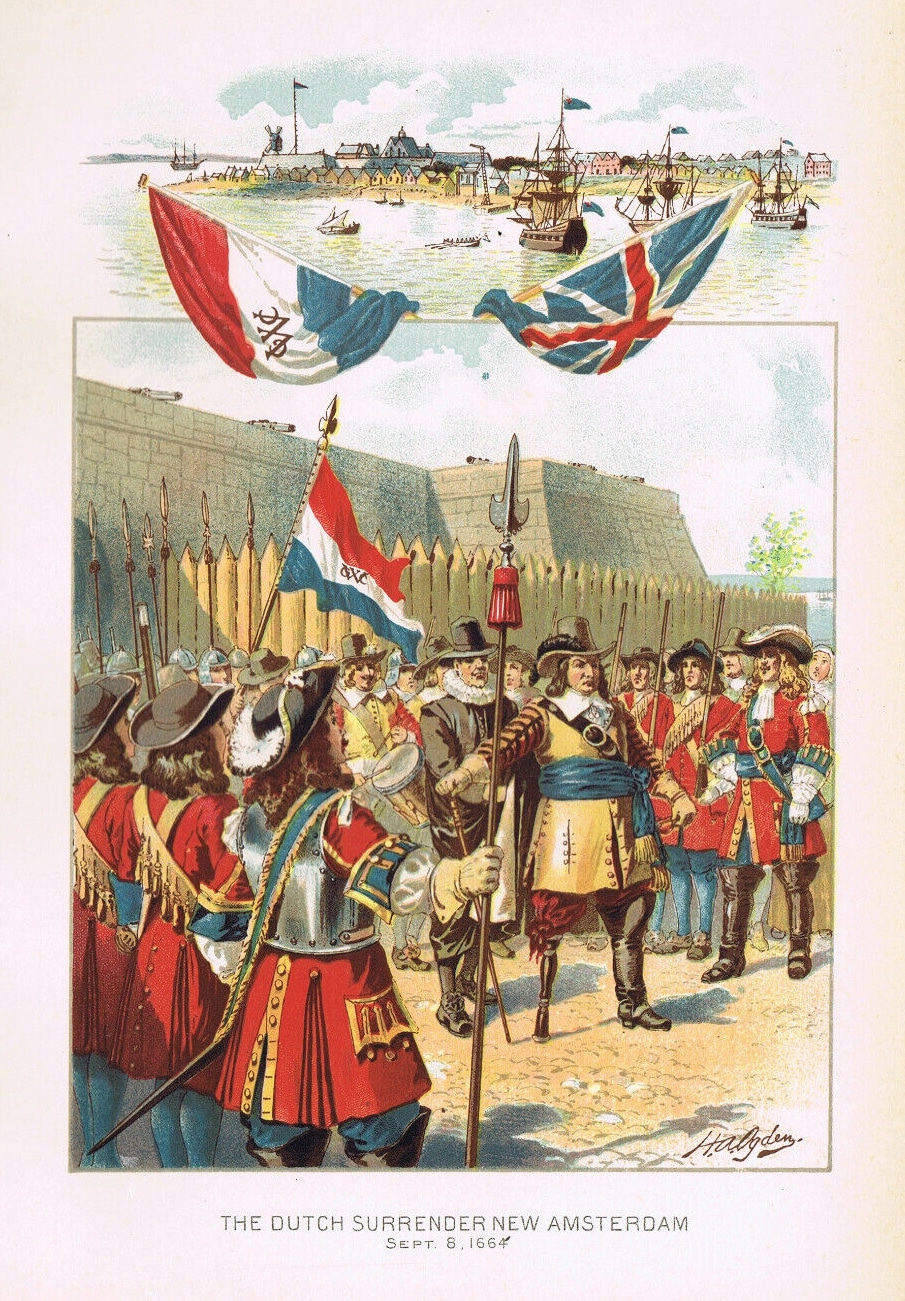 Nineteenth-century lithograph of the surrender of New Amsterdam to the English
© Wikimedia Commons
Peter Stuyvesant, the governor of New Amsterdam, wanted to fight. His citizens did not. Most simply wished to continue their work. Whether they lived under the Dutch flag or the English made little difference to them. Stuyvesant had no choice but to surrender.
On 8 September 1664, the surrender was signed. Fort Amsterdam became Fort James. New Amsterdam became New York. The inhabitants were allowed to stay, retain their property and continue practising their religion freely. Dutch even remained the main language for some time. It was a remarkably efficient business transaction, achieved without bloodshed. No cannon fire. No clouds of gunpowder. Only the scratch of a quill across parchment.
Yet New York would never have become New York had there not first been New Amsterdam. And that began here, on this small corner far away from the Old World, where the Lenape had lived for centuries before anyone crossed the ocean.
So keep walking. Keep listening. Because if you listen carefully, you’ll see more.
Elke Vanhaecke is collaborating with Ben Van Alboom on the podcast Belgium, USA, about migration stories from Belgium to America (autumn 2027). She also leads (audio) tours in New York. elkevanhaecke.com.

You might also like




Leave a Reply
You must be logged in to post a comment.