
The exhibition ‘Postcolonial?’ is groundbreaking – but what will happen after the exhibition ends
The exhibition Postcolonial? at the House of European History in Brussels explores the colonial past of European countries, and the traces that this history still leaves today. Personal testimonies, historical objects, and contemporary artworks make the story tangible.
In 2024, I visited the House of European History for the first time, which opened its doors in 2017 and has a mission to “explore the history of Europe in all honesty.” During my visit, I noticed that the permanent exhibition pays scant attention to colonialism and its consequences. The museum is now filling a notable gap in its story of European history with its exhibition Postcolonial?.
Because of the Black Lives Matter protests in 2020, there has been a strong increase in public attention to the colonial past of European countries. In Belgium, that attention had already been heightened since the reopening of the AfricaMuseum in 2018, but Black Lives Matter kicked the debate into high gear.
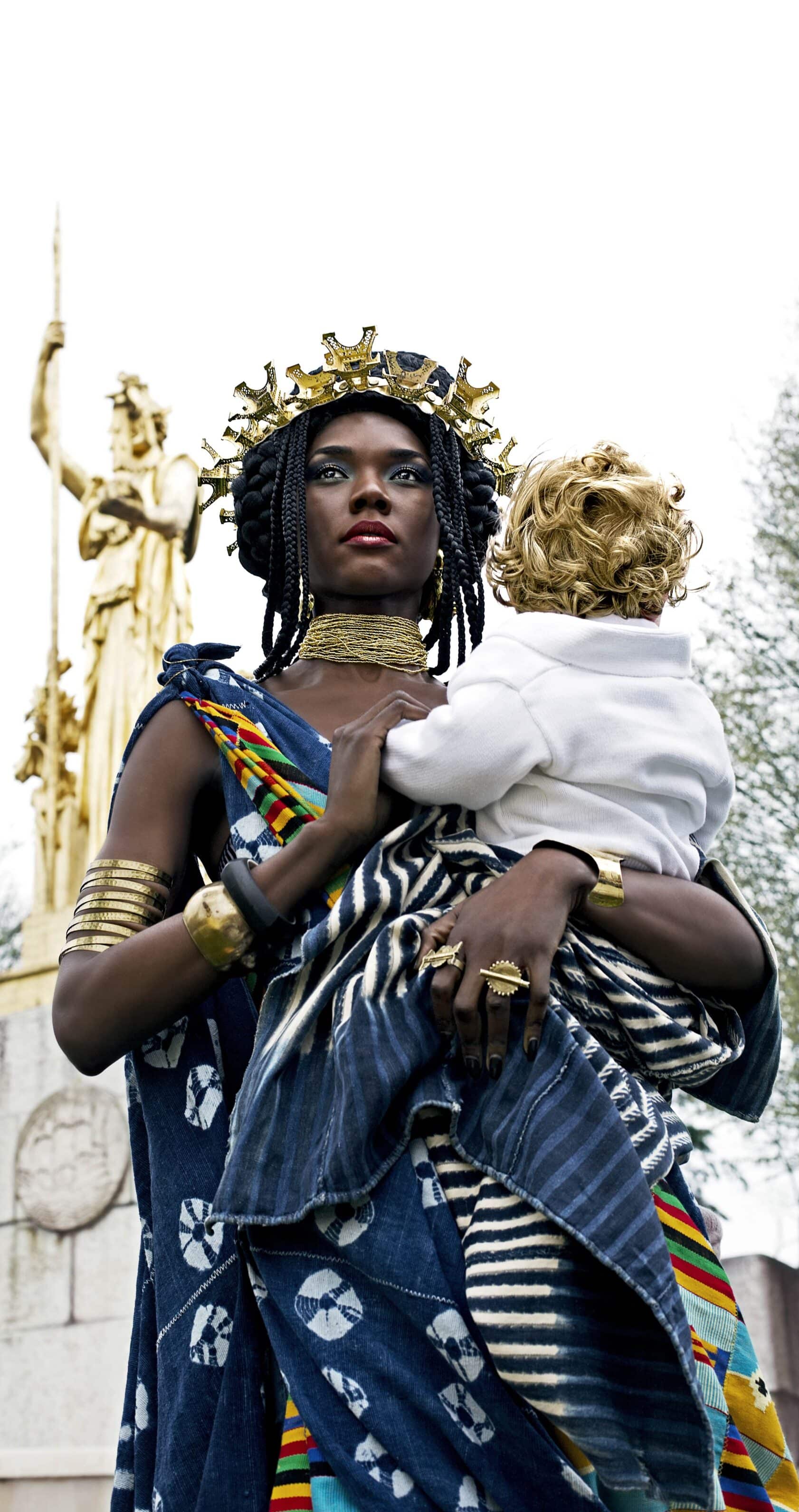 Alexis Peskine, Raft Of Medusa, 2016
 © House of European History, Brussels
The recent debate has three notable features. First, compared to twenty years ago, there is a much more critical view of colonialism as an unjust system. Second, it’s not institutions like museums that are driving the debate, but Black activists, artists, and writers, often with roots in former colonies like Congo or Suriname. Third, there has been more focus on the contemporary consequences of colonization in countries that were colonial powers, including Belgium and the Netherlands.
Postcolonial? reflects these three trends in the debate, at a time when the theme of (de)colonization has faded somewhat from public and political attention. The expo manages to approach colonialism from a European perspective, rather than just from separate national histories. It’s somewhat of a surprise that an exhibition like that hasn’t taken place earlier in Brussels, the capital of Europe, or at the nearby AfricaMuseum in Tervuren.
Resistance symbols
The exhibition is built around four major historical sections. Part one deals with the structural foundations of European colonialism, from the fifteenth century to 1945. One of the capitalist foundations was the exploitation of resources and so-called racially inferior populations in conquered areas that were forcibly turned into colonies.
During that period, the Netherlands built a vast colonial empire in America, Asia, and Africa. The young Belgian state also started looking for a colony after gaining independence in 1830. In 1885, King Leopold II became the owner of a huge area in Central Africa, in what is now the Democratic Republic of Congo. In 1908, the Belgian state took over the area as an official colony.
For a long time, the dominant narrative about colonization paid little attention to the resistance of colonized peoples. Yet resistance was a necessary step toward independence. The expo doesn’t shy away from that history. At its start, there’s a timeline with key moments from European colonialism and the anti-colonial resistance of both men and women. Examples include the uprisings of Angolan Queen Nzinga against the Portuguese (1624) and of Jamaican heroine Nanny of the Marrons against the British (1728). Postcolonial? also highlights such independence figures as Indonesian President Sukarno and Congolese Prime Minister Patrice Lumumba as symbols of resistance against Dutch and Belgian colonialism, respectively.
Part two takes the visitor to the period when the European colonial empires were breaking apart and eventually collapsing. Between 1945 and the end of the twentieth century, more than eighty colonies officially managed to free themselves from colonial rule.
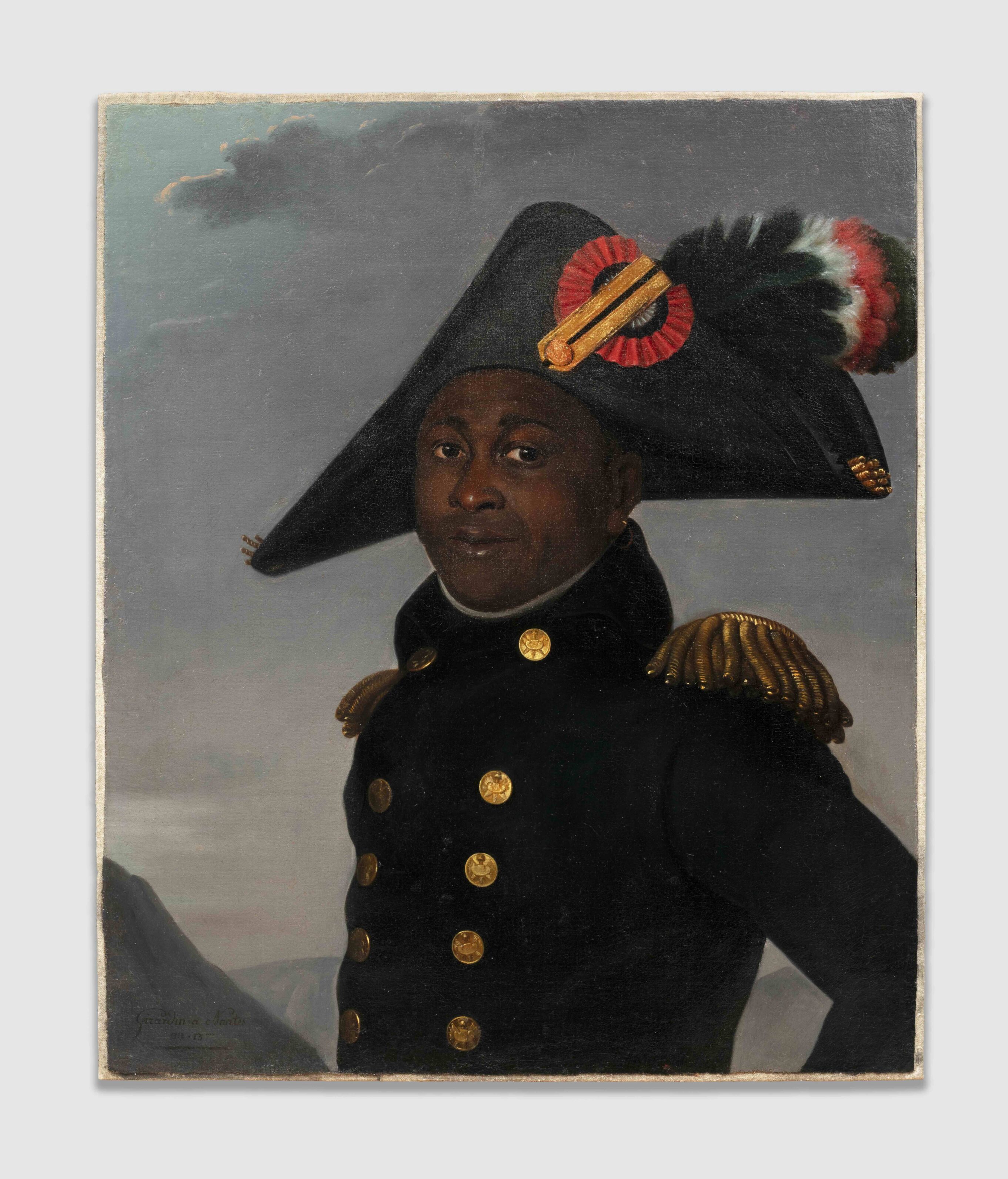 Alexandre François Louis de Girardin, Portrait of the Haitian leader Toussaint Louverture, 1804
 © House of European History, Brussels
A symbolic moment of that period was the Fifth Pan-African Congress, which took place in Manchester in October 1945. The exhibition quotes from a congress statement: ‘We are determined to be free. We want education, the right to a dignified life, the right to express our thoughts and emotions, to adopt and create forms of beauty. Without all this, we die to live.’
Postcolonial? reminds the visitor why 1945 was a turning point. Europe had defeated Nazism and fascism, but the war had also exposed the vulnerability of the colonial powers. For anti-colonial leaders, the post-war period was the perfect time to demand freedom and self-determination.
Part three explores the tension between independence and true freedom in the context of the Cold War. In the 1950s, the anti-colonial struggle gained momentum. The year 1960 was a peak: just in Africa alone, seventeen countries gained their independence. Congo was one of them. In several colonies, resistance fighters took up arms and liberation wars broke out. One of the highlights of the exhibition is an iconic black-and-white photo of the young Luzia Inglês Van-Dúnem, active in the Angolan struggle for independence against Portugal.
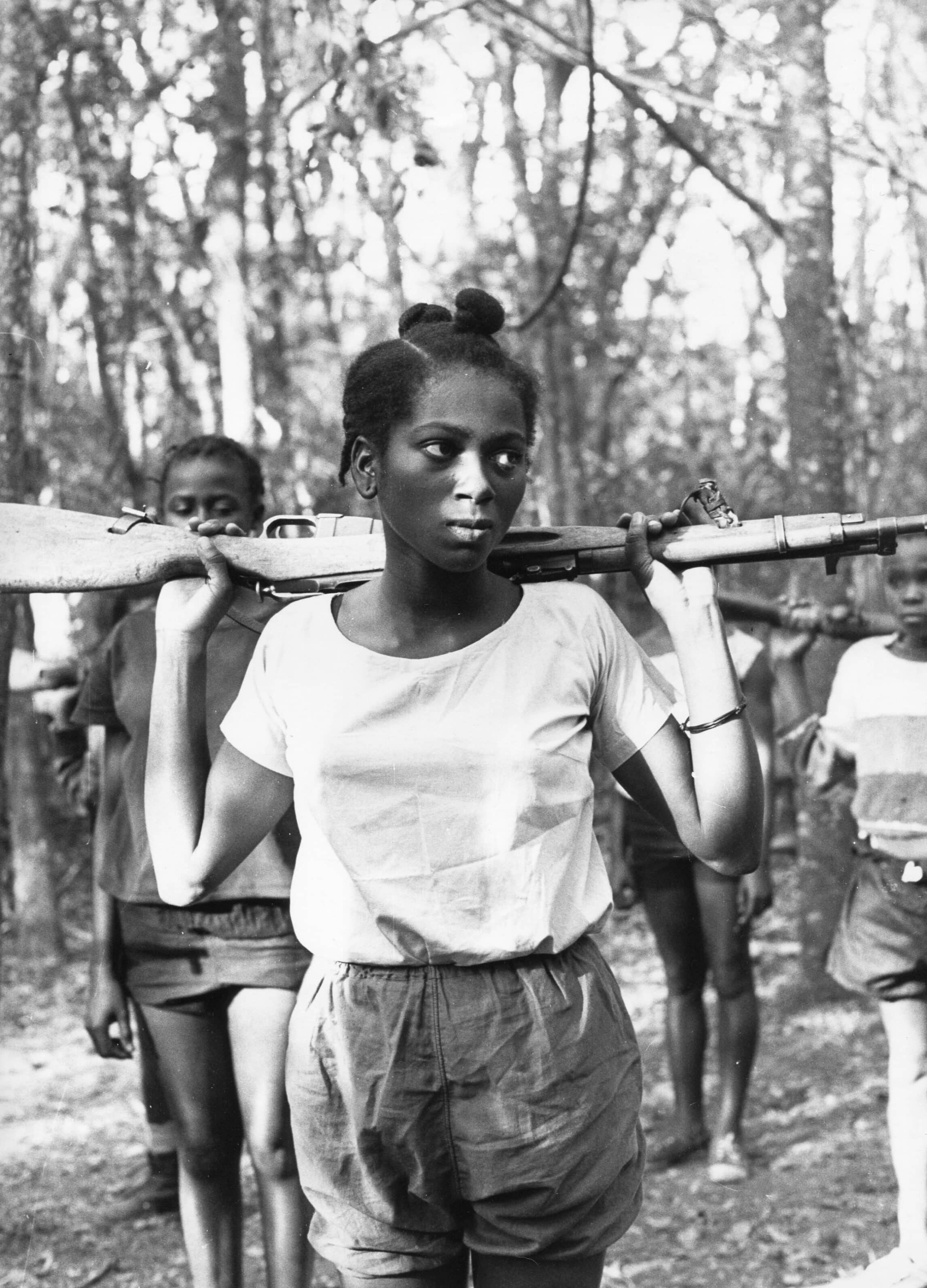 Luzia Inglês Van-Dúnem in 1968. The resistance fighter was active in the Angolan struggle for independence against Portugal
© Augusta Conchiglia / House of European History, Brussels
European countries like the Netherlands and Belgium tried to defend their geopolitical and economic interests by often responding to resistance with violence. During the Indonesian War of Independence (1945-1949), an estimated hundred thousand civilians lost their lives. In Congo, the nationalist government was undermined, and the murder of the democratically elected Lumumba sparked a rebellion.
What’s next? is the central question in the fourth and final part of the exhibition, which examines the contemporary traces of colonialism. The efforts of artists, activists, writers, and other citizens have helped over the past years to make these traces visible and spark debate about how European societies (ought to) deal with them. Colonial statues and street names often receive a great deal of attention in this discussion. At the same time, cities in Belgium and the Netherlands are considering public tributes to anti-colonial figures like Lumumba and Anton de Kom from Suriname. In the exhibition, there’s a statue of Leopold II covered in red paint that was removed from public space in Ghent. It shows how contested monuments can still serve an educational purpose in a museum.
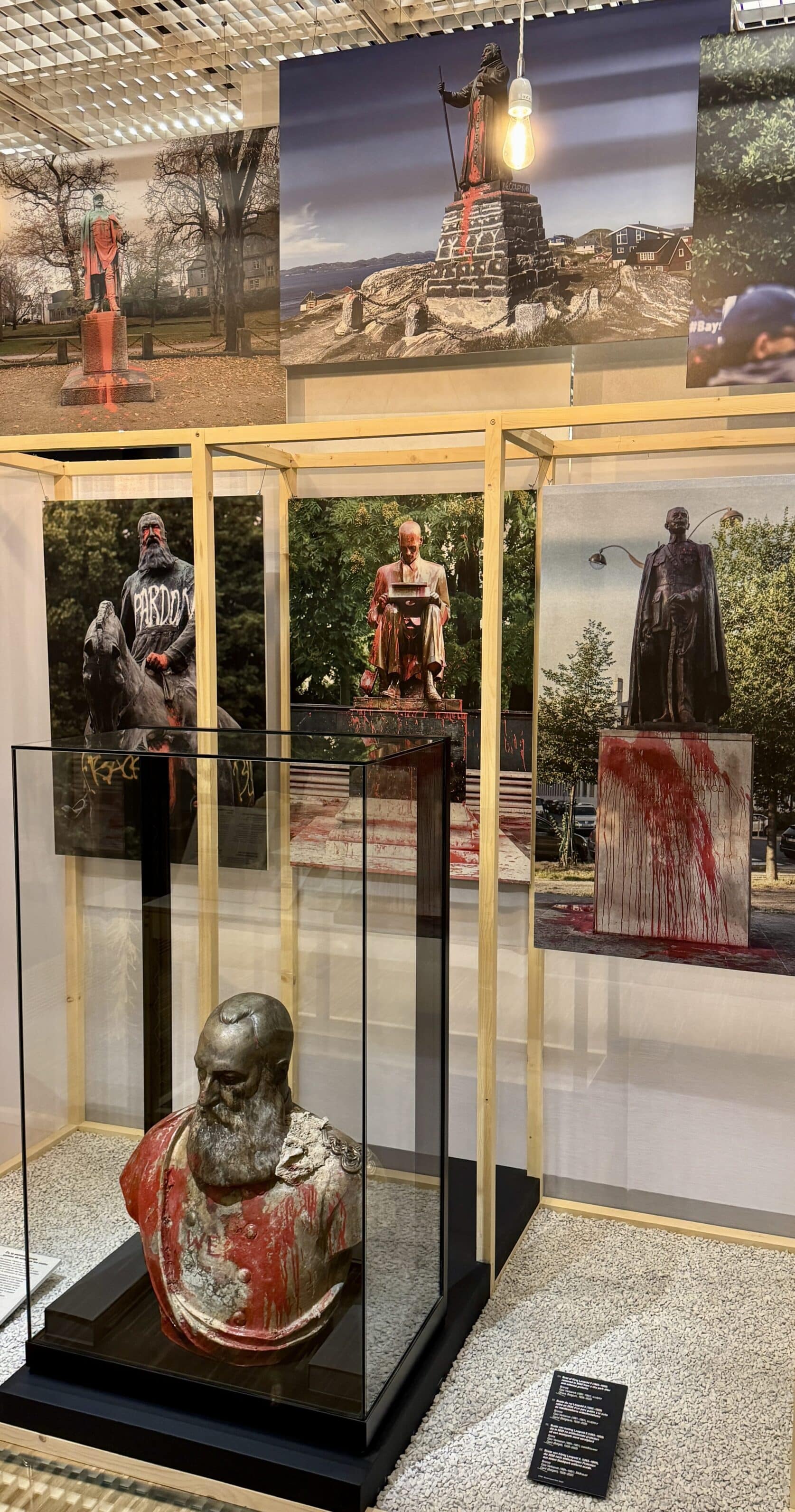 This statue of Leopold II, smeared with red paint, was removed from public space in Ghent
 © House of European History, Brussels
The last part of Postcolonial? also highlights the colonial legacies in the job market, education, housing, healthcare, and popular culture such as holiday traditions and comic books. People of African descent still often face structural racism today. The exhibition refers to the study Being Black in the EU (2024). Comparative figures show that Belgium scores high when it comes to discrimination based on skin colour and migration background.
Interestingly, this section remains rather superficial about the number of cultural objects that are now kept in European museums like the AfricaMuseum and the Dutch Wereldmuseum after they were stolen or acquired under unequal conditions during the colonial period. Nevertheless, in recent years, there has been a new wave in the debate about restitution or return. In 2022, Belgium passed a historic law, while countries such as the Netherlands, Germany, and France are taking concrete steps to return heritage to various countries such as Sri Lanka, Nigeria, Benin, and Senegal.
Objects, artworks, and stories
Postcolonial? makes the four historical parts visible and tangible using nearly two hundred historical objects and documents, from the seventh century to the present. For example, there’s a racist object from the South African apartheid regime: a bench plate with the inscription ‘Whites Only.’ On the other hand, the exhibition also shows objects from anti-racist movements. For instance, there’s a smashed car window that refers to the violence against the Dutch activist group Kick Out Zwarte Piet (Black Peter), which campaigned for years with the slogan ‘Zwarte Piet is racism.’
The route also includes twenty-five contemporary artworks. ‘Corvée’ by the Congolese artist Steve Bandoma represents cultural objects that were taken during the colonial period and are still part of European museum collections today.
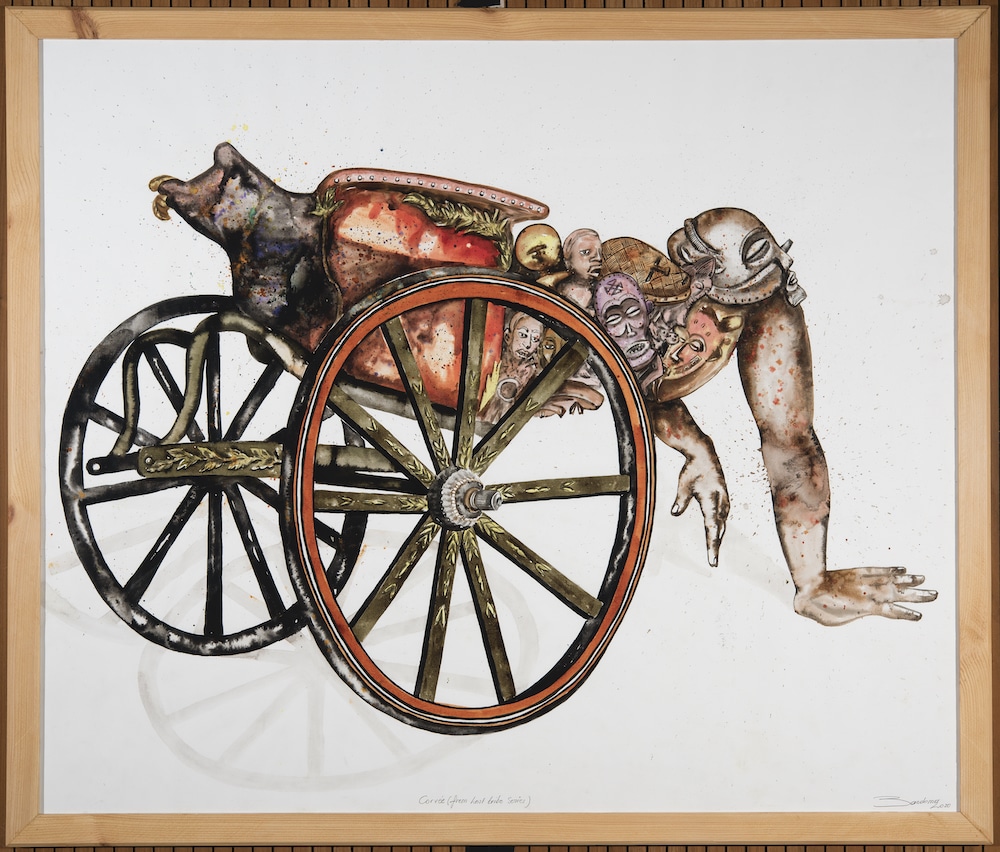 Steve Bandoma, Corvée. The work of this Congolese artist represents cultural objects that were taken during the colonial period and are still part of European museum collections
 © RMCA
The colonial history becomes more powerful when it is told by people who have experienced its effects themselves and bear the scars of that past. In different parts of the exhibition, visitors can watch and listen to men and women who share how the past has had a lasting impact on their lives and those of their families. These personal testimonies put a human face on colonialism.
Anthropologist Leah Latumaerissa, of Moluccan descent, talks about her great-grandfather, a former soldier of the Royal Netherlands East Indies Army (KNIL), and the broken promise of the Dutch government to let his family return to their homeland. Jacqui Goegebeur, daughter of a Belgian father and a Rwandan mother, gives a moving account of the injustice that mixed-race children (mestizo) faced during the colonial period. The recent conviction of the Belgian state for the kidnapping of five mestizos as a crime against humanity shows that the search for recognition and justice continues to this day.
Ambitious collaboration
Postcolonial? is the result of an ambitious collaboration between chief curator Kieran Burns, and such co-curators as the French Togolese cultural expert Ayoko Mensah, other museum staff, and an international network of historians, researchers, activists, community leaders, and various other experts.
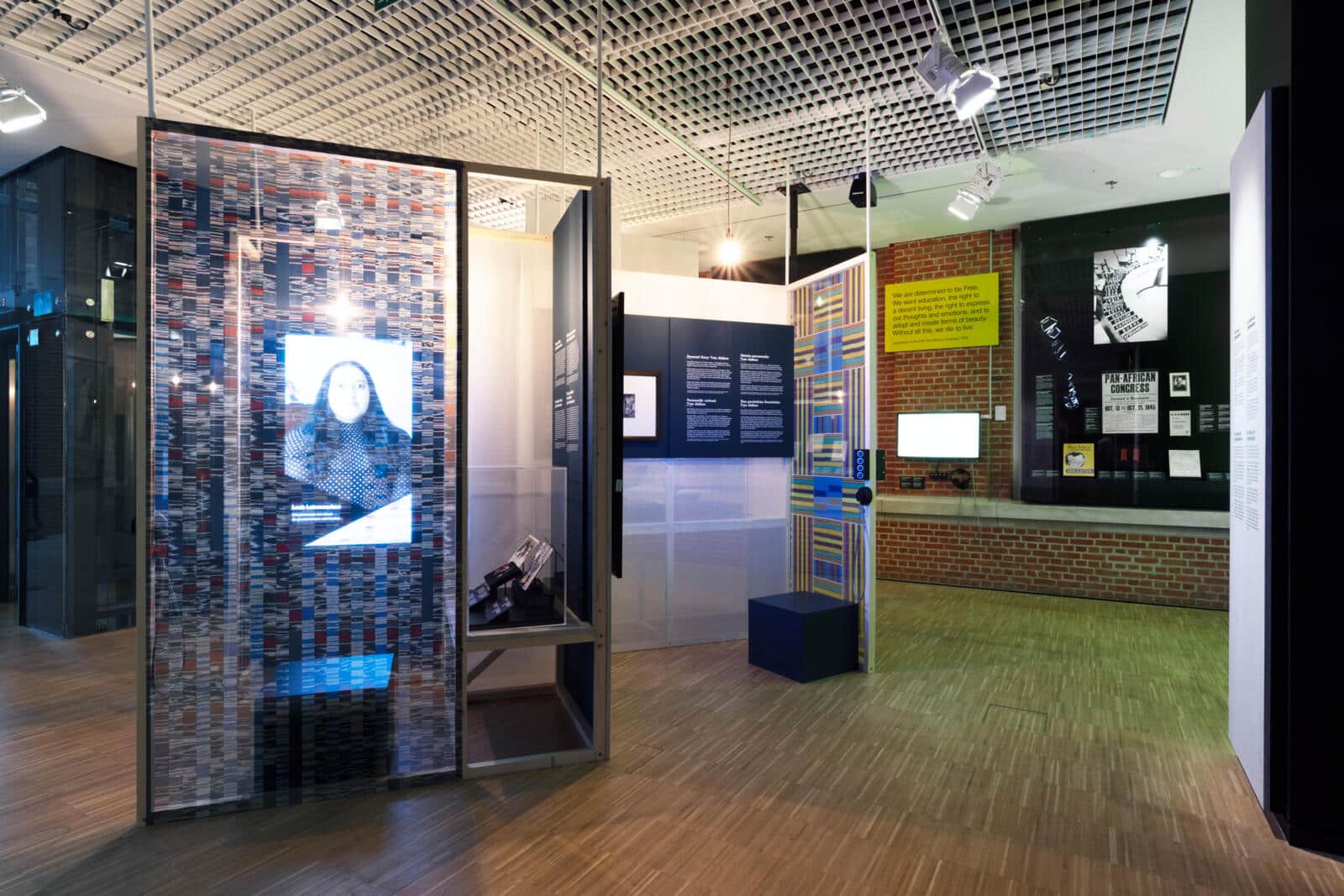 Anthropologist Leah Latumaerissa talks in the exhibition about her great-grandfather, a former soldier of the Royal Netherlands East Indies Army
 © EU, European Parliament
The museum worked with a dual advisory and evaluation framework. On one hand, there was the Academic Advisory Group, which included Dr. Olivette Otele, a historian and professor at the School of Oriental and African Studies (SOAS) in London. On the other hand, there was the Panel of Critical Friends, which included, among others, anthropologist Mitchell Esajas from the cultural and documentation centre The Black Archives in Amsterdam and Inès Mwe-Di-Malila from the Collectif Mémoire Coloniale, one of the main diaspora organizations focused on (de)colonization in Belgium.
The broad collaboration around Postcolonial? results in an exhibition that deliberately emphasizes multiple voices and perspectives. Along the route, various voices and viewpoints of colonized peoples and their descendants resonate. The expo is groundbreaking because it breaks through the dominant European colonial narrative and puts the human experiences of oppression and resistance front and centre.
The exhibition features a quote from the Cameroonian thinker Achille Mbembe: “The history of Europe is not limited to the borders of Europe… Europe must be approached as a global issue.” That is Postcolonial?’s greatest achievement: at the heart of European democracy, the expo integrates colonialism and even neocolonialism (China’s current role) into the story of European history.
The exhibition has the potential to reach a wide audience both from home and abroad. Admission is free, the texts are available in Dutch, French, English, and German, and the museum organizes a programme of activities and tours, also for schools. The biggest challenge now lies with the House of European History itself: will this innovative story about colonialism also get a permanent place in the European story the museum wants to tell after the temporary exhibition ends?
The Postcolonial? expo will be on view at the House of European History in Brussels until March 14, 2027.
You might also like





Leave a Reply
You must be logged in to post a comment.