
“If You Love Language, You’ll Never Be Bored” – In Memoriam Paulien Cornelisse
The Dutch language has lost its most curious listener. Paulien Cornelisse, who died on 30 September 2026, aged 50, was a household name in the Netherlands, and a familiar one in Flanders. Her 2009 book about everyday Dutch sold 700,000 copies in a language with some 24 million speakers. She took the words the rest of us use without thinking and made them strange, funny and worth a second look.
Her curiosity never let up. A week before she died, she lay recovering from another round of treatment and found she had the energy for only one thing: wondering whether apes yawn a lot. The Dutch have an expression for being utterly spent, op apegapen liggen, literally “to lie ape-yawning”, and she couldn’t let it go. She turned the thought into her final newspaper column.
Cornelisse was an Amsterdammer through and through: born there on 24 February 1976, raised there, and back there again after a year in the United States, at Brandeis University near Boston. At the University of Amsterdam she chose to study psychology, which in hindsight makes perfect sense. Everything she went on to do was about people: what they say, what they actually mean, and the comic gap between the two.
Everything she went on to do was about people: what they say, what they actually mean, and the comic gap between the two
She did not become a psychologist, though. In the early 2000s she joined Comedytrain, the Amsterdam stand-up collective where many Dutch comedians learned their trade, and found her way into cabaret. In the Netherlands that word has little to do with feather boas. It is a theatre tradition in its own right, in which a single performer fills an evening with a mix of comedy, storytelling and reflection. Her first full-length show, Dagbraken, premiered in 2008 and won her the Neerlands Hoop prize for new talent. The jury saw an ordinary person on stage, but a contrary and innovative one, with a strikingly original mind that produced idiosyncratic humour about language. In Hallo Aarde (“Hello Earth”) she went on to examine the often remarkable ways people behave and speak, herself included, and her third show, Maar ondertussen (“But Meanwhile”), earned her a nomination for the Poelifinario, the leading Dutch comedy award, in 2014.
She made something as elusive as language tangible for everyone
By then Cornelisse was far better known as a writer. In 2009 she published Taal is zeg maar echt mijn ding (“Language Is, Like, Totally My Thing”), in which she examined all manner of linguistic phenomena, from the popularity of the word ding (“thing”) to the effect of capital letters. People often say something other than what they mean, she wrote in the foreword. That is no bad thing, she argued, but it does make language a fascinating object of study.
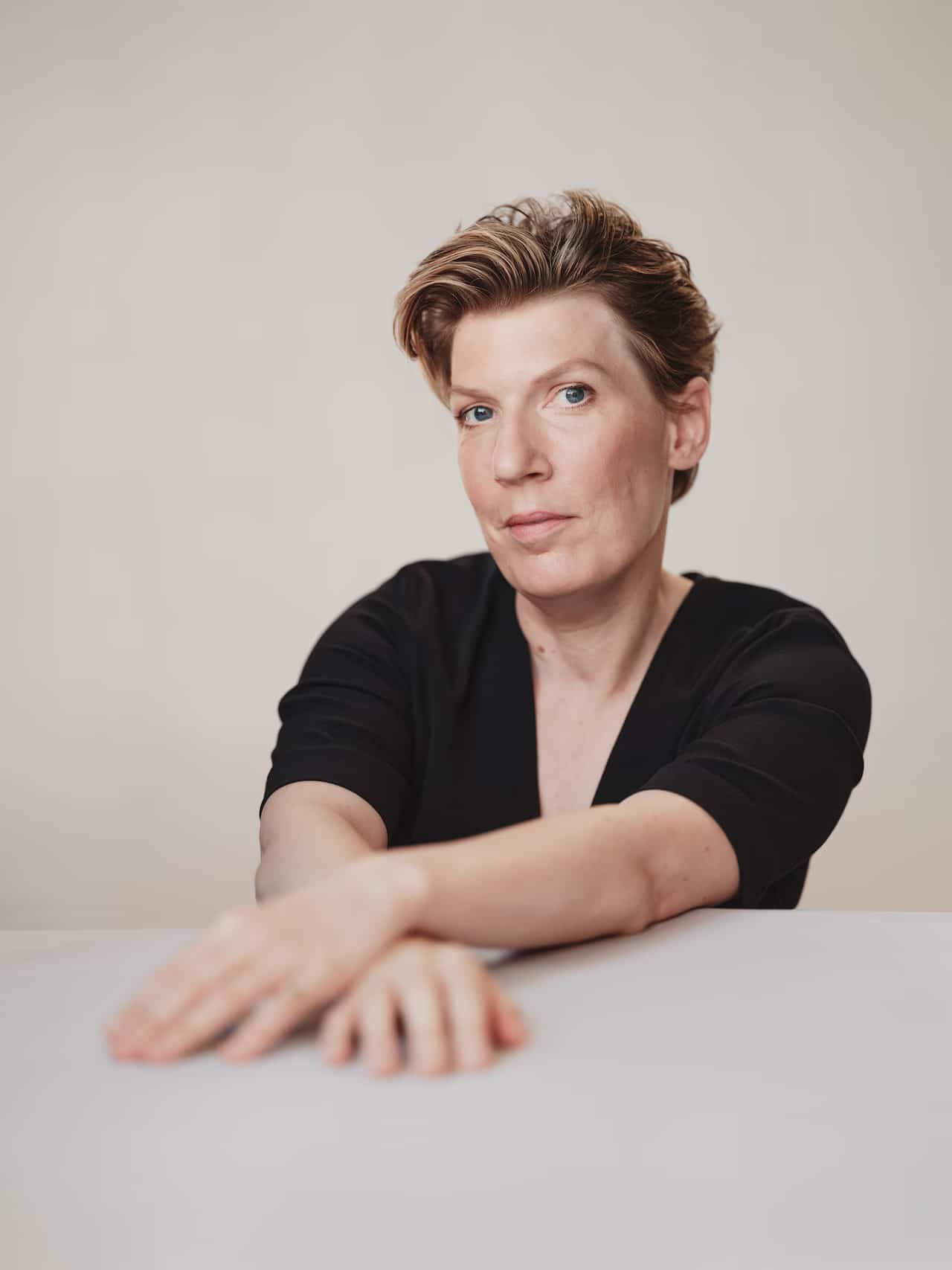 Paulien Cornelisse
© Frank Ruiter
The book was a phenomenon. It sold more than 300,000 copies in its first year, went to number one and spent well over two years in the Dutch bestseller list. Sales eventually reached 700,000. In 2018 it even became a romantic comedy, directed by Barbara Bredero, which won four awards at the Glendale International Film Festival in Los Angeles. More language books followed: En dan nog iets (“And Another Thing”) in 2012 and Taal voor de leuk (“Language for Fun”) in 2019. She was a newspaper columnist throughout, first for a decade at NRC Next and NRC, and from 2018 at de Volkskrant, where her columns ran to just 150 words.
In 2023 Cornelisse gave an interview to Onze Taal, the magazine of the Dutch language society of the same name, in which she put into words just how hard it is to talk about language at all:
“Talking about language is like those fish in that David Foster Wallace story. When a big fish swimming the other way asks them, ‘How’s the water today, boys?’, they look at each other, puzzled: water, what’s that? Language is so omnipresent, so much the thing we’re all swimming in, that it’s hard to say anything general about it.”
Yet Cornelisse could do exactly that like no one else. Whether it was a snatch of conversation overheard on the train or a tiny word like hèhè, she always found something interesting to say about it. That tiny word even got a book of its own: Hèhè, about the things we say without noticing, was her essay for the 2025 Dutch Book Week, and demand was such that it had to be reprinted before the week was out. She made something as elusive as language tangible for everyone, whether language was “like, totally their thing” or not.
Then there was the guinea pig. In 2016 she published her first work of fiction, De verwarde cavia (“The Confused Guinea Pig”), about a guinea pig with an office job. The sequel, De verwarde cavia: Terug op kantoor (“Back at the Office”), appeared in 2024, completed when she was already ill, and won the NS Publieksprijs, the Dutch readers’ choice award, in 2025.
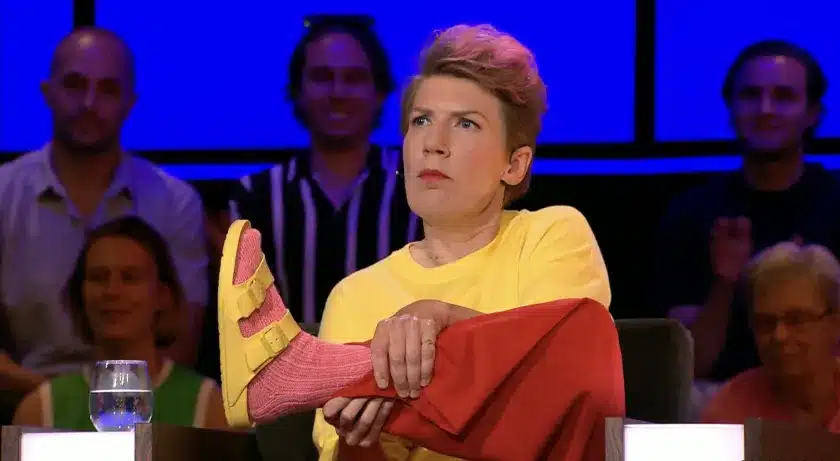 Pauline Cornelisse in De slimste mens
© KRO-NCRV
Television made her a familiar face well beyond the bookshop. In 2013 she won the Dutch reality game show Wie is de Mol? (“Who Is the Mole?”). By then Flemish viewers had already discovered her as a contestant on De slimste mens ter wereld (“The Smartest Person in the World”), the quiz in which she reached the finals weeks of the 2012 season. More than a decade later she returned to that quiz in its Dutch edition, De slimste mens, this time on the other side of the table: in the autumn of 2025 she succeeded Maarten van Rossem as its jury member. It was from that chair, only last week, that she explained where her love of language came from. “If you love language, you’ll never be bored,” she said. “Wherever you are, you hear people talking, and you can start wondering why someone puts something the way they do, or what they really mean.” Studying language, she said, had become a way of life.
Recognition came from her fellow language lovers too. In December 2025 the radio programme De Taalstaat named her its language master of the year. That same year the members of Onze Taal voted her “Language Pioneer of the Century (So Far)”. “How wonderful. I also really like how thorough the title is,” she said at the time. The society has since made clear that, as far as it is concerned, she keeps the title for the rest of the century as well.
Cornelisse was diagnosed with cancer in 2024. She cancelled Komma, the theatre show she was working on, and used Instagram to urge her fans to go and see an unknown performer instead. She was open about being ill. In 2025 she described it as a setback she woke up to every single day, and said she had learned that it helps to be hopeful, but that you also have to make room for despair.
She kept working all the same. Komma never reached the stage, but the columns continued, and so did the quiz. In the current season, which is still on air, she wears a different hat or cap every evening, having explained in the first episode that chemotherapy had cost her her hair and that she didn’t want to wear a wig. In that episode, recorded this summer, she said that how she felt varied from day to day, but that what prevailed was sheer joy at being there.
Cornelisse died in the Antoni van Leeuwenhoek hospital in Amsterdam, with her loved ones around her. And the apes? In that last column she pictured one mid-yawn and reached her verdict: they probably don’t yawn often, but when they do, they give it everything.
You might also like

In Jozef Deleu’s Poetry, Nothing Was Lost





Leave a Reply
You must be logged in to post a comment.