
Gaston Eysselinck, The Outdoor Stairs Architect
The group photo of the 1930 CIAM congress in Brussels, that year’s summit of Europe’s modernist architects, shows Le Corbusier, Gropius and Mies van der Rohe. Among them, a 23-year-old Flemish architect. Back home in Ghent, people called him “the outdoor stairs architect”, and they did not mean it kindly. Gaston Eysselinck (1907–1953) tried to drag Flanders into international modernism, but his tenacity cost him his career. Nearly a century later, his furniture designs are wanted at auction, yet his name is still largely unknown outside architectural circles.
Like any other branch of history, architectural history is organised around a more or less fixed sequence of movements and great names. That gives clarity and guidance: a canon of benchmarks and a shared frame of reference that makes the conversation about the past easier.
Since the 1970s and 80s, however, architectural historians have increasingly turned their attention to the “lesser gods”: designers who were never visible enough to make it into the official canon. For a long time, Gaston Eysselinck was one of them. His contemporaries Renaat Braem and Léon Stynen are still far better known. The architectural historian Marc Dubois spent years describing and drawing attention to Eysselinck’s oeuvre, and his monograph, published in 2019, is the crowning achievement of that work. It is an attempt to give Eysselinck a definitive place in the architectural historiography of the Low Countries. Exactly which place he has earned is for architects and historians to chew on.
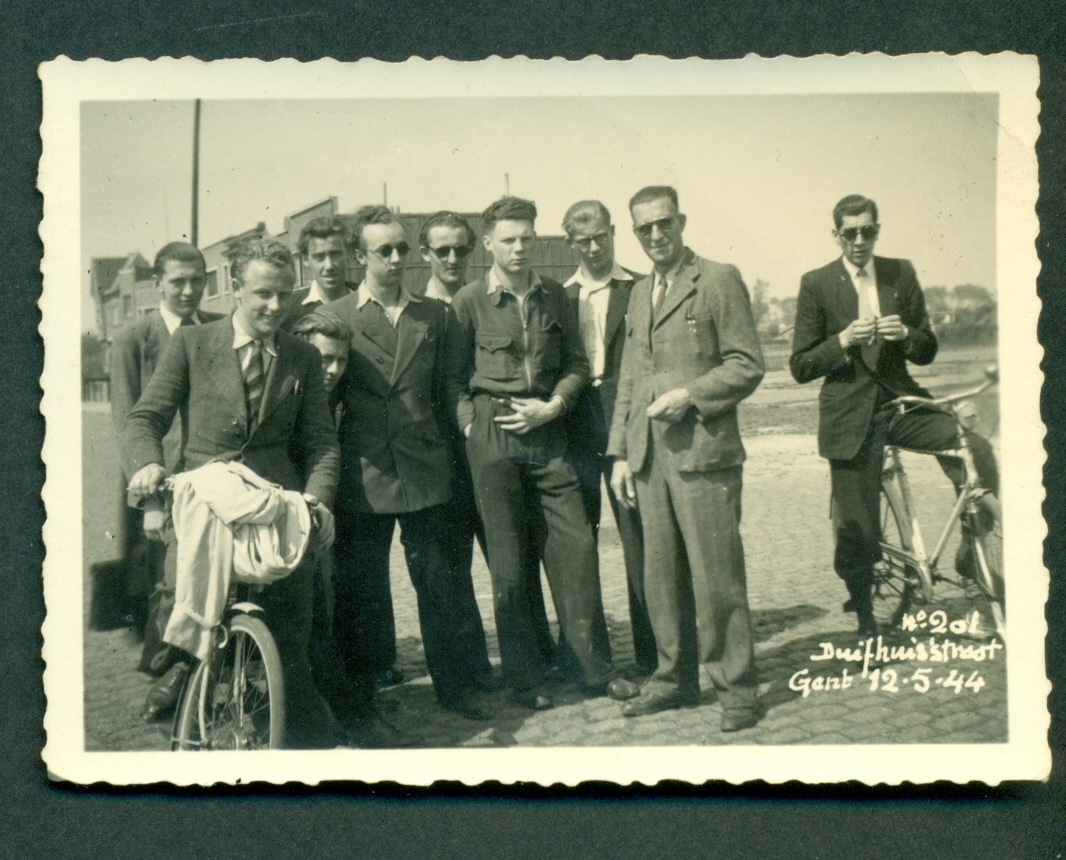 Gaston Eysselinck (second from right) and others on a study trip in Ghent, 12 May 1944
© Design Museum Gent, archief Eysselinck
What Eysselinck’s story does show is why these lesser gods are worth studying. It is precisely among the less famous, more locally active designers that you can see how international ideas trickled down and spread. Strongly influenced by Le Corbusier’s functionalism and supported by Huib Hoste, the most important opinion-maker in Flemish architecture at the time, Eysselinck was one of the first to wake the sluggish Ghent architecture world from its eclectic and neoclassical sleep and to put the principles of international modernism into Flemish practice. That is also one reason why he did not immediately claim a place in the canon: the provincial soil in which he wanted to plant his ideas was not yet ready for them.
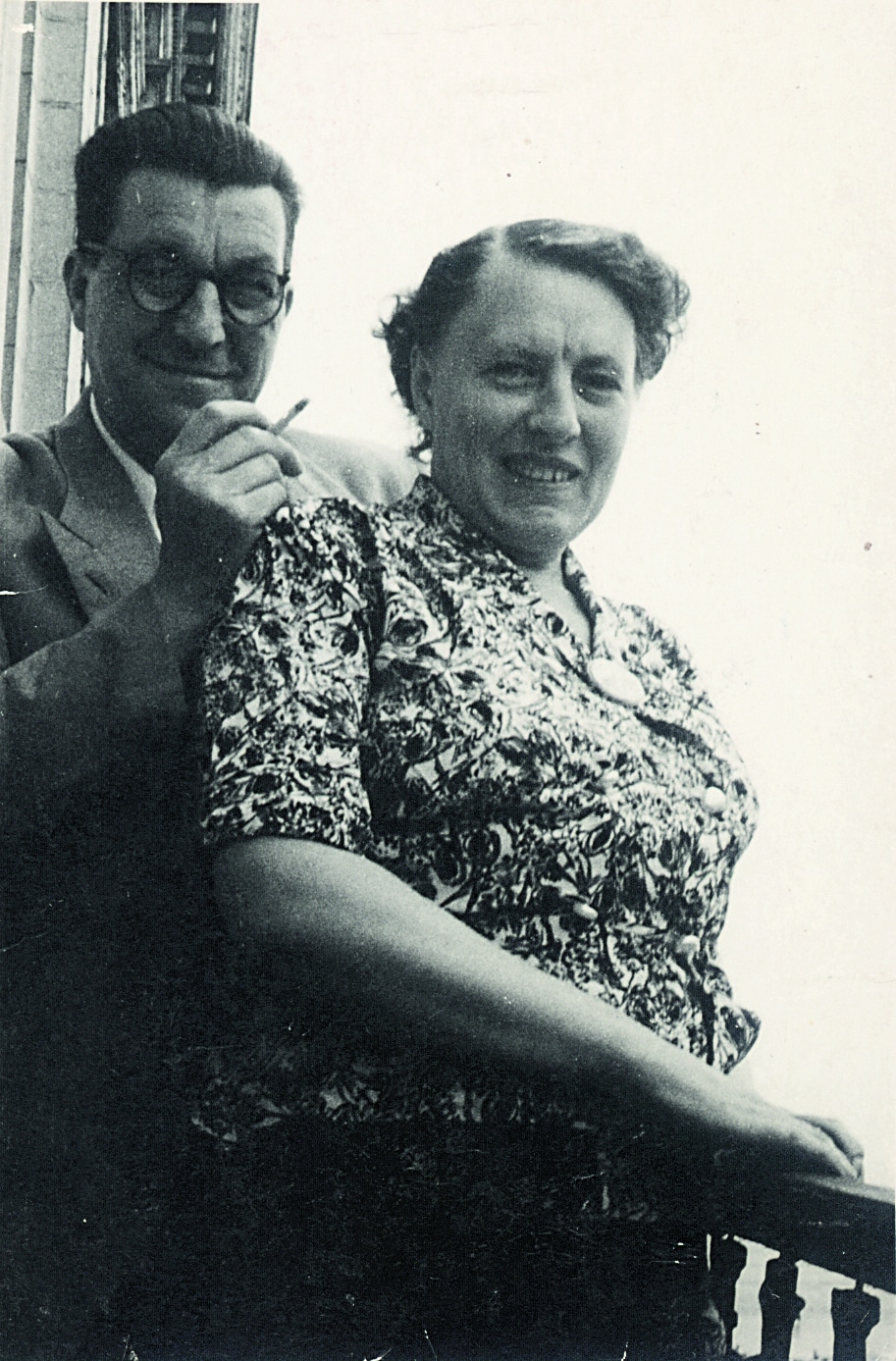 Gaston Eysselinck en Georgette Troy
© Design Museum Gent, archief Eysselinck
Dubois’ book is primarily an interpretive inventory of archival material that had never been studied before. The Eysselinck Archive is kept at the Design Museum Ghent, and the emphasis lies on the designs, books and letters it contains and on the architectural vision they reveal. Dubois provides enough context to make this accessible to lay readers as well. He explains the Flemish and international architectural ideas of the time and situates Eysselinck in his concrete surroundings: Ghent, where he lived from 1922 to 1945, and the seaside city of Ostend, where he lived from 1945 until his death.
His story as a designer really begins in 1923, when Eysselinck, only sixteen, enrols at the Ghent Academy. One of his teachers there is the engineer-architect Auguste Desmet, who introduces him to the principles of modernism developed by Adolf Loos and Le Corbusier, among others, and, the Dutch modern movement het Nieuwe Bouwen. When Desmet becomes a professor at Ghent University in the 1930s, Eysselinck succeeds him as a teacher at the Academy.
One of the finest chapters in the story, although a brief one, concerns two study trips Eysselinck made to the Netherlands with his fellow students. Even before 1914, the North was a major source of inspiration for the South in architecture: first through Berlage, then through the Amsterdam School and the work of Dudok. The first “pilgrimage” took place in August 1927. The students visited Rotterdam, Amsterdam, Bussum, Hilversum (a few schools and Dudok’s home), Utrecht, Vianen, Prinsenhage and Breda. Eysselinck’s surviving sketches show, among other things, how impressed he was by Café De Unie in Rotterdam, designed by J.J.P. Oud and still a modernist classic today.
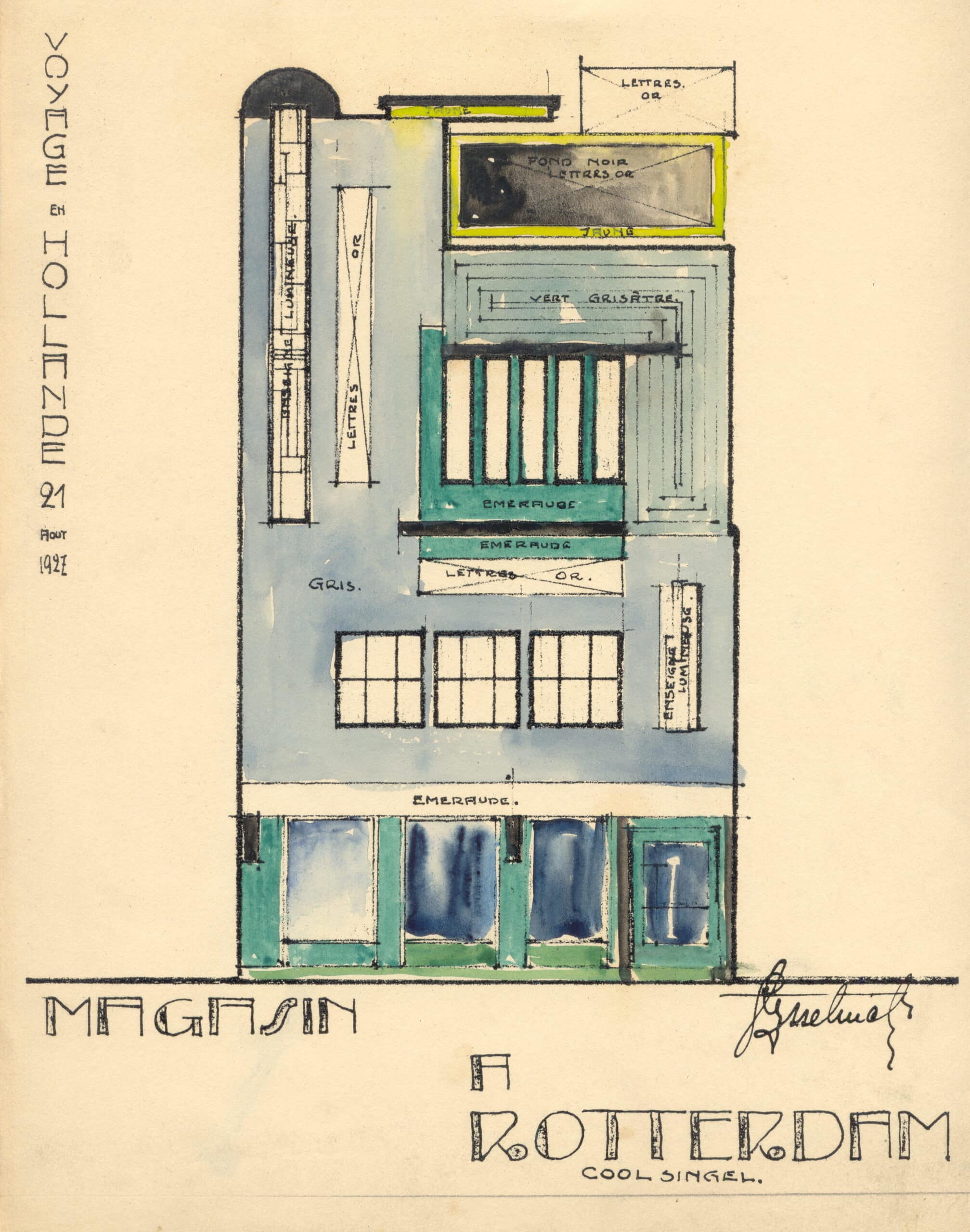 Coloured sketch of Café De Unie in Rotterdam, made by Eysselinck in 1927 during his second study trip to the Netherlands
© Design Museum Gent, archief Eysselinck
Two years later came a second pilgrimage, which is better documented: the archive holds Eysselinck’s report and notes. The journey began by train to Rotterdam and continued by bicycle to Delft, Rijswijk, The Hague, Wassenaar (the Villa Park De Kievit housing estate), Leiden, Haarlem, Amsterdam, Bussum, Hilversum and finally Utrecht, where the main attraction was J. Crouwel’s new Main Post Office of 1924. For Eysselinck, however, the highlight was De Volharding, the building on the Grote Markt in The Hague by J.W.E. Buijs.
Everything Eysselinck absorbed from his training, his reading and his travels merged into a vision in line with the new ideas being put into practice internationally. Architecture had to be functional rather than merely pleasing, and it had a social purpose: to help emancipate people and improve living conditions for everyone, especially the working class. Like many architects of the new style, Eysselinck was a convinced socialist, though not in a party-political sense. He even thought Ghent socialism of his day was becoming too bourgeois. His rejection of bourgeois taste shows in a note he scribbled in a book about Henry Van de Velde. Van de Velde’s plan for Antwerp’s Left Bank, practically the largest urbanisation project of twentieth-century Flanders, is dismissed by Eysselinck, who wrote in both French and Dutch, as “académisme redoutable” (formidable academism): “Van de Velde aristocrate a travaillé pour l’aristocrate avec la bourse de l’aristocrate, où reste la 1ère maison ouvrière? The aristocrat Van de Velde has worked for the aristocracy with the purse of an aristocrat. Where is the first working man’s house?”). He called the designer of the Ghent University Library, a building Eysselinck actually liked, “l’homme du style pauvre pour gens riches” (“the man of the impoverished style for rich people”).”
This intransigence came from an absolute belief in the Nieuwe Bouwen, but it did his career more harm than good. Eysselinck repeatedly clashed with the powers that be, with fellow architects and with the authorities that enforced planning regulations. As Dubois puts it: “As a convinced socialist, his attitude towards government interference in building applications is more that of a true liberal.”
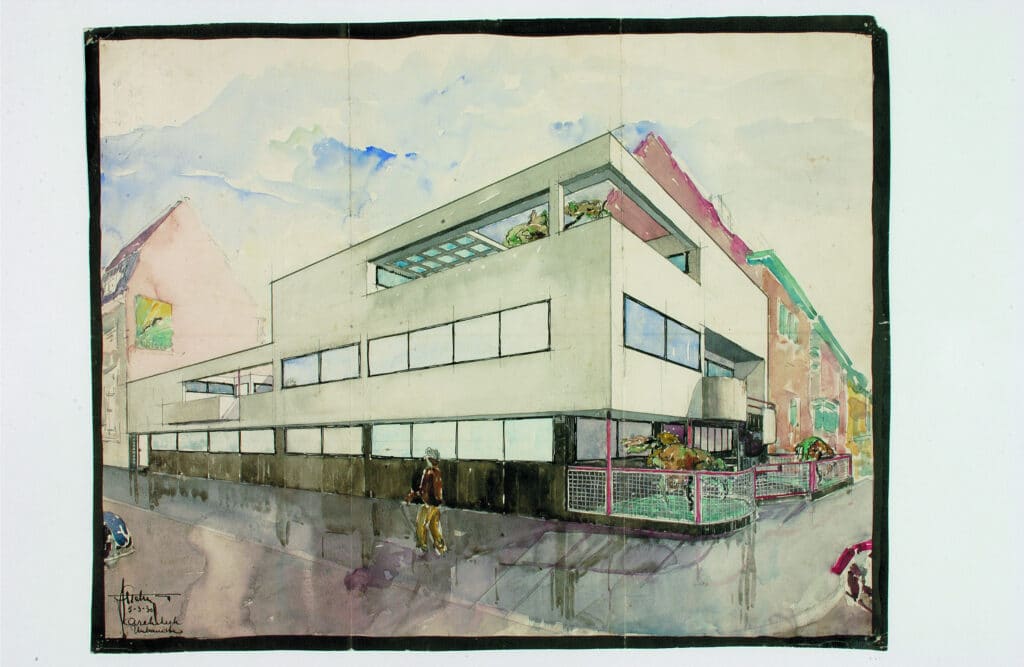 Coloured perspective drawing of the first design for Eysselinck's own house, 5 March 1930
© Design Museum Gent, archief Eysselinck
That attitude was brought on by bad early experiences with urban planning. Eysselinck called his own corner house in Ghent’s Miljoenenkwartier, a “compromise”: the design had to be modified several times before the city council would grant a permit. It nevertheless remains a wonderful early example of the new building principles in Ghent and in Flanders as a whole. It is probably one of the first houses in Flanders with an external staircase, an idea he may have picked up in the Netherlands, where such stairs were common among architects of the new school.
His fellow townspeople did not appreciate it. The house was called “a white bunker” and “a blocky box”, and its architect was nicknamed “the outdoor stairs architect”. Yet in a small but steadily growing circle, it earned him recognition. In 1937 he received the Van de Ven Prize for the Haerens house in Ghent, completed in 1935. It was the most important architectural award in Belgium at the time, and he won it before his contemporaries Renaat Braem (1938) and Léon Stynen (1939).
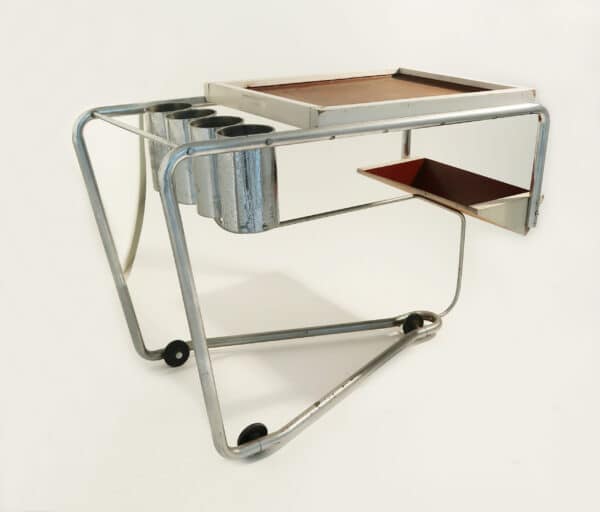 Serving trolley designed by Eysselinck
© Design Museum Gent, archief Eysselinck
The archive reveals not only a builder but a complete designer who, like Le Corbusier, also designed the furniture for his buildings, usually built in. Surviving pieces are rare: of many designs only a single example remains, and of others none at all. But the drawings show that Eysselinck’s steel furniture was among the most advanced in Europe at the time. His “Factory for Rational Steel Furniture”, Fratsta, never really got off the ground, partly because from 1935 onwards he switched to wood, influenced by designers such as Alvar Aalto.
Today, collectors seem to have caught up with him. A 1931 TZS1 chair by Eysselinck was auctioned as recently as January 2025, and stools he designed for the Ostend post office went under the hammer in 2023. Perhaps the time has come for a Belgian furniture maker to launch Fratsta after all. In these vintage-loving times, there might well be a market for it.
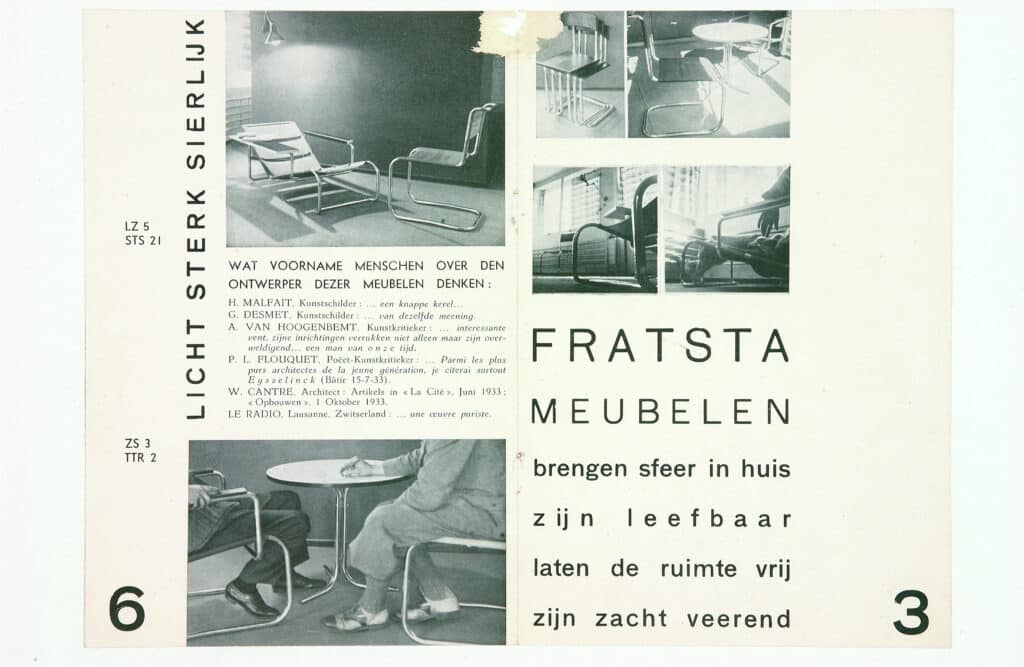 Brochure for Fratsta, Eysselinck's Fabriek voor Rationele Staalmeubelen (Factory for Rational Steel Furniture)
© Design Museum Gent, archief Eysselinck
On top of conceiving furniture and private and public buildings, Eysselinck worked as an urban planner and designed several funerary monuments. It took years of struggle and opposition to get the post office building in Ostend constructed. Today it houses the cultural centre De Grote Post and is probably his best-known work. His very last design was a funerary monument. When his last partner, Georgette Troy, fell ill and died, it proved the final blow. He designed a monument for her grave in Ostend, that also features in Charlotte Van den Broeck’s Bold Ventures and Koen Peeters’ novel A Room in Ostend, and on 6 December 1953 he took his own life in his apartment near the seafront.
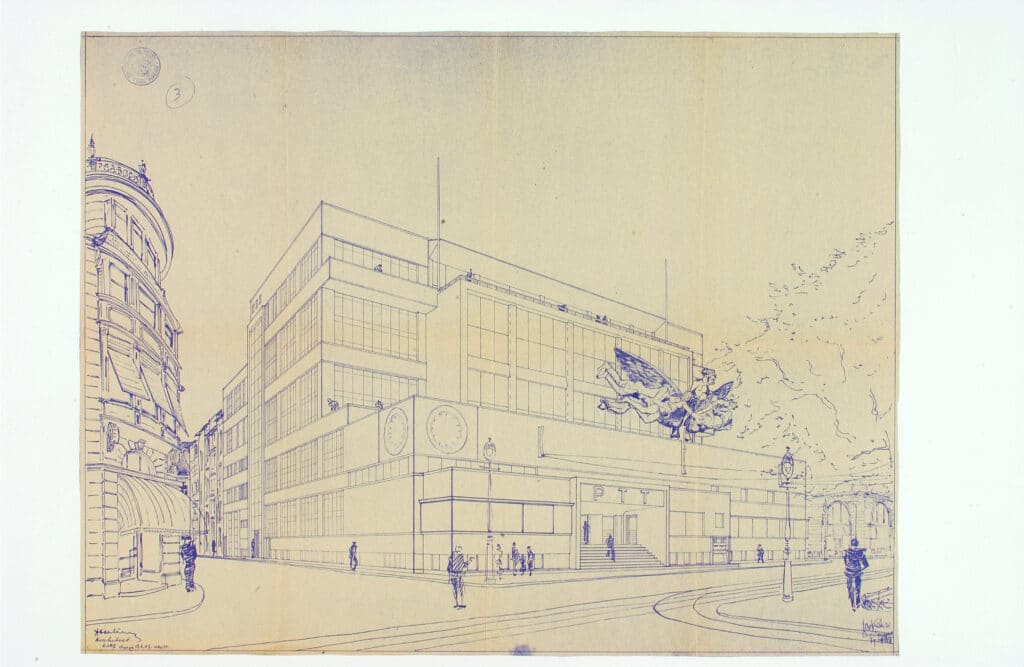 Final design drawing for the Post Office in Ostend
© Design Museum Gent, archief Eysselinck
Partly because of his early death, at 46, his built oeuvre remained small. That may be another reason why he never enjoyed the fame of the longer-lived Braem and Stynen. It is to Dubois’ credit that his monograph rescues Eysselinck and his work from oblivion. His meticulous research in the Eysselinck archive, his knowledge of architectural history and his ability to place this figure in a broader context deserve high praise.
Which brings us back to that 1930 photo on the steps of the Brussels Centre for Fine Arts. Whether or not Gaston Eysselinck ever makes it into the canon, at that moment he stood right in the middle of the picture, surrounded by the great international minds who inspired him. In his own way and in his own field, he tried to pull the Flanders of his day out of its provincialism, conservatism and mediocrity. His radicalism and international outlook earn him a place in the cultural history of the Low Countries. I suggest a spot on the lowest balcony, at the top of the outdoor staircase.

You might also like

In Jozef Deleu’s Poetry, Nothing Was Lost






Leave a Reply
You must be logged in to post a comment.