
Wanted: Poet to Subtitle the City
A city is nothing without a poet to sing its praises. Today city poet laureates take up the microphone as well as the pen, and work collectively as well as on their own initiative. ‘You also need to be sociable and entrepreneurial.’
For as long as I can remember, I’ve felt drawn to the city laureateship. It always struck me as a fabulous task: being permitted to subtitle city events in poetic form. Whenever that position became vacant where I lived, I resolved at a young age, I would do whatever it took to apply – or keep my fingers crossed that I would be assigned that role, if it turned out to be a matter of some sophisticated appointment process.
To my delight, the opportunity presented itself in 2025: Zoë van de Kerkhof, city laureate of Leiden, where I live and was born, stepped down after her three-year appointment. As she had followed a writing course I gave a couple of years ago, I plucked up the courage to approach her for a cup of coffee: what exactly did the laureateship involve?
Acity laureate should be strong both on the page and on stage
A spritely poet took a seat opposite me, filled with enthusiasm for the tasks she had been able to fulfil. As the city laureate she wrote around twenty poems a year, she explained, including a number of specific fixtures: the anniversary of the university, Remembrance Day on 4 May, commemorating victims of World War II, Keti Koti on 1 July, celebrating the abolition of slavery in the former colony of Suriname in 1893 – along with several ad hoc requests that easily filled her schedule.
Those tasks gave her access to all kinds of bubbles she would never have entered otherwise. ‘I immersed myself in the most diverse subjects: from insulation material for a municipal sustainability campaign to the city’s textiles history.’ All these glimpses of different areas and meetings with different people over the last three years have made her love the city even more, she said.
A competition was set up to determine Van de Kerkhof’s successor. Any resident could apply with a maximum of three anonymously submitted poems. After a first selection round by an expert jury, the runners-up and final winner were decided during a series of public performances. So if the process works, then the new city laureate should be strong both on the page and on stage.
In the run-up to the application deadline, my thoughts went with increasing frequency to the question of what the city laureateship would bring with it and to what extent I would be suited to it. Would I succeed in producing a poem every two weeks on request? Was I really both a writer and a performer? And did I know my own city well enough to write poems offering insight into what was going on?
Know your city
I’m clearly not the only one to be enchanted by the idea of a city poet laureate, as the popularity of the office is growing. Where in 2001 only two Dutch municipalities had official laureates, in 2015, there were 146. Venlo was the first Dutch location with a designated poet, as Emma Crebolder was appointed to the role for a year from 1 January 1993. In Flanders, Antwerp claims to have launched the first laureateship with Tom Lanoye in 2002. Most municipalities have a single poet laureate, but some, such as Kortrijk, Utrecht and Antwerp, appoint a collective. Besides city laureates, there are also island poets, for instance on Texel and Terschelling, and poets for provinces, as in Zuid-Holland and Gelderland. The appointment is generally for two or three years, but sometimes a poet stays in place longer, if a successor cannot be found in time.
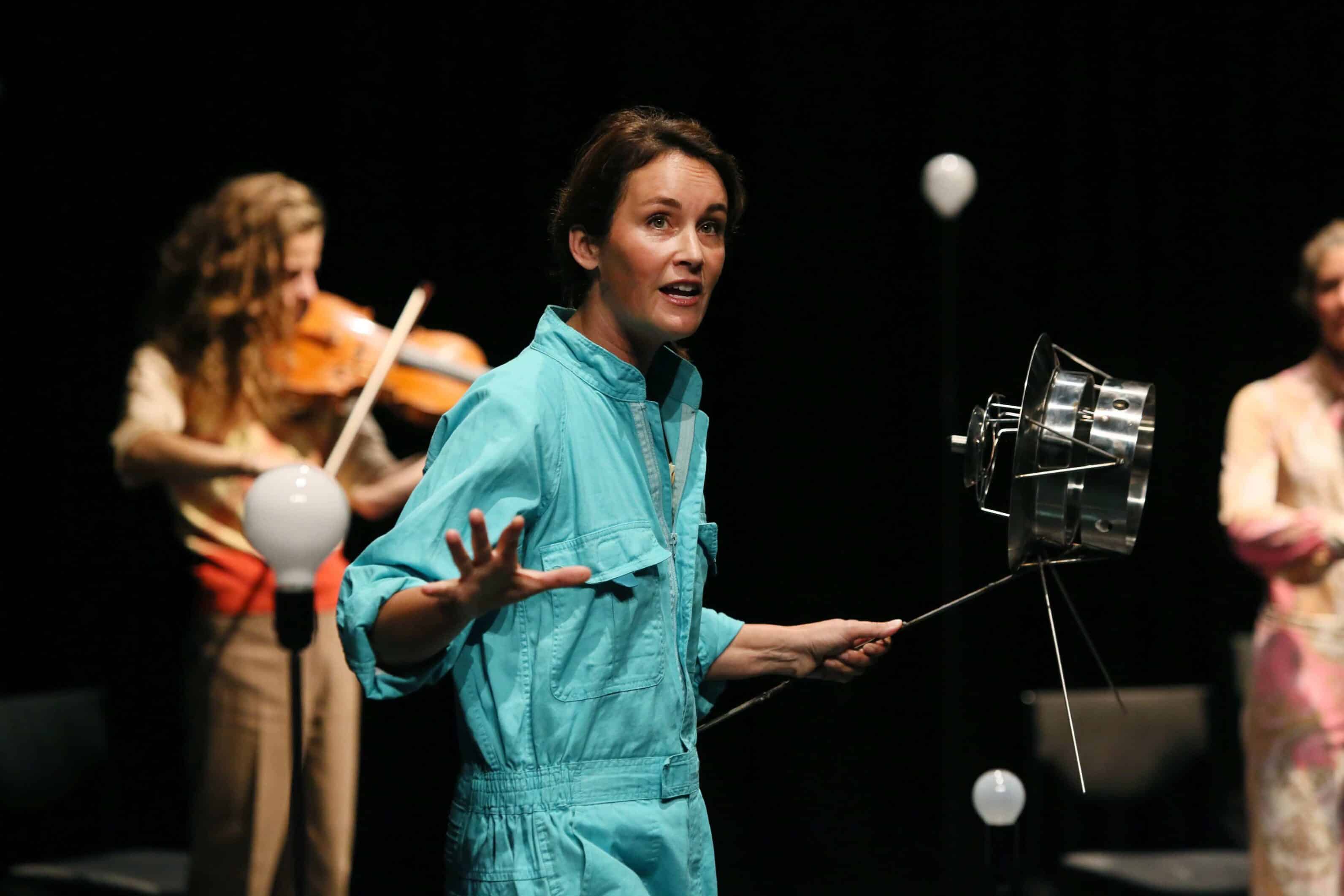 ‘In a sense the city laureate ‘designs’ the city,’ says expert Steven Van de Putte. ‘Former city laureate of Amsterdam Marjolijn van Heemstra used a poetry project to argue for a more integrated style of city development, in which flora and fauna were also given space’
 © Sanne Peper
Over the years, the city laureateship has also been broadly interpreted, with different functions. In order to bring clarity to this, in 2024, Steven Van de Putte, who was city laureate of Deinze in East Flanders from 2019 to 2022, wrote the manual Iedereen stadsdichter (Everyone a city laureate). In more than 500 pages, he brings together good practices from Flanders and the Netherlands, and offers local councils and city laureates a model for collaboration. For this purpose, he spoke with dozens of city laureates in both the Netherlands and Flanders. His conclusion: the laureateship can be fulfilled in countless different ways.
Where in 2001 only two Dutch municipalities had official laureates, in 2015 there were 146
As a poet laureate, according to Van de Putte, you play a social and sometimes even therapeutic role, for instance, collaborating on projects around vulnerable target groups, such as lonely elderly people or single people. Lars Ferwerda, former city laureate of Alphen aan den Rijn, produced poems for facilities for the elderly in the local area, which were displayed in care homes and provided material for conversations between residents. Sanne Leenders, former laureate of Turnhout, worked with residents to write poems about how they felt, which were then published as a collection. Such projects often have a participatory side: residents are encouraged to join in, for instance with a workshop at a festival.
As a poet laureate you play a social and sometimes even therapeutic role
There is also a certain amount of city marketing involved in the title: the poetry can, after all, contribute to a more positive image of the city. It also sometimes leads to visible changes in public spaces, for instance with the addition of a poetry bench. The city laureateship also has a philosophical significance. In this respect Van de Putte calls the poet the ‘city designer’. ‘I’m thinking of examples like former laureate of Amsterdam Marjolijn van Heemstra: she used a poetry project to argue for a more integrated style of city development, in which flora and fauna were also given space.’
A city laureate should also teach the population something about poetry, indirectly by performing at events not solely attended by poetry lovers, such as memorials and festivities, as well as through more direct outreach in the form of workshops and lectures.
Poetic freedom
Clear agreements as to the interpretation of the city laureateship are essential for a good collaboration with the city council, says Van de Putte. ‘Ideally, there should be a clear contract – not only with practical agreements, for instance on remuneration and the minimum number of poems to be produced, but also on content. It is also important that the vision of the city and the poet come together in a shared project. Finally, poetic freedom must always be safeguarded: poets should be able to express themselves critically – albeit constructively – as to the functioning of their cities.’
The latter condition proved problematic in Antwerp. In 2022, the post was taken up by a pool of five poets: Ruth Lasters, Lotte Dodion, Yannick Dangre, Proza-K, and Lies Van Gasse. Lasters stepped down early because the aldermen had declined her poetry. Her poem ‘Losgeld’ (Ransom) criticised the unfair treatment of children and young people in vocational education.
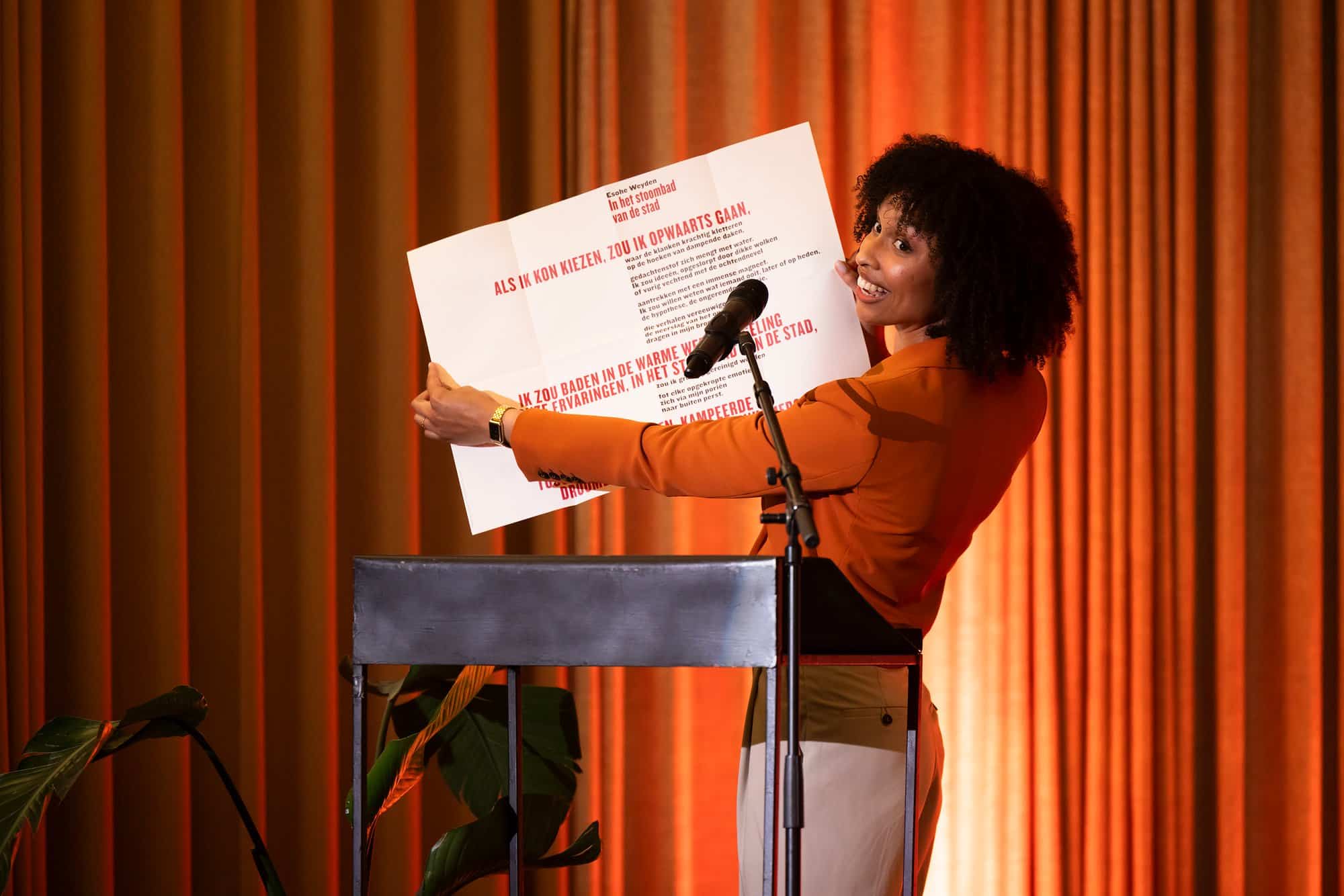 A city poem by Esohe Weyden to celebrate twenty years of Permeke Library: ‘I would love it if my poems could attain a lasting place in the city.’
© Koen Broos
After Lasters’ resignation, the other city laureates also decided to quit. They stated, in the words of Dodion, that a city laureate can no longer hold ‘the critical freedom they had previously’. They also objected to the fact that, unlike in previous laureateships, no concrete agreements were set out in writing.
Meanwhile Antwerp has a new city laureate in Esohe Weyden. The city is also approaching the laureateship differently: the council is no longer the employer, but rather a conglomerate of Antwerp’s major cultural institutions, which also provided the jury that picked Weyden, and give her complete artistic freedom.
Poetry on a sweater
Weyden’s appointment was broadly set out in the media, so that she immediately received requests from all sides. ‘That fits well with my ambitions: I want to make this city laureateship into a close collaboration. The more people who approach me, the better.’
Weyden has a background in spoken word and likes to perform her poems. She also hopes always to make her poetry visible in some medium or other – be it on a building or a jumper. ‘I would love it if my poems could attain a lasting place in the city. I also hope to be able to perform at events that don’t solely attract poetry lovers, and I’d like to work with their input. That way I hope to reach people who aren’t yet big literature fans.’
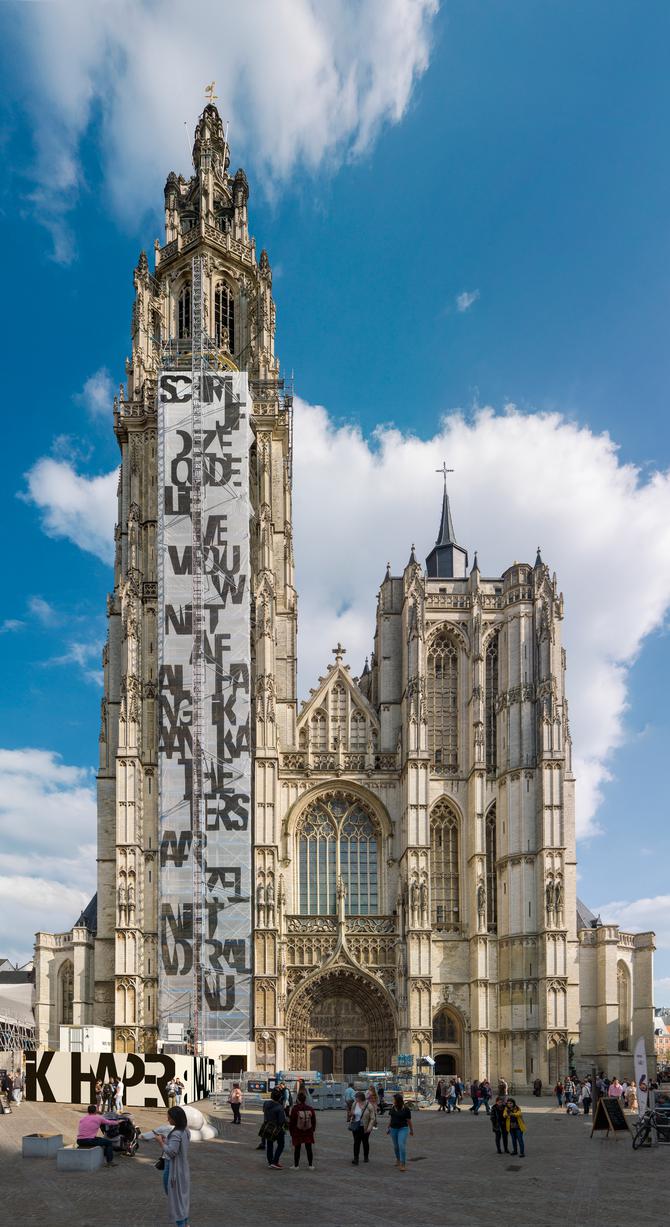 The poetry of Maud Vanhauwaert went on show on church towers, shipping containers, on sandwich boards and banners.
© Maud Vanhauwaert
Those wishes fit well with the Antwerp poet laureateship, which often receives great visibility in the public space. For instance the verses of predecessors Tom Lanoye and Stijn Vranken were displayed on the Boerentoren and on a bridge respectively. The poetry of Maud Vanhauwaert went on show on church towers, shipping containers, on sandwich boards and banners, and also took on the form of a quest, a game of hopscotch, a parking permit, a marriage certificate, a colouring book and a word search.
Weyden’s ambitions show that the city laureateship can be far more than merely writing and performing. ‘You also need to be sociable and entrepreneurial and have a network in the city, so that you can set up awesome projects. It would be logical to be selected for those attributes as well, as city laureate.’
A couple of hundred euros
Zoë van de Kerkhof, too, was ambitious in her fulfilment of the city laureateship in Leiden, although she did find the many deadlines, as well as the financial part, somewhat disruptive. ‘I don’t like talking about money, but in the end, I need to be able to meet my fixed costs. More to the point, how do you convert poetry to euros? Sometimes I spend months brooding over a poem. Of course, I also want to provide poems to good causes and charities, but I need to be able to make a living from my writing.’
A good city laureate is not only occupied with composing poems, but preferably also with a range of other projects
It seems almost impossible to establish appropriate remuneration for such a wide-ranging position, Van de Putte noted during his tour. ‘There are big differences in the financial compensation city laureates receive for their activities. Some are paid an annual fee of several thousand euros from the city council, others receive a couple of hundred euros for each activity, such as a performance. The latter format works particularly well when the city laureate is expected to engage in a number of activities agreed in advance, but becomes awkward if the poet works on longer projects or has a pile of side functions to fulfil, such as jury member or putting in appearances at a wide variety of events.’
A good city laureate, in short, is not only occupied with composing poems, but preferably also with a range of other projects. ‘Separate budgets must be made available for this, independent of any fee for the laureates themselves,’ says Van de Putte. ‘There is often a lack of clarity about this in the collaboration with the local council, which is a pity. A great many city laureates have to make a living from their writing, so it’s important to keep this in mind.’
Talent development
In the Netherlands, the city laureateships are interpreted somewhat differently from in Flanders, Van de Putte observes. ‘In the Netherlands, the structure tends to be more informal, with the poet writing a few poems a year. This kind of fairly open-ended collaboration, interestingly enough, often results in a great deal more productivity. In Flanders, I see more supervision, for instance in the form of a mentoring programme. That has positive effects: the city laureateship gains depth and impact on the city. When you add in a form of talent development, you create potential city laureates of the future.’
A great example of such a programme can be found in Kortrijk, in the form of a collective that develops interventions in the region and functions as an ambassador to the city’s Memento Woordfestival. The group is spearheaded by a figure known as the Letterzetter (typesetter), who prepares them and helps them flow on through to the professional circuit. Up until mid-2026, poet Myriem El-Kaddouri holds this pioneering role.
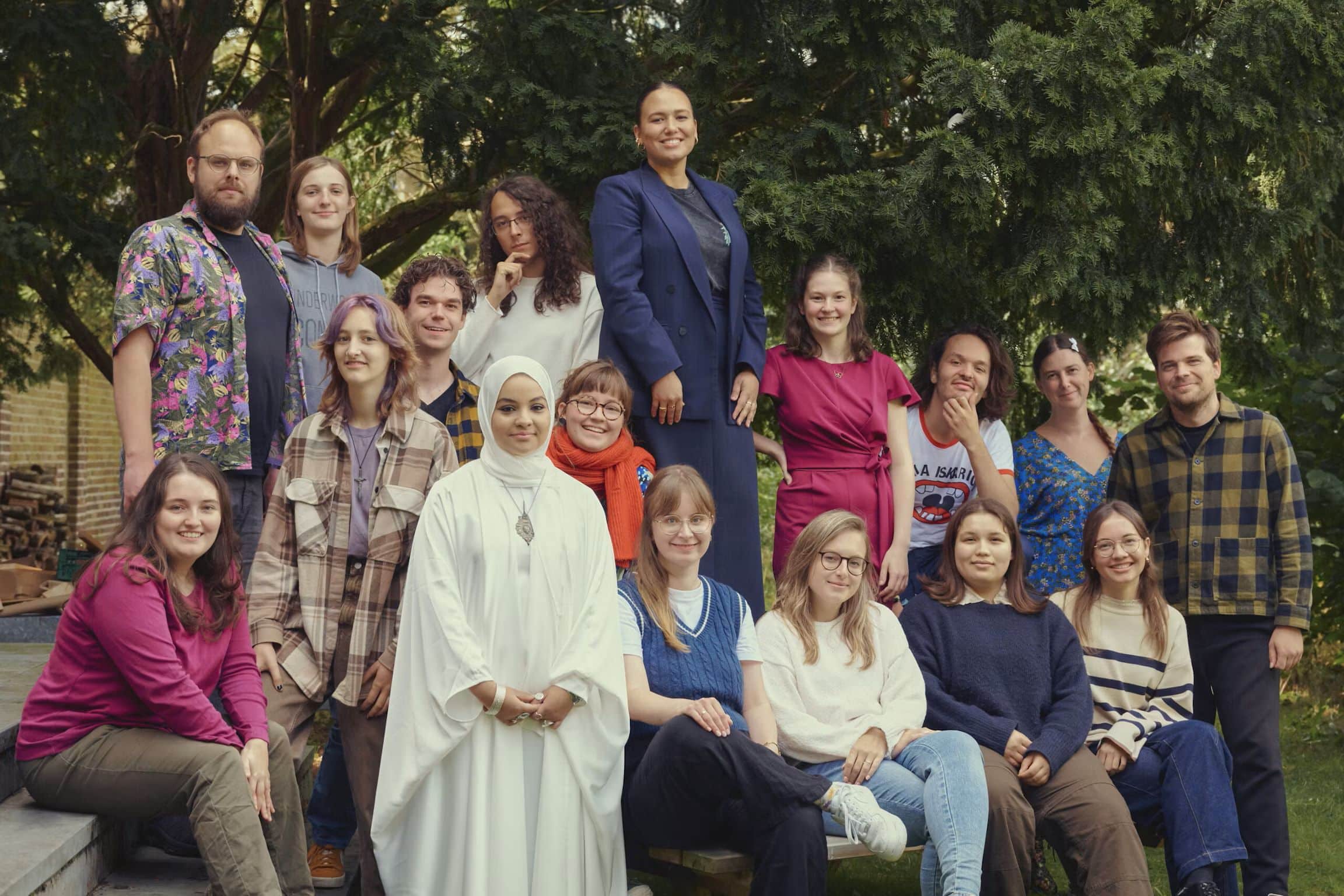 Myriem El-Kaddouri (middle above) is the Letterzetter of the Kortrijk Collective of the same name: ‘We’re a close-knit group, where we get to know one another well.’
 © Letterzetter
It’s not a classic city laureateship, she emphasises. ‘This role doesn’t revolve around me as a person: I’m just the captain of a boat full of word artists. Kortrijk’s Letterzetter role is a talent development pathway for people from eighteen to twenty-eight in Kortrijk and the surrounding area with literary ambitions, whether as a writer or a spoken word artist.’
It’s not a strictly delineated process: you can dip in and out when you’re ready. The form it takes also varies. ‘We have regular collaborations with other collectives, but also with festivals and events. These projects are shared out between members of the collective, depending on what fits in with their development pathway.’
The group meets on the last Friday of each month in the library to discuss what they’re working on and what they could use help with. ‘It soon becomes a close-knit group, where we get to know one another well,’ El-Kaddouri notes.
Collective
The highlight of Kortrijk’s city laureateship is Memento Woordfestival, which takes place on the second weekend of March. ‘As the Letterzetter, I curate the programme and give the collective a place in the activities. We also try to make poetry extra-visible in the city, for instance with posters in public spaces.’
Of course, in her role, El-Kaddouri also writes poems for the city, but that’s more of a side job. ‘In the past year, there were only two: a poem for an opening event and one for the local football team. I’m more there to motivate young people, so they gain a place on podia and in the city. We like to establish collaborations with partners – not only in the region, but also on a supralocal level. We try to generate activities on different levels and in different sectors. This way, the makers in the collective have the opportunity to build up a multi-layered professional practice.’
Myriem El-Kaddouri: ‘The collective counterbalances mechanisms that play the makers off against each other, by focusing on values such as generosity, openness and knowledge sharing’
El-Kaddouri considers the form of the collective very valuable. ‘It counterbalances mechanisms that play the makers off against each other, by focusing on values such as generosity, openness and knowledge sharing. We learn from each other and from other collectives, across national borders as well: we recently visited Tilburg – a city which, like Kortrijk, isn’t necessarily seen as the centre of the publishing world – and then our counterparts from Tilburg came to us. It would be a shame not to look beyond the border between the Netherlands and Flanders: after all, we speak the same language. I do detect a difference in writing culture though: the Netherlands seems to offer more space for cross-overs with other art forms, whereas in Flanders the concept of literature is rather more classic. But in the end we all have the same aim: bringing poetry to the people.’
Poetic cement
I’ll return for a moment to my own city laureate ambitions. In the end the death of someone close to me on the day of the deadline made the choice for me: my application was ready, but I didn’t feel emotionally able to press send. In all honesty, the enthusiastic stories of all the laureates I spoke to for this article have made me regret more and more that I didn’t go through with it.
Meanwhile the new city poet has been selected: Raymond Tilma succeeded Zoë Van de Kerkhof in spring 2025. I wish him every success, and comfort myself with the thought that the city laureateship isn’t forever. Perhaps someday I’ll have another chance of becoming the poetic cement of my city.
You might also like





Leave a Reply
You must be logged in to post a comment.