
Oana Stan is an art historian and the founder of Women of Haarlem, a public history project that brings stories of women from the past into the present through city walks. In her opinion piece, she reflects on why making women’s history visible in public space is not an ideological gesture, but a corrective one.
My walking tour often gets called ‘women tour’ or ‘feminist tour’. The historical theme of my walks is immediately associated, in many people’s minds, with feminism. While it’s hard to deny there is truth in that, I find that label somewhat reductionist. In my tours, I try to avoid the trope of women’s exceptionalism and show something more straightforward and fundamental: wherever and whenever you look back in history, you will find traces of women’s presence. The message that I want to send is that their existence in history was far from niche, what was niche was their visibility.
Womens existence in history was far from niche – what was niche was their visibility
To achieve this, my tours rely on a form of strategic segregation. In trying to repair the ages long distortion, I willfully use a temporary magnifying glass on women’s contributions across different areas of society, education, or the economy and my stories always connect women to their historical contexts. This perspective is necessary because for centuries, the access to education, archives and even publishing has overwhelmingly catered to men. As such, the discipline of history itself was marked by this. Letting people know today that women had just as strong a presence in history as men is therefore not an ideological gesture, but merely a corrective one.
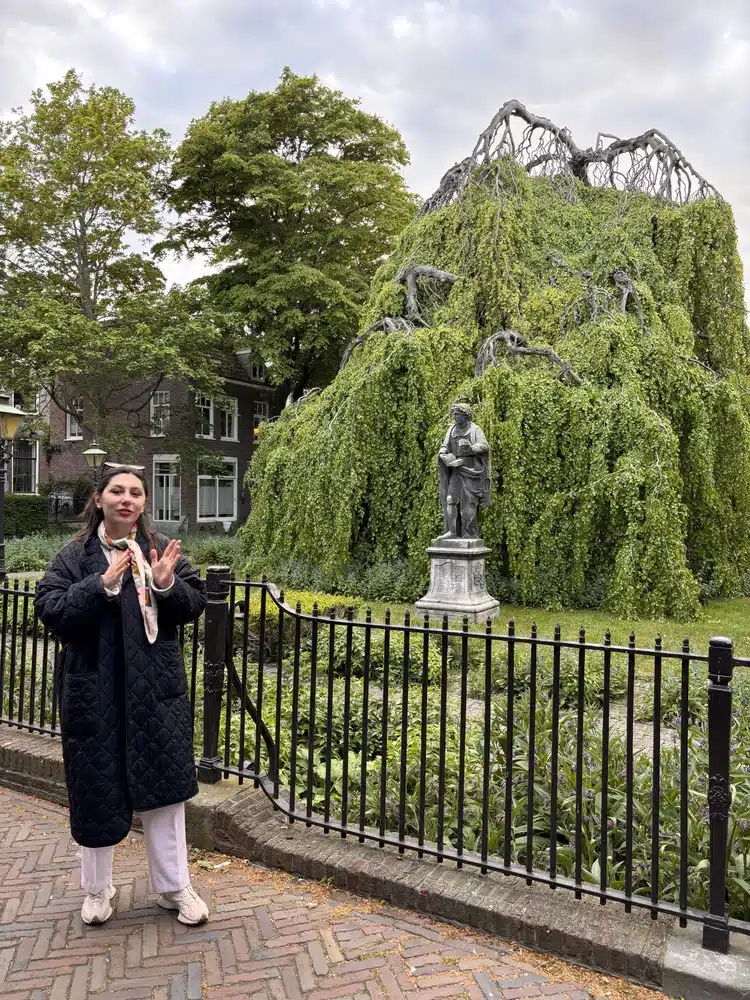 Oana Stan on one of her guided tours in Haarlem
When I mention the attendance at my tours is growing slowly, I often hear I should branch out and abandon my ‘niche’. This illustrates exactly why the work I do is necessary. I did not start Women of Haarlem because I wanted to become a tour-guide, but because I was driven by the mission of putting my years of research to good use. From that research I learned in earnest that women’s existence in history was anything but marginal. Historical narratives have been so effective in suggesting so, that up to this day people find women’s stories with surprise.
I do not consider my work as activist in the sense you might imagine – I am not aiming to translate the past into fashionable contemporary political arguments. Alternatively, the drive of my project as a public educational platform is what gives it its activist dimension. I want to show that problems that people faced in the past are not as distant as we tend to imagine, and by showing that, reaffirm why historical research deserves a more prominent spot in our everyday life.
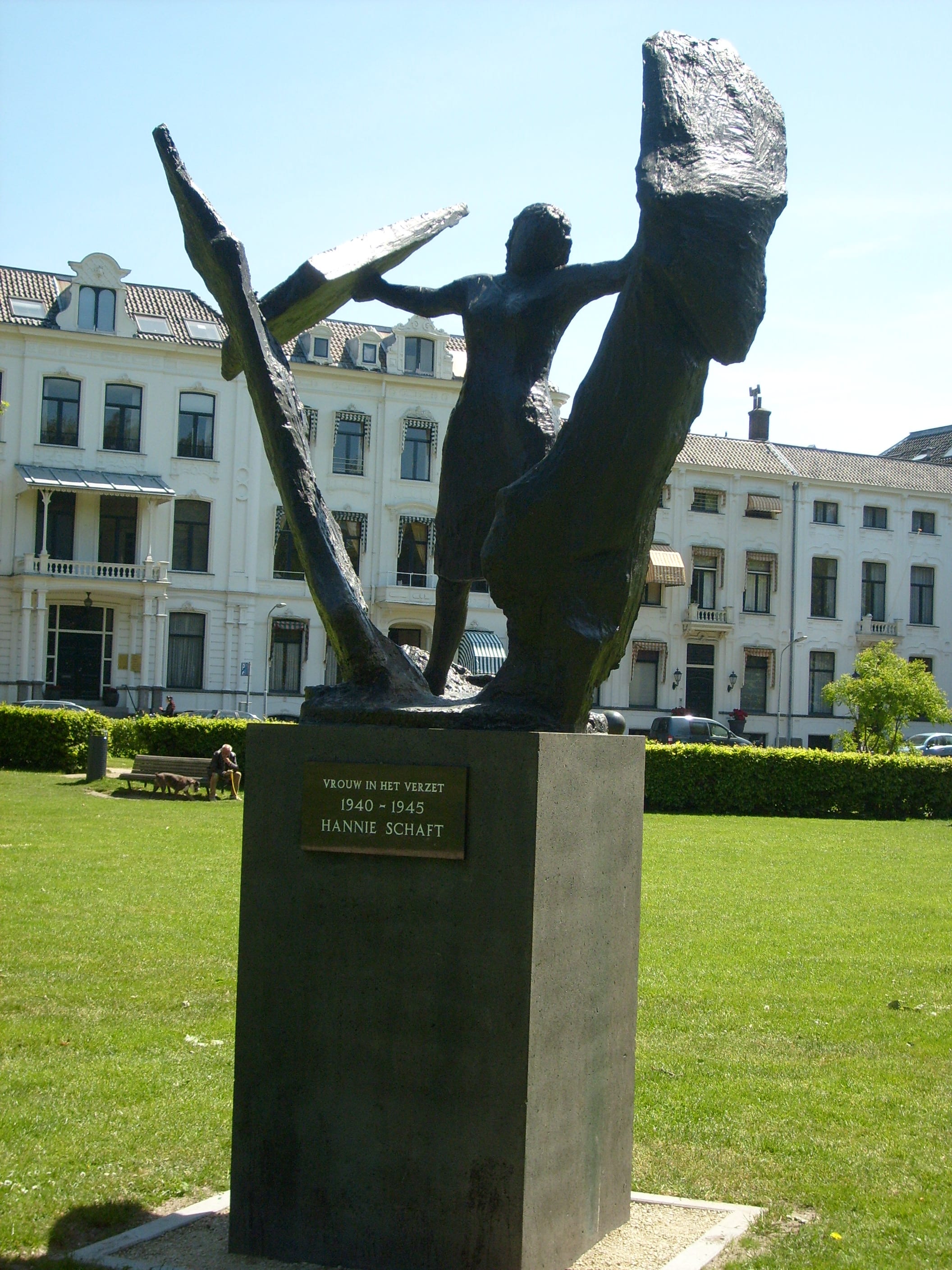 "Vrouw in het Verzet", statue to commemorate Hannie Schaft in Kenaupark, Haarlem
The way I perceive cultural activism does not entail promoting an agenda. Cultural activism should try to defend and advance culture and education as public goods. At a time when austerity measures cut funding for universities and cultural institutions, it becomes crucial to manifest why research matters beyond academic circles. Austerity often cuts through institutions that are already in great deficit, but I think scholars themselves must also take responsibility for justifying their role in society.
We see it in Europe and further that trust in expertise and academic knowledge is waning. Addressing this issue must be in part shared by researchers themselves. If we continue to produce historical work that only speaks to our colleagues in specialized publications, it will seem natural if the public will deem it distant, and therefore, unnecessary and easy to defund. When that research is shared, debated and experienced collectively, it becomes something else entirely. With my project, that literally translates into taking my research for a walk.
My activism aims to restore complexity where simplification has taken place and pointing my finger to what’s been overlooked
This is what I mean with cultural activism – I do not seek to bend the past and instrument it in present-day battles. My activism aims to restore complexity where simplification has taken place and pointing my finger to what’s been overlooked. Responsible dialogue with history does not commodify it but rather expands the access to it.
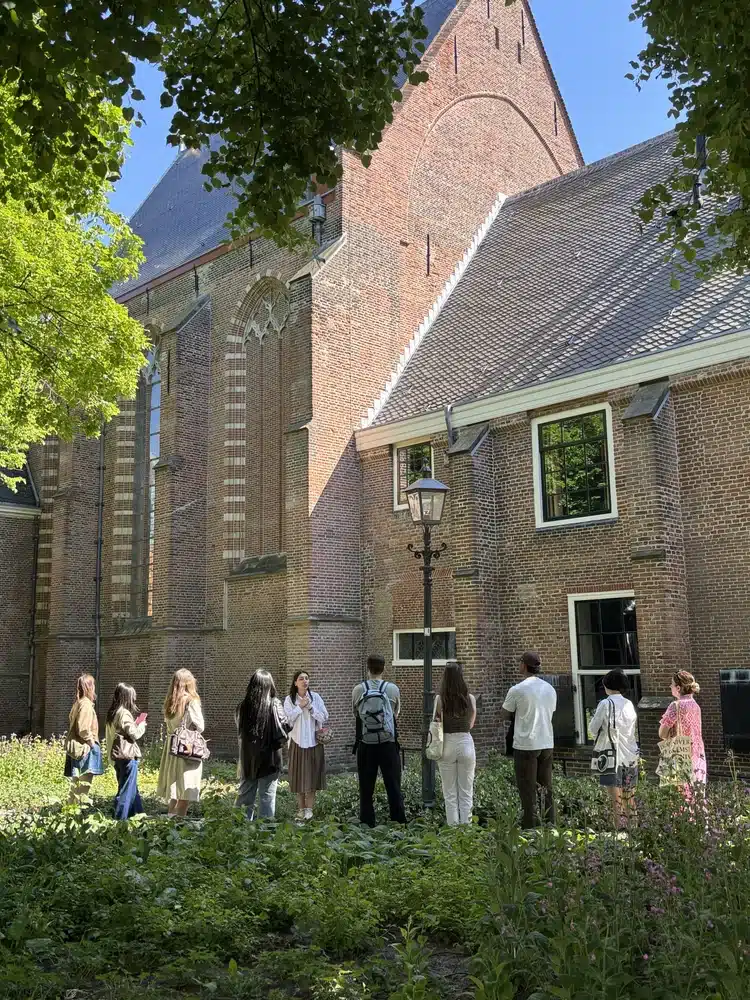 The Women of Haarlem tour with Oana Stan
There is also another reason why such work feels important today. We are witnessing an oversimplification of cultural experiences to match the shrinking attention spans. Yet, the reactions I get during my tours suggest something else. My visitors often tell me: ‘I have walked these streets my whole life, and now I see them differently.’ Such a shift in perspective may seem small, but I argue it is significant because it proves that historical knowledge can have the power to change how we relate to the spaces we inhabit.
I am not naïve – I do not expect a walking tour to transform society. What I do believe is that when research leaves the archive and enters the street, something important begins to happen. Visitors take what they learn to conversations with their friends and families. Other researchers may decide to share their own work on a larger scale. Step by step, historical knowledge turns into something living – a shared resource, and not just specialized niche language.
If historical research can help people recognize themselves in the past – and recognize the past in the places they move through every day – then it is already working. And perhaps that is the most meaningful form of activism it can offer.

You might also like

In Jozef Deleu’s Poetry, Nothing Was Lost




Leave a Reply
You must be logged in to post a comment.