
Philips Galle: The Engraver Who Gave Up on Erasmus’s Dream

The engraver and print publisher Philips Galle was a central figure in the cultural and intellectual life of the Low Countries during the late sixteenth century. As religious and social tensions mounted, his work became increasingly conservative until, eventually, his humanist dream was replaced by a strictly Catholic stance.
He was a highly talented engraver and a dear friend of whom I think with sadness, because – though devoted to the Augsburg Confession – he remained in the Roman Church for the sake of the fleshpots of Egypt and so as not to have to leave the beautiful city of Antwerp.
These bitter words “born of sorrow,” were penned in old age by the Calvinist poet, jurist, calligrapher and theologian from Antwerp, Paulus de Kempenaer – who had also been forced to leave the city on the Scheldt in 1584 due to his faith – when he looked back on his friendship with Philips Galle. Galle had remained a Catholic, despite his interest in the Augsburg Confession, a key foundation of the Reformation movement.
Galle, born into a patrician family during the second half of the sixteenth century, became one of Europe’s leading engravers and print publishers.
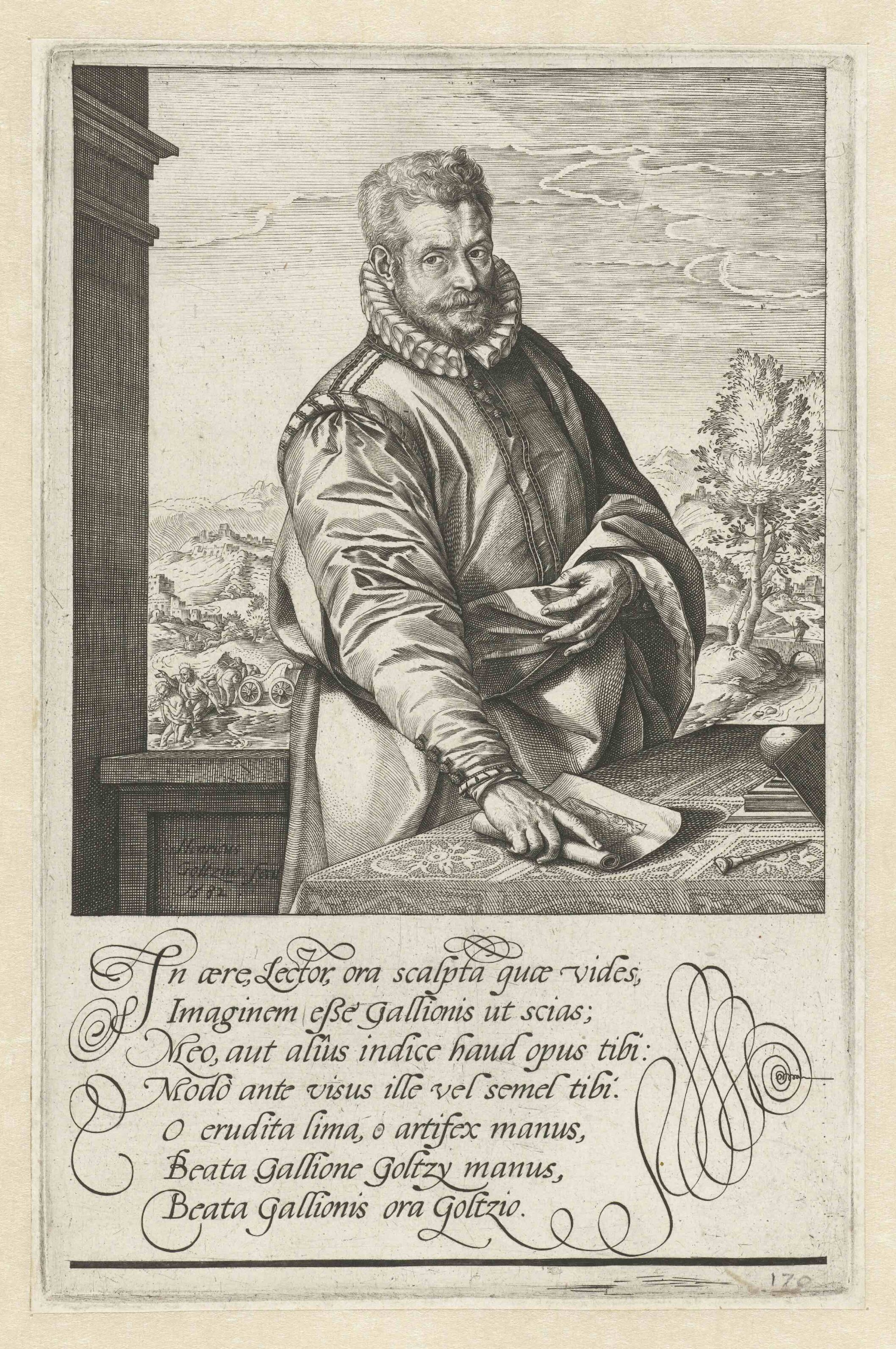 ‘Portrait of Philips Galle’, Hendrick Goltzius, 1582
© Rijksmuseum, Amsterdam
His earliest dated print, published in 1557, immediately revealed his talent as an engraver capable of expertly adapting to the styles and techniques of the artists – such as Pieter Bruegel, Maarten van Heemskerck, Frans Floris and Giulio Romano – whose work he translated into copper. Yet Galle’s true significance and influence lie in his vast and influential body of work – comprising more than 3,700 prints – that was distributed throughout Europe by his studio and publishing house in large editions throughout his long career, from 1563 until his death in 1612.
Philips Galle was born in Haarlem in 1537 and learned his trade from the unconventional humanist, moralist and engraver Dirck Volckertsz Coornhert. It was Coornhert who probably introduced Galle to Hieronymus Cock, who was a painter and the principal publisher of prints (after Pieter Bruegel), in Antwerp. After Cock’s death in 1570, Galle moved to Antwerp and, following in Cock’s footsteps, became one of the most important print publishers on the European mainland, catering primarily to the upper-class bourgeoisie and the urban intellectual elite.
Through its sons and sons-in-law and grandsons – engravers all – along with an extensive network of marriages, the Galle dynasty remained active as print publishers until the third quarter of the seventeenth century. Though several women of the Galle family, including those who married into it, were certainly involved in publishing activities, none are known to have worked as engravers or etchers.
Interest in Reformers
What influence did the turbulent period surrounding the Pacification of Ghent have on the content of the many prints emanating from Galle’s publishing house? Were there any notable changes in the themes or subjects?
While working with Hieronymus Cock and also in his own publications before he settled in Antwerp in 1570, Galle collaborated primarily with two fellow townsmen: the painter Maarten van Heemskerck, who provided the designs, and the physician and humanist Hadrianus Junius, who supplied the texts – usually in Latin – that accompanied the prints. Without exception, these are allegorical and moralizing prints offering guidance concerning proper human conduct on earth. The themes – clearly influenced by Coornhert’s doctrine of “perfectionism” – concern the precarious quest for moral human perfection. This striving for perfection is neither specifically Catholic nor distinctly Protestant in nature; rather, it represents a moral philosophy that could be called “Erasmian.” It is a philosophy that strongly emphasises reason, free will and individual responsibility for one’s actions during life on earth.
A characteristic example is a print with the lengthy title “It is easier for a camel to go through the eye of a needle than for a rich man to enter the kingdom of God,” from the series The Misery of Riches (1563), which was designed by Heemskerck and features text by Junius.
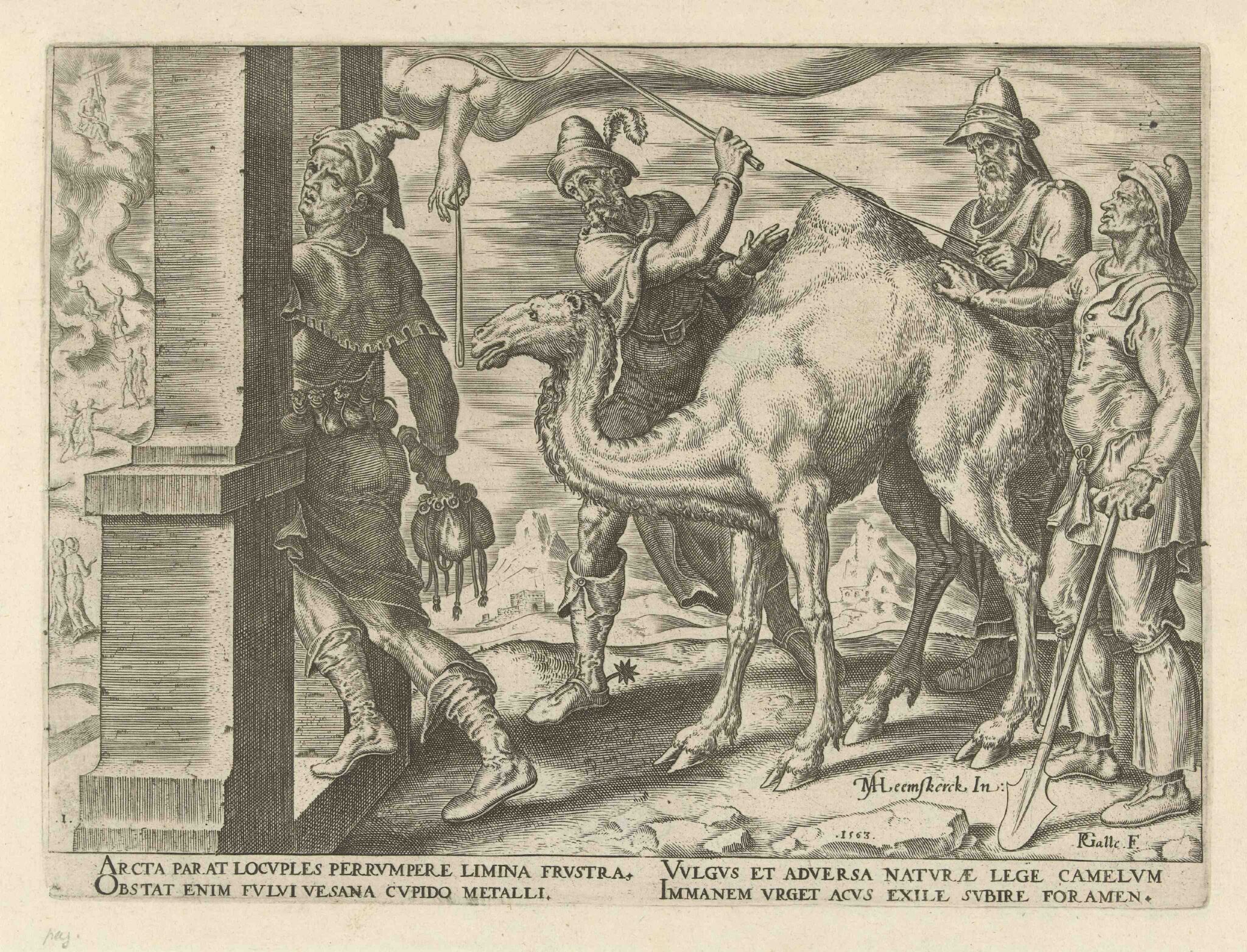 Philips Galle (after a design by Maarten van Heemskerck), ‘It is easier for a camel to go through the eye of a needle than for a rich man to enter the kingdom of God’, a print from the series The Misery of Riches, 1563
© Rijksmuseum, Amsterdam
Archival sources reveal that Galle always remained firmly within the fold of the Catholic Church, as noted in the quote from De Kempenaer at the beginning of this text, despite decades of suspicion and allegations that he secretly adhered to a reformist philosophy. However, Galle certainly seems to have taken a keen interest in religious reform and reformers – hardly surprising considering he had been taught by the unorthodox thinker, Coornhert.
Galle’s interest in reform is reflected in a series of portraits of humanists and theologians, the first edition of which was published in 1567. This collection highlights critical and reform-minded thinkers, some of whom remained within the Catholic Church – such as Savonarola, Erasmus and the only Dutch pope, Adrianus VI – and some who broke away from the Roman Church, among them Luther, Zwingli, Calvin and Galle’s physician-friend from Haarlem, Junius.
Towards the end of the 1560s, Galle increasingly focused his publishing efforts on Antwerp, a city that, far more than Haarlem, and certainly more than Amsterdam, was a leading centre for the production of books and prints.
In 1570, after Galle’s former patron Hieronymus Cock died, his widow, Volcxken Diericx, continued to run the print publishing business, albeit on a smaller scale. Galle evidently saw this as an opportunity to follow in Cock’s footsteps and become the Netherlands’ foremost print publisher, serving an international market.
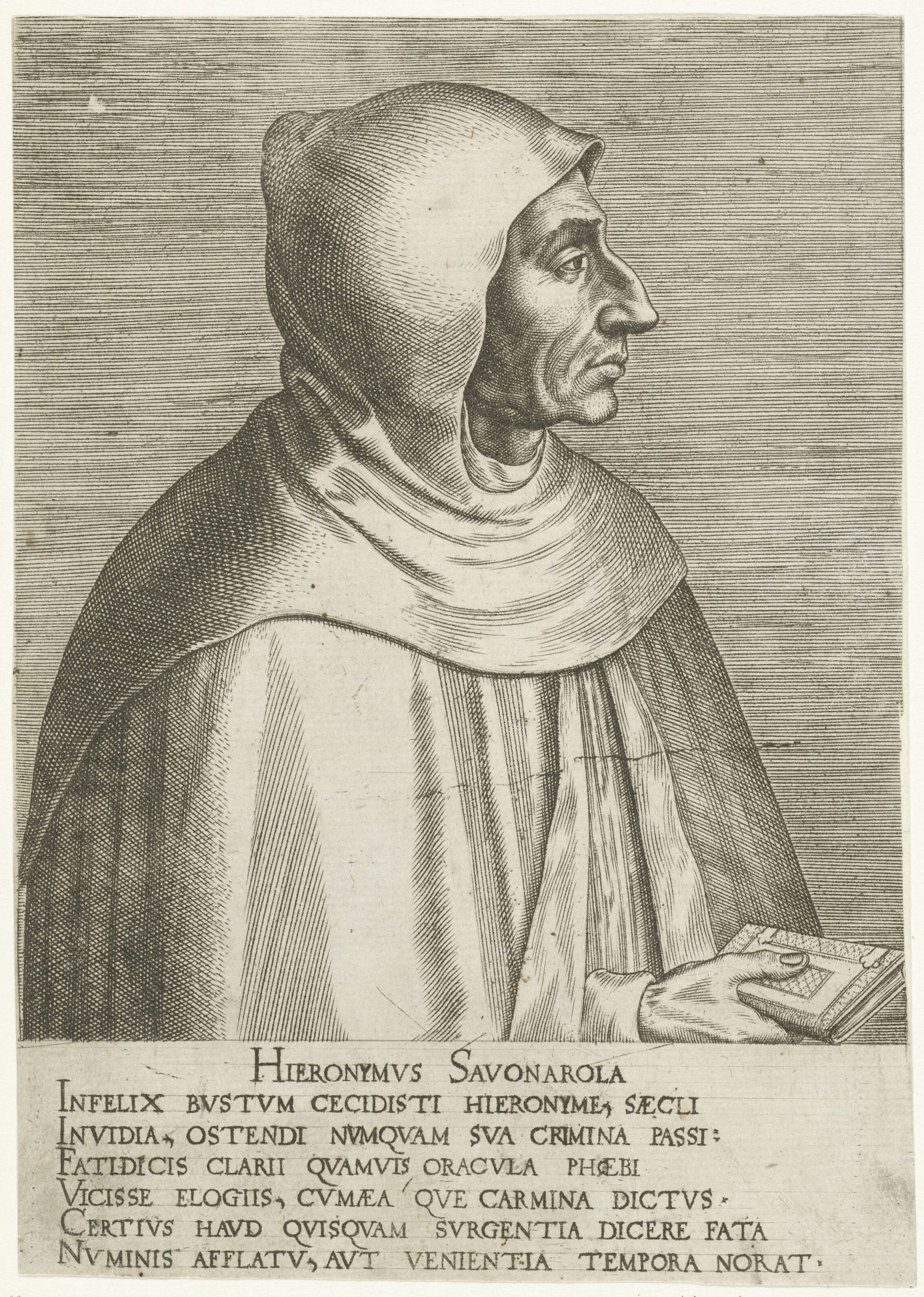 Philips Galle, Portrait of Girolamo Savonarola, 1567
© Rijksmuseum, Amsterdam
He settled in Antwerp, where the presence and activities of Christoffel Plantin undoubtedly served as a stimulus since, even before moving to Antwerp, Galle had been part of Plantin’s inner circle of friends. From 1571 onwards, he collaborated regularly with the Officina Plantiniana in the production of illustrated books. This partnership continued for decades with Jan Moretus and his successors, with the Plantin-Moretus and Galle dynasties remaining closely linked until the mid-seventeenth century.
Galle quickly established himself in Antwerp’s cultural and intellectual scene, eventually holding administrative positions within the Guild of Saint Luke. His circle of friends included cartographers Gerard Mercator and Abraham Ortelius. With his keen eye for market trends, Galle’s catalogue expanded dramatically. He catered to the international public’s voracious appetite for imagery and shifting expectations, offering themes ranging from landscapes, cartography, hunting scenes, ornamental prints and cityscapes. His output also included a pattern book featuring elaborate hairstyles, a richly illustrated volume on squaring the circle and an unsuccessful attempt to produce an illustrated edition of Dante’s Divine Comedy.
Following the death of Maarten van Heemskerck in 1574, other designers – such as the Bruges-based Florentine Joannes Stradanus, Hans Vredeman de Vries and Maarten de Vos – played a prominent role in expanding his catalogue.
The evolution of Galle's catalogue offers a fascinating mirror of the political, religious, and social developments of his time
The core of Galle’s output was still primarily concerned with religious, allegorical and moralizing publications, as it had been during his Haarlem period. However, the emphasis shifted towards highlighting the life of Christ as a model for the human life path. One example of this is the extensive print series Actionum Speculum Christi Iesu Vitae (1574), in which Christ serves as a “mirror of life” – that is, as an ethical guide and spiritual mentor on life’s journey. The texts were written by Benito Arias Montano, a humanist and theologian at the Spanish court, who was part of Galle’s extensive international network of humanist scholar-friends. Both men also belonged to Plantin’s inner circle and were associated with the secretive “House of Love,” a clandestine spiritual group cantered around Christoffel Plantin that appears to have positioned itself somewhere between the increasingly fierce Catholic and Calvinist protagonists.
A More Careful Choice
At a time when religious convictions in the Southern Netherlands were being voiced and fought over with increasing vehemence, Galle became more cautious regarding the choices and tone of his publications – maybe in an attempt to remain commercially attractive to both sides.
In a significantly expanded 1572 edition of his series of portraits of scholars, he no longer included outspoken Calvinist champions such as Luther, Zwingli or Calvin. Instead, he shifted the focus to depictions of writers and humanists who prioritized ethics and religious tolerance such as Thomas More, Erasmus, Janus Dousa and Pietro Bembo. Notably, his friend Arias Montano authored all the (new) texts accompanying the portraits.
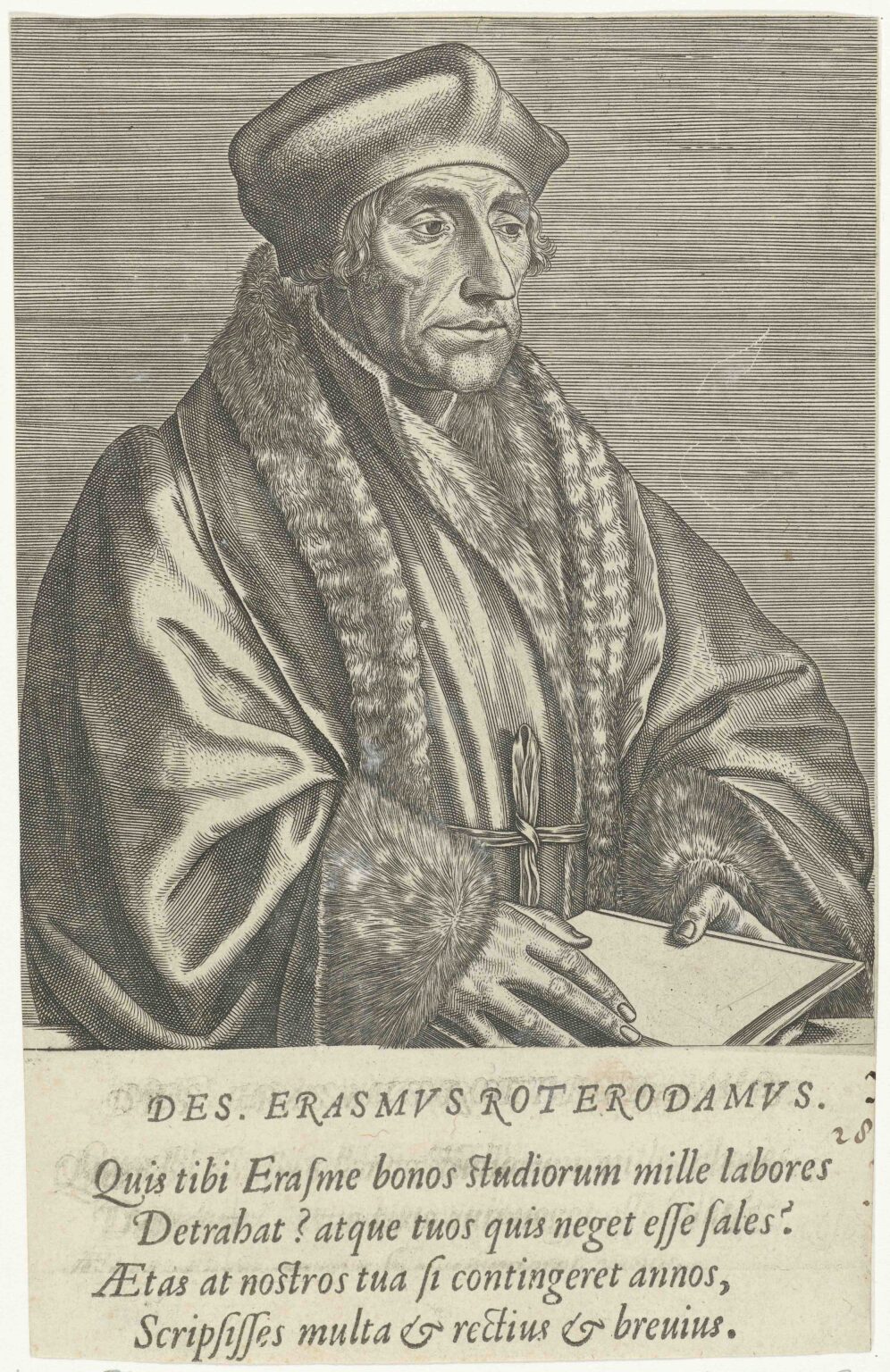 ‘Portrait of Desiderius Erasmus’, Philips Galle, 1572
© Rijksmuseum, Amsterdam
We know that Galle closely followed the turbulent political and military developments and incorporated them into his publishing projects thanks to an engraving with extensive text that depicts the 1573 Siege of Haarlem, as well as a popular booklet recounting events in the Low Countries between 1566 and 1579, which was reprinted five times in just a few years. Galle does not explicitly take a side in the religious disputes, though he was clearly not fond of the Spanish. Instead, he pinned his hopes on William of Orange restoring and preserving the unity of the Netherlands – a striking parallel to the developments surrounding the Pacification of Ghent.
After the fall of Antwerp in 1585, Philips Galle remained in the city, working steadily, expanding and diversifying his publishing list. He began to focus on the publishing itself, leaving the actual engraving to his talented sons Theodoor and Cornelis, his sons-in-law Karel de Mallery and Adriaen Collaert (who were also engravers), the Wierix brothers and the many anonymous apprentices in his workshop.
Illustrated books and print series’ featuring extensive letterpress text were frequently produced and distributed internationally in collaboration with Jan Moretus and the Plantin Press. Though Galle’s friend Johannes Stradanus continued to supply design drawings from Florence until his death in 1605, Galle increasingly used the services of anonymous designers. Production became standardized, eventually failing to match the quality seen prior to 1585. After 1600, Galle’s output was often formulaic and mediocre.
The Influence of the Jesuits
With regard to religious publications, Galle’s emphasis on allegorical, humanistic, moralizing themes and personal religious experience largely disappeared. Instead, the focus was on individual engravings, print series’ and illustrated books that emphatically affirmed and propagated Church dogma; aligning perfectly with the mood of Counter-Reformation. Examples include series’ depicting prominent cardinals, famous Jesuit and Franciscan saints – for example, richly illustrated lives of Saints Francis and Catherine – and instructional catechisms such as the popular Institutiones Christianae by Petrus Canisius (1589) and Veridicus Christianus by Ioannes David (1602), both of which were printed in large editions and frequently reissued.
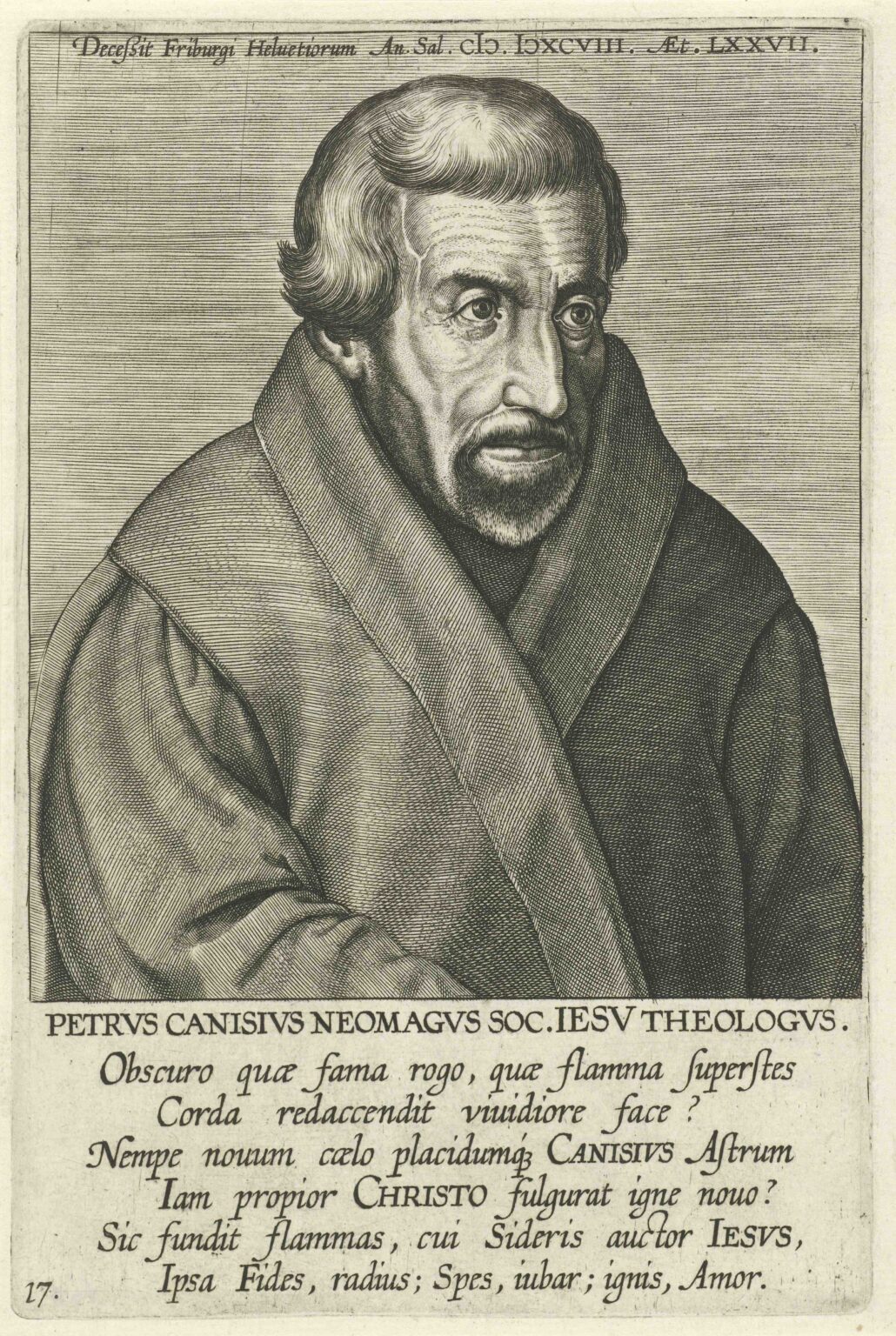 Portrait of Petrus Canisius, atelier of Philips Galle, 1604
© Rijksmuseum, Amsterdam
The influence of the Jesuits, who regarded Antwerp as the stronghold of the Counter-Reformation after 1585, is clearly evident in Galle’s publishing output, not only in the choice of subjects but also in the commissions that led to the creation of prints and print books. This same trend is also visible in the output of the Officina Plantiniana.
In 1587, just two years of the fall of Antwerp, Philips Galle issued yet another revised version of his portrait series’ from 1567 and 1572. And once again, the selection of subjects had changed radically. Virtually all the Calvinists, including the more moderate ones and even his personal friends Junius and Dousa, had been dropped. Even his close friend Plantin was excluded, perhaps due to lingering suspicions of unorthodoxy – suspicions that also attached to Galle himself. Significant changes were also made to the captions: all references to Reformers were removed, with the sole exception of the highly cautious studios quidam (“a certain scholar”), used to refer to Calvin beneath the portrait of Sebastian Münster. The new series’ opened – quite ostentatiously – with portraits of those prominent theologians whose orthodoxy was beyond question, such as Thomas Aquinas, the Bishop of Antwerp Laevinus Torrentius and the Jesuit scholars Ximenes and Schottius.
The Jesuits' influence is clearly visible throughout Philips Galle's catalogue
Galle knew his target audience well – as evidenced by the more or less unchanged editions of this series in 1595 and again in 1606. In another edition from 1604, significantly expanded to include theologians and prelates, what began as a humanist pantheon of open-minded writers, humanists and scholars transformed into something fundamentally different: a group of thinkers and theologians defined primarily by their adherence to Catholic doctrine. Little remains of the original concept, although a (limited) number of copper plates were reused.
After 1600, the activities of Galle, who died in 1612, diminished significantly. The publishing business was taken over by his eldest son, Theodoor, who continued to issue new prints alongside numerous reissues from his father’s catalogue. Following Theodoor’s death in 1633, Galle’s grandson Johannes took over. He remained active in the print publishing business until his death in 1676, mainly reprinting plates by his father and grandfather. All told, the three generations represent more than a century of print production.
The development of the publishing house founded by Philips Galle clearly reflects the political, religious and social developments in the Southern Netherlands. In retrospect, it cannot be viewed in isolation from the hopes, expectations and ultimate disappointments harboured by a group of humanist intellectuals and print and book publishers at the time of the Pacification of Ghent.
The text is based on my doctoral research: Manfred Sellink, Philips Galle (1537–1612): Engraver and Print Publisher in Haarlem and Antwerp, dissertation, Vrije Universiteit Amsterdam, 1997.
Further reading: Manfred Sellink and Marjolein Leesberg, The New Hollstein Dutch & Flemish Etchings, Engravings and Woodcuts, 1400–1700: Philips Galle, Sound & Vision Publishers, Rotterdam, 2001. Four volumes, with a detailed introduction and biography in Volume 1.







Leave a Reply
You must be logged in to post a comment.