
Forget, Forgive and Live Together : The Enduring Lesson of the Pacification of Ghent

After years of conflict, religious tensions and revolt against Spanish rule, various regions of the Netherlands concluded a peace agreement in 1576 that, unfortunately, soon broke down. Yet today, 450 years later, we are still talking about this failed treaty. According to Dutch historian Judith Pollmann and her Flemish colleague Marnix Beyen, the goal of the treaty was to make it possible for former enemies to live together again. ‘It was a form of transitional justice: everything that had happened had to be forgotten.’
Even though it did not last very long, the Pacification of Ghent was a turning point in the history of the Low Countries. “At that moment, the Habsburg regime lost control,” says Judith Pollmann, Professor of Early Modern History at Leiden University and a 2025 Spinoza Prize laureate. “The Governor-General was dead. The Council of State – the advisory body of the Spanish King Philip II that assumed power pending the arrival of the new Governor-General – was ineffective. A coup took place within that power vacuum.” The assemblies of the provinces who remained loyal to the Crown took matters into their own hands and entered into negotiations with the rebellious provinces of Holland and Zeeland, led by William of Orange. “This meant that the provinces which had previously sided with the king were now striking a deal with the rebels. For the first time, Philip II’s position in the Low Countries appeared to be truly hanging by a thread.”
Yet the peace quickly fell apart. As Pollman notes, “ending a civil war with an unfinished document, drafted under immense pressure, that merely deferred the key negotiating points…. Well, the chances of it yielding a sound solution were, of course, slim.” Because the treaty had to be concluded in great haste due to the threat of mutinous soldiers, the thorny issue of religion had been sidelined.
 The first article of the Pacification states that everything that had happened was to be forgotten. That is the moment when all war crimes are officially swept under the rug
© Studio Oostrum
It soon became apparent that the provinces interpreted the document in different ways. Officially, the religious status quo was to be maintained everywhere. For the rebellious provinces of Holland and Zeeland, this meant legitimizing the power of Reformist groups, while the other provinces remained Catholic. However, religious persecution had to cease, and free travel between the provinces had to become possible again. “For the Southern Netherlands, this meant that all kinds of people who had fled the regime could return home,” says Pollmann. “We are talking about tens of thousands of refugees. What happened next – the Calvinist seizure of power in Flemish and Brabantine cities – would not have been possible at all had those people remained in exile.”
For many Catholics, Calvinist activism went much too far. In early 1579, a number of southern, French-speaking provinces, united in the Union of Arras, agreed to defend Catholicism and seek rapprochement with the Spanish king. The union’s counterpart was the Union of Utrecht, an alliance of several northern provinces formed to oppose the Spanish king. Thus, the civil war resumed.
Marnix Beyen: 'All manner of interpretations were attached to it. Who had actually betrayed the Pacification? Was it the Catholics, with the Union of Arras, or was it the Protestants?'
The vague nature of the Pacification sparked early debate regarding the agreement’s significance and who was responsible for its failure, says Marnix Beyen, a professor at the University of Antwerp specializing in Belgian history. “All manner of interpretations were attached to it. Who had actually betrayed the Pacification? Was it the Catholics, with the Union of Arras, or was it the Protestants?”
Pollman suggests that the lack of clarity was probably not a coincidence. The document may have been “intended to be open to multiple interpretations. The main thing was simply that it existed. It generated momentum for negotiations with the new governor-general, Don Juan, and meant that William of Orange could attempt to become the leader of the revolt across the entire Netherlands. Yet it is hard to claim that its content ultimately played a decisive role in the political future of the Netherlands.”
Forgetting rather than remembering
Why did the treaty remain relevant? “The first article of the Pacification states that everything that had happened was to be forgotten,” says Pollmann. “This is standard in all early modern treaties used to end civil wars. Primarily, it represents an amnesty: legal immunity for everything that occurred during the civil war. With the Pacification, all the war crimes of the preceding years were effectively swept under the rug.”
Within Holland and Zeeland, it legitimized the status quo. It was relevant because it erased all traces of the civil war. Pollman adds that “there are quite a few cities in Holland where official records from 1572 to 1576 are ‘missing’. (In 1572, the Sea Beggars (watergeuzen) captured the town of Ten Briel (now Den Briel), marking one of the insurgents’ first successes, IC). The Leiden city administration had the best city secretary in the Netherlands, yet the minutes from 1572 to 1576 suddenly disappeared. It was the same story with the States of Holland: everything vanished. So, I think they took the instruction to ‘forget’ quite literally.”
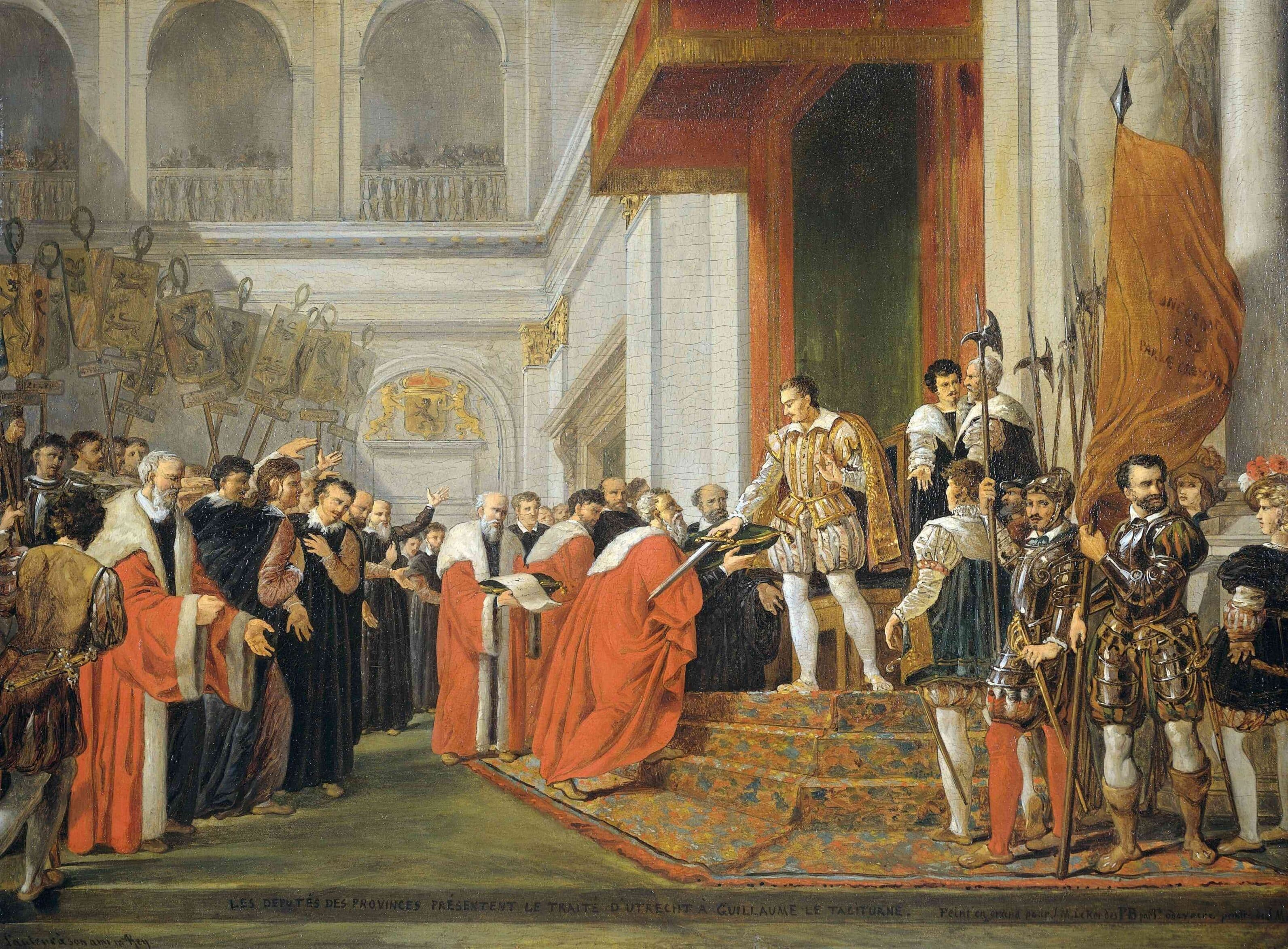 Painting of the Union of Utrecht. In 1579, barely three years after the Pacification of Ghent, a number of northern provinces united against the Spanish king. Earlier, several southern, French-speaking provinces had joined forces in the Union of Arras; they sought to defend Catholicism and, in fact, to reconcile with Philip II. Thus, the civil war in the Netherlands resumed
© Rijksmuseum, Amsterdam
According to Pollmann, this provision was genuinely intended to erase memories and find a way for people who had once sought to kill one another to coexist peacefully. That would be impossible if they held on to their memories of injustice, conflict and pain. “It was essentially a form of transitional justice. The question was: What must be done to end a civil war? But if the civil war itself is forgotten, the document recording that process is not necessarily memorable in its own right.”
In the years that followed, the memory of the Pacification largely faded away. This made sense for the southern provinces, since they had returned to Habsburg rule. Pollmann explains that the Pacification “recalled a time when the southern provinces had been disloyal to the king. In retrospect, they did not want to dwell on that.” Consequently, the Pacification was portrayed as a kind of necessary evil. “Something had to be done about those mutinous troops. William of Orange took advantage of the situation but, fortunately, it didn’t last too long. At least, that is the Southern Netherlandish narrative.”
New life in the nineteenth century
Although the treaty itself did not last long, the act of forgetting was quite effective: for centuries, the Pacification lay largely dormant. It was not until the nineteenth century that the treaty regained political significance when it was deployed in an ideological struggle – ironically, in the former Southern Netherlands, which had by then become the young nation-state of Belgium. As Marnix Beyen notes, “the treaty was roused from its slumber around 1876, on the occasion of the tercentenary, when a major commemoration of the Pacification of Ghent took place in Ghent.”
But, in Beyen’s opinion, the Pacification did not lend itself well to a national commemoration: “A national commemoration is often a story about ‘us’ and ‘them.’ You need martyrs, a hero, an enemy and so on. Yet the Pacification was a very messy affair involving diplomats, rather than warriors. That is difficult to fit into the overarching narrative of the nation’s development. Moreover, Belgium came into being in 1830 through a struggle against the Netherlands. How, then, does a peace agreement in which the Seventeen Provinces reached a shared accord fit into that picture?
 Marnix Beyen: 'The treaty was roused from its slumber around 1876 – on the occasion of its tercentenary – when the great commemoration of the Pacification took place in Ghent.'
 © Jonathan Ramael
Beyen believes that it was the internal tensions in Belgium that eventually led to the Pacification playing a role in the culture of remembrance. “When a conflict arose within Belgium between clericals and anti-clericals (or liberals, IC), the anti-clericals began to view the Dutch Revolt as an example. Many of these anti-clericals also converted to Protestantism and saw the Netherlands as a major source of inspiration. It was at that point that the Pacification – quite anachronistically – came to be described as a moment of rapprochement between Belgium and the Netherlands.”
The Pacification celebrations of 1876 reignited the conflict. As Beyen explains, “Catholics viewed it as an anticlerical interpretation of events, one that ignored the Calvinist oppression that had followed. The Pacification celebrations served as a kind of cover allowing liberals to spin an anticlerical narrative about the Geuzen (‘Beggars’) – the anti-Spanish rebels. We read very little about the complexities or the pragmatism in accounts of those festivities. The focus was reduced to a single moment in that struggle – a moment that was subsequently betrayed – because that fits the national narrative.”
Marnix Beyen: ‘The 1876 celebration of the Pacification served as a kind of cover behind which the Liberals could tell an anticlerical Geuzen narrative’
In the Netherlands, Pollman says that the Pacification was not celebrated on a grand scale in 1876. “I think they would have preferred to skip it. Four years earlier, in 1872, the commemoration of the capture of Den Briel by the Sea Beggars in 1572 got completely out of hand, with street fights between Catholics and Protestants. It became a source of division.” In the Netherlands, confessional and liberal groups during the era of pillarization were actually seeking political compromises. “At that time”, according to Beyen, “the aim in the Netherlands was to achieve a kind of pacification in the present, and people preferred to leave the past alone.”
In the twentieth century, the Pacification became part of the greater Dutch ideology of the Flemish Movement in Belgium. Flemish nationalists viewed the Union of Arras as a betrayal by the Walloon provinces. Beyen explains that, “in the 1930s, a tendency emerged to view the Pacification as a kind of Burgundian dream. But those French-speaking provinces didn’t want to participate.”
Judith Pollmann: 'The Pacification was not commemorated in the Netherlands in 1876. An earlier commemoration had led to street fighting between Catholics and Protestants'
The Pacification also came to serve as a model within the fascist wing of Flemish nationalism. Beyen explains that, “the new direction adopted by Verdinaso – the League of Dutch National-Sympathisers (Verbond van Dietsche Nationaal-Solidaristen) – was based on the idea that, rather than opposing Belgium, we should advocate for a kind of personal union between the two royal houses.” Imperial concepts also played a role in this vision. Beyen continues: “In this way, the old Seventeen Provinces would be reunited, along with their colonial empires. If that included Congo, Indonesia, Suriname and South Africa it would have become one of the world’s largest empires.” During the Second World War, such Greater-Netherlands ideas clashed with the German occupying forces. Later in this issue, Beyen explores in greater depth how the Pacification is remembered within those circles.
The Pacification today
In the Netherlands, the Pacification never secured a prominent place in the national culture of remembrance. Other documents – such as the Union of Utrecht, the Apology of William of Orange and the Act of Abjuration – became the ‘birth certificates’ of the nation and “the Pacification is never included in this bundle of documents,” says Pollmann. “People have little idea what it’s about – even less so than in Belgium. Take, for instance, the article stating that people would not be persecuted for their religion. In the Netherlands, the prevailing belief is that this was first enshrined in the Union of Utrecht though it had already been set down in writing in the Pacification.”
However, Beyen concedes that the commemoration of the Pacification does remain significant at the local level: “Ghent has its own culture of remembrance that reflects the city’s ideological stance.” There, the Pacification aligns with an urban self-image that emphasizes freethinking, pluralism and municipal autonomy rather than central authority.
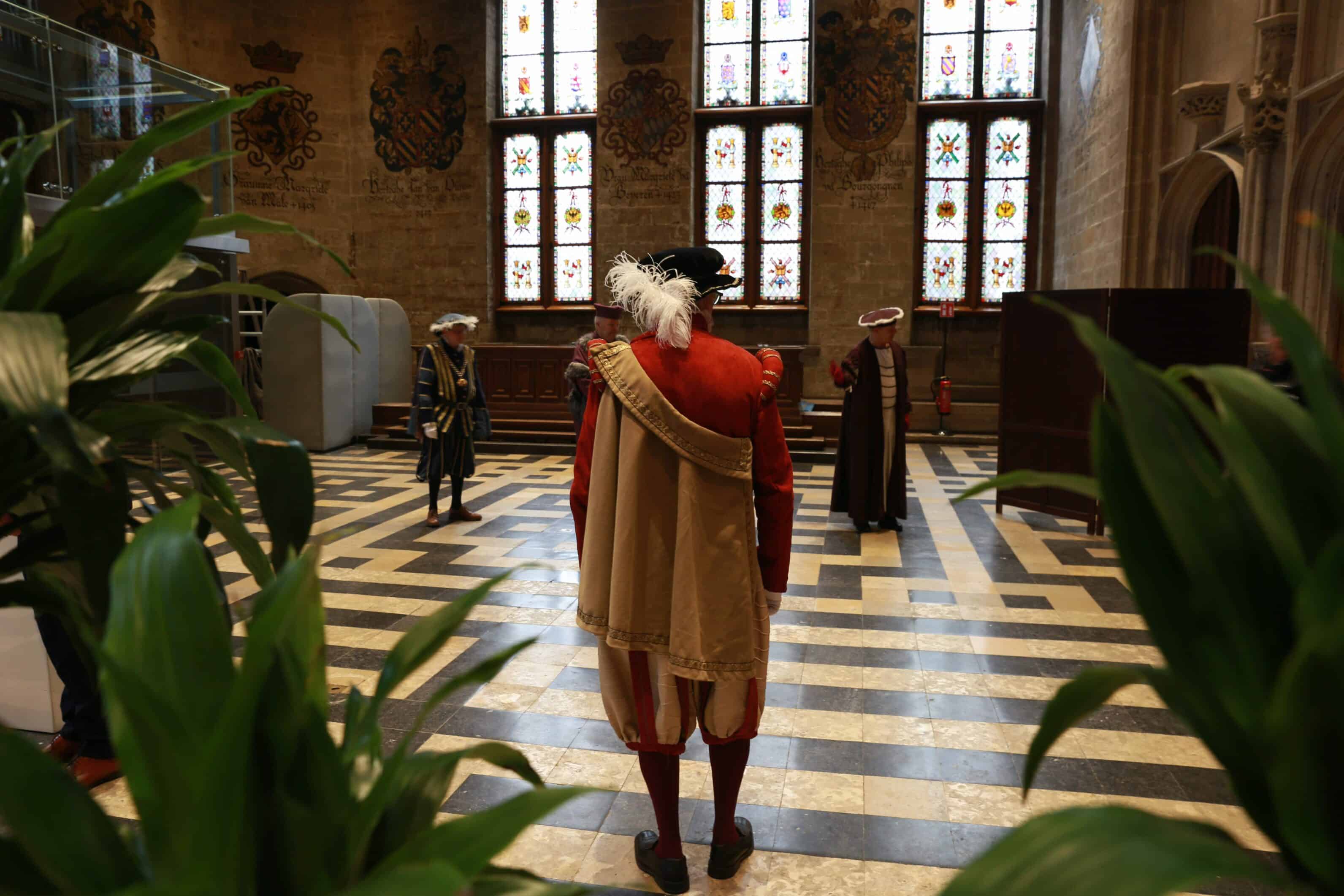 The Pacification was sealed in a hall of Ghent's city hall, later named the Pacification Hall. Ghent's memory of the treaty fits a civic self-image that emphasizes free-thinking, pluralism and municipal autonomy in the face of central authorities
© Stad Gent
In the Netherlands, too, commemorations of the Dutch Revolt resonate more at the local level than at the national one. For instance, in 2022 – the 450th anniversary of the capture of Den Briel – a partnership was established involving some forty municipalities. Pollmann explains that “they engaged with their memories of the Eighty Years’ War in their own ways, while still collaborating extensively.” These municipalities viewed 1572 as the ‘birth of the Netherlands.’ And, as far as the partnership is concerned, the 1576 commemoration marked the conclusion of their activities. Pollmann notes that “they are set to disband at the end of this year. It is a logical endpoint, as it marks the moment the civil war in Holland and Zeeland came to an end.”
Interestingly, it is precisely these kinds of local initiatives that transcend national borders. For instance, the Dutch ‘1572 municipalities’ collaborate with Antwerp and Ghent. The same applies to the organizers of the Pacification Lectures. Beyen notes that “the origins of these lectures lie in the aftermath of 1976.” During that commemorative year, a group of lawyers who found the Pacification legally intriguing began organizing lecture events that alternate between Ghent and Breda. In this way, the cross-border cooperation that was central to the Pacification itself is mirrored in the culture of its commemoration.
The Pacification raises a timeless question: how can groups that stood diametrically opposed for years learn to live together again?
This year, Judith Pollmann is delivering the Pacification Lecture. In her address, she will reflect on the significance of the Pacification in the present day. As she reminds us, “the starting point of the Pacification was the question: How do you end a civil war?” The Pacification thus raises a timeless question: How can groups that were diametrically opposed for years subsequently live together again? What do they do once the violence has ended? Remember, forgive, prosecute – or forget?
“Article One of the Pacification states: we are going to pretend it didn’t happen,” says Pollmann. “That is in complete contrast to how we handle things today, with truth and reconciliation commissions and the like. People thought very differently about such issues at the time of the Pacification of Ghent. They really wanted to draw a line under the civil war. I want to show that it is possible for us to view it that way, too.”

You might also like




Leave a Reply
You must be logged in to post a comment.