
How Bruges Became a Pearl of the Medieval World
Between the middle of the ninth century and the middle of the sixteenth, Bruges became one of the most extraordinary places on earth. It was never the largest city in Europe, nor the seat of an empire, nor the home of an imperial court. Yet few places were as entangled with the wider world, or as adept at absorbing, reshaping and projecting influences that came from far beyond their immediate horizons.
Our new exhibition – Bigger Picture: Connected Worlds of Bruges – explores the rich history of the city, placing it in the context of connections with other cities, regions and even continents. From the time Bruges first appears in written sources in the 9th century, it was clear that this was a location that thrived because of its connections. Bruges and its history were inseparable from the wider networks in which it was embedded. We tell the story of Bruges and its surrounding area through five worlds. In doing so, we remind how important it is to look beyond city walls – and to how the North Sea and the British Isles, the Mediterranean, the Near East and Africa and, by the end of the fifteenth century, the Atlantic played roles in shaping how the Bruges developed.
Bruges today lies some distance inland, but in the early Middle Ages access to the sea was central to its rise. By the seventh and eighth centuries, the North Sea already supported dense patterns of movement and exchange. That created opportunities for urban centres, market places and new ports to develop along maritime corridors. Bruges was one of a number that prospered and over time rose to form part of a series of connections that linked the coasts of what are now England, northern France, the Low Countries, Germany and Scandinavia.
Goods and people moved between towns and regions regularly and in considerable volume. Textiles, salt, slaves and raw materials moved back and forth across the water. Remarkable numbers of silver coins minted in the Low Countries were found in England in the early Middle Ages, bearing witness not only to the existence but the scale of trade. The vibrancy of these ties can be seen elsewhere too, for example from the spread of Christianity into Scandinavia and the Baltic, where Bruges was a key point of departure not only for merchants but also for missionaries and evangelists.
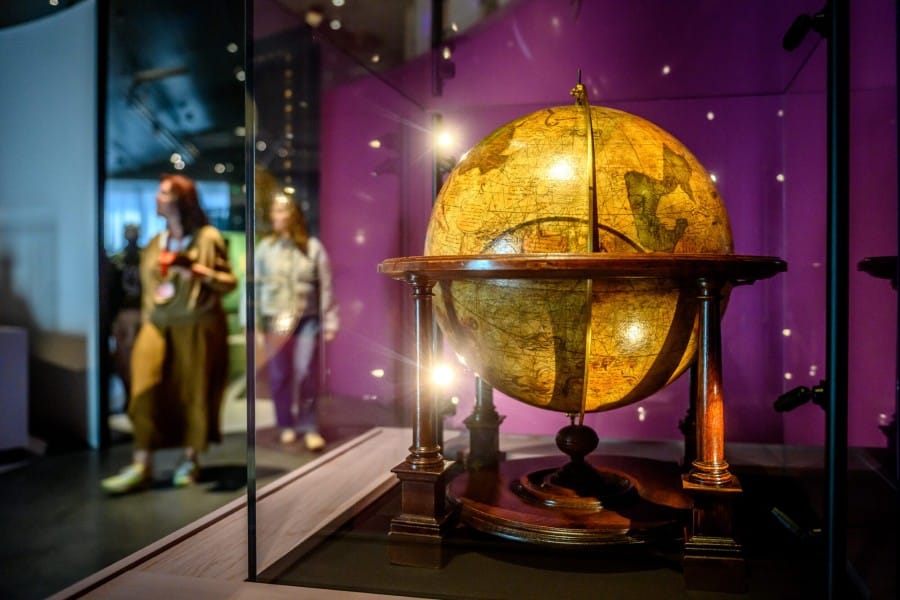 Bruges was a key point of departure not only for merchants but also for missionaries and evangelists
© Jan Darthet
The importance of Bruges can be seen too from the fact that it was a place of refuge for those of high status but in need of exile. When King Harold was defeated at the Battle of Hastings in 1066, it was to Bruges that his mother Gytha and sister Gunhilde fled – the latter so highly regarded that she was buried within the walls of Saint Donatian’s church when she died. The remarkable lead plaque that describes her life is one of the treasures on display in the exhibition; so too is the mantle (or cloak) of St Brigid which Gunhilde is said to have brought with her to Bruges – and which was revered in the city because of the saint’s association with sheep and wool, something that became central to the economy of Flanders.
When King Harold was defeated at the Battle of Hastings in 1066, it was to Bruges that his mother Gytha and sister Gunhilde fled
Some of these ties were strengthened by elite marriages. For example, William the Conqueror, who triumphed at Hastings was married to Mathilda of Flanders, who was crowned Queen of England in 1068 at Westminster Abbey. Mathilda’s niece, Adela, was Queen of Denmark though her marriage to King Cnut IV and, after his death, Duchess of Apulia and Calabria in Southern Italy after she married Roger Borsa.
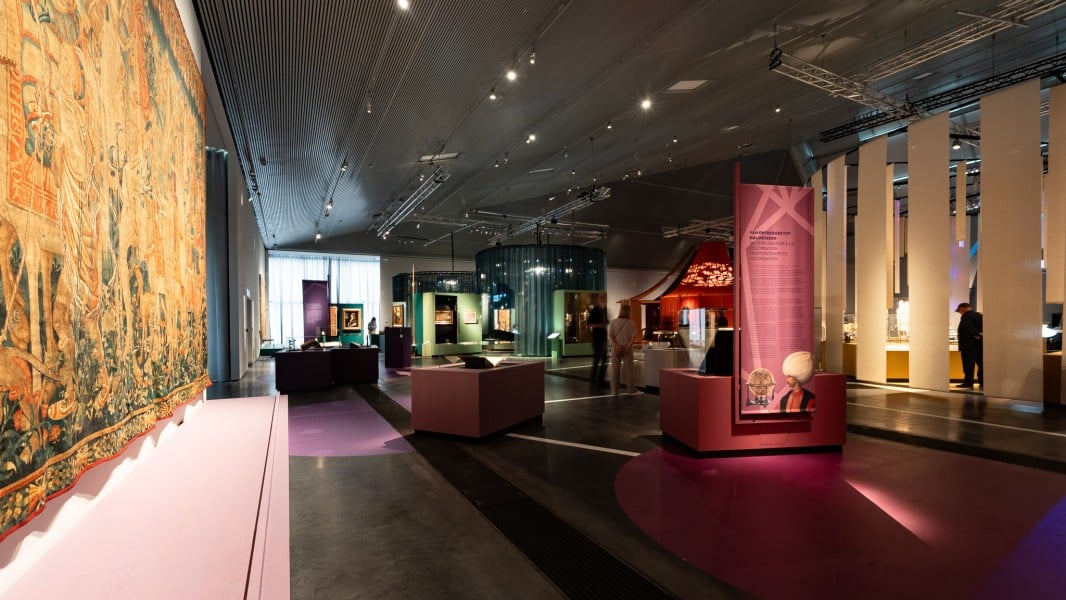 Bigger Picture: Connected Worlds of Bruges – explores the rich history of the city, placing it in the context of connections with other cities, regions and even continents
© Stad Brugge
If this gives an indication of how horizons were beginning to widen, then so too should the fact that others were paying attention to this part of north-west Europe as well. One good example comes from the global geography of al-Idrisi who was writing in the 1150s at the court of the Norman king Roger II in Sicily. Maps play a key part of the exhibition – with that of al-Idrisi the star of the show as it allows us to demonstrate how important perspective is when understanding both geography and history. For al-Idrisi, Bruges was already a prominent town whose name and reputation had travelled far – and part of the deeply interlinked set of locations that were tied together across Europe, Africa and Asia.
As Bruges grew, it needed to invest in infrastructure – such as roads, water supply and sewage disposal (to limit the spread of disease as well as to reduce the stench) – as well as to develop civic institutions. That included courts staffed by aldermen with expertise in mercantile law adjudicated disputes swiftly and with admirable regard for the merits of each case, rather than the standing of the disputants. It also meant being open to adopting ideas from elsewhere such as innovations from Italian city states like bills of exchange, credit mechanisms and book transfers that reduced the risks of long-distance trade and vastly increased the volume of business that could be done, with accounts being settled through ledgers rather than using coin.
Bruges’ success was such that it became a magnet for local populations as well as for those from further way. Urbanisation saw major investment in infrastructure, from civic buildings to churches, from housing to hospitals, from roads to water and sewage systems. The city grew to the extent that by 1300, perhaps 50,000 people lived in Bruges, an extraordinary demographic concentration at a time. Feeding that many mouths required careful planning and coordination: the management of land and water, the steady inflow of grain and other staples from beyond the city, and systems of production and exchange capable of sustaining an urban population on this scale. One could argue that there were multiples cradles of medieval capitalism in Europe. Bruges, though, was certainly one of them.
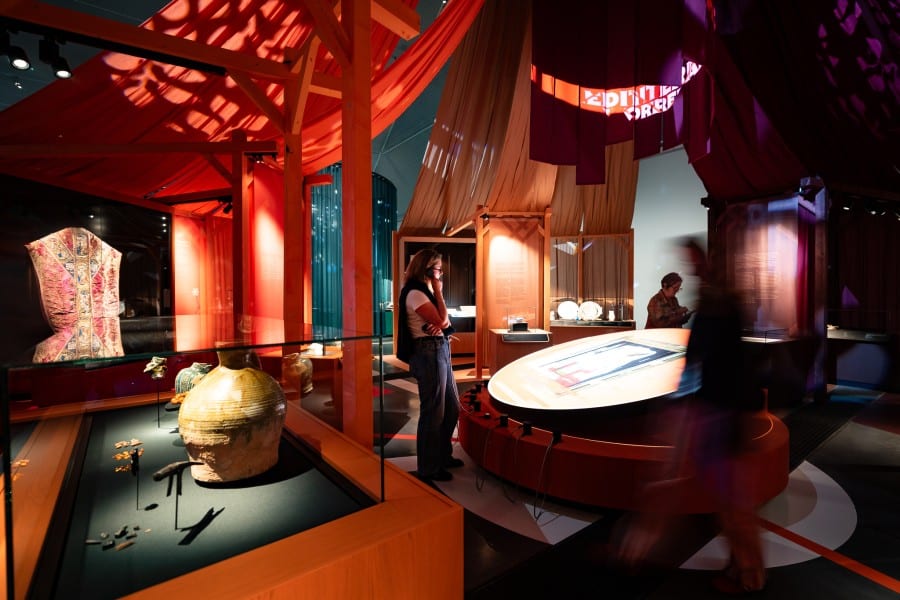 Another section of the exhibition looks at the role of Christianity and ties with both Constantinople and Jerusalem
© Stad Brugge
Another section of our exhibition looks at the role of Christianity and ties with both Constantinople and Jerusalem. Many people in Bruges did not move far from home – because long-distance travel could be expensive, time-consuming and dangerous; so we explain how local pilgrimage sites developed that allowed local people to be able to visit shrines that contained the bones of virtuous men and women whose examples the Church encouraged believers to follow. One such figure was Saint Donatian, whose bones were brought to Bruges from Rheims in the mid-ninth century by Count Baldwin I. His cult became a focal point for processions, feast days and civic identity.
Over time, though, ambitions as well as perspectives widened. By around the year 1000, sites in the Holy Land such as Bethlehem, Nazareth and (above all) Jerusalem loomed ever larger in the imagination of people in Flanders, and especially those of the rich and powerful. At the end of the 11th century, Count Robert of Flanders traveled to Jerusalem so he could see for himself the places where Jesus Christ had lived, been crucified and risen from the dead. On his return home, he met Emperor Alexios I Komnenos, the ruler of the Eastern Roman empire (that is often today called the Byzantine empire). That meeting began a long relationship between Robert’s family and Constantinople, the imperial capital, which at the time was by far the largest and most spectacular city in Europe.
A few years after meeting, the Counts of Flanders were sending military support to the east to help drive back the pressure posed by Seljuk Turk raiders. One of the prize objects on display is a manuscript showing the Emperor Alexios alongside the Fathers of the Church, portrayed as a defender of Christian doctrine. Kindly lent by the Vatican library, it is one of only two images of this emperor that survive.
Connections between Flanders and Constantinople deepened over the following decades. By the end of the 1090s, Flemish knights – led by Robert II of Flanders – played a key part in the First Crusade that fought its way across Asia Minor and eventually reached the Holy City of Jerusalem itself, promptly capturing it in the summer of 1099. Just over a hundred years later, another Count of Flanders, Baldwin IX, was on his way east to try to shore up the position of Christians in the east. Short of funds, the fighting army stopped at Constantinople on their way. In 1204, stirred on by suspicion, greed and false promises, the knights scaled the walls and sacked the city. Many treasures were sent back to western Europe – such as thorns that were part of Crown of Thorns, that was kept in Namur.
The knights now had to decide what to do with control of Constnatinople which was by far the largest Christian city in the world at the time. They held an election to choose a new ruler, and appointed Baldwin IX, Count of Flanders as emperor. He was succeeded a few years later by his brother Henry; Baldwin’s daughters Joan and Margaret were proud of their heritage, and often signed documents citing their Constantinopolitan lineage.
In the mid-12th century, Thierry, Count of Flanders commissioned the construction of what became known as the Basilica of the Holy Blood, home to blood of Jesus Christ that was likely only brought to the city after 1204
These ties with the East left a mark on the city of Bruges too: in the mid-12th century, Thierry, Count of Flanders commissioned the construction of what became known as the Basilica of the Holy Blood, home to blood of Jesus Christ that was likely only brought to the city after 1204. But connections with Jerusalem lasted for hundreds of years. For example, in the fifteenth century, Anselm Adornes, a merchant of Genoese origin ennobled by success, returned from a pilgrimage to Jerusalem and remodelled his family chapel to evoke the Holy Sepulchre itself. With its octagonal tower and Calvary relief, the Jerusalem Chapel brought the Holy Land to Bruges.
This is one reason why we were so keen to show the famous painting of Scenes of the Passion of Christ which is usually held the Galleria Sabauda in Turin. Created by Hans Memling, one of Bruges’ most famous sons, the painting shows Jerusalem in a way that would not only have been recognisable to those living in Bruges but familiar: it was designed to show that while the Holy City was a long way away, it looked similar to the place that citizens called home.
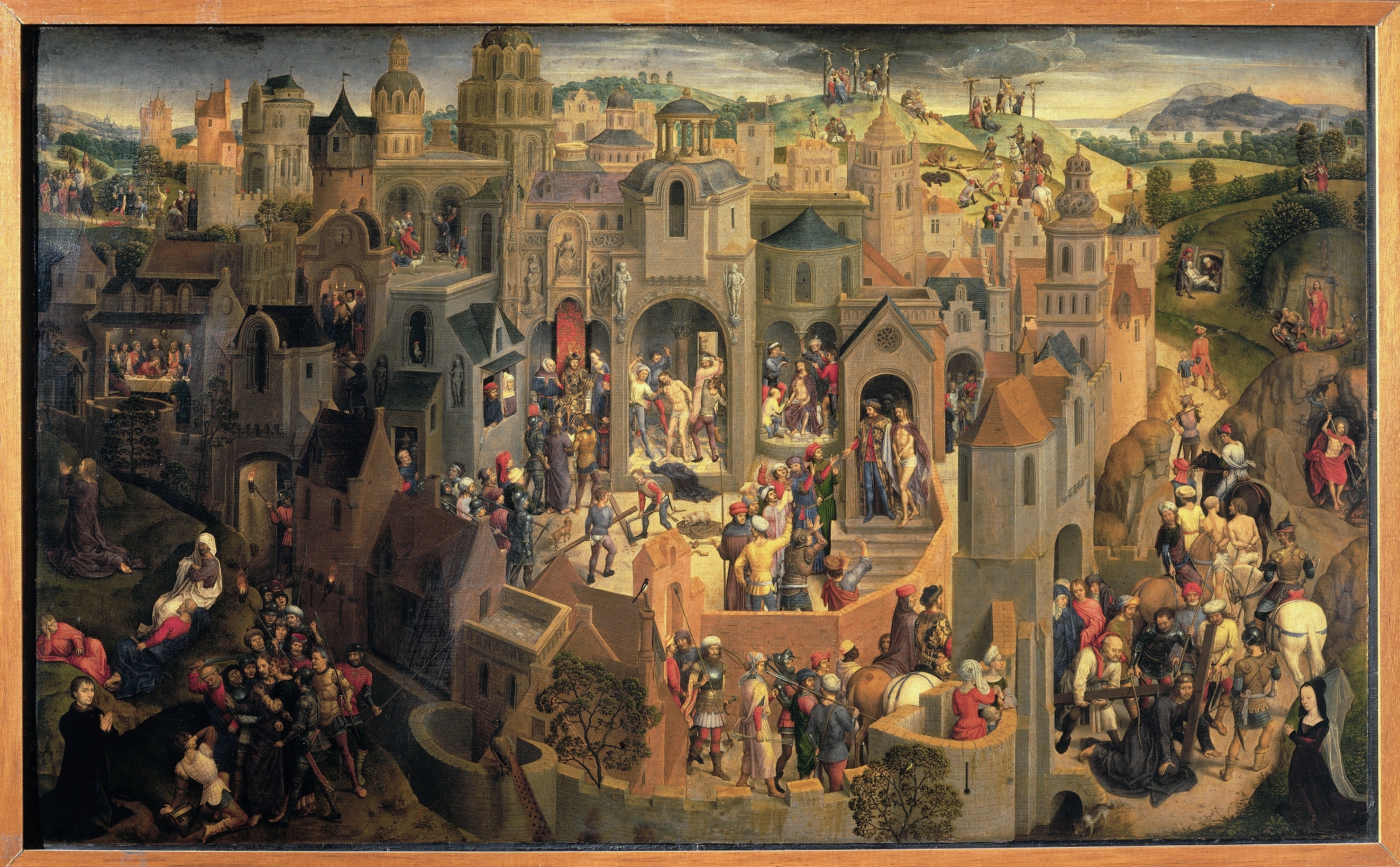 Scenes of the Passion of Christ by Hans Memling
© Public Domain
Another of our worlds looks at connections with the Mediterranean and beyond, focusing on the transmission of information, knowledge and technologies from afar. For example, we have the world’s oldest geared machine on display from my home town of Oxford (where it is kept – and very rarely lent by the History of Science Museum) to show how ideas about mathematical calculation and accuracy were brought to Europe from the Arab world. We show the portrait of Margaret van Eyck by her husband Jan – again, one of Bruges’ most celebrated figures – and invite viewers to think about how geometry helped artists make ever better creations.
Stones were used as ballast for ships that came to Bruges and helped keep them stable in the water. That might not seem glamourous; but no stones meant more risk.
History is also useful in helping focus on practicalities and logistics. So in this section of the exhibition, we have stones that were used as ballast for ships that came to Bruges and helped keep them stable in the water. That might not seem glamourous; but no stones meant more risk. We have documents recording how merchants from Italian cities calculated prices and profits for the goods they were shipping to Bruges, which shows the importance not only of keeping accurate records but on being sensitive to market conditions. And we also display and a magnificent purse with multiple pockets that could keep different denominations of currency: we all know what coming back from distant lands can feel like with a few coins and notes that are less useful at home than they are abroad.
We thought it was important too to show Bruges within parallel contexts of other things happening in other parts of the world. As in the other worlds, the outstanding scientific committee of Jan Dumolyn, Axel Langer, Jo van Steenbergen and Wim Declerq helped identify some wonderful connections. One was the idea of the ideal leader. From the rich archive of history, none were more admired in the Middle Ages than Alexander the Great. His name is well known in Europe, of course; but perhaps less appreciated is that he was hugely important across many parts of Asia too – so we introduce different ways his achievements were celebrated and emulated.
We thought long and hard about how to show the famous portrait of Philip the Good, the poster boy of Bruges at its peak. In the exhibition, we have him next to Giovanni Bellini’s equally well-known study of Mehmet the Conqueror, the great Turkish ruler whose capture of Constantinople in 1453 marked one of the key moments in world history. The two men were contemporaries; as well as rivals, they shared many similarities. We are the first to have ever brought the two together.
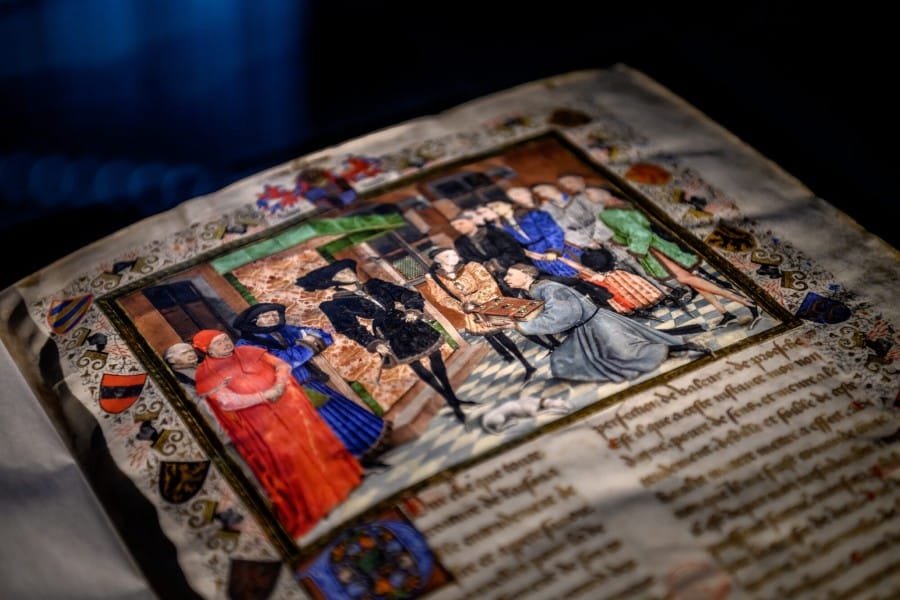 15th-century miniature, known as the presentation miniature of the Chroniques de Hainaut, attributed to Rogier van der Weyden
© Jan Darthet
We end with the Atlantic world that began to emerge in the 1400s. Flemish planters and investors played a crucial role in opening up the plantation complexes that were developed on islands in the Atlantic in the decades before Columbus crossed the Atlantic. Chief among the exports was sugar, a commodity that fetched high prices back in Europe and where demand was high. So important was Flanders in these developments that the Azores were known for a time as ‘Vlaamse eyelandes’ or the Flemish islands.
The exhibition ends in the mid-1500s. By this time, a new world was being opened up in the Americas. The main beneficiaries were the Spanish and Portuguese who had once been at the most westerly, distant parts of trade connections – and now found themselves perfectly placed to gain from the resources that could be exploited in what literally became known as the New World.
This was a time of opportunity for some, but not for all. In the case of Bruges, local competitors – like Antwerp and Amsterdam – worked hard to borrow from the example that the city had taught, and to offer incentives designed to attract artists, merchants and others. Ecological pressure and harbour silting also made access to the sea harder, requiring financial and labour investment in what seemed to be a losing battle. Bruges did not ride the wave of the early modern world; but that meant too that it did not have the same sins of exploitation and slavery that were incurred by others.
Today Bruges is recognised as a global city because it welcomes visitors from across the world and because its historic centre enjoys UNESCO World Heritage status. Yet this global character is not a modern invention: it was ever thus. From the start, Bruges was a world city and a city of the world: a place where distant regions met, where objects carried stories of faraway lands, and where local lives were shaped by global currents.
This exhibition therefore brings these worlds of Bruges into view in their full richness and complexity. It invites visitors to see the city anew – not as a beautiful survivor of a vanished age, but as a pearl whose brilliance was forged through centuries of connection, exchange and imagination, and which still shines all the brighter when set within the bigger picture of the worlds it was a central part of for so long.

You might also like





Leave a Reply
You must be logged in to post a comment.