
Marina Yee, The Sixth of the Antwerp Six, Found Beauty Where Others Saw Nothing
Her final work of art was a wall: in her hospital room, Marina Yee had the beige painted an eye-popping pink. The fashion designer, known as one of the Antwerp Six, is receiving posthumous salutes in several books and exhibitions.
“Be the sixth.” The instruction appears on one of the generously sized sheets of paper Marina Yee (1958–2025) used to address herself. They contain drawings, designs and quick, clever sketches hinting at work already imagined and dreamed of but not yet made. There are fragments of text, too: assertive eruptions of uninterrupted feeling and thought.
Several of these sheets adorned the walls of Gallery Sofie Van de Velde in Antwerp in spring 2026. They framed a small exhibition of artworks – collages, assemblages and installations – from the estate of Yee, who died on 1 November 2025. Her work does not have to adhere to the deadline of death: more exhibitions will follow in the future, and a book will be published at the end of October.
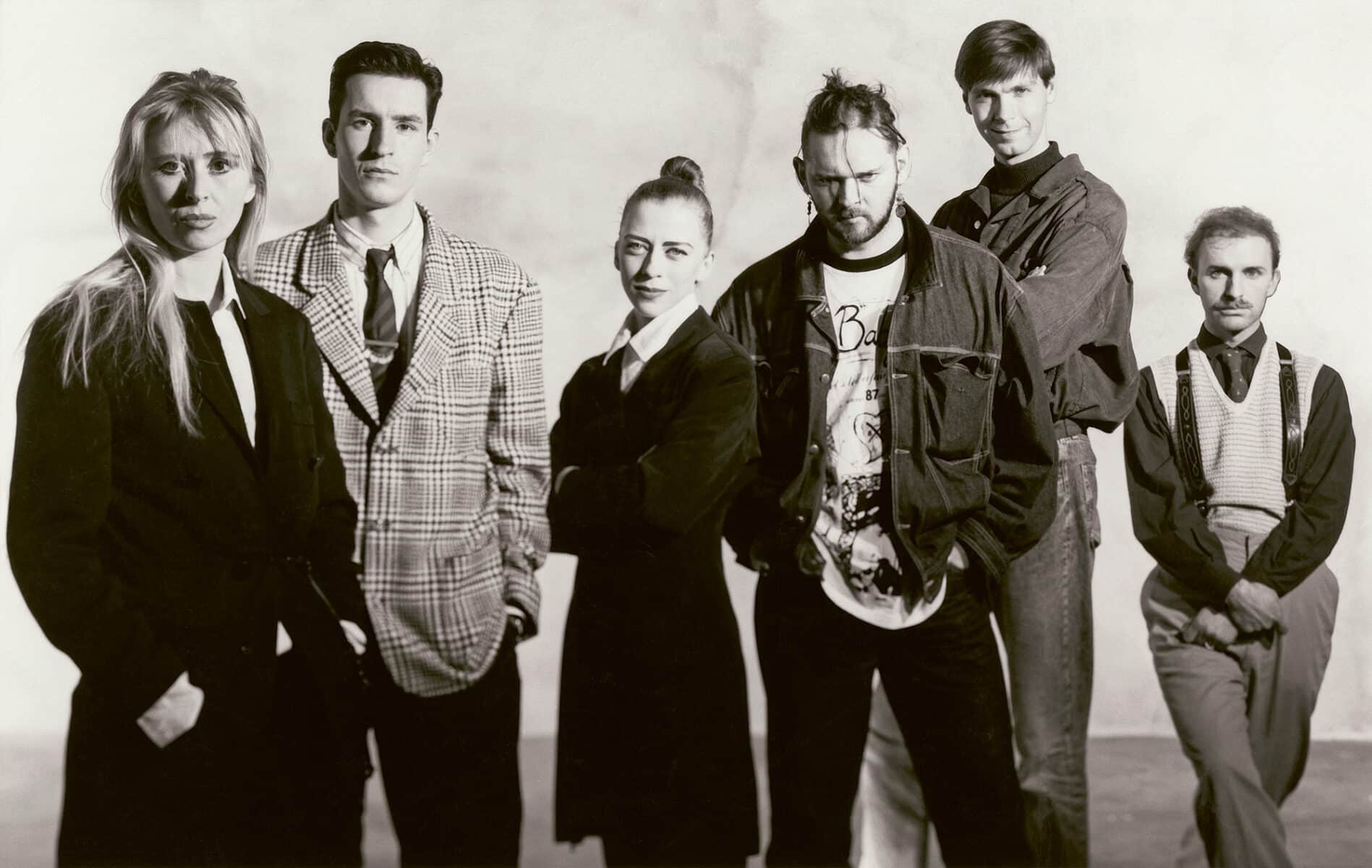 The Antwerp Six in 1986: Marina Yee, Dirk Van Saene, Ann Demeulemeester, Walter Van Beirendonck, Dirk Bikkembergs en Dries Van Noten
© Karel Fonteyne / MoMu
“Be the sixth”, then. It is a reference to the Antwerp Six: Dirk Bikkembergs, Ann Demeulemeester, Walter Van Beirendonck, Dries Van Noten, Dirk Van Saene and Marina Yee herself – the noteworthy group who studied fashion at Antwerp’s Royal Academy of Fine Arts in the late 1970s, went on to break through internationally and turned a quiet, small country into a centre of fa-fa-fa-fa-fashion.
“I think she was giving herself a pep talk,” said Sofie Van de Velde. “Marina often left messages for herself on pink Post-it notes and brown note paper. They were usually little words of encouragement, endearing compliments for herself, the applause with which she tried to patch up her perpetually battered self-confidence. ‘Be the sixth’ could be read as, ‘Go on, Marina! Don’t make yourself unnecessarily small. You are part of that beautiful history. You are one of the Six.’ At least, that’s how I interpret it.”
Fellow designer Dirk Bikkembergs is moved to tears when he sees her drawings
There is another possible interpretation: Yee is encouraging herself to be the sixth. She longed for the praise and acclaim bestowed on her former fellow students, but she did not trust commercial success and never pursued it either. Hence: don’t be the famous first, the successful second, the obedient third. Be the inimitable, reckless, mysterious sixth. Walk a little more slowly, arrive a little later, always bring the twilight and the mist with you.
Madame de Pompadour
In Damaged Goods, a video in which the camera caresses her final home and workplace, Yee is interviewed off-camera by Sofie Van de Velde. She has only a few days left to live; death is preparing to stamp the date, yet Yee sounds serene and resolute. She acknowledges the vulnerability that forms the melody of her life, calling herself “a fragile human being”, but at the same time, and more than ever, she reveals the powerful, sovereign, original loner she has been cultivating within herself since early childhood.
During her years at the academy, from 1977 to 1981, Yee made an impression on everyone – not least, the Other Five. There is the talent: she sketched beautifully and could make a skirt rustle in a fashion drawing. Dirk Bikkembergs is moved to tears when he sees her drawings, he said in De Zes, the much-discussed book Oscar van den Boogaard wrote based on interviews with the illustrious fashion designers and those around them.
There is also the unsuspecting flair with which Yee made the city her home. The days did not define her; no, she defined the days. And there was the physical presence, of course – Yee was a woman who captured the eye. Especially when, during her student years, she was briefly with Ronald Stoops – “the most beautiful punk in the city” – and was a sensation whirling through the streets. How perfectly she captured the euphoria of rebellion to Van den Boogaard, at that unique point in time when the last threads connecting you to your youth have just snapped, and the bridge to adulthood is still no more than a sketch on the drawing board, leaving you as a blissful island: “We looked spectacular and smelled of sex.”
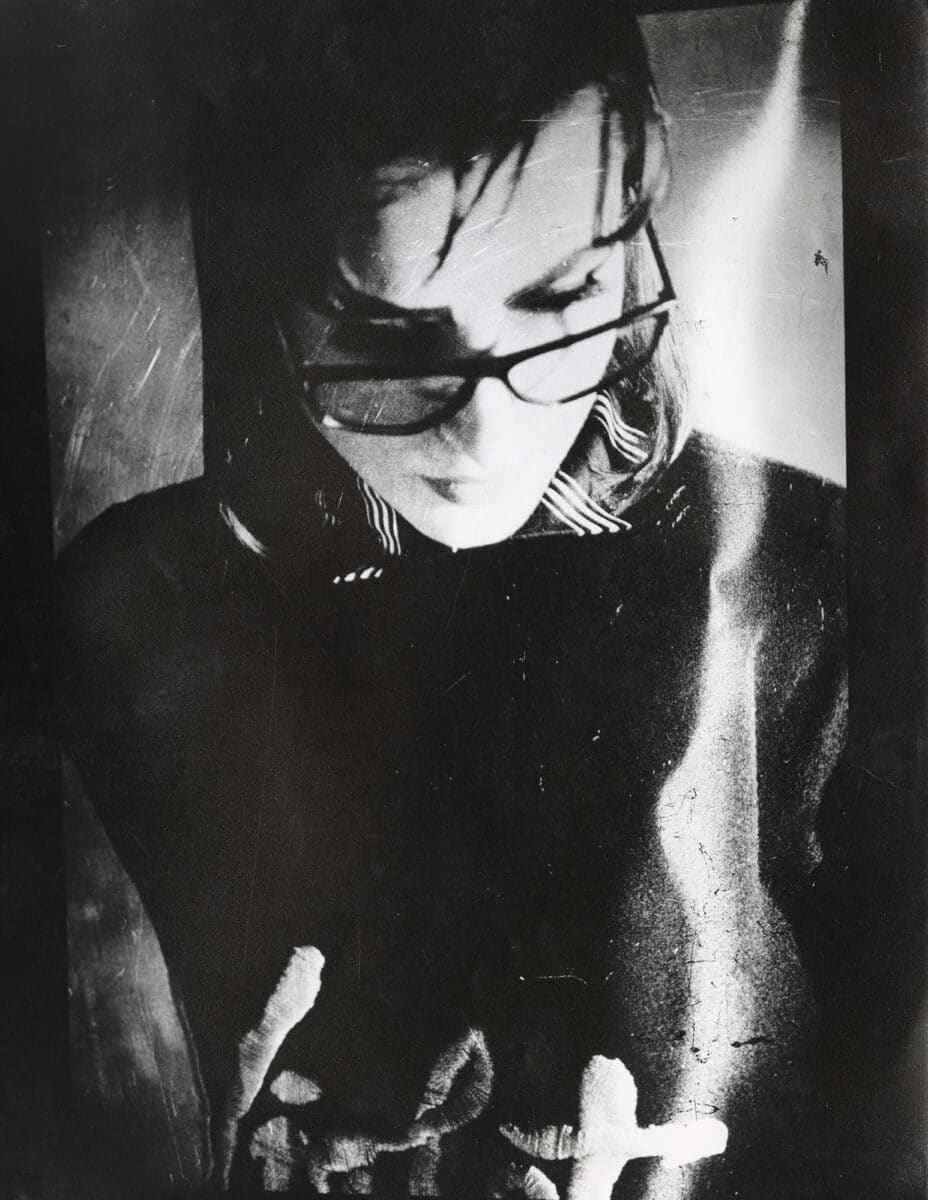 Marina Yee by Ronald Stoops in 1986
© Ronald Stoops / MoMu
On the final night of 1985 – the boisterous group had already graduated and were beginning to make waves – Yee was the driving force behind a clandestine New Year’s Eve party at the Bourla. The Six and their entourage squatted in the theatre foyer and threw an extravagant party. The theme: the Marquis de Sade. Yee – miniskirt, corset, whip, white wig, eyes plotting sex and murder – was Madame de Pompadour, the vivacious centre of it all. If you saw her that night, you saw freedom.
But there was also the wavering self-doubt. At first it came as mocking uncertainty, later as nagging fear of failure. As she puts it in De Zes: “What is a deadline when you want to stay in bed, not out of laziness, but out of fear of the demands made by daylight?”
After graduating, Yee went on to design for Gruno & Chardin and Bassetti, and under the name Marie she launched her own collections in the late 1980s. But there was also that fear of failure, that hesitant, painstaking slowness that made her so ill-suited to the tyranny of schedules and appointments, and there was her aversion to hierarchy. She promised herself never to acquire the languor of the bourgeoisie. “What is mass production when all you want to be is an individual?”
Her former fellow students travel to dizzying heights, designing couture spun only from stardust, but Marina Yee herself lets the bus go by
Eventually, it turned into self-sabotage. Yee pulled the plug on projects, burned bridges and developed a nervous resentment towards the competitive fashion world. In the early 1990s, she turned her back on it completely. Her former fellow students climbed to exhilarating heights, designing only couture in stardust, while Marina Yee herself misses the boat and plops down on the docks.
In the decades that follow, Yee designed theatre costumes, opened a tearoom in Brussels near Vossenplein, and taught in Tournai, Ghent and The Hague. She continued to design clothing and make art – and saw no strict dividing line between the two – but does so away from the limelight, without shows, prizes and portfolios that you can trade for a palazzo.
It wasn’t until 2018 that she would make a public comeback, when Laila, a Japanese boutique, sold Yee’s clothes. This led to a small collection for the Asian market. Rafael Adriaensens became her business partner, and in 2021, Yee launched her own label: M.Y. Collection. Her return to the fashion world was a success, but then came the brutal diagnosis: pancreatic cancer. Death arrived with her winter collection.
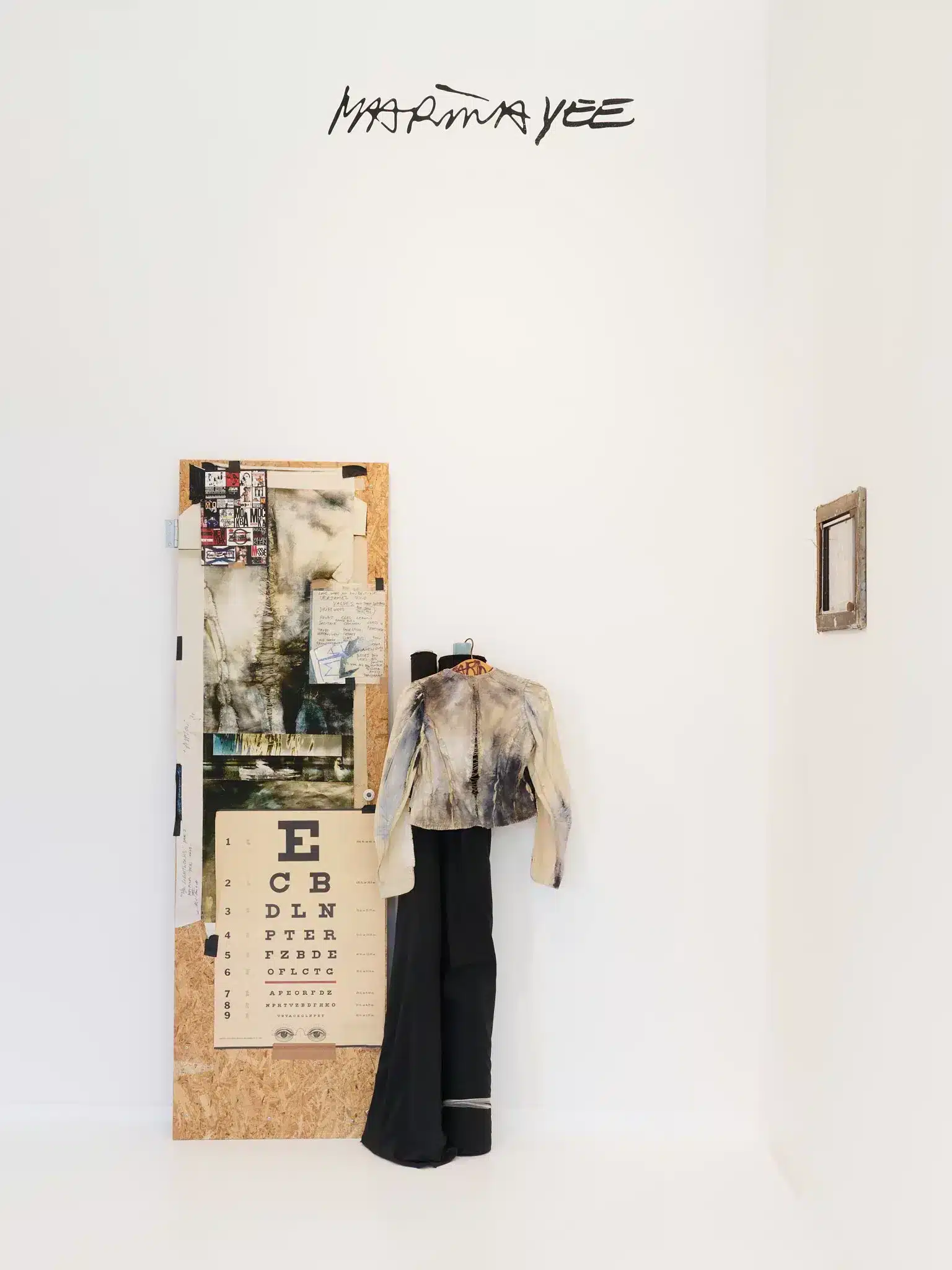
© Gallery Sofie Van de Velde
In Damaged Goods, Yee calls herself a bohemian. As she said it, with the calm precision of someone who will learn to die tomorrow or the day after, it does not sound like a conscious rejection of convention, but rather like a fate from which there was no escape. Her blind navigation was no gimmick: Marina Yee could only ever be the sixth.
Stolen seeds
The fact that the sixth left the fashion world in the early 1990s also had much to do with the seventh: Martin Margiela. He studied alongside the Six but set off on his own early on – while the others focused mainly on London, Margiela became Jean-Paul Gaultier’s assistant in Paris in 1984.
Yee and Margiela had known each other since secondary school in Hasselt. At the arts school, she was “a wild little horse” (her words, in De Zes), while he was “a very stiff boy”. They quickly became best friends, and later, when both studied at the academy in Antwerp, their friendship gave way to love.
'You know I see beauty in imperfection, in sickness, in what's broken'
Yee appeared to be the bold one in the relationship, the curious trailblazer. At the beginning of the 1980s, travelling alone in Japan, she discovered the universe of Rei Kawakubo. She fell for the boldness of the designer’s work, for its absence of glamour. “Japanese and European women in ripped, oversized jumpers with holes in them and shapeless trousers. I thought: ‘Oh!’” The discovery of anti-fashion and the principles of deconstruction became the foundation for Yee’s own work – and something she passionately shared with Margiela, with whom she felt a profound affinity.
At the time, Kawakubo was a couple with designer Yohji Yamamoto. “Those two were also an unhappy love story,” Yee said bitterly in De Zes.
For it was unhappy, the long, drawn-out dance between Margiela and his muse. On 23 October 1988 – Yee would later call it “my day of death” – the Six made an appearance in Paris. Martin Margiela, their old friend, presented his first collection at the Café de la Gare. During the show in the small theatre, Yee began to cry. She saw the models, but she also saw the future: she saw Margiela having breakfast beneath clear skies, and she saw how she herself would not be able to endure. And she was furious, because she believed Margiela would harvest from stolen seeds. Yee claims he copied her ideas, and, on a much deeper level, her mannerisms, her personality, her obsessions, her dreams. He has eaten and drunk from her, greedily inhaled her until she no longer existed.
And yet she lands back in his arms: Yee resumed her relationship with Margiela and moved in with him in Paris. “It is the most irrational thing I have ever done,” she told Oscar van den Boogaard more than thirty-five years later. “I erased myself so I could be close to him. He started to hate me, but I had hated myself for a very long time.”
The relationship withered, and Yee disappeared from Paris, from the fashion world and from a life that had left her body emaciated and her skin dull. She looked in the mirror and saw neither disillusionment nor decay. She saw nothing. “I felt robbed. Robbed of my image.”
The Atelyee
For the Antwerp Six, the exhibition at the MoMu – Fashion Museum Antwerp, which is accompanied by a beautifully produced, substantial catalogue, Marina Yee was still able to determine how the room devoted to her would be filled: she had her studio reconstructed. It is a peculiar space, a workshop that is also a wunderkammer, a museum. Yee filled it to the brim with drawings, garments and assemblages, but also with objects and things she had rescued from their ordinary existence.
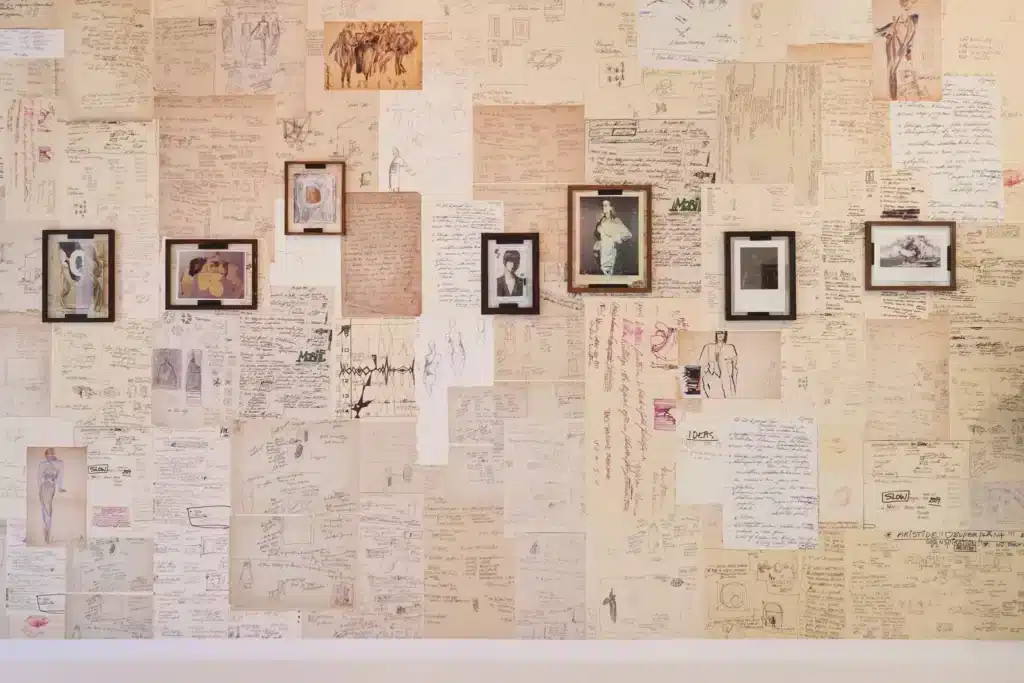 Sofie Van de Velde: 'Marina would often leave herself little notes: small pep talks, touching bits of self-praise, the encouragement she used to try to hammer the dents out of her perpetually battered confidence'
© Gallery Sofie Van de Velde
And yet there is no chaos, only serenity: Yee had everything arranged. Silver foil here, pebbles there, glass over there, branches and flowers further on. Often they are things regarded as broken or superfluous in the wider world beyond the studio. “You know that I see beauty in imperfection, in sickness, in brokenness,” Yee said in Damaged Goods. And: “Shells, bits of wood, little things that are broken… To me, they are not broken but wounded. I want to take care of them.”
The woman Yee is the child Yee, born with a butterfly net in her hand. As a young girl, she found beauty where others saw nothing. It was the blueprint for the person she would become: she paused for the things others walked past, rushed on where others stopped. In both her garments and her art, Yee used the materials and objects she collected – an adoptive mother to overlooked beauty.
In Damaged Goods, Yee also called herself “a hermit”. According to Sofie Van de Velde, she had to coax herself to go out. “You see it recurring over and over in her notes: ‘Today I am going outside.’ You can interpret that figuratively, as a resolve to take her work out into the world, to not be afraid of an audience. But she meant it literally, too. Marina had the tendency to stay within the walls of her studio.”
'At 67, I've come to realize I'm a happy woman and a happy creator'
That atelier in the center of Antwerp, which also happens to be the apartment where she lived with her son Tzara, must have been the bunker that shielded Yee from the chaos and the cruelty, from the decibels and the ugly bragging. But a bunker of tenderness, not a shield of steel and heavy concrete.
“I am actually a happy person,” Yee said in Damaged Goods. “At sixty-seven, I have the insight that I am a happy woman and a happy creator.” Looking at her studio at MoMu, you can begin to understand this hard-won happiness. You see it in the way she lovingly runs feathers brought back from the park through her fingers, the way she lets her palms study a texture, the way she searches for golden light on grey pebbles. How she stops, waits, waits, is quiet and then begins to work on a detail of a shirt sleeve.
Fiddling, yes, perhaps that is the word that fits Yee best: hers has been a life of beautiful fiddling.
Expo
De Antwerpse Zes, until 17 January 2027, at MoMu – Fashion Museum Antwerp, momu.be. Another exhibition will follow at Gallery Sofie Van de Velde, sofievandevelde.be.
Books
Oscar van den Boogaard, De Zes, Pelckmans, Kalmthout, 2026, 319 p.
Geert Bruloot, Romy Cockx, Kaat Debo (red.), De Antwerpse Zes, Hannibal Books, Antwerpen, 2026, 400 p.
Kaat Debo, Rafael Adriaensens, Geert Bruloot, Sofie Van De Velde (red.), Marina Yee. Form, Memory, Archive, Hannibal Books, Antwerpen, 2026 (due out on 26 October)
You might also like



Leave a Reply
You must be logged in to post a comment.