
Learning Dutch From a Bomb Shelter
“I would absolutely love to see Kyiv become a place where scholars of Dutch come together.” These were the words of Olha Petrenko, a Dutch lecturer in Ukraine, during Nederlands Centraal, an event organised by the Taalunie (Dutch Language Union). We found her speech so moving that we wanted to publish it here in a slightly adapted form.
One of the strangest moments of my life was when I realised that I had become emotionally attached to the word “gezellig”. It started out completely innocently. You first use it ironically. Then a little too often. And at some point you catch yourself looking at a café in Kyiv thinking, “Yes… this is actually quite gezellig.” And then you suddenly realise something rather dangerous: the Dutch language has become embedded deep in your personality. That is probably the moment when you officially become a scholar of Dutch.
We have gathered here at Nederlands Centraal to share our own small or grand declarations of love for the Dutch language – a language that is central to each of us in a different way.
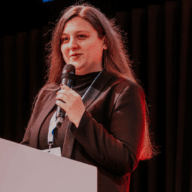
 Olha Petrenko speaking at Nederlands Centraal: “When I was a student, Dutch was a dream language for me. Today, for me and my students, it has become a language with which we build dreams.”
 © Cyaans Photography
Having been immersed in Dutch for years now, I even suffer from a kind of occupational hazard: I sometimes analyse human relationships as though they were grammatical constructions. Some people feel like short, clear sentences: you immediately know where you stand. Others are more like subordinate clauses: more complex, more nuanced, and only at the end do you understand where the conversation was actually going. And with some people you immediately get the same feeling as with a good translation: as though suddenly everything just falls into place.
Today I want to tell you something about Dutch Studies in Ukraine – but from a linguistic perspective. Or rather, three linguistic observations from Kyiv. Or what Dutch Studies has taught me about visibility, motivation and survival.
Semantics
It is impossible to talk about the place of Dutch Studies in Ukraine without pausing to consider semantics. Meaning. Because words such as klein (small), minder verspreid (less widespread) or niet klassiek (non-classical) often acquire a rather strange connotation in academic contexts.
For many Ukrainians, Dutch Studies remains something of a terra incognita – small and unfamiliar. Not everyone understands why someone would choose Dutch. Slowly but surely, we are changing that perception. Our university is the only university in Ukraine where Dutch is offered. A second Dutch department at another university has been closed since the large-scale invasion.
Currently, we have twenty-six students studying Dutch across three subjects: language acquisition, knowledge of land and people and translation studies. In addition, we also have one PhD student – who now happens to stand before you and will soon defend the first doctoral thesis in Dutch Studies in Ukraine.
But why do students choose Dutch? After years of teaching, I have found three answers.
The first answer is pragmatic. Dutch Studies is still a relatively uncrowded niche. In a world where everyone is trying to stand out, choosing an unconventional language can sometimes become your greatest professional asset.
The second answer has to do with community. Thanks to organisations such as the Dutch Language Union, the International Association for Dutch Studies and the Comenius Association for Central and Eastern European Dutch Studies scholars, our students and I feel part of a large, international community of Dutch scholars. The Dutch Language Union has always been there – when Dutch Studies first emerged in Ukraine some twenty years ago, during its heyday and throughout the difficult past four years.
The third answer is the most emotional. Ukrainian society, which has spent years trying to keep its own language visible and fighting not to lose its voice, intuitively understands why every language matters. Perhaps that is why our students choose not only Dutch but also the idea that all languages deserve protection, visibility and love.
How to motivate students
If I have to explain motivation, I do so through separable verbs. Not only because I found them incredibly difficult as a student, but also because they perfectly describe how education works today. Good motivation does just happen, after all. You have to build it up, expand it, continue it, pass it on and merge it.
When I started teaching in 2018, I underestimated three things. First: generations change incredibly quickly. And so lessons have to constantly change along with them. Today, for example, it works surprisingly well to have a WhatsApp group alongside the lessons, where something appears almost daily: a word of the day, five strange slang expressions, a meme or a video. We’ve even put together a Spotify playlist of Dutch-language music – a list that is now being expanded by several generations of Ukrainian Dutch language students.
Secondly, I realised that language is never just grammar. Language is also culture. Norms and values. Humour. Music. Collective memory. Passion. The strongest motivation arises when students see that language opens doors.
Thanks to additional support for a lecture series at our Dutch department, connections are suddenly emerging between scholars of Dutch in Kyiv and Belgian and Dutch journalists, ambassadors, female writers and translators. Between students from Kyiv, Budapest, Belgrade, Bratislava and Bucharest, discussing the relevance to them of Paul van Ostaijen’s poetry collection Bezette stad. Between a student at KU Leuven researching motivation in Dutch Studies and a Ukrainian colleague from Lviv who supports cultural projects within UNESCO.
Education today requires enormous flexibility. Sometimes you teach from a classroom, sometimes via Zoom, sometimes from a bomb shelter
And thirdly, we have learned something that many teachers around the world will probably recognise: education today demands enormous flexibility. Sometimes a lesson has to be moved at short notice. Interrupted. Postponed. Continued online. Sometimes you teach from a classroom, sometimes via Zoom, sometimes from a bomb shelter.
So what is ultimately the recipe for motivation? In my opinion, it is very simple: students truly learn a language when that language does not live only in their textbook but also in people, projects, music, conversations, well-being and shared passion.
How to make Dutch Studies more visible
Finally, I want to talk about conditional sentences. Because they are more relevant today than ever.
“If this happens…”
“If everything goes well…”
“If circumstances allow…”
There is a well-known expression: “If you want to make God laugh, tell Him your plans.” In Ukraine, that sentence can sometimes feel painfully familiar. Ukrainians no longer plan months ahead but day by day. But perhaps that is precisely why dreams remain important.
When I was a student, Dutch was a dream language for me. Today, for me and my students, it has become a language with which we build dreams. So how can we make Dutch Studies more visible in Ukraine?
If I successfully complete my PhD this year, we want to launch a Dutch degree programme. And with a stronger institutional foundation, we will also be able to train more translators – people who bring Dutch-language literature into Ukrainian. The Ukrainian writer and now also soldier Oleksandr Myched writes in his book De taal van oorlog (Mazirel Pers, 2024), translated into Dutch: “Literature saves no lives, except when it does.”
And there is one more dream. If the skies above Ukraine ever regain their peace again and when circumstances are safe enough, I would very much like to see Kyiv itself become a place where scholars of Dutch come together. For summer courses. For colloquia. For joint projects. For encounters. That colleagues from the Dutch Language Union, Comenius, the IVN and other partners could one day be able simply to come to our university and see how Dutch Studies is alive in Ukraine.
Because Dutch Studies exists today in Ukraine despite everything. But at the same time, also thanks to so many people. And perhaps visibility is ultimately exactly that: not speaking loudly, but continuing to resonate.
Ultimately, all our lessons are declarations of love for language. For the idea that smaller languages can also build great bridges
Today, one of the workshops focused on the book Liefdesverklaring aan de Nederlandse taal (Declaration of Love for the Dutch Language) by Mira Feticu. And honestly, I think that is a beautiful title. Because ultimately, all our lessons, translations, projects, collaborations, and conversations are simply declarations of love to language as a precious commodity. To the idea that language connects people. That smaller languages can also build great bridges.
That words cross borders even before people do. And perhaps that is ultimately the most beautiful definition of Dutch Studies in Ukraine: a small language that opens up great possibilities.
Olha Petrenko delivered this speech on Monday, 18 May, in Antwerp during Nederlands Centraal, an event organised by the Dutch Language Union.
You might also like





Leave a Reply
You must be logged in to post a comment.