
Holland, not Belgium: Dutch and Belgian Footprints in Michigan

Hundreds of thousands of emigrants left Belgium and the Netherlands for the United States, and for both groups of migrants Michigan became an important destination. Yet while Belgian traces have largely disappeared, Dutch roots remain highly visible.
Every year between 1 and 10 May, Holland celebrates Tulip Time: around 600,000 tourists visit the coastal town in western Michigan. They come for the millions of tulips blooming throughout the city, for the working windmill De Zwaan (which was transported from the Netherlands in pieces in 1964 and rebuilt here), for traditional wooden clog dancing and for a host of other festival activities.
Throughout the rest of the year, Holland’s tourist office – complete with a windmill in its logo – continues to promote the region’s Dutch heritage. Besides Windmill Gardens, home to De Zwaan, visitors can explore Nelis’ Dutch Village (a theme park featuring canals and Dutch-style houses), the Klomp Delft Factory and several tulip growers.
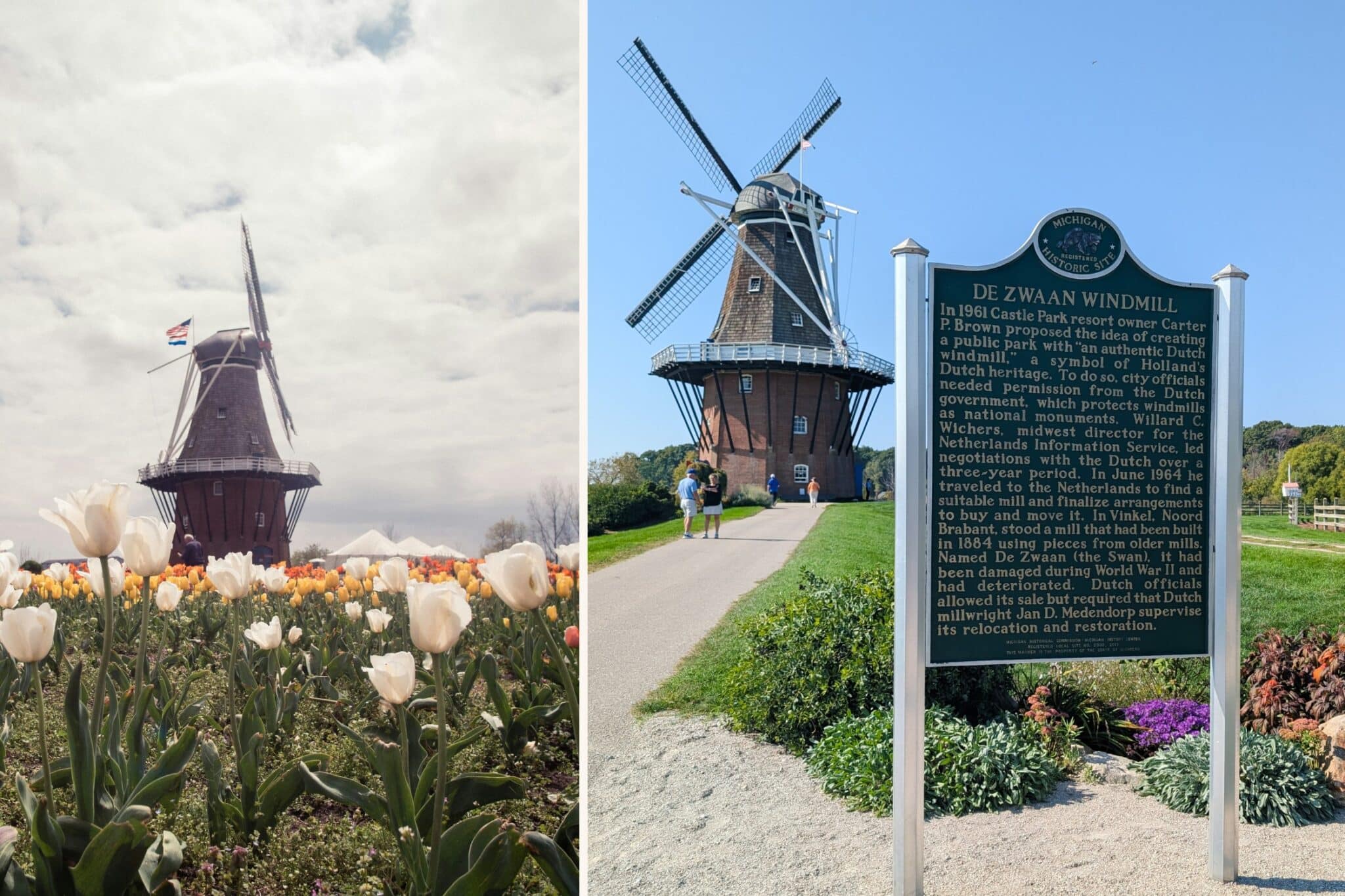 Windmill Gardens in Holland. The coastal town in Michigan focuses heavily on the Dutch history of the region
 © Gio Bartlett - Unsplash / Trui Moerkerke
There is no Belgian-American equivalent to this exuberant celebration of Dutch-American identity. Why is that?
Leaving
Years ago, when he was still mayor of South Bend, Indiana, Democratic politician Pete Buttigieg remarked during an interview with NPR (National Public Radio) that he had not realised how Midwestern he was until he left the Midwest to study elsewhere. For many migrants, myself included, that observation is relatable. Ten years ago, my family and I moved to Ann Arbor, a university town near Detroit.
It is only when you leave that you realise how Flemish, Belgian and European you are. You catch yourself bringing up your Belgian roots in almost every conversation and looking for something familiar in a new country. We had been here for barely two weeks when a Dutch professor at the University of Michigan took us to a dinner hosted by NAUL, the Netherlands America University League. It wasn’t long before we became fascinated by the history of the Dutch-speaking community in this region and forged bonds with Dutch-Americans and Belgian-Americans.
Belgians in Michigan
After Wisconsin, Michigan is the state with the most inhabitants of Belgian descent. There are more than 50,000 of them, according to figures from Bernard A. Cook’s Belgians in Michigan (2007). According to the historian, between 1830 and 1975, a total of about 200,000 Belgian migrants left for the United States.
The waves of Belgian immigration are linked to periods of economic crisis. Before 1930, it was mainly Flemings who sought a better life in the States, as farmers, labourers in the automotive industry or skilled craftsmen (carpenters, masons…). Others moved to neighbouring Ontario in Canada to work in tobacco cultivation. In the nineteenth century, various Flemish clergymen had come to Michigan, and by the end of that century, the Flemings had their own parish in Detroit, with the church of Our Lady of Sorrows.
The book Belgians in America by Philemon D. Sabbe and Leon Buyse (Lannoo, 1960) contains a wealth of information about the rich social life of Belgian immigrants in the first half of the twentieth century. This can also be found at the Genealogical Society of Flemish Americans in Roseville, housed just north of Detroit in the basement of a senior living complex. There you will find a collection of photographs of Belgian community life from the previous century and the archives of the immigrant newspaper Gazette van Detroit, which, after its founding in August 1914, just as the First World War broke out, grew into the voice of the Flemish community in North America. At its peak, it had 12,000 subscribers. Until the 1970s, the Gazette was published in Dutch; after that, it became bilingual, mixing Dutch and English. It wasn’t until 2018, after 104 years, that the publication ceased to exist.
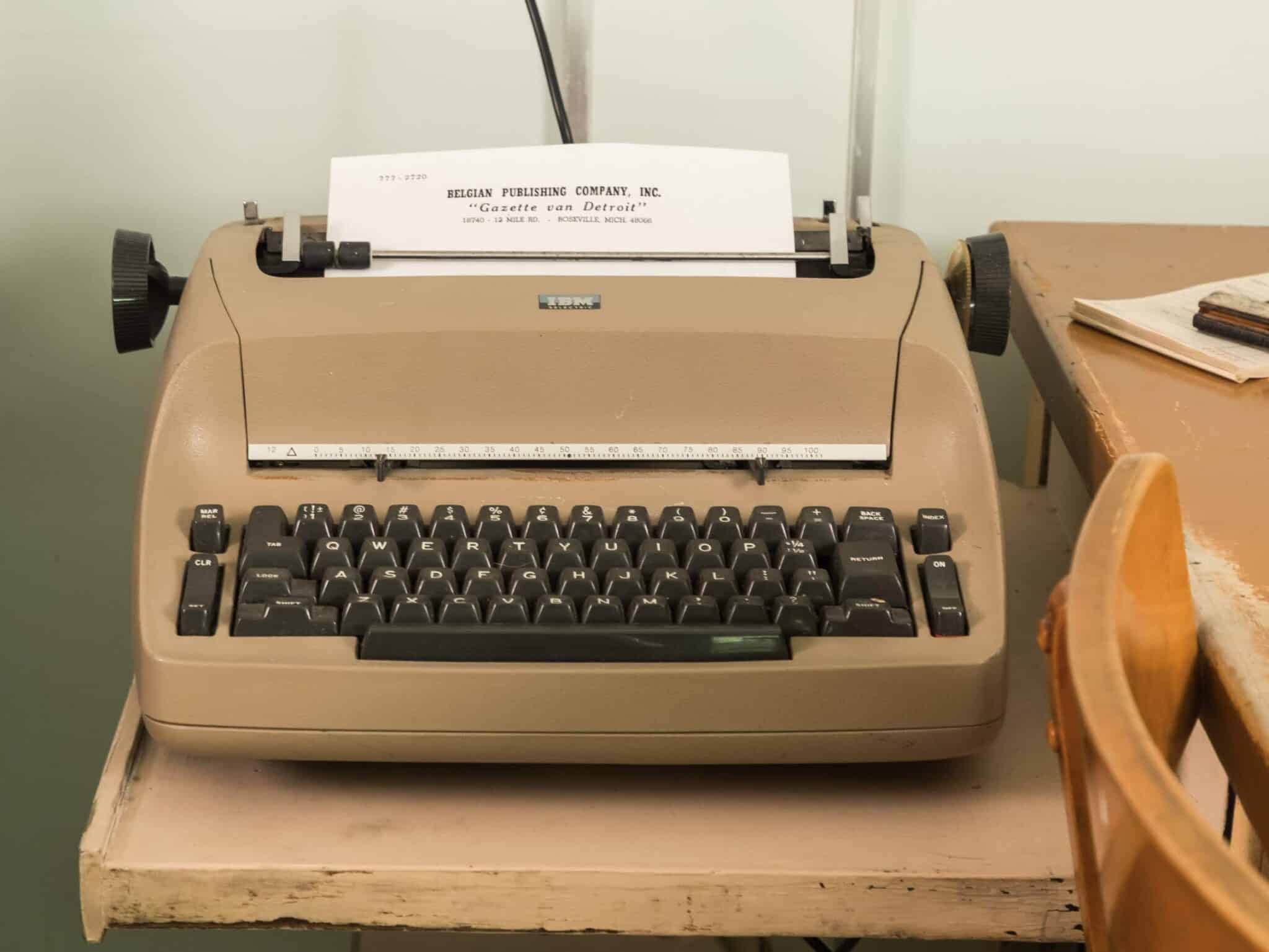 Archival material from the Gazette van Detroit (1914-2018), located at the Genealogical Society of Flemish Americans in Roseville near Detroit
© Trui Moerkerke
Orchestras were popular among Belgian migrants, such as the East Detroit Band, founded in 1893, and Eendracht Maakt Macht, established in 1910. Theatre groups bore names such as Moedertaal en Volksvermaak (Mother Tongue and Popular Entertainment), ’t Roosje bloeit in ’t Wilde (The Rose Blooms in the Wild) and Kunst en Vermaak (Art and Entertainment).
Detroit is still home to the Belgian-American Association (BAA), founded as early as 1927 to represent the interests of Belgian merchants and businesses in and around the city. Today, it is a club for people of Belgian descent, with 225 members who meet monthly and organise social activities. The BAA also has an orchestra that performs a few times a year (The Belgian Band), a women’s club and an association of retirees.
On Detroit’s East Side, you can find Cadieux Café. This traditional pub, where you can drink countless Belgian beers, was a long-time gathering place for Belgian immigrants. Pigeon fanciers met in this Belgian icon, and their club had a cycling team, as that was also a hobby introduced there by Belgians. Pub owner Ron Devos (1960-2025), himself a former cyclist, hosted a radio programme: The Belgian Hour.
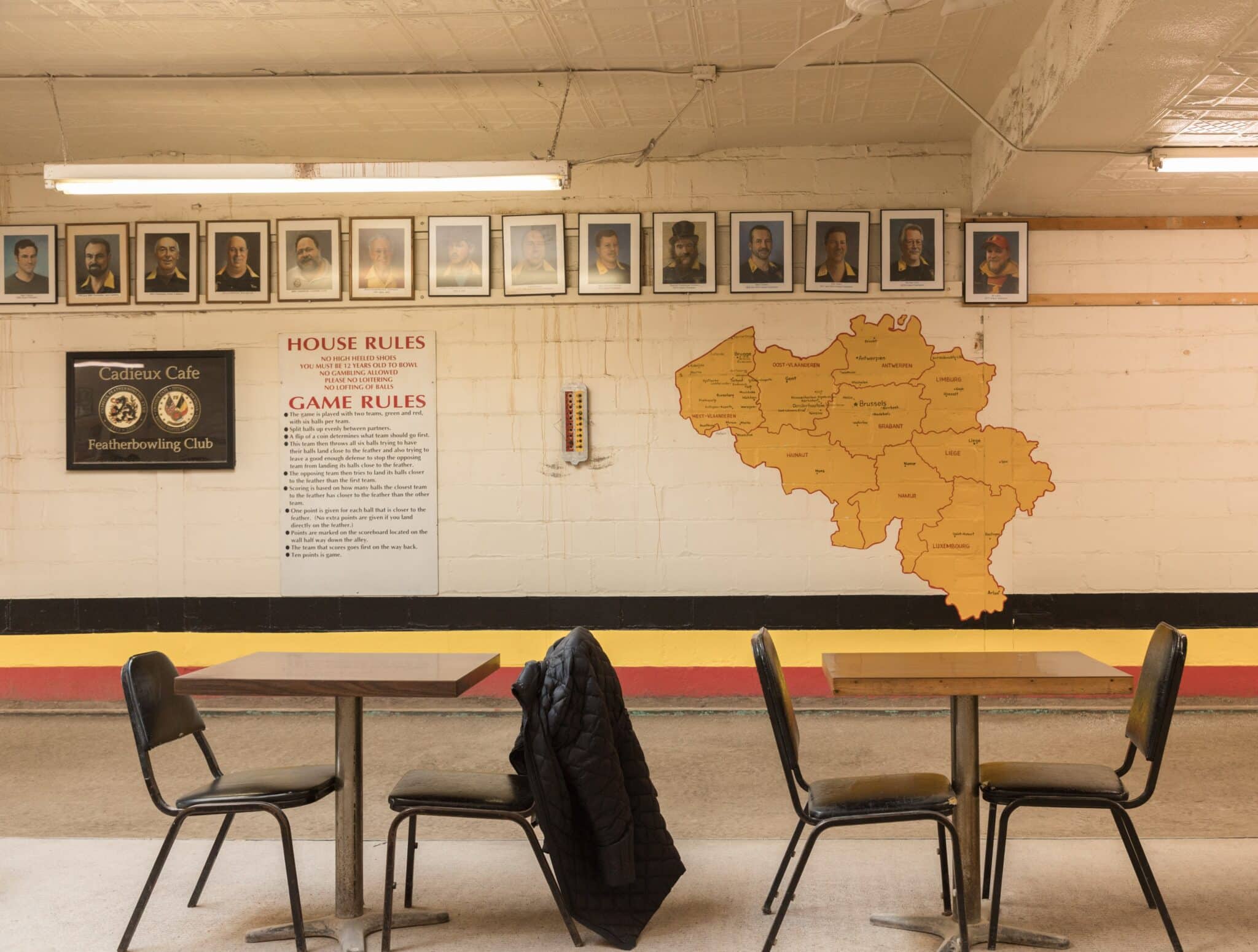 The Belgian Cadieux Café on Detroit’s East Side has a lane where you can play krulbollen, or feather bowling, as the folk game is called here
© Trui Moerkerke
The pub came under American ownership in 2019, but the interior has hardly changed, and you can still play krulbollen, known locally as feather bowling. Players throw wooden discs resembling cheese wheels down a concave lane towards a feather fixed at the far end. Whoever finishes closest wins. In the room containing the Cadieux Café lane, the Belgian tricolour still proudly adorns the wall, painted along its entire length. There are feather bowling clubs that play every week and crown a champion annually – one for men and, for the past few years, one for women.
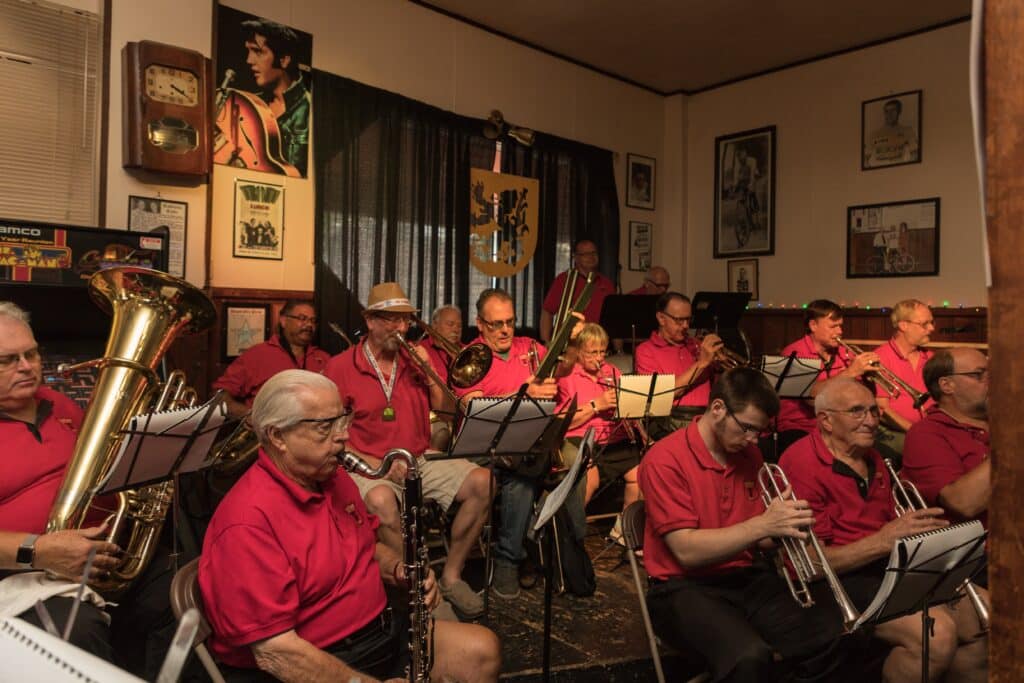 The Belgian Band plays the Brabançonne and The Star-Spangled Banner at Cadieux Café at the start of every feather bowling season
© Trui Moerkerke
At the start of the season, the wooden balls are ceremonially brought inside, accompanied by The Belgian Band, which plays The Star-Spangled Banner as well as the Brabançonne, the American and Belgian national anthems. Traces of pigeon racing, however, have vanished, and of the cycling glory, only the annual Debaets-Devos Memorial Race remains, along with a Cadieux Café team.
One nation under God
Despite their café and their cycling race, Belgians in the Detroit region, especially after World War II, have completely assimilated into American society. Many second- and third-generation Belgian-Americans no longer speak Dutch or French, and visible signs of Belgian ancestry are hard to find. But that does not alter the fact that some Belgian-Americans have left their mark on the history of the U.S.
In the 1950s, for example, the words “under God” were added to the Pledge of Allegiance, the oath that, to this day, schoolchildren recite in class every morning when saluting the American flag. That addition came about following legislation introduced by Louis C. Rabaut, a congressman for Michigan’s 14th District from 1935 to 1961. Rabaut, a devout Catholic and social democrat, was the grandson of migrants from Kortrijk. He believed that faith in God was the fundamental difference between America and communist Russia. In 2024, Rabaut’s great-grandson, Republican Tom Barrett, won a seat in Congress for Michigan. Clearly proud of his illustrious ancestor, and as a tribute, he named one of his children Louis.
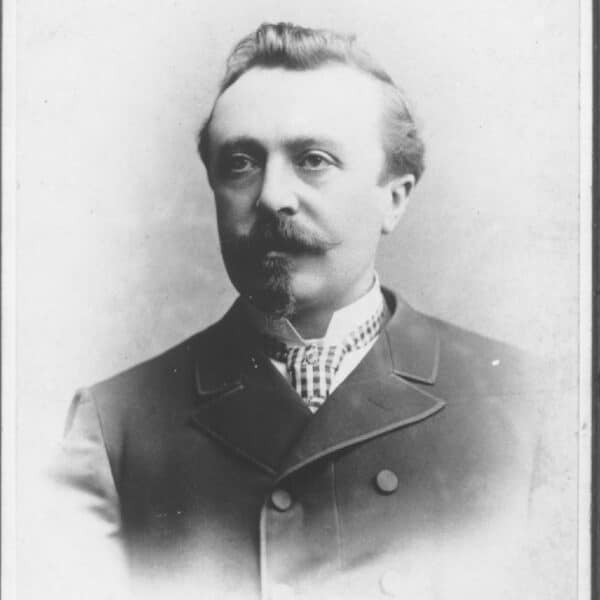 Furniture maker and ‘Detroit’s Edison’ Charles Van Depoele was born as Karel Van de Poele in Lichtervelde, West Flanders. He developed, among other things, the technology for the electric tram
 © RV
Charles Van Depoele, described in the Detroit Free Press in 1878 as “Detroit’s Edison”, also left a technological trail. The furniture maker, born Karel Van de Poele in Lichtervelde, West Flanders, was fascinated by electricity and founded the Van Depoele Electric Light Company in Detroit in 1880. He later developed, among other things, the technology for the electric tram, an invention that would transform urban transport worldwide.
A sense of ‘Dutchness’
Back to Holland. Anyone visiting the coastal town cannot ignore its Dutch roots. In the cosy downtown, you will find shops where you can buy Delft Blue pottery, Droste chocolate, liquorice, Gouda cheese and wooden clogs in all colours and sizes. A souvenir shop was aptly named ‘Gezellig’. The town on the shores of Lake Michigan also boasts beautiful beaches and an iconic red lighthouse, known as Big Red.
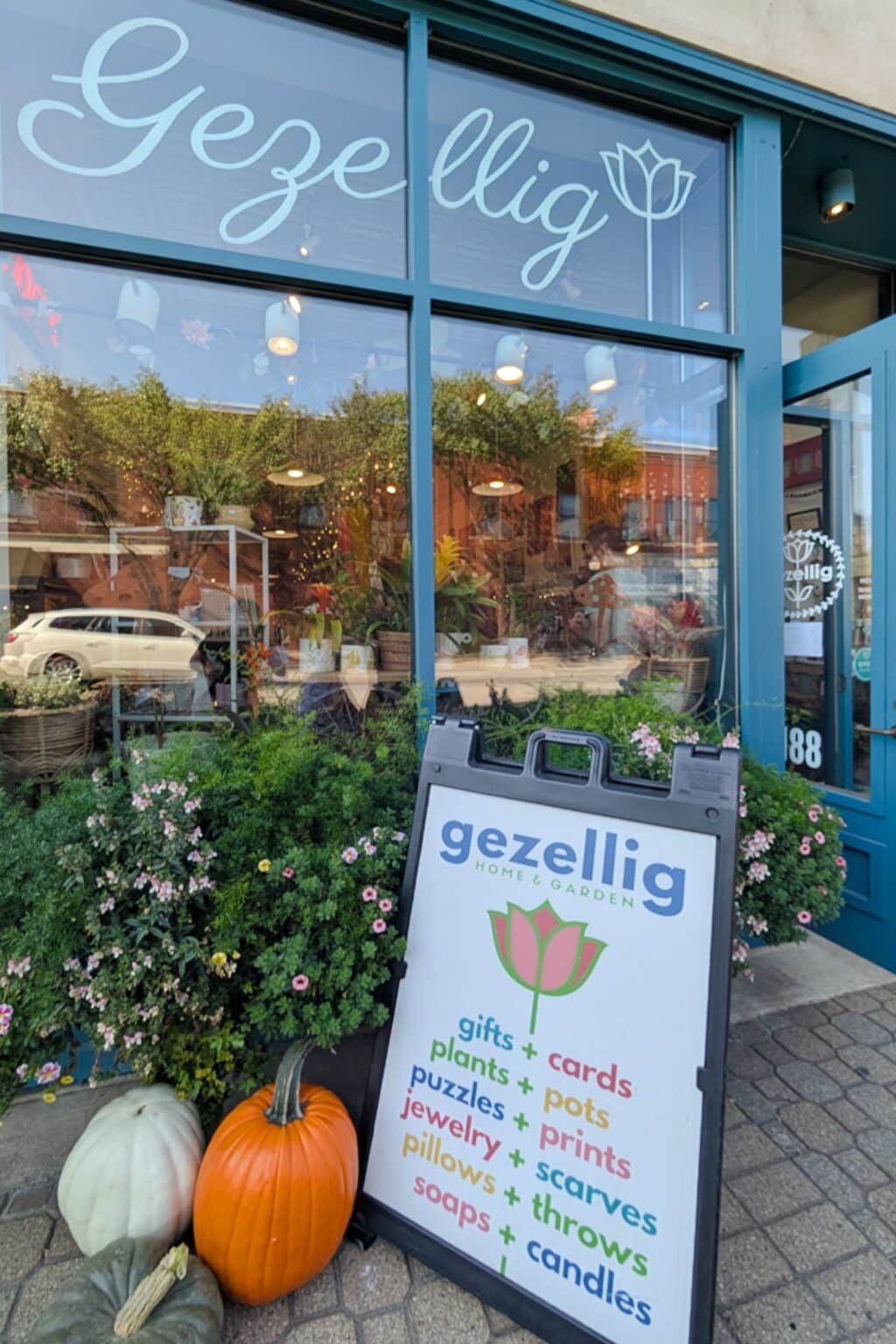 Souvenir shop Gezellig in Holland, Michigan
© Trui Moerkerke
It is in this region, with municipalities such as Zeeland, Zutphen, Harlem, Overisel and Vriesland, that the Reformed minister Albertus van Raalte settled in the winter of 1846-1847 with dozens of followers. The crossing from the Netherlands was motivated not only by economic reasons but also by a profound ecclesiastical schism: orthodox Calvinists had separated from the Dutch Reformed Church and sought religious freedom in America. Historian Hans Krabbendam writes in Freedom on the Horizon: Dutch Emigration to America 1840–1940 (Vrijheid in het verschiet: Nederlandse emigratie naar Amerika 1840-1940, Verloren Publishers, 2006) that between 1846 and 1914, 200,000 Dutch immigrated to America, primarily to the Midwest. After the Second World War, a second wave of 100,000 people followed.
Van Raalte built a mini-Dutch society in Michigan: churches, schools, a theological seminary and a newspaper (De Hollander). Krabbendam describes how this community worked collectively to shape Holland: “Necessary facilities such as a road, a bridge, a church, a school building, a jetty and an orphanage took precedence.”
Hope College is located in the centre of Holland, a Christian university founded in 1862 in partnership with the Reformed Church of America. Nearby Grand Rapids is home to Calvin University, which originated from a theological seminary of the Christian Reformed Church.
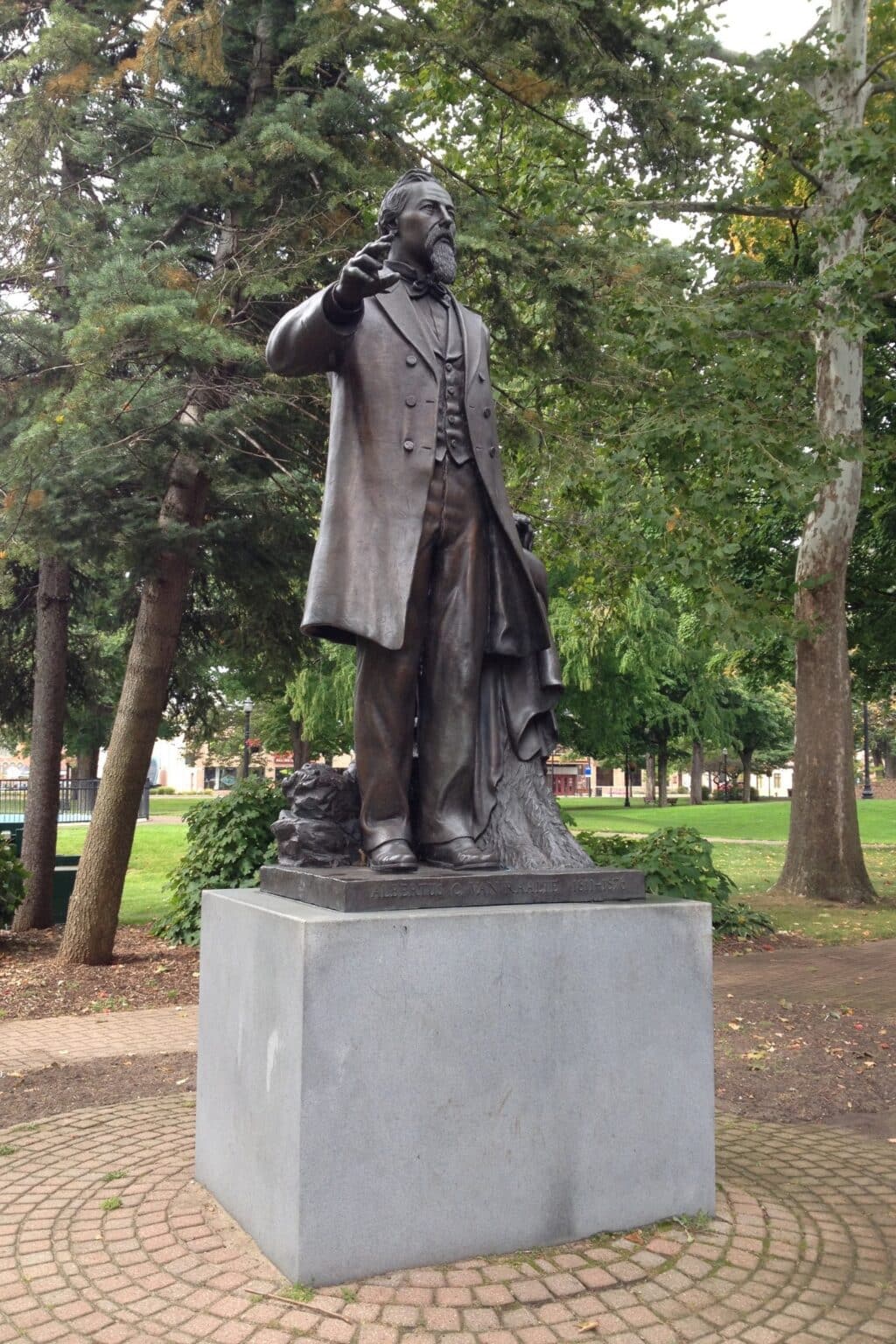 Statue of Reverend Albertus van Raalte in Holland, the city he founded in Michigan with other Dutch exiles
© RV
Dr. Robert P. Swierenga, Senior Research Fellow at the Van Raalte Institute of Hope College and a specialist in Dutch immigration history, explained during a lecture how migrants from the same villages preferred to settle together in order to soften the emotional impact of migration. “Few immigrant groups, if any, have concentrated as strongly as the Dutch. And that colonisation created fertile ground in which a strong sense of ‘Dutchness’ could thrive for many generations.” In The Dutch Midwest, his contribution to The Oxford Handbook of Midwestern History (2025), it reads as follows: “The Dutch came as a familial and religious community with a shared identity and the desire to remain within their group.”
That Reformed infrastructure – Hope College, Calvin University, the schools, the churches – ensured that the children and grandchildren of immigrants still grew up as Dutch, even if they themselves had never set foot in the Netherlands. That identity was transmitted systematically from one generation to the next.
The true Dutch heritage in the US lies in Christian universities and perhaps also in the voting booth
However, Holland and its Tulip Time festival must be viewed with some nuance. The souvenir shops offering plastic and wooden tulips and clogs have largely become a backdrop and part of a successful tourist narrative. The true Dutch legacy can be found in the Christian universities and perhaps also in the voting booth. According to Swierenga, the Dutch ties with the Republicans go back a long way. Since as early as the nineteenth century, most immigrants held socially and culturally conservative views. Western Michigan remains a Republican stronghold. A recent example is Betsy DeVos, Secretary of Education in the first Trump administration. DeVos is of Dutch descent and studied at Holland Christian High School and later at Calvin College.
An American story
On that first NAUL evening, ten years ago, I had little indication of how fascinating the search for one’s roots can be. Since then, I have visited Holland, explored the archives of the Detroit Gazette and followed the trails of Van Depoele and Rabaut. I now better understand why I ended up at a Dutch association that evening – where, incidentally, everyone still spoke Dutch – and not at a Belgian one: the Dutch had another one.
Perhaps the Belgian trace lies in the memories of a community that wanted to become so strongly American that it almost forgot itself
Perhaps the Belgian legacy lies elsewhere, not in a windmill or a tulip festival, but in the words that every American schoolchild recites daily and in the memories of a community that wanted to become so completely American that it almost forgot itself. The Dutch left behind a city bearing their name on the map. The Belgians left behind something that no one recognises as Belgian anymore, and that is perhaps the most American story of all.

You might also like





Leave a Reply
You must be logged in to post a comment.